
When the Parent Has PKU
Clair's Story: Caring for a Child Without Phenylketonuria
Having a child when you have PKU is no small feat. You’re warned of the dangers of unplanned pregnancy, and the words given by your doctor are ‘maternal PKU’ and ‘pre-conception diet.’
Pregnancy with PKU
It’s of course important, high phe in your blood levels is incredibly damaging to any potential pregnancy, however all this talk of doom and an even stricter diet than the one you’re already struggling with is incredibly overwhelming. Especially when it usually starts as soon as you’re transferred to the adult clinic at 16!
Despite all the pressure, when my husband, Chris and I decided we were potentially ready to try for a child, I had done a lot of work on my health, both my diet and my mental health so I could be ready for the challenge that was to come. My dieticians were incredibly supportive and were able to keep me informed of my diet and regular blood levels to keep my health monitored.
Protein allowances changing during pregnancy
When I discovered I was pregnant my levels were a little on the higher side, so in the space of a few weeks I went from 5 exchanges a day to 3 to 0! I survived on a diet of just fruit, vegetables and prescription food. I can’t lie, it was incredibly boring! Around the 3-4 month stage however I started to have lower and lower levels, until I was given the glorious news that I could increase my exchanges. I got all the way up to 28 exchanges by the end of my pregnancy.
I was very lucky to have a quite trauma-free natural birth and then the day my baby was born, as well as all the emotions that I felt on finally getting to meet my baby girl, I was so relieved that I had done it. All that hard work I put into my diet for over 2 years had been worth it, she was perfect!
Postnatal care for a PKU mother
However, of course that’s not just the end of the story, happily ever after, the end! I now have an actual human to care for and raise, but now she was out in the world, my little village could help me take care of her. What was most important for me was the post-natal care for myself, recovery from giving birth and without my daughter’s liver working with mine, my levels would soon go rocketing back up.
My family bought over dishes of prescription food & snacks, and my friends helped me get out and about of the house, to keep my sanity and ground me to remember I was still Clair. Of course the tiredness gets to us like any new parents, taking turns with the night feeds, the nappy changes and the cuddles.
Weaning, as a PKU mother
Then 5 months comes around, and I’m sitting in a family centre room, talking about how you wean a baby from milk to solids, discussing boiling eggs, what meat they can eat, introducing cow milk, and introducing water as an everyday drink. I raise my hand and ask: “what if they get too full from water to have their food?”
The woman gives me a confused look and says that shouldn’t be an issue. The question comes to my head because I remember my parents saying to me about how they would only give me water when I had my substitute drink as it would fill me up too much! I realised I suddenly had to learn how to give a full protein healthy ‘normal’ diet.
Learning about non-PKU food for your baby
It’s well known that mums with babies/toddlers have a hard time putting themselves and their eating first, too busy running around keeping everyone else fed and alive! For me, I had all the full-on parenting and challenges with weaning, but with the added complication of having to care for my own diet.
The recommendation in weaning is to give them what you are having! It makes sense, you only have to make a little bit extra of your own food and they don’t need special (and overpriced) baby specific food, they just need to try as many foods, textures, and flavours as possible.
However, how does someone who has never boiled an egg, cooked tuna pasta, or made a chicken curry in her life, suddenly figure this out? Not only that, if it’s just me and my daughter, I have to make completely separate meals, with the hope that she does finish it because I can’t hoover up any leftovers like other mums could.
PKU self-care with a toddler
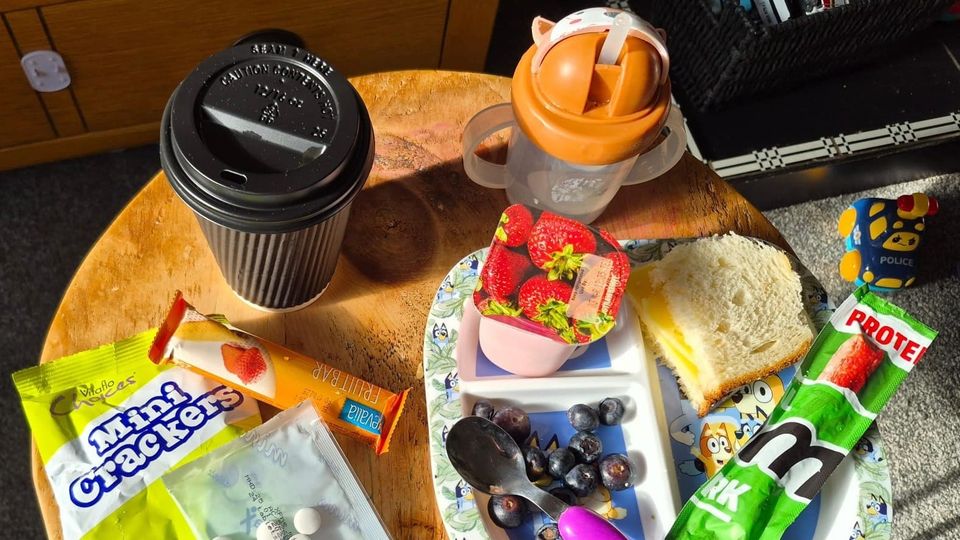
I found I was cooking less and less for myself and, what’s worse, if I was cutting off the crust of toast for her at the start of a busy day, it was all too easy to pop the crusts in my mouth. Or to test the pasta I was cooking for her by eating bits over and over again. While I had more and more energy for cooking exciting things for my daughter, I had less energy to cook for myself.
So I would either eat something really bad for me or not eat at all. Both are, of course, not ideal. She’s now just over 2 years old and I’m still getting this balance right. I’m making sure my family remind me to eat, my husband helps cook my meals, and I always aim to eat healthier overall. As, even though I can’t eat my daughters' food, my daughter absolutely loves eating my PKU food.
It has been so exciting watching her eat all the food I couldn’t! Before Christmas, we had a kid’s birthday party and it was so lovely to sit at the table and know she could eat anything she wanted on the party table. Definitely worth all the work!
Own mask first!
The classic metaphor for parenting is when flying, you put your own mask on before you put your child’s on. For PKU parents you have to not only our your mask on, you have to get someone else to make sure it’s actually strapped on, check the O2 amount, and remind you that you’ve not put up your tray properly, before you can even get to your child’s mask! But self-care is still so important, as being on diet (whatever that looks like to anyone!) is the best way I know I can take care of myself, my mental and physical health and therefore be the best parent I can possibly be for my daughter.
 Pauline
Member discussion