
Twixtmas reading, 2025

If you need reading ideas to curl up with while polishing off leftovers, here are a few articles which caught my eye over the year. They didn’t make it into the monthly newsletters simply because there was no room.
The articles don’t fit neatly into categories, but are arranged with PKU research and interest at the top; Rare Disease and advocacy articles follow; with Brain, neurological, and mental health reading at the bottom.
PKU research and interest
Progress on at-home phe monitoring
The perpetual gift which never arrives is a step closer this year. The Egoo machine has been under-going trials in the UK ahead of (hopefully) gaining approval here. The trials have gone well, and compliance is progressing.
The NSPKU took a machine to Parliament in November to demonstrate the process and discuss the need with MPs. So, while the machine is not yet available in the UK, there has been exciting progress. I am watching closely and will report on progress. (Thanks to the Egoo team for putting up with my emails!)
How much protein do you really need?
Socials and chats seem to pulse with protein recommendations these days, something of concern for ageing adults with PKU. I’ve been thinking about this for some years as the menopause approaches, so was relived to read this article in the Economist. It is behind a paywall, but the gist is:
- WHO recommends 0.83g of protein per kilo of body weight.
- A 2022 review in Nutrients noted that a ratio of 1.2g/kg plus resistance training could reduce muscle shrinkage with age.
Reassuringly (despite some influencers suggesting 2g/kg or more) “A meta-analysis published in Sports Medicine in 2022, though, found that eating more than 1.6g/kg does not lead to further muscle growth.”
Research opportunities
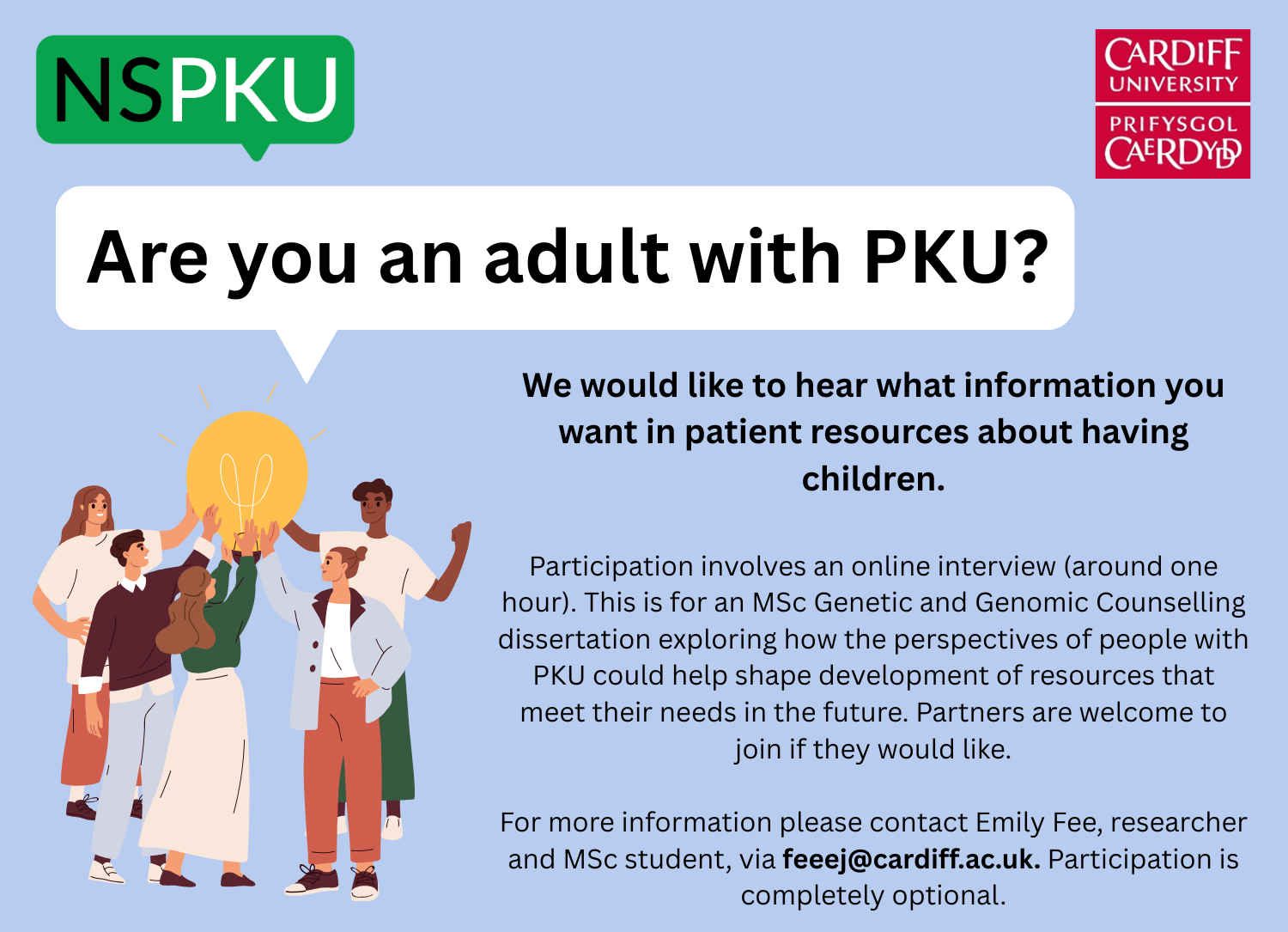
Please help Emily, a master’s student, with her research. This research is so important and will help make PKU Life easier in future. It will take a small amount of your time: email her on feeej@cardiff.ac.uk if you can help, thank you.
Newborn screening
NHS plans to DNA test all babies in England to assess disease risk - BBC News. Screening newborn babies for rare diseases will involve sequencing their complete DNA using blood samples from their umbilical cord, taken shortly after birth.
Rare disease and advocacy reads
Weight-Loss Drugs
The rise of weight loss drugs has had an effect on how people perceive obesity treatments, specifically that patients need more than a restricted-diet treatment. This change in perception needs to be brought to bear on PKU; a rare disease which, for many, is still treated entirely by an incredibly restricted diet first developed over 70 years ago.
I’m still musing on the best way to use this in my PKU advocacy. However, the NSPKU are making a start, with their new campaign for treatments beyond Sapropterin (Kuvan) and the restricted diet on the NHS. If you aren’t already a member, consider starting your new year by joining a patient group actively campaigning for better treatments in the UK. www.NSPKU.org
How Weight-Loss drugs are redefining the way our bodies work.
This is an older Guardian article, given the pace of innovation in the field of weight-loss drugs. I include it here because the final paragraph resonated with me as a patient with a rare disease: “When you don’t understand the disease, it is almost automatic in medicine that we start blaming the patient because we feel uncomfortable”
“When you don’t understand the disease, it is almost automatic in medicine that we start blaming the patient because we feel uncomfortable”
Lessons from the Human Genome Project - YouTube
This video (YouTube link) is seven years old now, but I came across it this year during an advocacy course. It is a story of collaboration and sharing which led to one of the greatest breakthroughs in science - and one which will have treatment repercussions in the future we still don’t fully comprehend.
“It’s an exciting moment, at the same time it’s just the beginning of what is really a much longer voyage… I think the next 10 years are gonna see some exciting developments.”
Seeking urgent second opinions - Martha’s rule
Something which may have been missed in the return to school rush. This new initiative ensures that people in hospitals in England can ask for an urgent review of their care. Every hospital will have a dedicated phone number for patients, families, and staff to call to request a rapid review. Martha's rule rolled out to all acute hospitals in England - BBC News
Gen Z significantly under-represented in research
“Members of Gen Z – those born between the late 1990s and the early 2000s – are significantly underrepresented in clinical trials and health studies.” The Guardian article goes on to argue that Gen Z could miss out on new treatments due to this disparity. There is a new UK-wide registry which makes it easier to join studies ⇨ https://bepartofresearch.nihr.ac.uk/
Should you take creatine?
Another article behind the Economist’s paywall, this one looks at the legal, safe performance enhancing drug usually considered only for muscle-bros and weight trainers. “Creatine works mainly by increasing the amount of energy that muscles can produce.”
And this may not be the only benefit, as studies have reported an increase in cognitive abilities after creatine, and some have noted an improvement in depression symptoms. Most exciting for me are studies in animals (rats) showing creatine assisting brain injury recovery.
Buy me a cuppa ☕ — your support helps keep this blog free, and helps to me write about PKU, brain injury & mental health.
Brain & mental health
Adolescence lasts into 30s - new study
A new study which scanned the brains of about 4,000 people, some as old as 90, has revealed four pivotal stages for your brain. The BBC reported on this in November, with brain changes coming at ages 9, 32, 66, and 83.
"The brain rewires across the lifespan. It's always strengthening and weakening connections, and it's not one steady pattern - there are fluctuations and phases of brain rewiring," the lead author of the research, Dr Alexa Mousley (University of Cambridge).
A new method for diagnosing brain tumours
The Guardian reports on a new testing method which could cut treatment times from weeks to hours. It does note, though, that this is very much in development. And thought needs to be given to how patients are then treated. “Faster diagnoses were welcome and reduced the period of uncertainty for patients, the main question was how the new technology could be used to change care.”
Two strokes, 30 years apart, show a gaping need near-rehabilitation
Sheila Hale writes in the Guardian with compelling frankness about nursing her husband and then her son, who each had a stroke decades apart. She describes the shocking lack of change in treatment - particularly in the poor provision of near-rehabilitation provided by the NHS.
“I remain haunted by the people who miss out on precious rehab…39% of stroke patients are abandoned by the NHS after six months. A third remain too disabled to work, many because they believed, or had no choice but to believe, the doctors who wrote off their chances of recovery.”
"The brain rewires across the lifespan. It's always strengthening and weakening connections"
Women carry a higher genetic risk of depression
As the Guardian article notes: “We already know that females are twice as likely to suffer from depression in their lifetime than males”. Now it appears there is a genetic role in this disparity. The researchers found 16 genetic variants linked to depression in women, and eight in men.
Musicians feel pain differently
Playing a musical instrument has long been known to be beneficial for the brain. An article in The Conversation describes how long-term training and experience can shape how we perceive pain. “This is exciting because it might help us understand why some people are more resilient to pain than others, along with how we can design new treatments for those living with pain”.
Brain puzzles and dementia
TLDR: they help, but do not prevent dementia. Doing a puzzle engages different to areas of the brain, which stimulates blood flow to those areas, which helps maintain function. Keep up the puzzling, but bear in mind that “We all benefit from a lifestyle aligned with better brain health: prioritising movement, a nutritious diet, and activities that fire up multiple parts of the brain and involve other people.”
Redefining you after BI
A clinical psychologist, and a clinical tutor & clinical neuropsychologist write on adjusting to life after a brain injury. The grief for a life no longer possible or which has been irrevocably changes is something which I’ve experienced after brain injury. So I nodded through this article, particularly the conclusion: “redefining your sense of self following a brain injury could be essential for good psychological wellbeing and adjustment following a brain injury.”
Brain injury in parliament
In December, a Westminster Hall Debate took place in the UK parliament on the ‘Potential merits of a comprehensive acquired brain injury action plan’. The debate is still available on Parliament TV.
Spread the word
I hope you’ve enjoyed this round up. I will be back with the usual monthly emails in 2026.
If you find value in my newsletters, please share them. Your support means a lot, and your feedback shapes what comes next. Do get in touch!
Cheers,
Pauline
Newsletter #42
Member discussion