# PigPen | Pauline O'Connor
> Books, recipes, articles, and advocacy on PKU, low-protein food, rare disease, brain injury, and mental health.
Public Ghost content for AI and LLM tooling. This file includes a bounded export of public pages first, then recent public posts.
Append `.md` to any post or page URL to get the content in Markdown (for example, `/example-post.md`).
## Pages
### About this site
URL: https://www.pigpen.page/about/
Last updated: 2024-08-28T18:04:20.000Z
PigPen.page is an independent publication launched in July 2024 by Pauline§. If you subscribe today, you'll get full access to the website as well as email newsletters about new content when it's available. Your subscription makes this site possible, and allows PigPen.page to continue to exist. Thank you!
### Access all areas
By signing up, you'll get access to the full archive of everything that's been published before and everything that's still to come. Your very own private library.
### Fresh content, delivered
Stay up to date with new content sent straight to your inbox! No more worrying about whether you missed something because of a pesky algorithm or news feed.
### Meet people like you
Join a community of other subscribers who share the same interests.
---
### Start your own thing
Enjoying the experience? Get started for free and set up your very own subscription business using [Ghost](https://ghost.org/?ref=pigpen.page), the same platform that powers this website.
### About Pauline
URL: https://www.pigpen.page/about-me/
Last updated: 2025-10-24T13:53:30.000Z
**Pauline O'Connor** is an author of fiction and non-fiction, and a patient advocate. She campaigns for brain injury survivors and for those diagnosed with the rare disease Phenylketonuria (PKU).
Her experience has inspired others to reimagine what recovery can mean:
> **"Her story was phenomenal, and really shows anything is possible."**
After successful careers in winemaking and education, a sports injury in 2014 led to a bleed in Pauline’s brain — a life-changing event that she documented through writing. Her debut memoir, *Living with Mild Brain Injury: The Difficulties of Diagnosis and Recovery from Post-Concussion Syndrome*, was published by Routledge in 2020.
> **"Pauline...is also a role model for people who have PKU."** J.J.Brown, public health advocate & author.
Diagnosed at birth with PKU, Pauline has lived with the condition for over forty years. Her second book, *Living with PKU*, shares practical and personal insights from that journey. She also created the *Low Phe* series of alphabet books, diet guides, and colouring books for children and families. Pauline works with patient groups to advocate for improved research and treatments for PKU.
> Pauline writes about real lives shaped by rare disease, injury, recovery, and resilience — stories that turn science and struggle into hope.
Her motivational presentations, PPI insights, and patient workshops have been well received by patient charities, clinical researchers, and community groups such as the WI & the U3A. For a **speaking engagement** which will enrich and motivate your group, see [Speaking](https://www.pigpen.page/speaking/) for details or [contact Pauline](https://www.pigpen.page/contact/) to discuss your needs.
Offline, Pauline is Head Butler for ''FluffMuppet", the Keeshond.
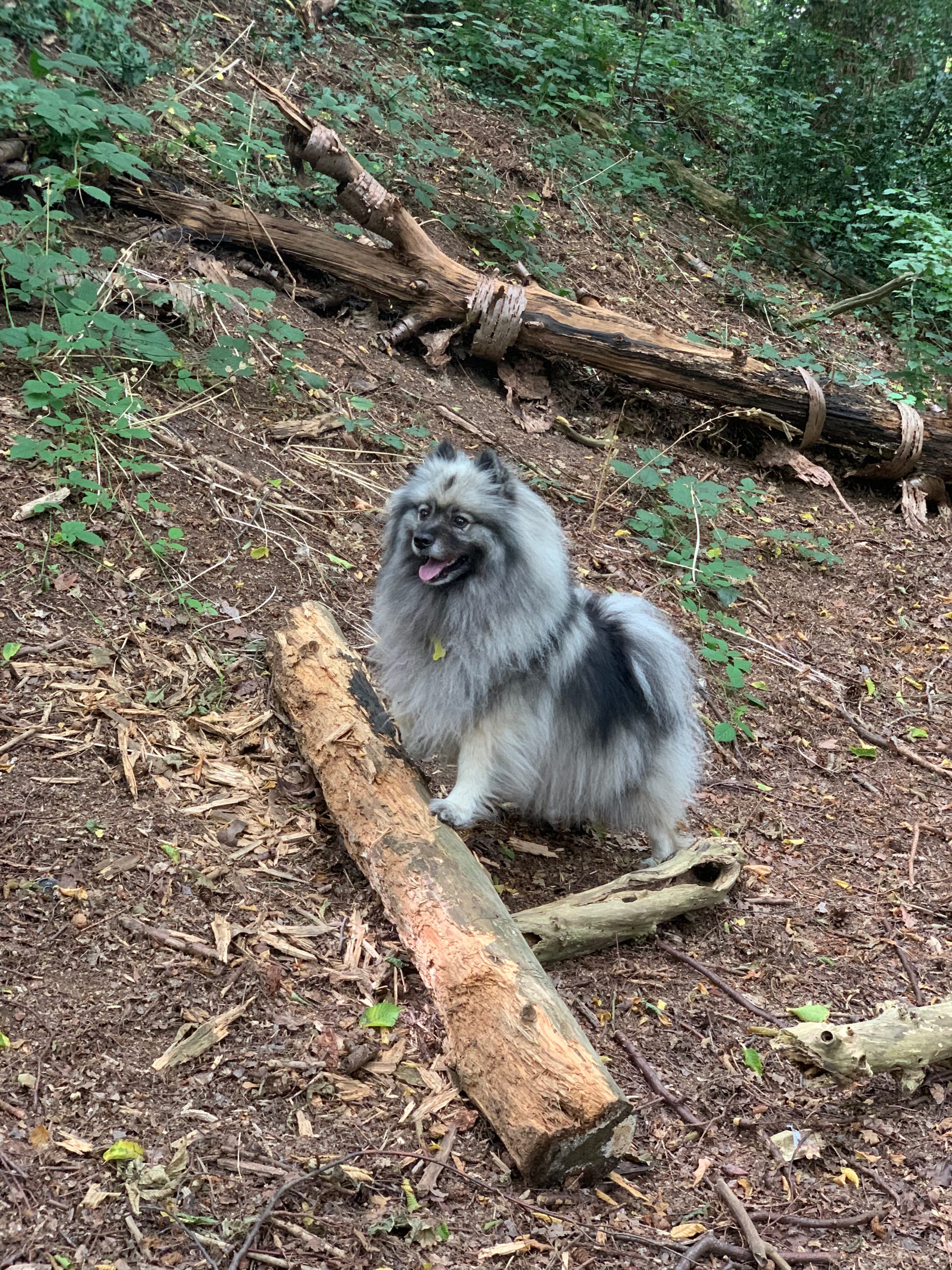
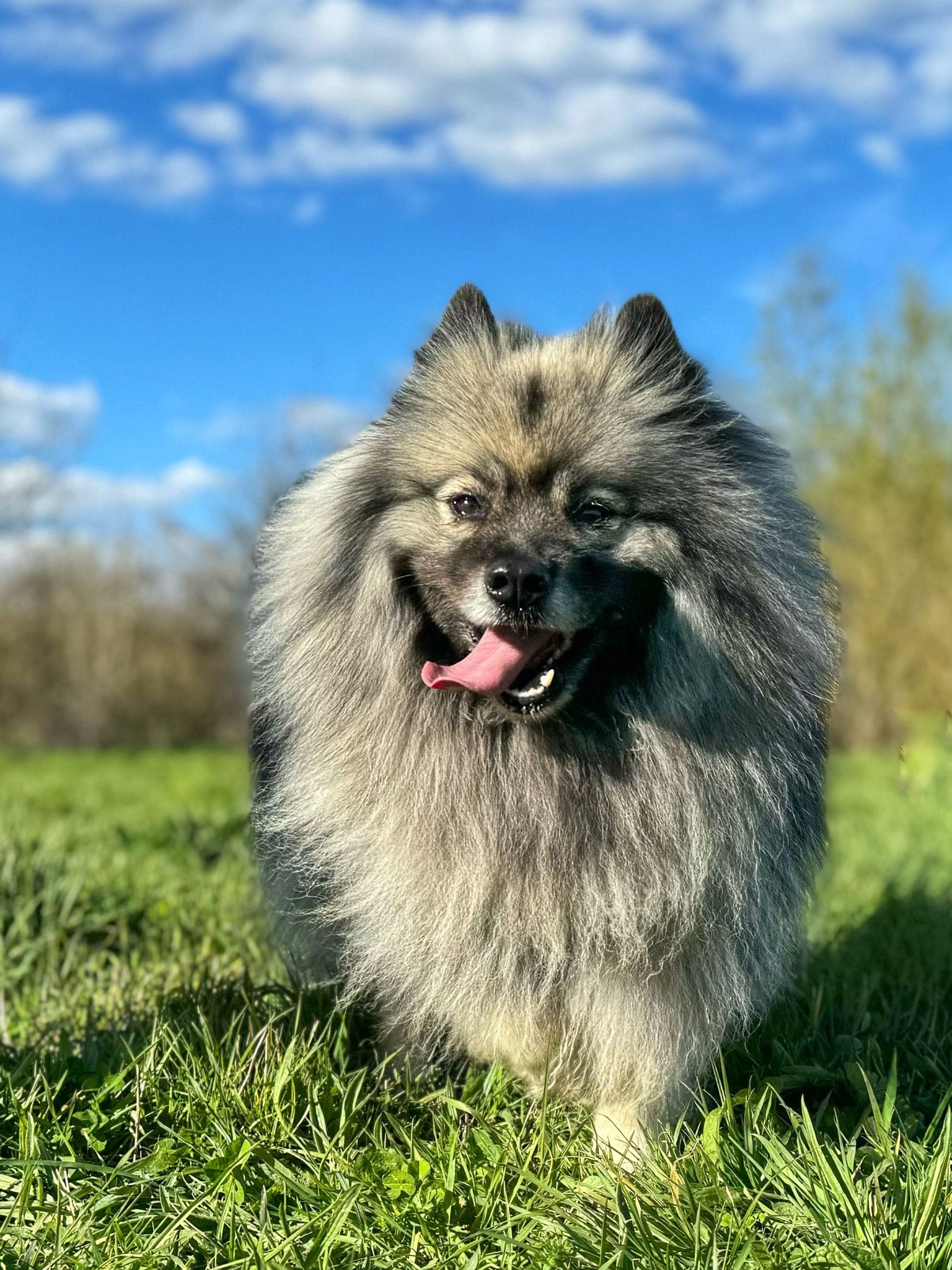
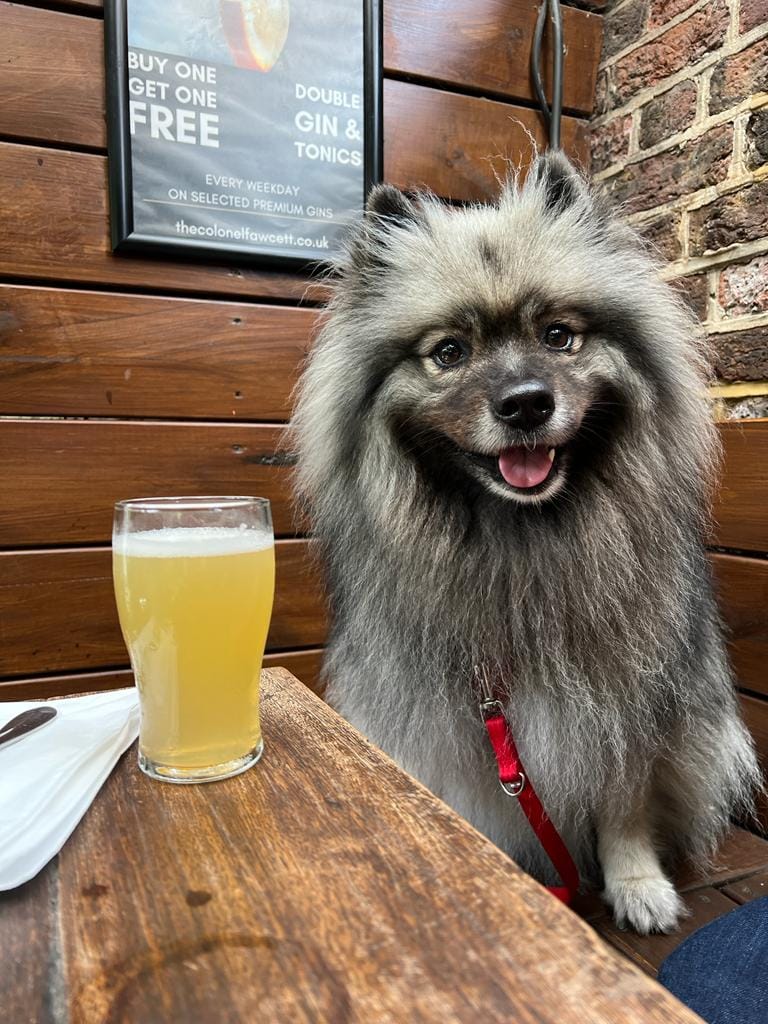
FluffMuppet keeps me grounded (and insists on getting outside every day)
If you’d like to follow my writing and advocacy journey, join the PigPen community for monthly stories and updates.
## Join the community
Get early updates, recipes and your free gift.
Join us
Email sent! Check your inbox to complete your signup.
No spam. Unsubscribe anytime.
### Qualifications
- Bachelor in Viticulture and Oenology, Lincoln University, NZ.
- Diploma in Wines & Spirits, Wine & Spirit Education Trust, London, UK
## Memberships
[**NSPKU**](https://www.nspku.org/?ref=pigpen.page): the national charity for people living with the rare metabolic condition Phenylketonuria (PKU). If you have PKU, or care for someone who does, they offer support and information.
[**Alliance of Independent Authors**:](https://www.allianceindependentauthors.org/members/join?affid=14348&ref=pigpen.page) a global membership association for self-publishing authors. A non-profit, our mission is ethics and excellence in self-publishing.
[**Society of Authors**](https://www2.societyofauthors.org/?ref=pigpen.page): the UK trade union for all types of writers, illustrators and literary translators, at all stages of their careers. They offer a contract vetting service and other helpful advice for new authors.
[**ALCS**:](https://www.alcs.co.uk/?ref=pigpen.page) the Authors' Licensing and Collecting Society are a a not-for-profit organisation. They work to ensure you receive the money you’re entitled to as a writer when someone copies or uses your work. They collect money from all over the world, then pay it out twice a year. Please join now, you may be missing out on money which you have earned.
Buy me a cuppa ☕ — your support helps keep this blog free, and helps to me write about PKU, brain injury & mental health.
[Buy Pauline a cuppa ](https://donate.stripe.com/14keYi5dp9E26Oc9AA?ref=pigpen.page)
###
### Tags:
URL: https://www.pigpen.page/tags/
Last updated: 2026-01-08T21:02:18.000Z
Pauline O'Connor (PigPen) articles on PKU, Brain Injury, mental health, Phenylketonuria, concussion, TBI, ABI, Rare Disease.
[**Advocacy**](https://www.pigpen.page/tag/advocacy/)
[**Brain injury**](https://www.pigpen.page/tag/brain-injury/)
[**Concussion**](https://www.pigpen.page/tag/concussion/)
[**Low Protein**](https://www.pigpen.page/tag/low-protein/)
[**Mental health**](https://www.pigpen.page/tag/mental-health/)
[**News**](https://www.pigpen.page/tag/news/)
[**PKU**](https://www.pigpen.page/tag/pku/)
[**Recipes**](https://www.pigpen.page/tag/recipes/)
[**Writing**](https://www.pigpen.page/tag/writing/)
###
### Books
URL: https://www.pigpen.page/books/
Last updated: 2026-02-11T14:38:18.000Z
[Find Pauline's books](https://bookshelf.start.page/?ref=pigpen.page)
[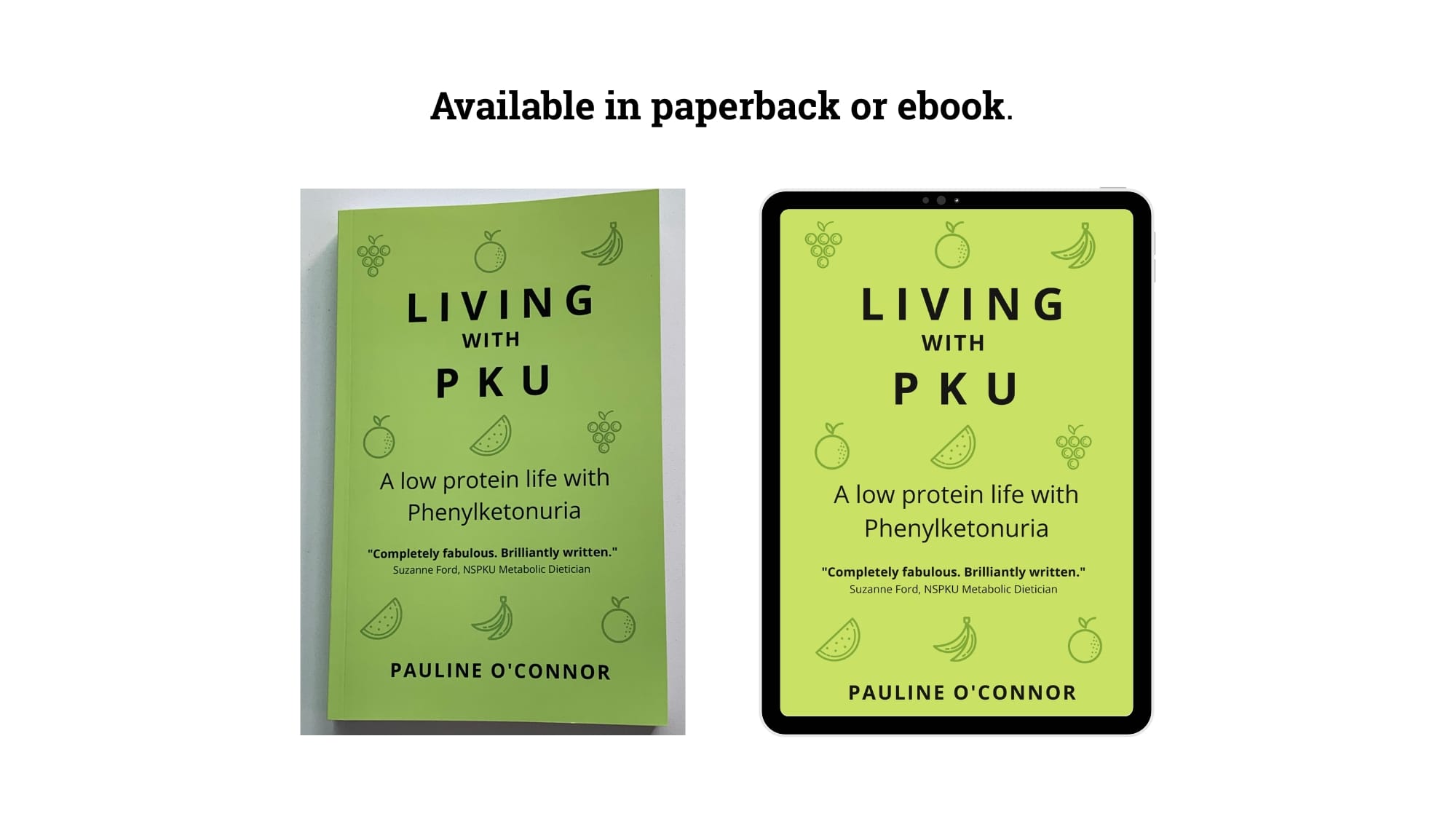](https://www.pigpen.page/living-with-pku/)
Living with PKU: A low protein life with Phenylketonuria. Available in print and digital formats
### [Living with PKU:](https://www.pigpen.page/living-with-pku/) A low protein life with Phenylketonuria
Paperback & ebook
> **"Completely fabulous. Brilliantly written."** Suzanne Ford, NSPKU Metabolic Dietician
[](https://www.pigpen.page/low-phe-kids-books/)
The Low Phe Series for kids with PKU
## [](https://www.pigpen.page/mild-brain-injury/)
### The [Low Phe Series for kids](https://www.pigpen.page/low-phe-kids-books/) with PKU
Paperback, ebook, & printable colouring PDF
> **"A wonderful resource"** Prof. Anita MacDonald
[](https://www.pigpen.page/red-hat-stories/)
The Red Hat Stories. London-based short fiction
### [The Red Hat Stories](https://www.pigpen.page/red-hat-stories/) London-based short fiction
Paperback & ebook
> “**My favourite read of the year.**”
[](https://www.pigpen.page/mild-brain-injury/)
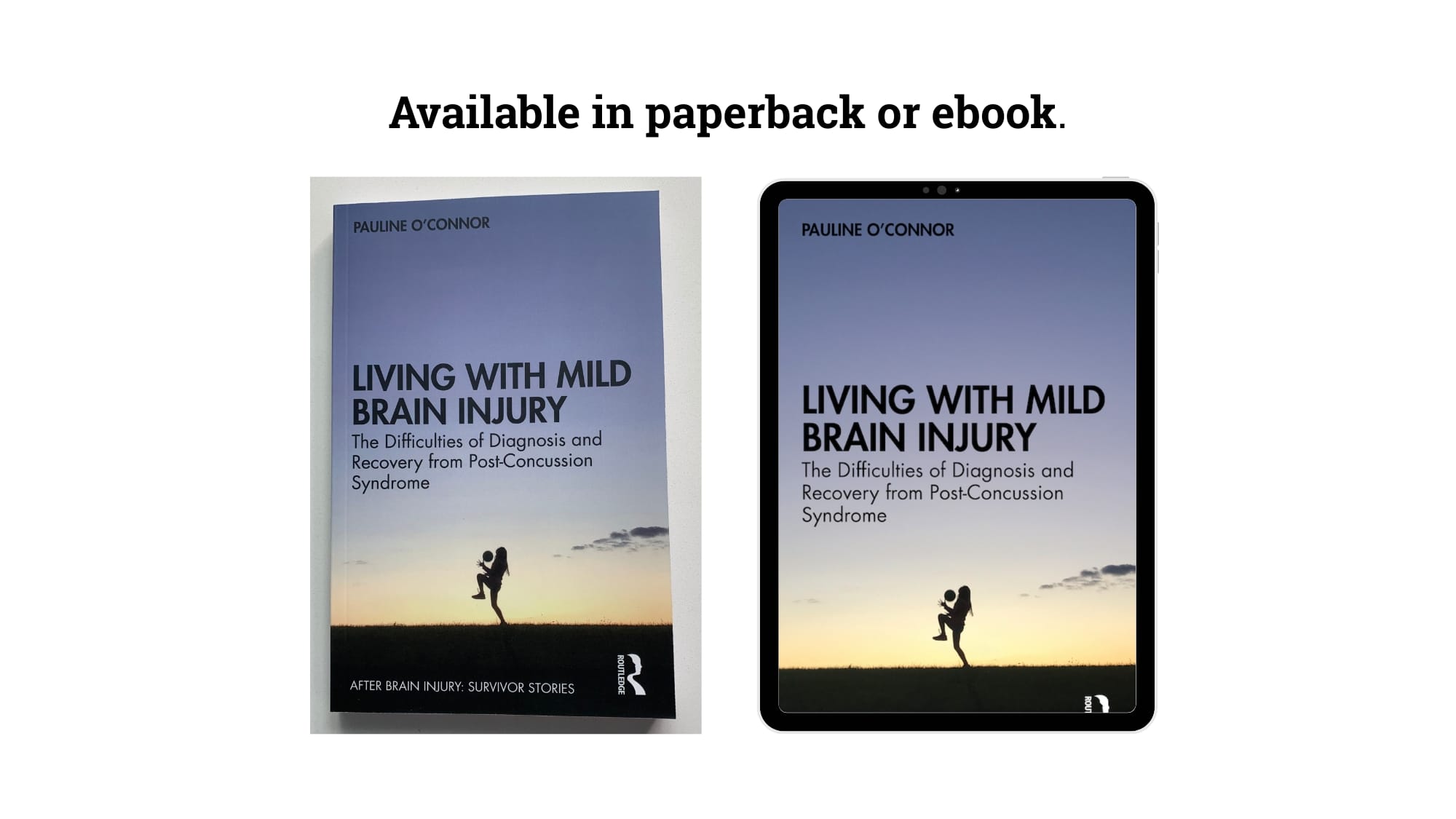
Living with Mild Brain Injury” is available in both paperback and ebook
### [Living with Mild Brain Injury](https://www.pigpen.page/mild-brain-injury/): The difficulties of diagnosis and recovery from post-concussion syndrome
Paperback & ebook
> “**Incredibly vivid**… this book will be of great benefit to professionals, survivors and their families alike.”
[Find Pauline's books](https://bookshelf.start.page/?ref=pigpen.page)
## Join the community
Get early updates, recipes and your free gift.
Join us
Email sent! Check your inbox to complete your signup.
No spam. Unsubscribe anytime.
### Speaking and advocacy
URL: https://www.pigpen.page/speaking/
Last updated: 2025-10-24T13:27:26.000Z

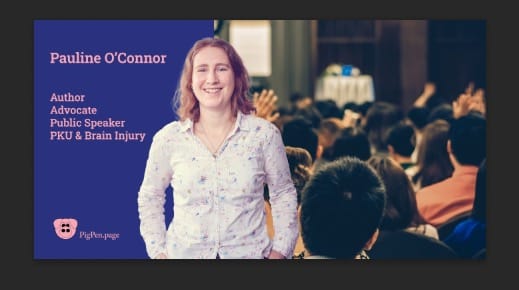
> **"**Pauline delivered a **fascinating and insightful talk**... made a very **positive impact** on the audience.**"**
### Inspirational Speaker
Book a speaking engagement which will enrich and motivate your group.
[Please contact me to discuss your needs.](https://docs.google.com/forms/d/e/1FAIpQLSc6DAoZE5bbFD-CxERRlTksemzo0lk71heCHOyCZXHYcA8QKw/viewform?usp=dialog&ref=pigpen.page)
> "One of our most experienced and active members told me he would put you **in the top five speakers** we've ever had!" U3A group coordinator
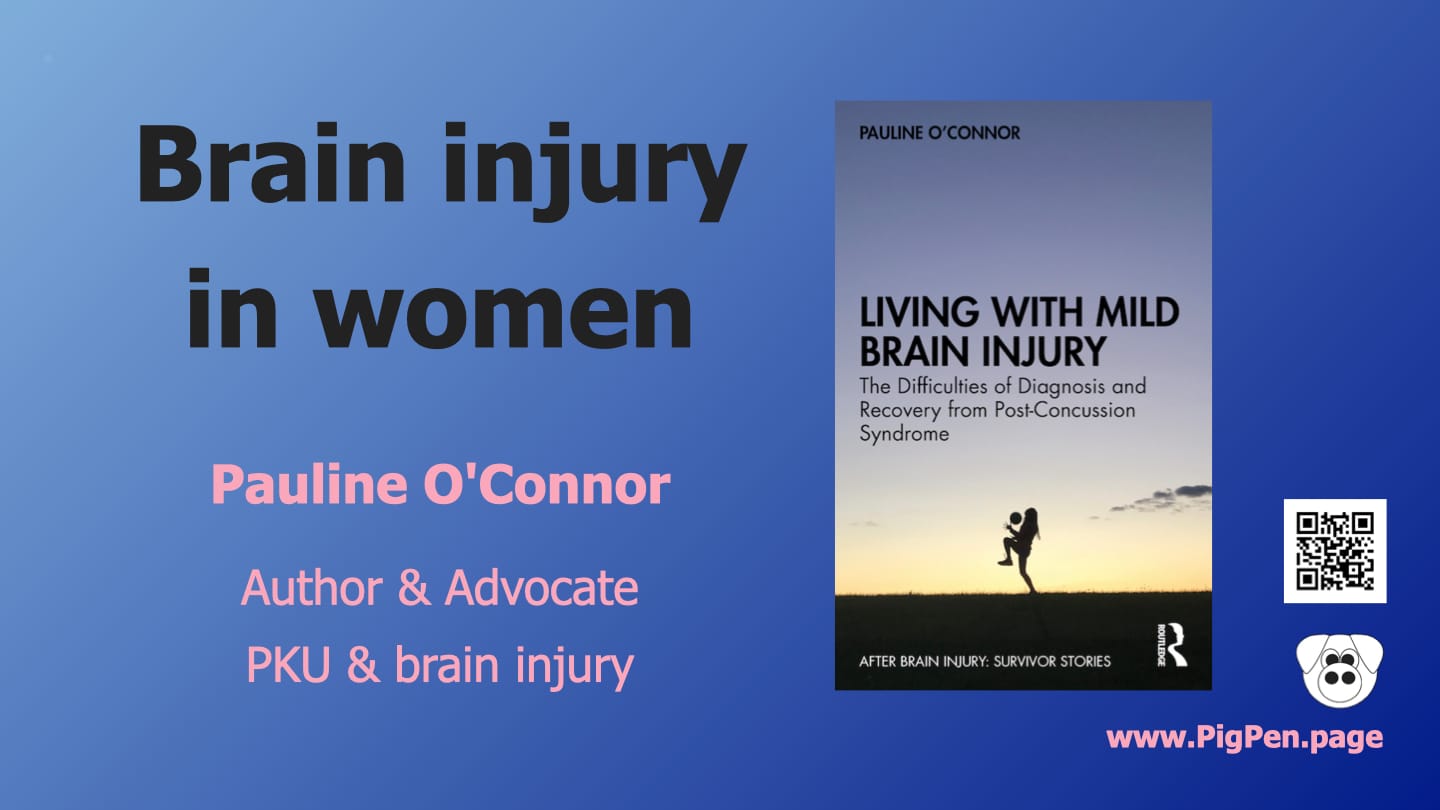
- **Brain injury and Recovery — how women are different** Pauline discusses how brain injury presents differently in women, and what that means for society.
- **Living with Mild Brain Injury** Pauline discusses the prevalence of brain injury in society and the small everyday things you can do to help.
- **PKU and Chronic illness** Living with Chronic Illness — lessons learned from living with a rare metabolic disorder.
**Fees**: In person: £50 up to 1hour + travel (negotiable). Online £40 up to 1 hr
Please note: these fees support my charity and patient group work.
**Patient groups (travel expenses only)** As part of her commitment to assisting brain injury survivors and advocating for others with PKU, Pauline collaborates with organisations like the NSPKU, ESPKU, and Headway in their patient programmes.
> Get in touch today. The fastest way to reach me is via this[**contact form**](https://us14.list-manage.com/contact-form?u=f73ac54f6732b3d571c1d2f66&form%5Fid=3475895e7198b5e0191bc1a41c2897ea&ref=pigpen.page)**.**
## Join the community
Get early updates, recipes and your free gift.
Join for free
Email sent! Check your inbox to complete your signup.
No spam. Unsubscribe anytime.
### Contact Pauline
URL: https://www.pigpen.page/contact/
Last updated: 2026-01-30T12:33:19.000Z
1. The fastest way to reach me is via this[**contact form**](https://docs.google.com/forms/d/e/1FAIpQLSc6DAoZE5bbFD-CxERRlTksemzo0lk71heCHOyCZXHYcA8QKw/viewform?usp=dialog&ref=pigpen.page) (google form).
2. Find me on [LinkedIn](https://www.linkedin.com/in/pauline-o-connor-pigpen/?ref=pigpen.page)
3. Or write to Office 100738, PO Box 6945, London, W1A 6US, U.K.
[](https://www.linkedin.com/in/pauline-o-connor-pigpen/?ref=pigpen.page)
pauline-oconnor-pigpen
## Join the community
Get early updates, recipes and your free gift.
Join us
Email sent! Check your inbox to complete your signup.
No spam. Unsubscribe anytime.
## Copyright
All content on this website is copyright © Pauline O'Connor, 2019-2026\. Nothing may be reproduced without my express permission in writing beforehand.
## Disclaimer
### **Nothing on this website is intended to replace medical advice or treatment.**
Consult your health care practitioner before making any treatment, medication, or lifestyle changes. If you feel the references I used are out of date, or you have new research, please contact me via the methods above.

Policies & terms
## Contributor terms
Thank you for your interest in sharing your story with the PigPen.page community.
These Contributor Terms explain how your submission will be handled and how we protect both you and your work.
**Your Story, Your Rights.** You retain full copyright for any story, image, or creative work you submit. By sending your story, you grant PigPen.page a non-exclusive licence to publish, edit (for clarity, grammar, or length), and promote it across the website and associated social channels. You remain the author and can reuse your story elsewhere at any time.
**Review & Agreement.** All submissions are reviewed before publication. If we both agree that your story fits the purpose and values of PigPen.page, it may be published on the site. Publication is not guaranteed, and I reserve the right to decline, edit, or remove submissions that contain medical advice, personal attacks, or confidential information.
**Privacy & Data Handling.** Your contact details will be used only to discuss and confirm your submission. They will not be shared with anyone else. If your story is accepted, your name (or chosen pseudonym) and any approved image may appear publicly.
**Medical Disclaimer.** Stories on PigPen.page reflect personal experiences only. They should never replace professional medical advice. Always consult your clinician or specialist team before making changes to your care or diet.
**Consent.** By submitting your story through the contact form or by email, you confirm that:
- The content is your own original work;
- You have the right to share it;
- You agree to these Contributor Terms and other PigPen policies
## Comments Policy
Last Updated: 18 November 2024
I’m glad you’re here, and I welcome thoughtful and civilised discussion. However, I reserve the right to edit or delete comments as I see fit, without explanation.
> **Please be respectful of our community and think before you post.**
Here are some examples (not comprehensive, but you’ll get the idea) of types of comments that might be removed:
- spam, junk, or marketing;
- personal or professional rants;
- threats to me or other visitors, I receive the right to report such posts to the authorities.
**Please be respectful of our community and think before you post.**
## Privacy Policy
Our contact details
Name: Pauline O’Connor
E-mail: Pauline(at)PigPen.page
(Privacy Policy updated on 18 November 2024)
**The type of personal information we collect**
We currently collect and process the following information:
- Name and email of subscribers for the purpose of the newsletter and comments service.
**How we get the personal information, and why we have it**
This information only comes directly from you when signing up to the email newsletter. We use the information that you have given us to contact you via email.
Under the General Data Protection Regulation (GDPR), the lawful basis we rely on for processing this information is your consent. You can remove your consent at any time. You can do this by contacting Pauline at the address above.
**How we store your personal information**
Your information is securely stored on Ghost.org and associated backups. We keep your name and email address for the purpose of contacting you via email.
If you wish you unsubscribe, please contact Pauline. We will then dispose safely dispose of your information by deleting it from our servers within 90 days.
**Your data protection rights**
Under data protection law, you have rights including:
- Your right of access. You have the right to ask us for copies of your personal information.
- Your right to rectification. You have the right to ask us to rectify personal information you think is inaccurate. You also have the right to ask us to complete information you think is incomplete.
- Your right to erasure. You have the right to ask us to erase your personal information in certain circumstances.
- Your right to restriction of processing. You have the right to ask us to restrict the processing of your personal information in certain circumstances.
- Your right to object to processing. You have the right to object to the processing of your personal information in certain circumstances.
You are not required to pay any charge for exercising your rights. If you make a request, we have one month to respond to you. Please contact us at Pauline(at)PigPen.page if you wish to make a request.
**How to complain**
If you have any concerns about our use of your personal information, you can make a complaint to us at Pauline(at)PigPen.page. You can also complain to the ICO if you are unhappy with how we have used your data.
The ICO’s address:
Information Commissioner’s Office
Wycliffe House
Water Lane
Wilmslow
Cheshire
SK9 5AF
Helpline number: 0303 123 1113
ICO website: [https://www.ico.org.uk](https://www.ico.org.uk/?ref=pigpen.page)
## Tip Pauline
This blog runs on your support.
[Buy Pauline a cuppa ☕](https://donate.stripe.com/14keYi5dp9E26Oc9AA?ref=pigpen.page)
### Newsletter
URL: https://www.pigpen.page/newsletter/
Last updated: 2026-01-21T15:32:58.000Z
## Join the community
Get early updates, recipes and your free gift.
Join us
Email sent! Check your inbox to complete your signup.
No spam. Unsubscribe anytime.
**Join the community** to get:
- 🎁 **Instant access to two free downloads**
• *Mental Health & PKU* — meaningful insight and practical strategies
• *Low Phe Colouring Book* — a fun, printable resource to empower kids with PKU
- 🧁 *PKU news & recipes* — simple, low-protein ideas and new food finds.
- 🧠 *Brain injury insights* — recovery stories, research updates, and calls for participation.
- 💚 *Mental health articles* — reflections and resources for living well.
Emails arrive once a month or when there’s exciting news — never spam, and your address stays private.
📩 [**Get your free downloads + monthly PKU resources**](https://www.pigpen.page/hello)
### Living with Mild Brain Injury
URL: https://www.pigpen.page/mild-brain-injury/
Last updated: 2026-02-12T15:28:09.000Z
##
The Difficulties of Diagnosis and Recovery from Post-Concussion Syndrome
##
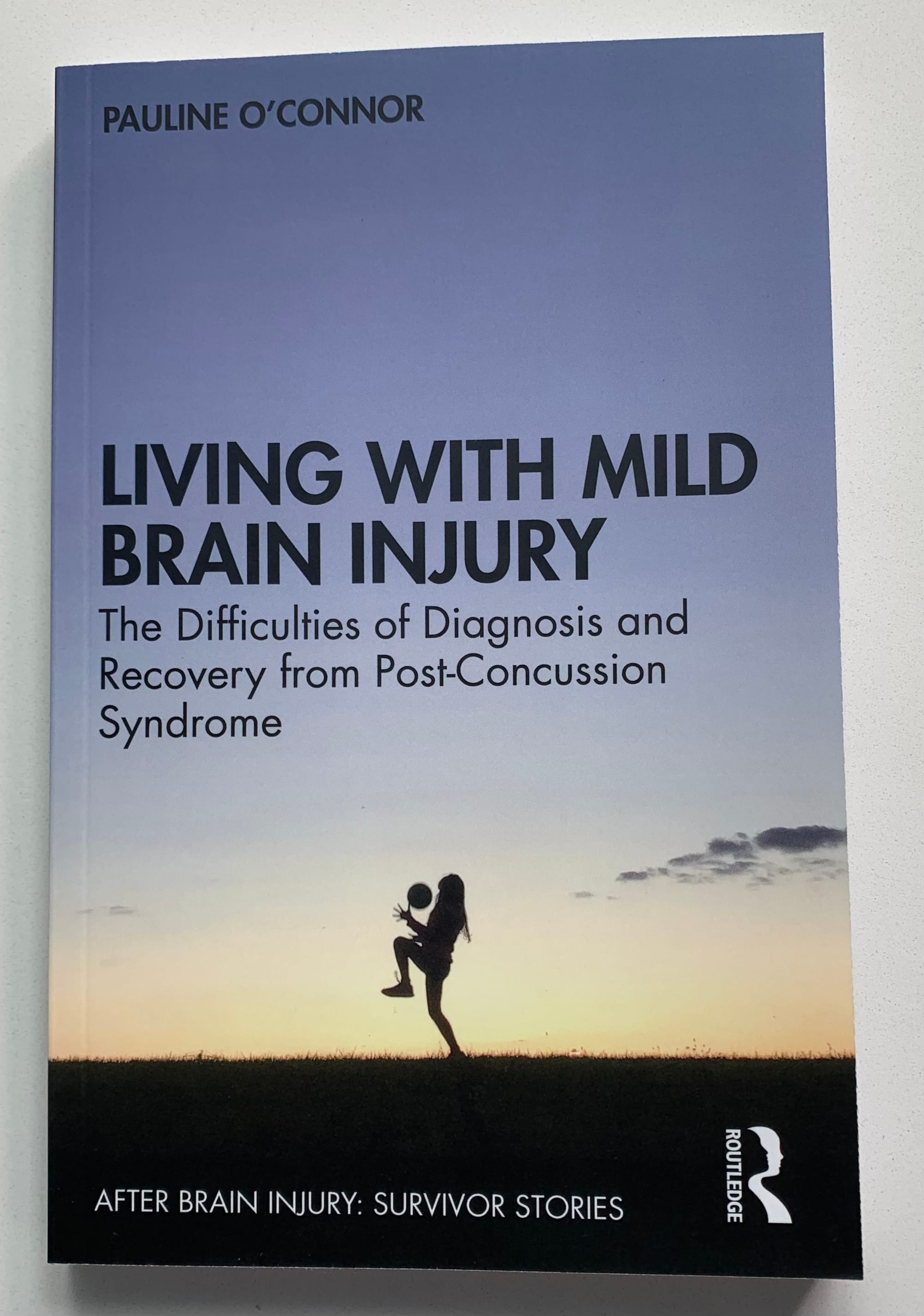
Living with mild brain injury: The Difficulties of Diagnosis and Recovery from Post-Concussion Syndrome, by Pauline O'Connor
[Buy now](https://books2read.com/u/mezJ1Y?ref=pigpen.page)
### Author: Pauline O'Connor
[Pauline O'Connor](https://www.pigpen.page/about-me/) is an author of fiction and non-fiction, and a patient advocate. She campaigns for brain injury survivors, and for those diagnosed with the rare disease, Phenylketonuria (PKU). A brain injury ended Pauline’s successful careers in winemaking and education. Now, she pursues her passions for advocacy and writing.
### A vivid memoir of concussion, recovery, and rediscovery.
This compelling memoir charts Pauline’s real-life experience—with symptoms, misdiagnosis, and a hidden bleed following a football tackle. Combining diary entries, clinic notes, and raw emotion, it offers invaluable insight for survivors, families, and healthcare professionals.
> *"⭐⭐⭐⭐⭐ I was engrossed, and read the book in a day."*
[Buy now](https://books2read.com/u/mezJ1Y?ref=pigpen.page)
### [*Read a free sample of Living with Mild Brain Injury*](https://www.amazon.co.uk/Living-Mild-Brain-Injury-Post-Concussion-ebook/dp/B08QXQ587P/ref=sr%5F1%5F1?crid=1PH4Y4OWGD90C&dib=eyJ2IjoiMSJ9.kPkn643zpPMNU068LCqNEw.RgH9TEkj9f6YNXuQjmx0h5YRmLnl4Nwtc%5FkpJgsB3wE&dib%5Ftag=se&keywords=living+with+mild+brain&qid=1750772728&sprefix=living+with+mild+brain%2Caps%2C61&sr=8-1&asin=B08QXQ587P&revisionId=4023334b&format=3&depth=1&ref=pigpen.page)
- **Paperback** ISBN: 9780367524081
- **Ebook** ISBN: 9781003057772 ASIN:B08QXQ587P
- **Hardback** ISBN: 9780367524081
### Who it's for:
- Brain injury survivors
- Loved ones and carers supporting someone with mild TBI
- Neurorehabilitation professionals
- Brain Injury awareness advocates and organisations
### What you’ll discover:
- Common hidden concussion symptoms
- Pitfalls in diagnosis and uneven recovery paths
- Impact on relationships, work, and identity
- A roadmap to resilience, informed by lived experience
### Author Insight
*"I wrote this to share my journey of an invisible condition—and to show that a happy life is still possible."*
### Praise for *Living with Mild Brain Injury*
###
“**Incredibly vivid**… this book will be of great benefit to professionals, survivors and their families alike.”**Dr Neil Parrett** *, MA(hons), DClinPsy, PgDip, CPsychol. Consultant Clinical Psychologist (Neurorehabilitation)*
⭐⭐⭐⭐⭐ "A **brilliantly written, and emotional** narrative of the author's struggles following a concussion during a football match... I was engrossed and read the book in a day. The book shows that even so called "mild" brain injury is anything but mild, especially to the person affected by it." *MrK via Amazon.*
⭐⭐⭐⭐⭐ "I found it to be a deconstruction of all the ways the brain helps us out as well as a reconstruction of the author's mental health and wellbeing, I was instantly gripped and found it **incredibly fascinating**." Sosomo *via Amazon*
### Buy the Book:
- [Paperback](https://books2read.com/u/mezJ1Y?ref=pigpen.page)
- [eBook](https://books2read.com/u/mezJ1Y?ref=pigpen.page)
- [Read a free sample](https://www.amazon.co.uk/Living-Mild-Brain-Injury-Post-Concussion-ebook/dp/B08QXQ587P/ref=sr%5F1%5F1?crid=1PH4Y4OWGD90C&dib=eyJ2IjoiMSJ9.kPkn643zpPMNU068LCqNEw.RgH9TEkj9f6YNXuQjmx0h5YRmLnl4Nwtc%5FkpJgsB3wE&dib%5Ftag=se&keywords=living+with+mild+brain&qid=1750772728&sprefix=living+with+mild+brain%2Caps%2C61&sr=8-1&asin=B08QXQ587P&revisionId=4023334b&format=3&depth=1&ref=pigpen.page)
## Living with Mild Brain Injury – Frequently Asked Questions
### What is this book about?
*Living with Mild Brain Injury* explores the long-term effects of post-concussion syndrome (PCS) and traumatic brain injury (TBI), focusing on the emotional, cognitive, and practical challenges that often go unseen. It highlights a survivor's story, and the difficult journey to diagnosis and recovery.
### Who is it for?
This book is written for people living with mild brain injuries, their families, friends, healthcare professionals, and anyone wanting to better understand the impact of TBI.
### Does the book focus on medical or personal experience?
The emphasis is on lived experience. While it references the medical landscape, it centres on the real-life accounts of people navigating life after brain injury, offering support and validation.
### Is this book suitable for someone newly diagnosed?
Yes. Many readers find it helpful in the early stages of recovery, especially if they are feeling isolated, misunderstood, or dismissed. It provides a sense of recognition and community.
### Is the book research-based?
The experiences described are grounded in a real-life account and supported by current knowledge of mild brain injury and post-concussion syndrome, but it does not replace clinical advice.
### Where can I buy it?
*Living with Mild Brain Injury* is available in paperback and ebook formats through [Routledge books](https://www.routledge.com/Living-with-Mild-Brain-Injury-The-Difficulties-of-Diagnosis-and-Recovery-from-Post-Concussion-Syndrome/OConnor/p/book/9780367524081?ref=pigpen.page) and [other major retailers](https://books2read.com/u/mezJ1Y?ref=pigpen.page).
### Can I read a free sample of the Living with PKU book?
Yes! You can read the first 40 pages of this book free via the [Amazon sample](https://www.amazon.co.uk/Living-Mild-Brain-Injury-Post-Concussion-ebook/dp/B08QXQ587P/ref=sr%5F1%5F1?crid=1PH4Y4OWGD90C&dib=eyJ2IjoiMSJ9.kPkn643zpPMNU068LCqNEw.RgH9TEkj9f6YNXuQjmx0h5YRmLnl4Nwtc%5FkpJgsB3wE&dib%5Ftag=se&keywords=living+with+mild+brain&qid=1750772728&sprefix=living+with+mild+brain%2Caps%2C61&sr=8-1&asin=B08QXQ587P&revisionId=4023334b&format=3&depth=1&ref=pigpen.page).
### Living with PKU
URL: https://www.pigpen.page/living-with-pku/
Last updated: 2026-02-12T14:44:04.000Z
## A low-protein life with Phenylketonuria
[](https://books2read.com/PKUBook?ref=pigpen.page)
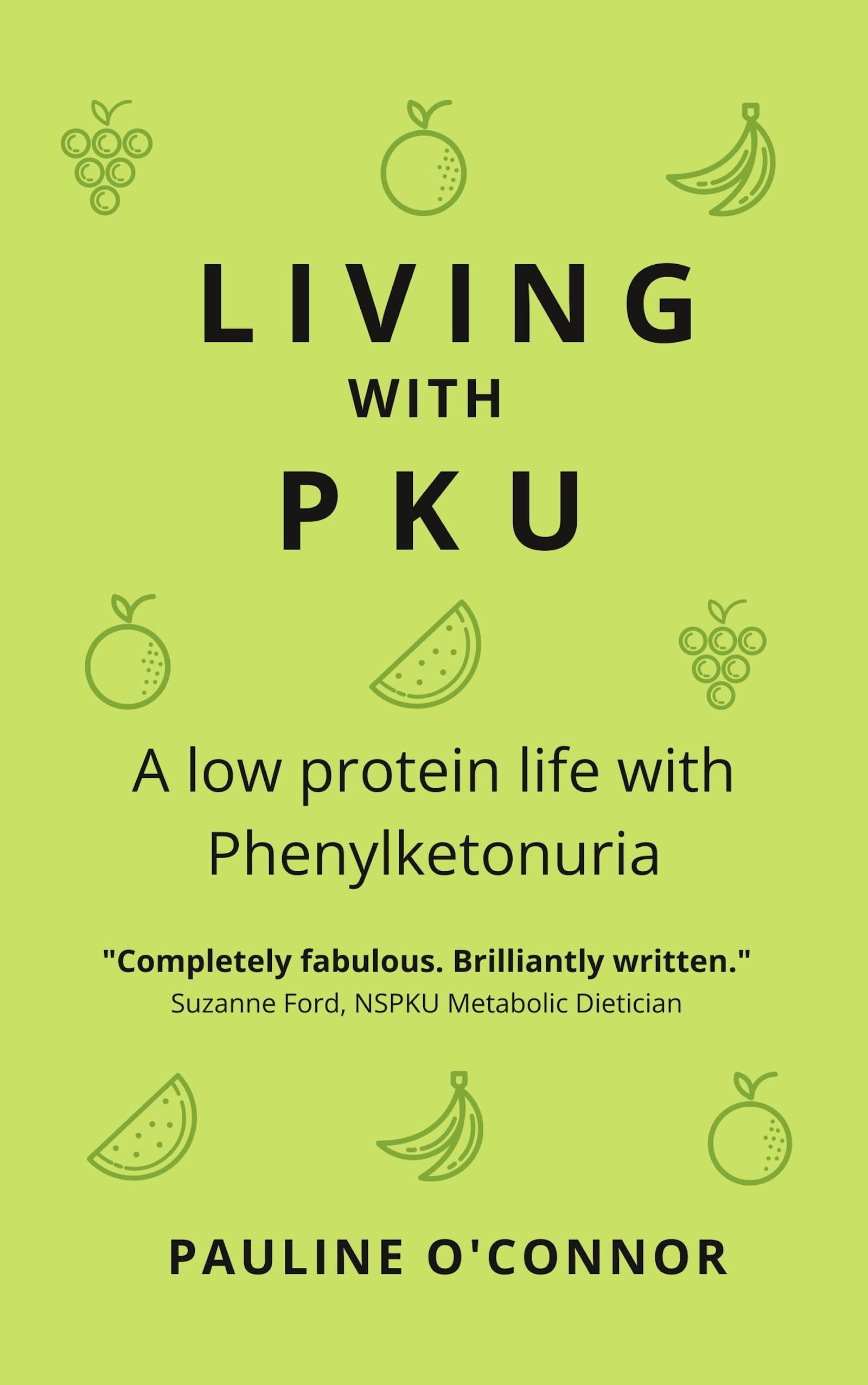
Living with PKU: A low protein life with Phenylketonuria, by Pauline O'Connor. Available in paperback and ebook.
[Buy now](https://books2read.com/PKUBook?ref=pigpen.page)
### Author: Pauline O'Connor
[Pauline O'Connor](https://www.pigpen.page/about-me/) is an author of fiction and non-fiction, and a patient advocate. She campaigns for brain injury survivors, and for those diagnosed with the rare disease, Phenylketonuria (PKU). A brain injury ended Pauline’s successful careers in winemaking and education. Now, she pursues her passions for advocacy and writing.
### A clear, compassionate guide drawn from 40+ years of PKU life.
Pauline explains PKU with remarkable clarity. Drawing on decades of personal experience and honest reflections, it helps teens, adults, and families navigate dietary complexities, emotional challenges, and everyday life with PKU.
> ⭐⭐⭐⭐⭐ "Absolutely brilliant & factual…lots of very good advice."
[Buy now](https://books2read.com/PKUBook?ref=pigpen.page)
## [Read a free sample of Living with PKU](https://www.amazon.co.uk/Living-PKU-protein-life-Phenylketonuria-ebook/dp/B0B4FB651S?ref%5F=ast%5Fauthor%5Fdp&asin=B0B4FB651S&revisionId=ee1d03e9&format=3&depth=1&ref=pigpen.page)
- **Paperback** ISBN: 9781739635619
- **Ebook** ISBN: 9781739635602 ASIN: B0B4FB651S
## A valuable resource for PKU
Living with PKU is a valuable resource for adults and teens with Phenylketonuria (PKU), or for families new to the disorder.
In clear and simple language, this book explains PKU and offers practical advice on living with it, including:
• PKU and mental health
• Managing PKU clinics
• Travel & emigrating
• Women & PKU
• Healthy eating and exercise
Pauline has lived with PKU for over forty years. In this honest account, she shares her experience and mistakes to help others navigating the difficult dietary treatment.
### Who it's for:
- Those newly diagnosed with PKU, or
- those with an allied disorder or a low-protein diet therapy.
- Parents and caregivers
- Dieticians, teachers, and allied health professionals
### What you'll discover:
- How PKU shapes choices, moods, and our professional & social lives
- Practical advice on low-protein living
- Stories of mistakes, insight, and acceptance
### Author Insight:
*"I want to share my ups and downs, experience and mistakes to help others navigating the difficult dietary treatment."*
### Praise for *Living with PKU:*
###
“**Completely fabulous. Brilliantly written**.” — *Suzanne Ford, NSPKU Dietician*
“**Well-written, as well as wise**, and never once does it run out of steam or become dull to a non-knowledgeable reader.” — *Alex Gazzola, journalist and author of* [*Allergy Insight*](https://www.allergy-insight.com/on-phenylketonuria-pku/?ref=pigpen.page)*.*
⭐⭐⭐⭐⭐“This would be an **excellent book for anyone** with PKU, their friends and family, and importantly, clinicians treating those with PKU. Knowing what the lived experience is of PKU is essential to providing better care and this should be read by GPs, dieticians, and consultants alike. Highly recommend!” *Philippa Turner on Amazon*
⭐⭐⭐⭐⭐“**Thank you for writing this book**... covered everything and is an invaluable resource. I will never truly know the challenges a life with PKU will entail but I feel this book has equipped me with some insights that will help me help my niece navigate through them.” *Amazon review.*
### Buy the book:
- [Links to your favourite store](https://books2read.com/u/3GWYnd?ref=pigpen.page)
- [Read a free sample](https://www.amazon.co.uk/Living-PKU-protein-life-Phenylketonuria-ebook/dp/B0B4FB651S?ref%5F=ast%5Fauthor%5Fdp&asin=B0B4FB651S&revisionId=ee1d03e9&format=3&depth=1&ref=pigpen.page)
- Get a free copy of the Mental Health and PKU chapters when you[ subscribe (for free)](https://www.pigpen.page/newsletter/#/portal/signup) to this website.
## Living with PKU – Frequently Asked Questions
### What is "Living with PKU" about?
This book offers a compassionate and practical guide to living well with Phenylketonuria (PKU), a rare inherited metabolic condition. It shares real-life experiences, nutrition strategies, mental health tips, and support tools for individuals and families managing a low-protein lifestyle.
### Who is this book for?
It's ideal for adults living with PKU, parents of children with PKU, carers, teachers, dieticians, and anyone seeking a deeper understanding of life with this rare condition.
### What makes this book different from clinical guides?
"Living with PKU" shares the lived experience. It goes beyond the science, exploring emotional wellbeing, social challenges, and identity with insight and honesty. It complements clinical advice with day-to-day lived wisdom.
### Is this book medically accurate?
Yes. While it’s not a replacement for professional medical advice, the content has been informed by research and reviewed by individuals with lived experience and expert dietitians.
### Does the book include dietary advice or recipes?
It includes discussion around managing the PKU diet in daily life, including shopping, social situations, and cooking low-protein meals, but it is not a recipe book. For that, see the companion titles in the Low Phe series.
### Is it available in print or ebook?
Yes, "Living with PKU" is available in both paperback and ebook formats through [**all** major retailers](https://books2read.com/u/3GWYnd?ref=pigpen.page).
### Where can I buy the book?
You can order find [**links to major online bookstores here**](https://books2read.com/u/3GWYnd?ref=pigpen.page)
### Can I read a free sample of the Living with PKU book?
Yes! You can either:
- Read the first 40 pages of this book free via the [Amazon sample](https://www.amazon.co.uk/Living-PKU-protein-life-Phenylketonuria-ebook/dp/B0B4FB651S?ref%5F=ast%5Fauthor%5Fdp&asin=B0B4FB651S&revisionId=ee1d03e9&format=3&depth=1&ref=pigpen.page). Or,
- Get a [**free copy of the Mental Health and PKU**](https://www.pigpen.page/newsletter/#/portal/signup) chapters when you subscribe (for free) to this website.
[](https://bookshelf.start.page/?ref=pigpen.page)
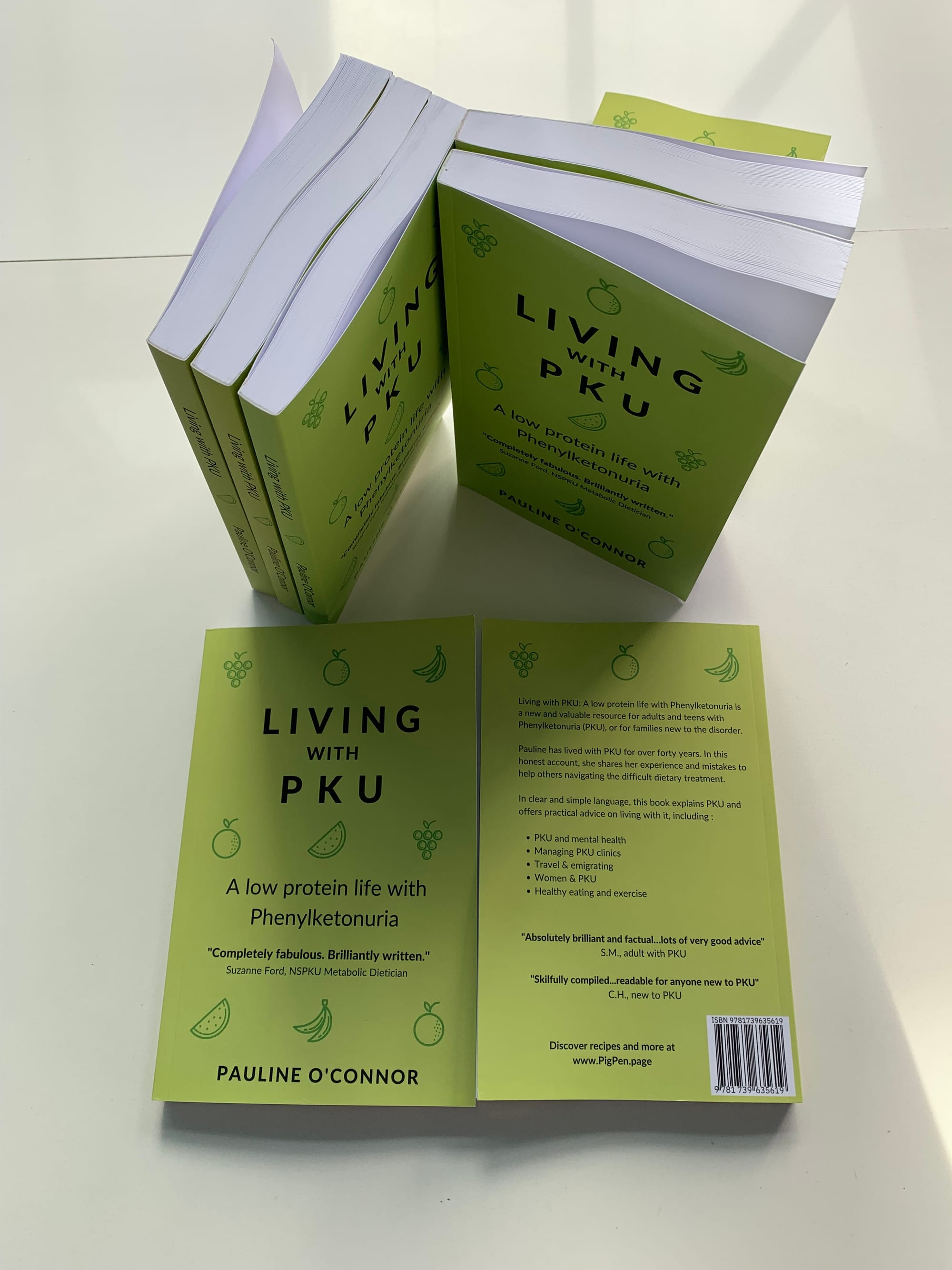
Living with PKU: a low-protein life with Phenylketonuria
### The Red Hat Stories
URL: https://www.pigpen.page/red-hat-stories/
Last updated: 2026-02-12T15:39:03.000Z
## London. A city of millions, where the solitary are never alone.

The Red Hat Stories. London-based short fiction, by Pauline O'Connor. Available in Paperback and ebook
[Find your Red Hat Story today.](https://books2read.com/u/4XWDoL?ref=pigpen.page)
### Author: Pauline O'Connor
[Pauline O'Connor](https://www.pigpen.page/about-me/) is an author of fiction and non-fiction, and a patient advocate. She campaigns for brain injury survivors, and for those diagnosed with the rare disease, Phenylketonuria (PKU). A brain injury ended Pauline’s successful careers in winemaking and education. Now, she pursues her passions for advocacy and writing.
0:00
/0:30
1×
Official trailer for 'The Red Hat Stories' (video has no sound)
### Short fiction exploring connection, loss, & serendipity.
This evocative fiction collection set in London reveals nine powerful tales of strangers who meet a mysterious red-hat-wearing woman. From grief to rediscovery, the stories uncover how brief collisions with others can leave lasting echoes.
> **"My favourite read of the year!"**
### Praise for *The Red Hat Stories:*
⭐⭐⭐⭐⭐ *"*Insightful short stories from a keen observer of human nature, these seemed to bring me right next to the narrator on her travels in London. Beautifully written and subtly heart warming. Inner thoughts are captured and shared to help the reader know each character's motivations. Highly recommend!*" J.J. Brown, author, on Goodreads*
⭐⭐⭐⭐⭐ *"*A well written and thoughtful selection of short stories, all interconnected by a woman in a red hat. My personal favourite was the redemptive path followed by the investment banker Charles." *Elizabeth Kelly on Goodreads*
[Find your Red Hat Story today.](https://books2read.com/u/4XWDoL?ref=pigpen.page)
- **Paperback** ISBN: 9781739635626
- **Ebook** ISBN: 9781739635633 ASIN: B0D92B1SL4
### Who it's for:
- Fans of literary short stories
- Curious observers of human connection
- Readers seeking reflection and surprise
### What you'll discover:
- Nine interwoven stories exploring fate and empathy
- Rich emotional landscapes—from solitude to revelation
### Author Insight:
*"I wanted to explore how small moments with strangers can forever alter our lives."*
### Buy the book via these hand [Links to your favourite store](https://books2read.com/u/4XWDoL?ref=pigpen.page)
###
## The Red Hat Stories – Frequently Asked Questions
### What is this book about?
*The Red Hat Stories* is a collection of short stories that explore loneliness, hope, and human connection in unexpected places. It weaves together characters from different walks of life, each touched by the mysterious presence of a woman in a red hat.
### Is this book for adults or teens?
It’s written for adults and older teens who enjoy reflective fiction, character-driven stories, and emotional themes. The stories are accessible and thought-provoking.
### What genre is it?
Literary fiction short stories. The tone is gentle, observational, and sometimes whimsical — with moments of poignancy and joy.
### Are the stories connected?
Yes, while each story stands alone, they are all linked by the presence of a mysterious woman in a red hat. As the collection progresses, her story is revealed.
### Is this book suitable for book clubs or discussion groups?
Absolutely. Each story prompts reflection and discussion, making it ideal for reading groups or creative writing inspiration.
### Is it available in paperback and ebook?
Yes, *The Red Hat Stories* is available in both formats at all [major online retailers](https://books2read.com/u/4XWDoL?ref=pigpen.page).
### Is the book appropriate for readers affected by mental health issues?
Yes. The stories are compassionate and affirming, often highlighting resilience and the importance of small human moments.
---
### Low Phe ABC
URL: https://www.pigpen.page/low-phe-kids-books/
Last updated: 2026-02-12T15:33:07.000Z
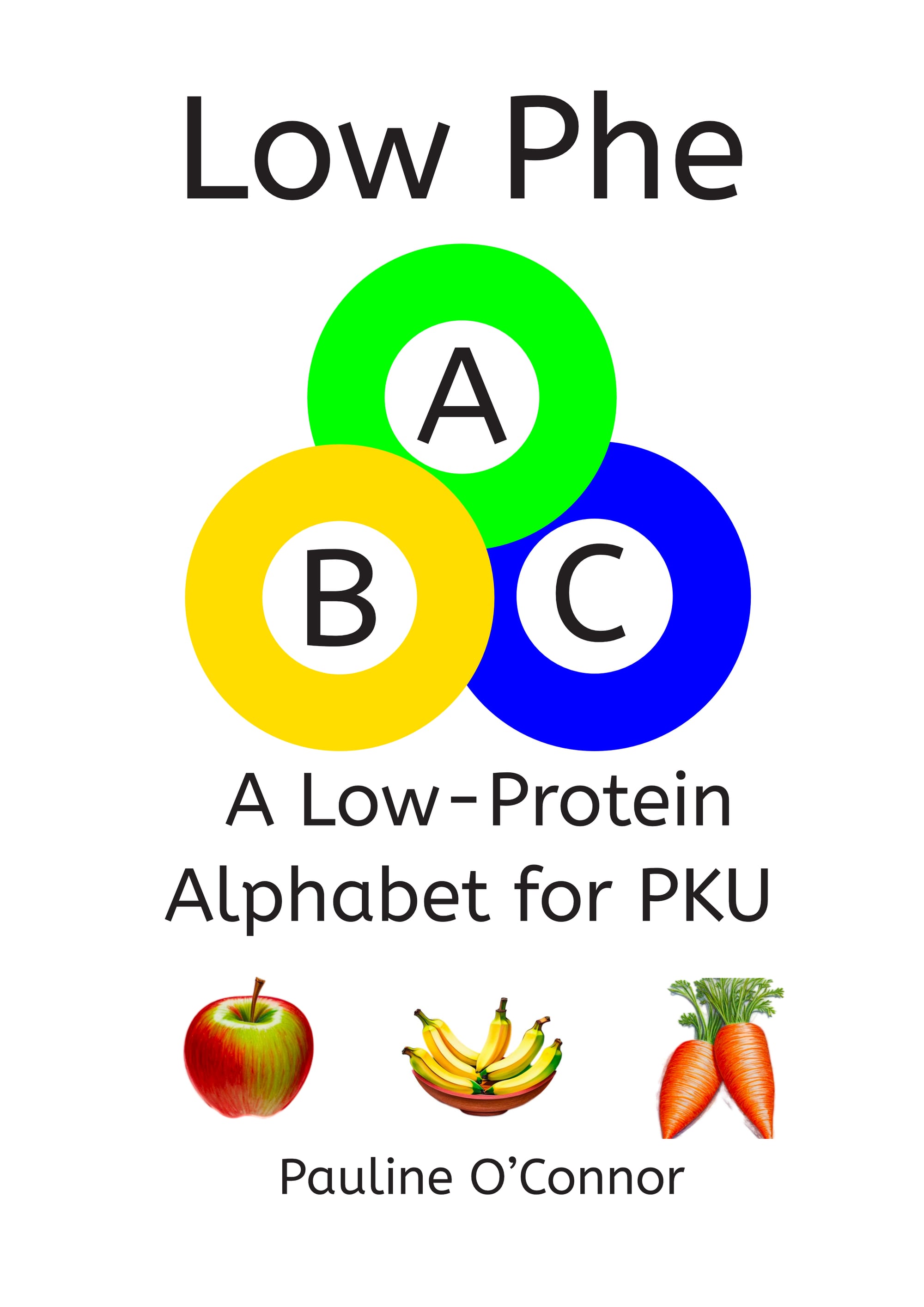
## A Low-Protein Alphabet for PKU
[Buy now](https://books2read.com/u/bzw1dG?ref=pigpen.page)
### Author: Pauline O'Connor
[Pauline O'Connor](https://www.pigpen.page/about-me/) is an author of fiction and non-fiction, and a patient advocate. She campaigns for brain injury survivors, and for those diagnosed with the rare disease, Phenylketonuria (PKU). A brain injury ended Pauline’s successful careers in winemaking and education. Now, she pursues her passions for advocacy and writing.
## Accessible, fun low‑protein book for PKU kids
Specially crafted for children with PKU, these books weave education and entertainment. The **Low Phe ABC Book** introduces protein‑free foods in bright illustrations, and the [**FREE colouring companion**](https://www.pigpen.page/newsletter/) invites playful learning—ideal for family engagement.
> **"A wonderful resource"** Prof. Anita MacDonald
[Buy now](https://books2read.com/u/bzw1dG?ref=pigpen.page)
- **Paperback** ISBN: 9781739635657
- **Ebook** ISBN: 9781739635640 ASIN:B0F99V1754
### Who it's for:
- Children aged 0-5 with PKU, or a low-protein diet therapy
- Parents, teachers, and family members
- Clinics and paediatric dieticians
### **What’s inside:**
- ABCs with protein‑free food examples
- Bonus coloring pages for creative exploration
- Reinforces dietary learning through play
- *Plus!* A printable colouring book option so you can print as many copies as you like.
### Author insight:
*"I hope these books show PKU families just how colourful, safe food can be."*
### Praise for the Low Phe Series:
- "This will be **a wonderful resource** for us to use...The children will enjoy colouring this booklet in.” *Prof. Anita MacDonald.*
### Buy the Book:
- Find them at [your favourite online store](https://books2read.com/u/bzw1dG?ref=pigpen.page)
- Get the [Digital PDF Download and print as many copies as you like](https://www.pigpen.page/newsletter/)!
## **Low Phe Series – Frequently Asked Questions**
### What is the Low Phe series?
This is a series of fun, educational books for children with Phenylketonuria (PKU), designed to support early learning and confidence while managing a low-protein diet. **All foods in the books are considered protein-free for PKU in the UK**.
### What books are included in the series?
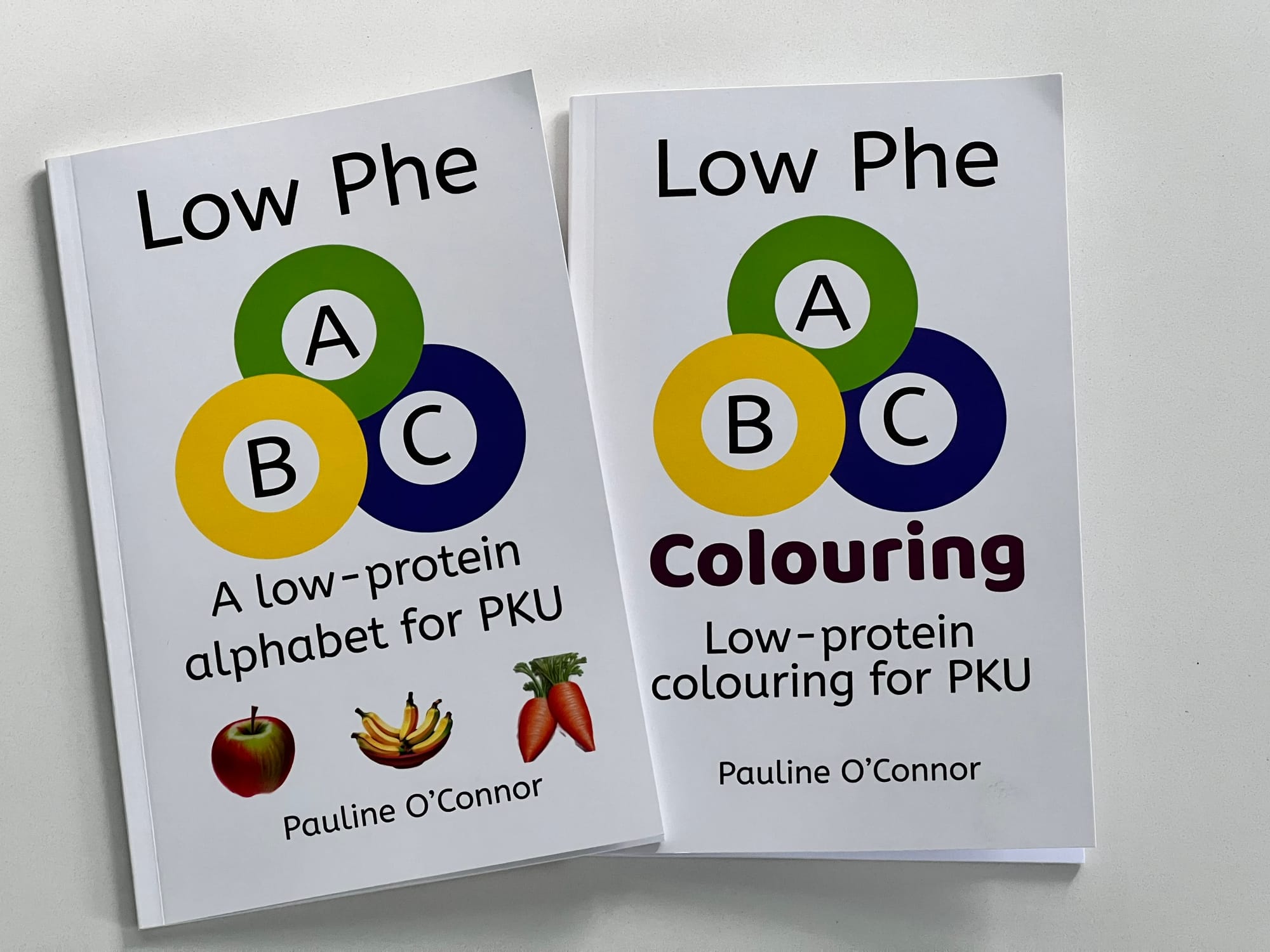
- *Low Phe: A Low-Protein Alphabet for PKU* is a full colour ABC reader.
- *Low Phe Colouring: Low-Protein Colouring for PKU* is a black and white version of the ABC reader designed for colouring in.
### Who are these books for?
Children living with PKU (typically ages 0–5), their parents, teachers, and siblings. They are also suitable for nursery or school settings to promote inclusion and understanding.
### What do the books teach?
The alphabet book introduces letters using low-protein foods and colourful images. The colouring book reinforces these foods through interactive play. Both support dietary learning and positive PKU food identification.
### Are they medical books?
No. The books have been checked by UK dieticians but they are **not medical advice** — they’re age-appropriate tools to introduce PKU in a fun and reassuring way.
### Are they suitable for children newly diagnosed with PKU?
Yes. They’re an excellent resource for early education and helping children feel seen and supported from the beginning. All foods in the books are considered protein-free for PKU in the UK.
### Are the books available in ebook and print?
Yes. Both books are available in paperback and digital formats at [PKUBooks.com](https://www.pkubooks.com/?ref=pigpen.page). Or at your [favourite online retailer](https://books2read.com/u/bzw1dG?ref=pigpen.page). The PDF colouring book allows you to print unlimited copies of the colouring pages, and is only available at [PKUBooks.com](https://www.pkubooks.com/?ref=pigpen.page).
### Can clinics or schools use them?
Yes! The re-printable PDF is ideal for clinics, schools, or parties. Find it at [PKUBooks.com](https://www.pkubooks.com/?ref=pigpen.page), or you can [contact me](https://www.pigpen.page/contact/) to find out more.
[](https://www.pkubooks.com/?ref=pigpen.page)
Low Phe ABC and Low Phe Colouring paperbacks.
## Posts
### PKU Day 2026
URL: https://www.pigpen.page/pku-day-2026/
Last updated: 2026-06-26T07:00:41.000Z
Hullo there,
The **28th of June is International PKU Day**: a chance for the Low Protein community to raise awareness of Phenylketonuria and allied inherited metabolic conditions, like Tyrosinaemia.
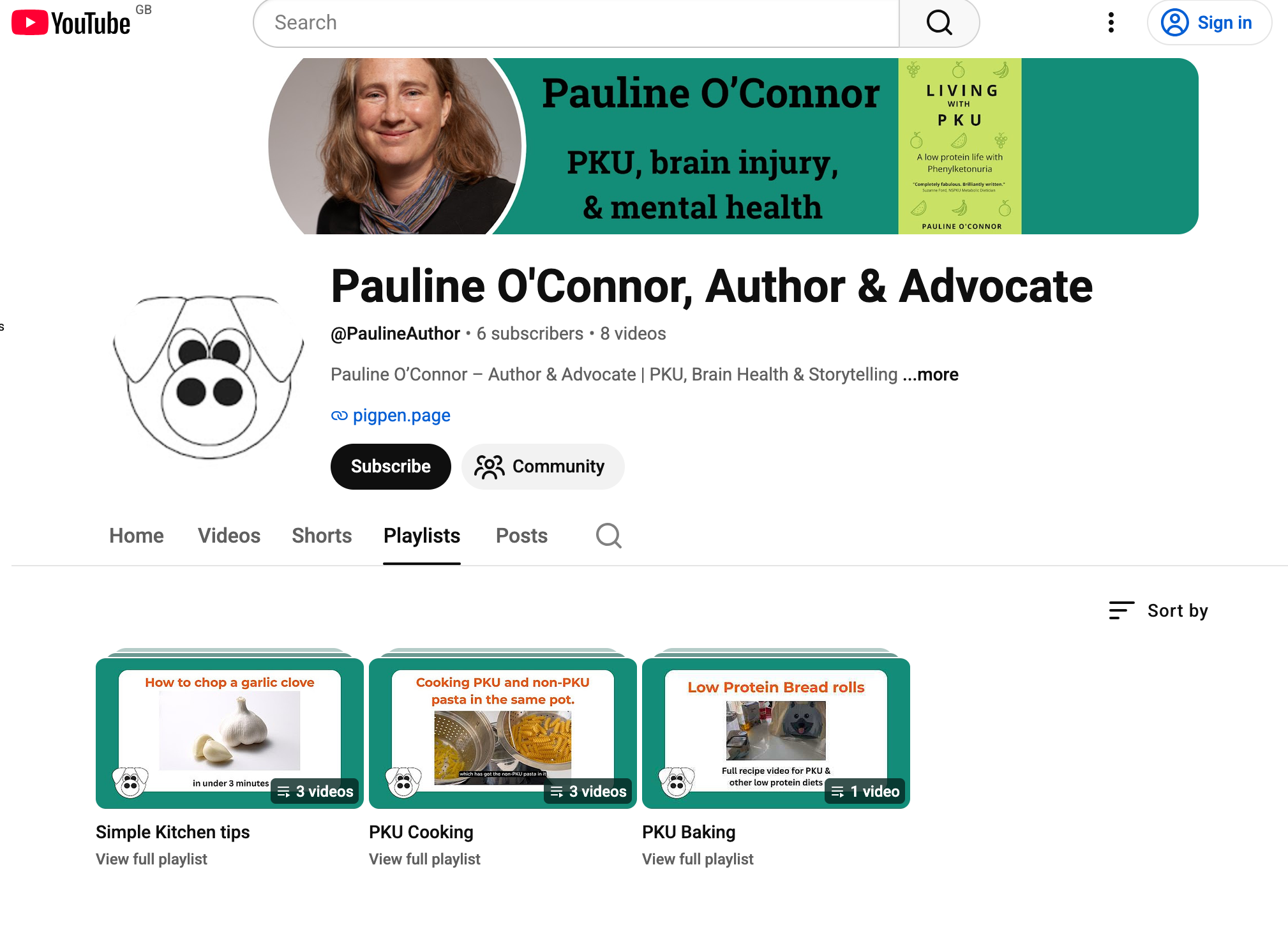
To mark it, I am launching my YouTube channel: [youtube.com/@PaulineAuthor](https://www.youtube.com/@PaulineAuthor?ref=pigpen.page)
It is a space for practical Low Protein recipes, stories, and conversations about PKU, brain health, and low-protein living. You can [start with the welcome video](https://www.youtube.com/watch?v=wsXFhMIyaBs&ref=pigpen.page) to get a feel for what is coming.
[](https://www.youtube.com/@PaulineAuthor?ref=pigpen.page)
Pauline O'Connor YouTube channel
I am also featured on the [Beacon](https://www.rarebeacon.org/blog/beyond-the-clinic-navigating-adulthood-with-pku/?ref=pigpen.page) for Rare Disease website this week, with a blog post about navigating adulthood with PKU.
And a quick milestone note: this month marks **four years since *Living with PKU*** was published, and one year since the *Low Phe ABC* children’s book came out. You can find both on my [books page](https://www.pigpen.page/books/).
[Pauline’s books on PKU, & Brain Injury, plus fiction worksPauline writes about real lives shaped by rare disease and resilience. Stories that turn science into understanding and action.PigPen | Pauline O'ConnorPauline](https://www.pigpen.page/books/)
If you find value in my newsletters, please share them. You can [find my books](https://bookshelf.start.page/?ref=pigpen.page) at all major retailers. Your support means a lot, and your feedback shapes what comes next. Do get in touch!
Cheers,
Pauline
P.S. If you watch one thing, start here: [welcome video](https://www.youtube.com/watch?v=wsXFhMIyaBs&ref=pigpen.page)
Newsletter #50
### Heatwaves & Brain Injury
URL: https://www.pigpen.page/abi-and-heat-waves/
Last updated: 2026-06-19T06:26:54.000Z
Heat waves and brain injuries do not mix. In the UK, heatwaves are projected to become more common. The [UK's 10 warmest years have all occurred since 2002](https://www.metoffice.gov.uk/research/climate/understanding-climate/uk-and-global-extreme-events-heatwaves?ref=pigpen.page#:~:text=The%20latest%20report,heatwaves%20and%20record&text=In%20contrast%2C%20only,the%20decade%202008-2017.), and Met Office projections show that UK summers will continue to become hotter and drier—a trend already visible in the data
> “A brain injury can sometimes cause problems with temperature regulation, making it harder for survivors to control their body temperature.”
Some brain injury survivors will be fine at these temperatures, but for most people such extremes can make it harder to manage the symptoms and effects of brain injury. [Headway UK reports](https://www.headway.org.uk/about-brain-injury/individuals/brain-injury-and-me/hot-weather-after-brain-injury-tips-for-keeping-cool/?ref=pigpen.page) :
“A brain injury can sometimes cause problems with temperature regulation, making it harder for survivors to control their body temperature.”
## Why is heat a problem with brain injuries?
The brain plays a role in the temperature regulation of the body. A specific part of the brain, called the hypothalamus, releases hormones which help to regulate the body’s temperature.
The hypothalamus help you to start sweating if it gets too hot, or to shiver if it gets cold. This means that damage to this part of the brain can impair this process in some people with a brain injury.
Furthermore, hot temperatures can stop nerve fibres from working properly. [“Excessive body heat can also stop nerve fibres from working. This makes it difficult for messages to get to and from the brain.”](https://www.flintrehab.com/tbi-and-heat-sensitivity/?ref=pigpen.page)
## How to cope in a heatwave
Many of the familiar tips to keep cool also apply to brain injury survivors. These include:
- keep hydrated
- avoid the sun or going outside during the hottest part of the day, usually between 11am and 3pm
- dress in cooler fabrics, such as linen or cotton
Brain injury survivors may need to learn their **heat-sensitivity triggers and have a plan.** Often symptoms like fatigue, brain fog, headaches can worsen before the person begins to feel physically hot.
> A key tip is: don't wait until you're uncomfortable. Act early, keep a checklist of your personal warning signs and share it with those around you.
Buy me a cuppa ☕ — your support helps keep this blog free, and helps to me write about PKU, brain injury & mental health.
[Buy Pauline a cuppa ](https://donate.stripe.com/14keYi5dp9E26Oc9AA?ref=pigpen.page)
### Tips for a brain injury survivor
As well as the above, someone with a brain injury would be advised to:
- **Remain somewhere with a stable temperature**. When we move between hot and cold environments (e.g., between outside and an air-conditioned room), the rapid changes in temperature can overwhelm the hypothalamus's ability to adjust the body's thermoregulatory responses—especially if that part of the brain has been injured—leading to overheating.
- **Take care of your skin and scars.** Wearing light clothing which covers arms and legs can help to protect us from the heat of the sun. Be sure to keep any scars covered or use sunscreen, as the sun can damage these areas faster.
- **Be aware of medication side effects.** Some medications have possible side effects which become more common in hot weather, or which can affect other medications.
On a personal note, I find that regular exercise helps me to manage my symptoms. Heat means finding a time to work out or maintain a regime of physio exercises becomes problematic. Planning to do my exercises first thing, when the day is cooler, can help me.
**Do you have any tips for managing a brain injury in high temperatures? I'd love to hear from you!**
## Join the community
Get early updates, recipes and your free gift.
Join us
Email sent! Check your inbox to complete your signup.
No spam. Unsubscribe anytime.
### You are more than your PKU!
URL: https://www.pigpen.page/you-are-more-than-your-pku/
Last updated: 2026-05-22T18:30:49.000Z
### Madison's Story, returning to diet as an adult.
I’m from near Southampton (UK), and am lucky enough to be diagnosed at birth with classical PKU. I currently take Sphere 20 lemon and have managed to incorporate it into my routine (still struggle with the food side of things lol).
### Growing up with PKU
When growing up I remember so clearly my mum always doing her best to make me fresh meals, birthday cakes, take my roasts into school at Christmas. I’m so grateful for my mum doing these things for me, as my life could have been very different to what I have now.
My sister was also a good egg and encouraged me to drink my Maxamaid supplement by turning it into a game of who could drink it first. (She always won…if you know, you know 🤢😭) although lots of my childhood memories are foggy I’m always reminded of the amazing family I had growing up.
*(Pauline's note: Maxamaid is an older PKU supplement for children. It's successor for adults is Maxamum and is still around.)*
### Secondary school and slipping away from the PKU diet
As I went through secondary school I had a hard time adjusting to the independence of taking my supplements at break time and eating the right foods. Slowly and surely the pressure of being different had me sneaking food at home, when I was out with my friends and always using food as a way to cope with struggling to manage my diet, teenage hormones and eating.
> **I’m so grateful for my mum ... my life could have been very different to what I have now**
### Returning to PKU diet, and positives
As for now, I’m 27 and currently going through the process of getting back on to my pku diet. This is proving challenging because of misunderstanding things, being used to ‘normal foods’ and just trying to reorganise my life to what I want/need.
Positives I take from this are that I don’t have a phobia of my monthly blood tests and have mastered taking my supplements before food/ spread out during the day.
### Fitting PKU into a busy life
Whilst sorting my diet out I also work full time and study at college one day a week which sometimes proves difficult. But I know that if I want to succeed in life I need to do things that make me feel uncomfortable and conquer every fear I’ve had around my PKU (mainly learning to accept it).
### Advice on returning to PKU diet
One word of advice I’d give to anyone returning to diet, keep trying and keep advocating for yourself! You can do it and always ask for support when you need it.
One piece of advice I’ve always had is don’t let PKU define YOU as a person. You are more than your PKU
> **You are more than your PKU!**
Over and out,
Maddison :)
*Pauline's note: *Huge thanks to Madison* for sharing her story. You can find more PKU Stories, or share your own at:*
[Your Story matters - Share your experience with PKU, rare conditionsI believe that every story matters. If you’d like to share your experience — whether funny, heartfelt, or practical — on my blog, please get in touchPigPen | Pauline O'ConnorPauline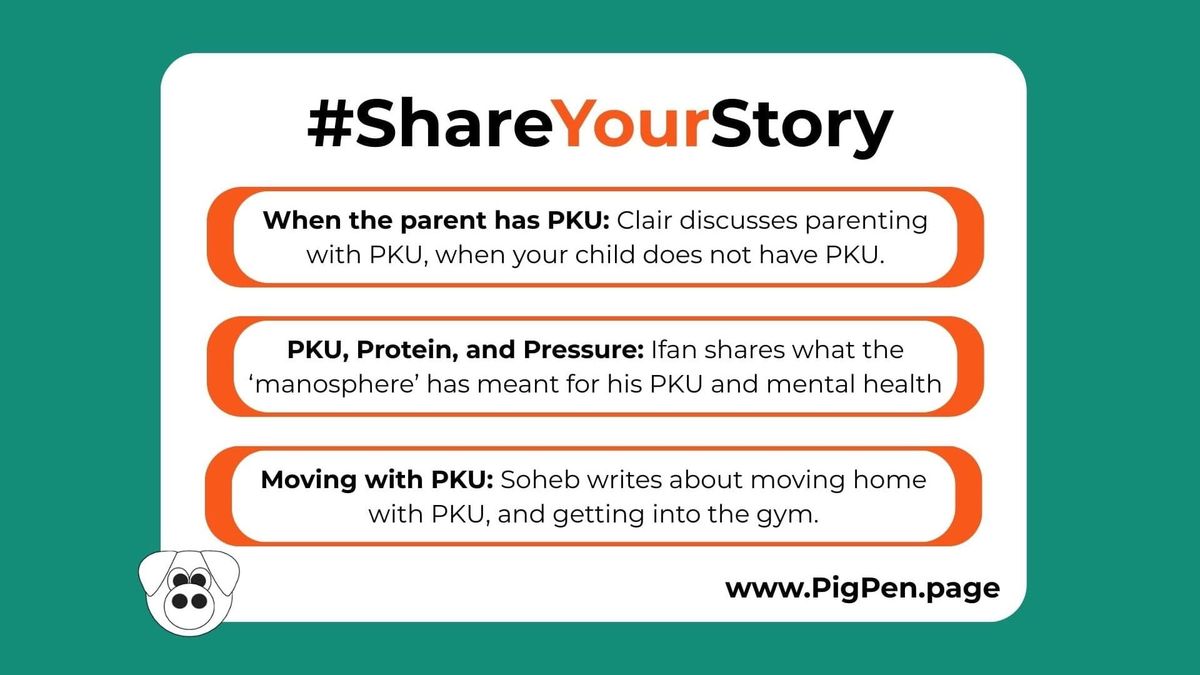](https://www.pigpen.page/share-your-story-2/)
## Join the community
Get early updates, recipes and your free gift.
Join us
Email sent! Check your inbox to complete your signup.
No spam. Unsubscribe anytime.
### Tips for PKU and non-PKU pasta
URL: https://www.pigpen.page/tips-for-pku-and-non-pku-pasta/
Last updated: 2026-05-15T07:05:41.000Z
Most people living with PKU will need to cater for both PKU and non-PKU eaters at the same time. This is certainly the case in our household, where many of our dishes are pasta-based. Below are a few tips for cooking both PKU and non-PKU pasta.
## Two pastas in one pot
If you have a ‘double broiler’ or pasta pot with steamer insert, you can cook both pastas at the same time and still keep them separate. This has proven to be a big winner in our household. It saves on time, stove space and washing up.
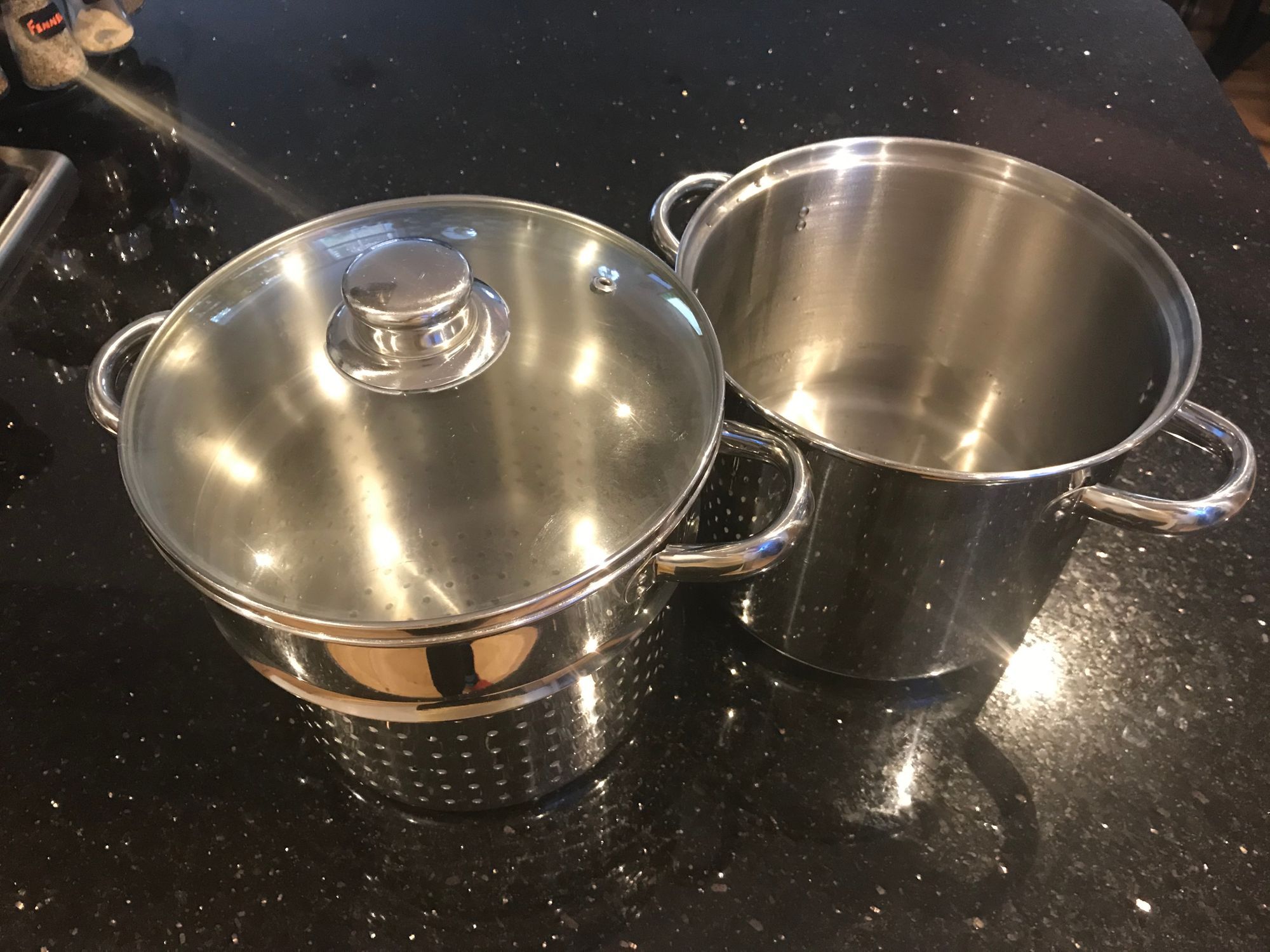
Our double broiler, or pasta pot.
We have found that it is easier to cook the PKU pasta in the top insert, and cook the non-PKU pasta in the bottom. It just sticks less this way. We also found that it is easier to have the empty insert in the pot while working out how much water to use.
You may need to experiment with your pots a bit, as you will want to ensure you have enough water to cover the pasta in the insert while cooking. We start with the insert in the pot and fill with water until the water level is up to about an inch above the bottom of the insert. Then we take the insert out and start heating the water on the stove. If you are unsure, err on the side of more water rather than less.
Buy me a cuppa ☕ — your support helps keep this blog free, and helps to me write about PKU, brain injury & mental health.
[Buy Pauline a cuppa ](https://donate.stripe.com/14keYi5dp9E26Oc9AA?ref=pigpen.page)
## Salt and oil
I once knew a Frenchman who insisted that pasta cooked without salt and oil was an abomination. I tried it, and can confirm that both PKU and non-PKU pasta benefit from being cooked in water which has had **lots** of salt added. We use about a tablespoon of salt in our big pot (photo above).
Yes, that both sounds and looks like a lot. But remember that when you drain the pasta most of the salt goes down the drain. Try it and I bet you find that it does make a difference to the flavour of the pasta.
Adding a drop of oil in the water will help to prevent the pasta from sticking. It really is just a drop of oil which is needed here. The oil will also reduce the bubbles in the pot, making for less boil over and less to clean up!
## A sauna in your kitchen
Bring your salted & lightly oiled water to the boil. Suzanne, the NSPKU dietician, recommends bringing the water to a rolling boil before adding pasta. She adds that:
> **“You are aiming for a sauna effect in your kitchen...lots of water boiling hard, lots of steam.”**
At that point, pour the one type of pasta into the bottom of the pot and give it a quick stir. Then, put in the insert, pour in the other pasta and stir again. We have found that both the Loprofin PKU pasta fusilli and the non-PKU equivalent cook in 12 minutes. It will take a bit of experimentation for your stove, but once you find your sweet spot remember to set a cooking timer. Taste carefully, and drain the pot when the pasta is firm and slightly chewy.
## Tips for cooking PKU pasta
1. Use plenty of water.
2. Add oil and salt.
3. Bring the water to a vigorous boil, get that sauna effect!
4. Set a timer.
If you liked this, why not try another time saver: my recipe for [making both PKU and non-PKU Lasagne in the same oven dish](https://www.pigpen.page/pku-and-non-pku-lasagne-in-the-same-dish/).
## Join the community
Get early updates, recipes and your free gift.
Join us
Email sent! Check your inbox to complete your signup.
No spam. Unsubscribe anytime.
### NSPKU England 2026 conference
URL: https://www.pigpen.page/nspku-england-2026-conference/
Last updated: 2026-04-30T19:35:41.000Z
This year the conference was held at the gorgeous Crewe Hotel and Spa, and I had a great time. Many thanks to all of those involved in creating a memorable conference.
There was so much chat and catching up that most of my notes were taken quickly. The following update is mostly photos taken on the day. I’ve organised them by talk and given comments needed. I hope you enjoy.
## Future treatments update
Professor Anita MacDonald gave her usual update on the status of sapropterin use and possible new treatments for NSPKU.
> As Anita said, “A minority of people have done well on Sapropterin (Kuvan), **but we need other options**.”
Much of this follows on her update from Wales six months ago, and I recommend reading that blog for full background.
[PKU research update, NSPKU Oct 2025, exciting new treatmentsInsights from Prof. MacDonald’s talk at NSPKU 2025 — Sepiapterin, JNT-517, and more — and what they might mean for adults living with PKU.PigPen | Pauline O'ConnorPauline](https://www.pigpen.page/whats-in-the-treatment-pipeline/)
There was still a way to go on registering other new treatments for PKU in the UK. This has been slowed by the UK’s exit from the EU.
#### Sepiapterin
Sepiapterin (Sephience) is similar to sapropterin, but has a greater success rate. See more here:
[PKU future treatments update. Sepiapterin, mRNA, gene therapyThe NSPKU conference held from 17-19 May 2024 included an update on possible new treatments for PKU. These are my notes from the sessions on sepiapterin, mRNA, gene therapy, solute carrier 6, and options for PegPal.PigPen | Pauline O'ConnorPauline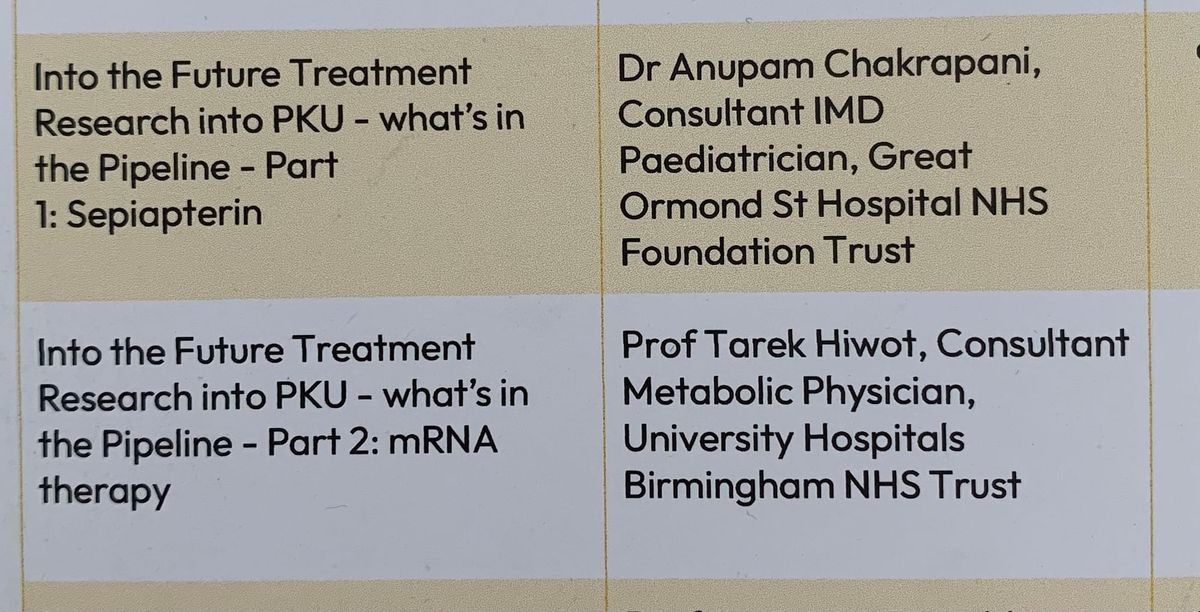](https://www.pigpen.page/pku-future-treatment-update/)
It has been approved for use in the EU, but the UK requires a separate licence and approval now. We understand the company will be applying for licence at uk end of 2026, approval may intake several years.
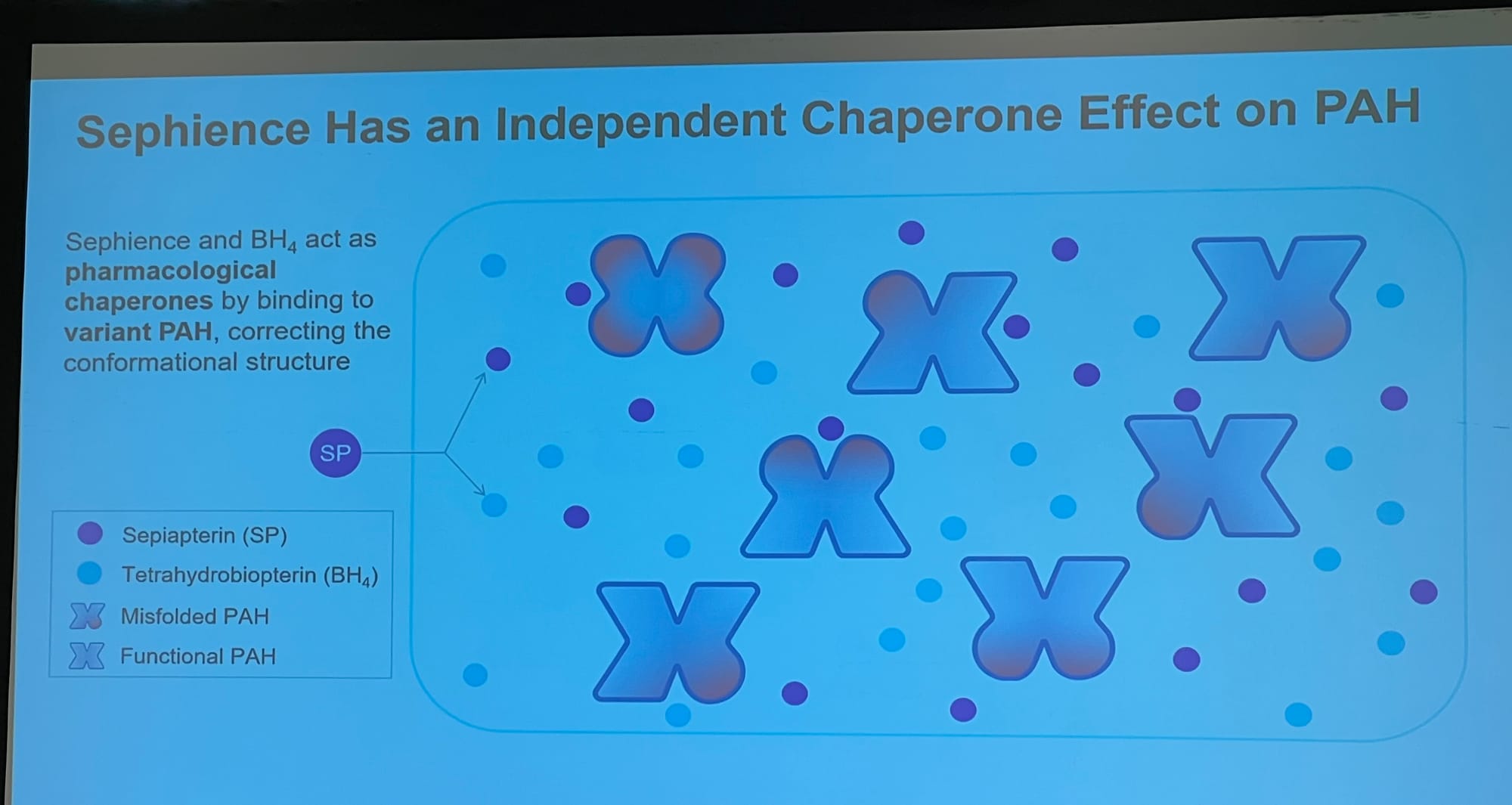
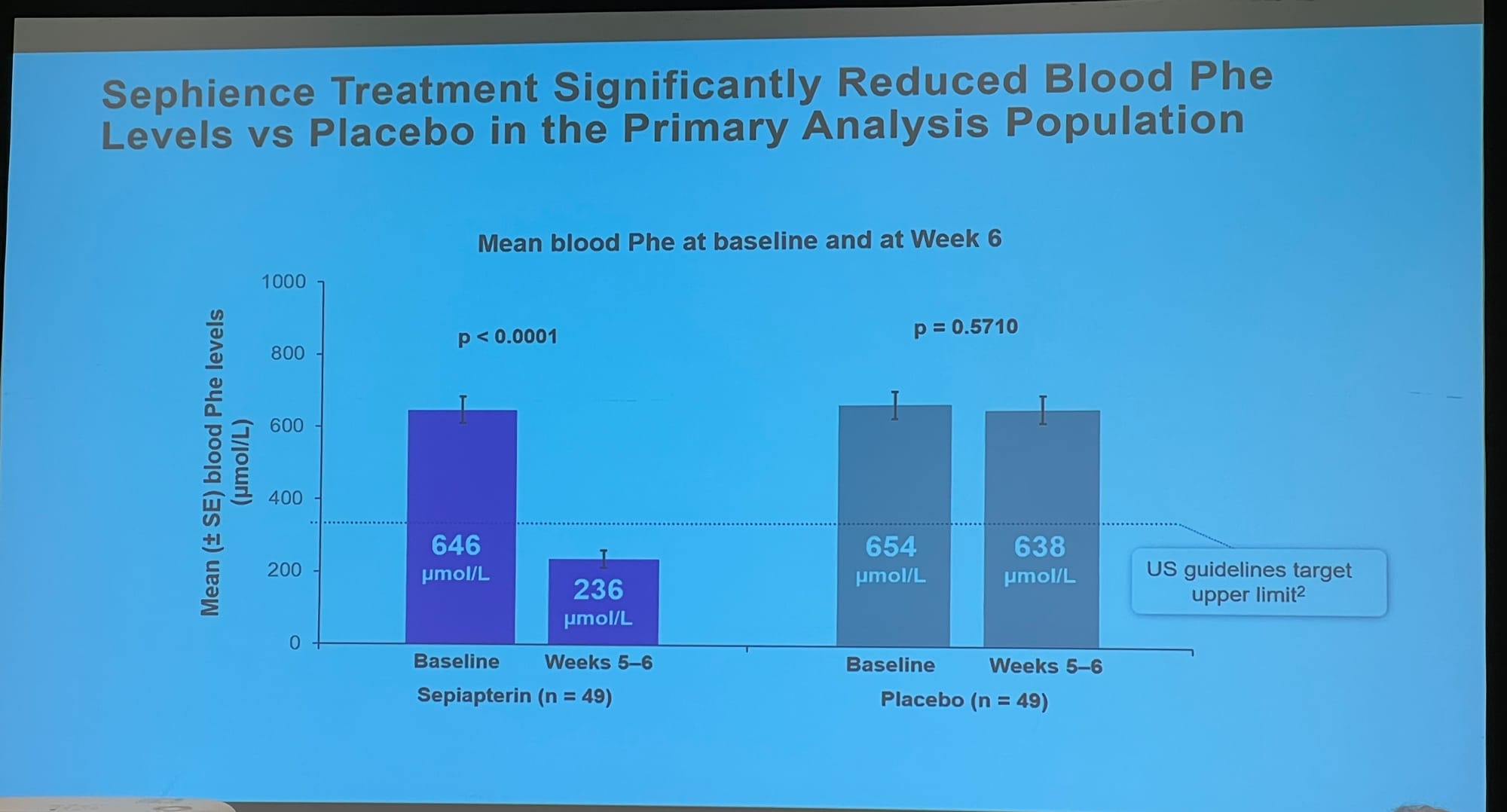
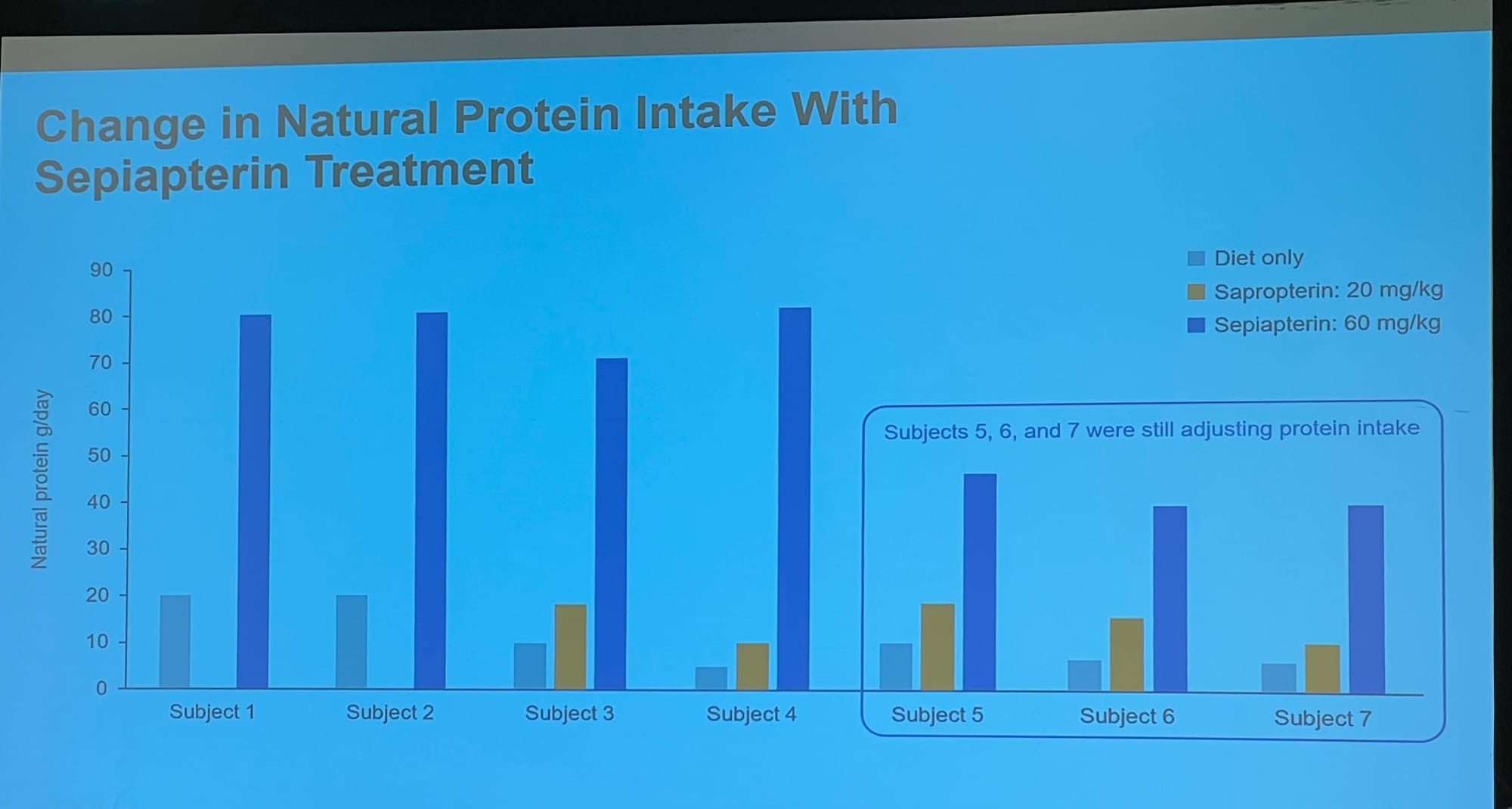
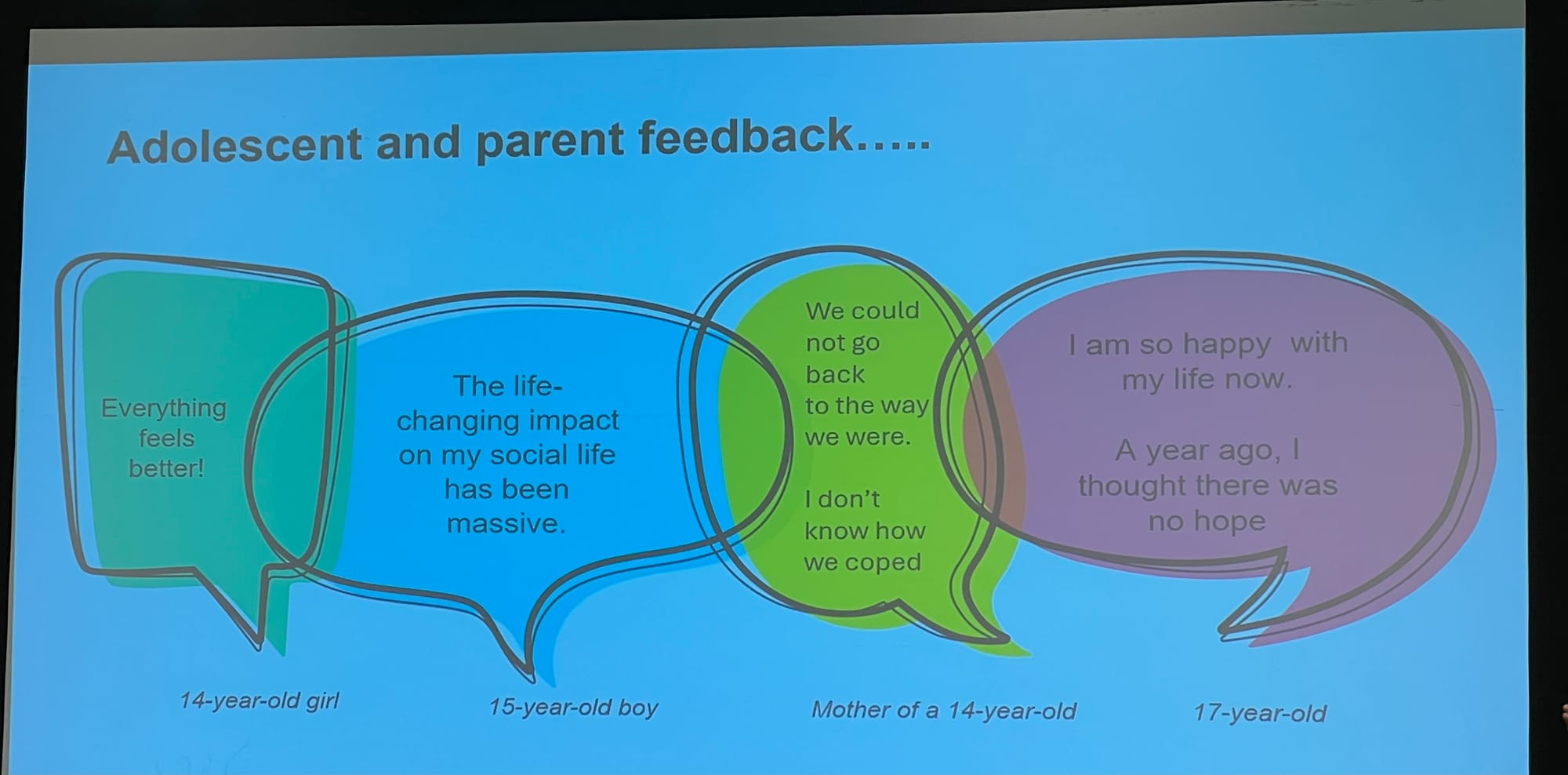
Slides showing: 1: how Sephience works by helping reshape our misshapen enzyme; 2: the reduction in blood phe in a recent trial; 3: the change in protein allowance; 4: Personal feedback on the effects of the treatment.
#### Kidney treatment options
Both options for possible kidney days treatments are still going through their trials.
**JNT-517 (Repinatrabit)**
Otsuka are putting JNT-517 through the final trials before going for a licence. Results still a year away at best.
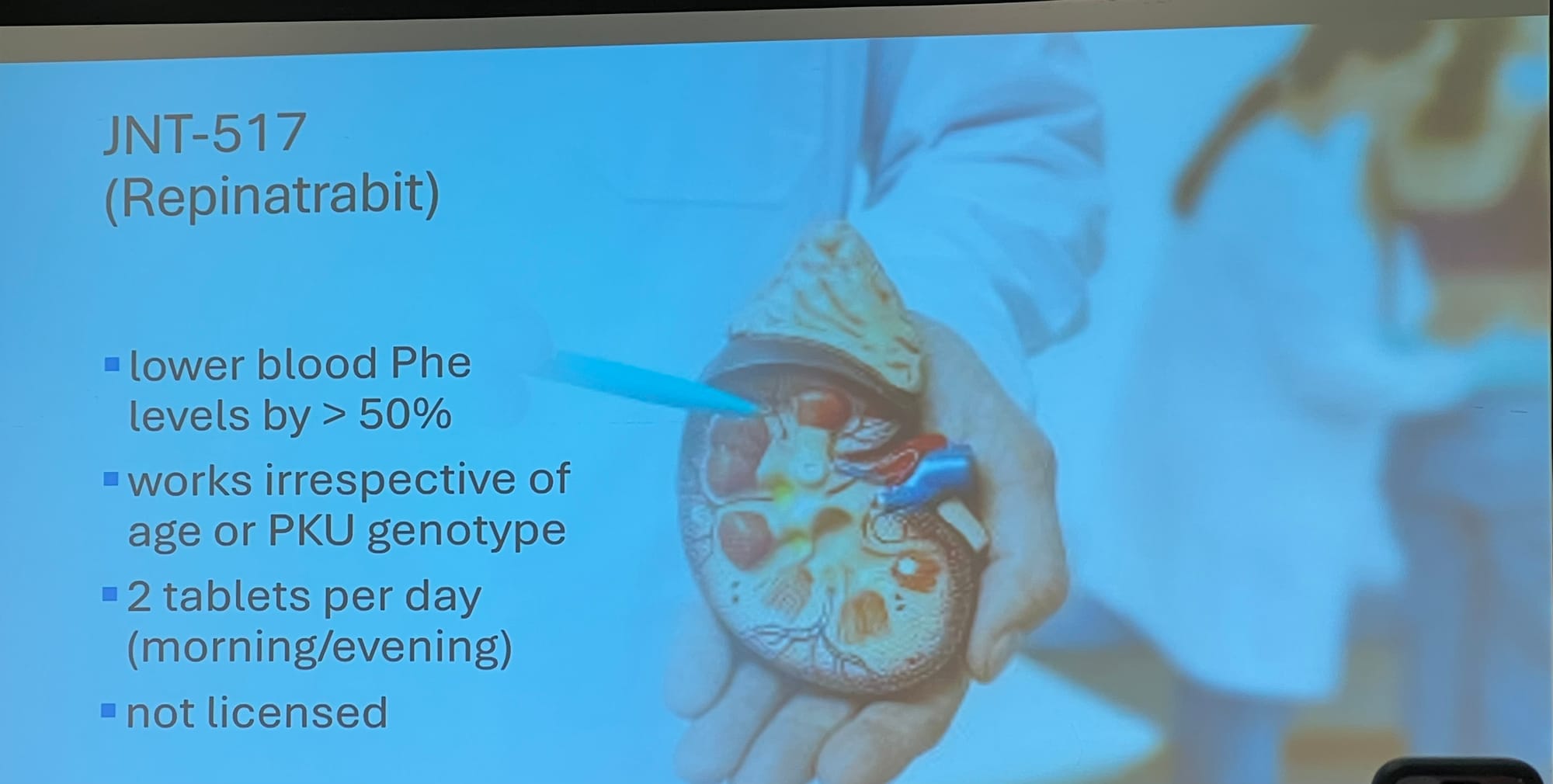
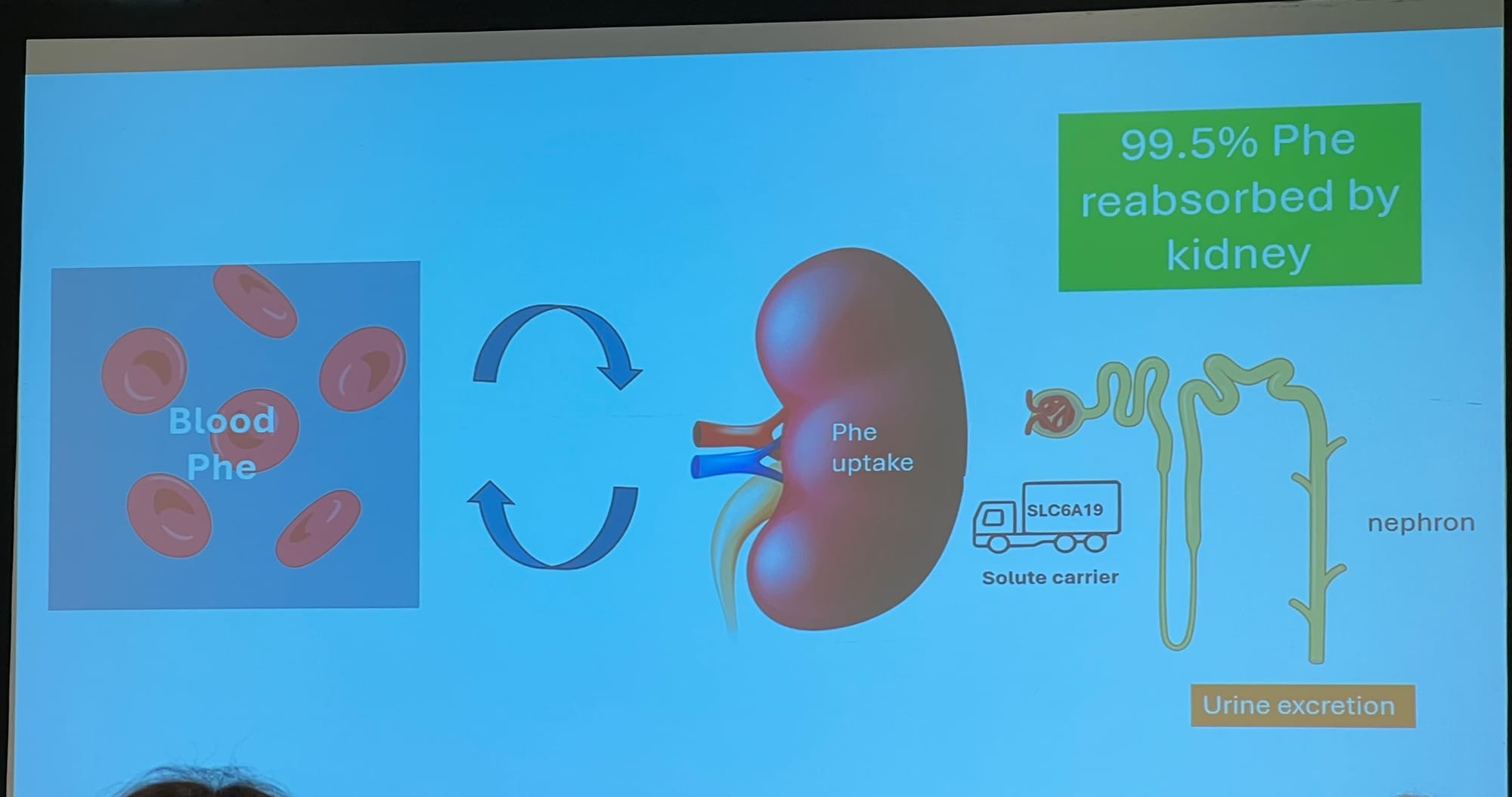
Slides detailing: 1: current knowledge on JNT-517, and 2: how JNT-517 works.
**MZE782**
Maze Therapeutics going to trial their kidney treatment option in UK soon. As this hasn’t started, we are unlikely to see anything about availability for several years.
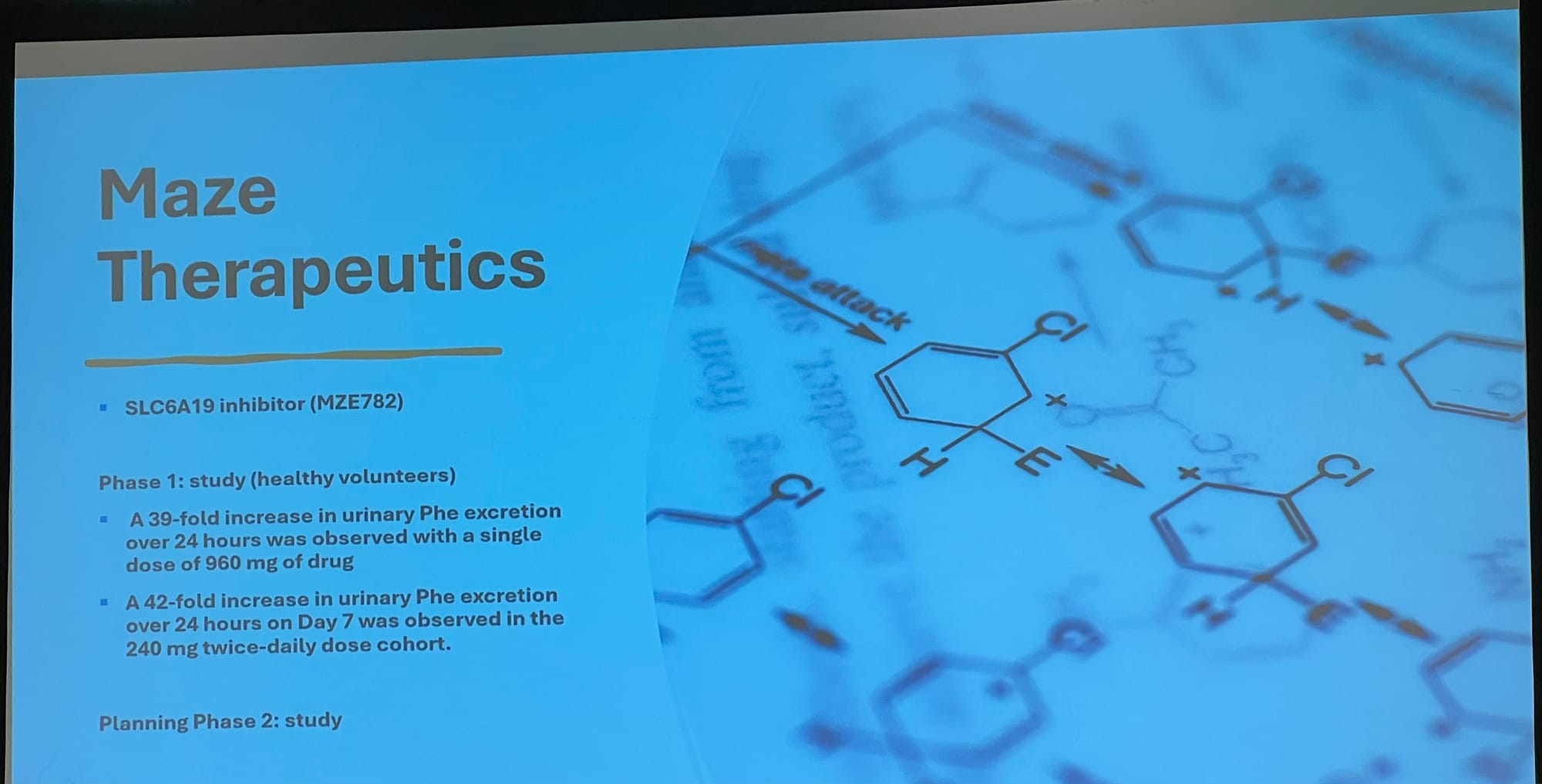
Slide on Maze Therapeutics drug option.
## Home Blood phe monitoring
There was an update by Dr Pinto on the trials of the Egoo machine. This is a device, referred to in the slides at POCT, which allows for a result at home in 30 minutes. For obvious reasons, it has long been desired by the PKU community.
Dr Pinto and team ran trials in homes to compare the real-world use of the device against traditional monitoring. At present, we take dried blood spots (DBS) which are posted to the clinics for analysis.
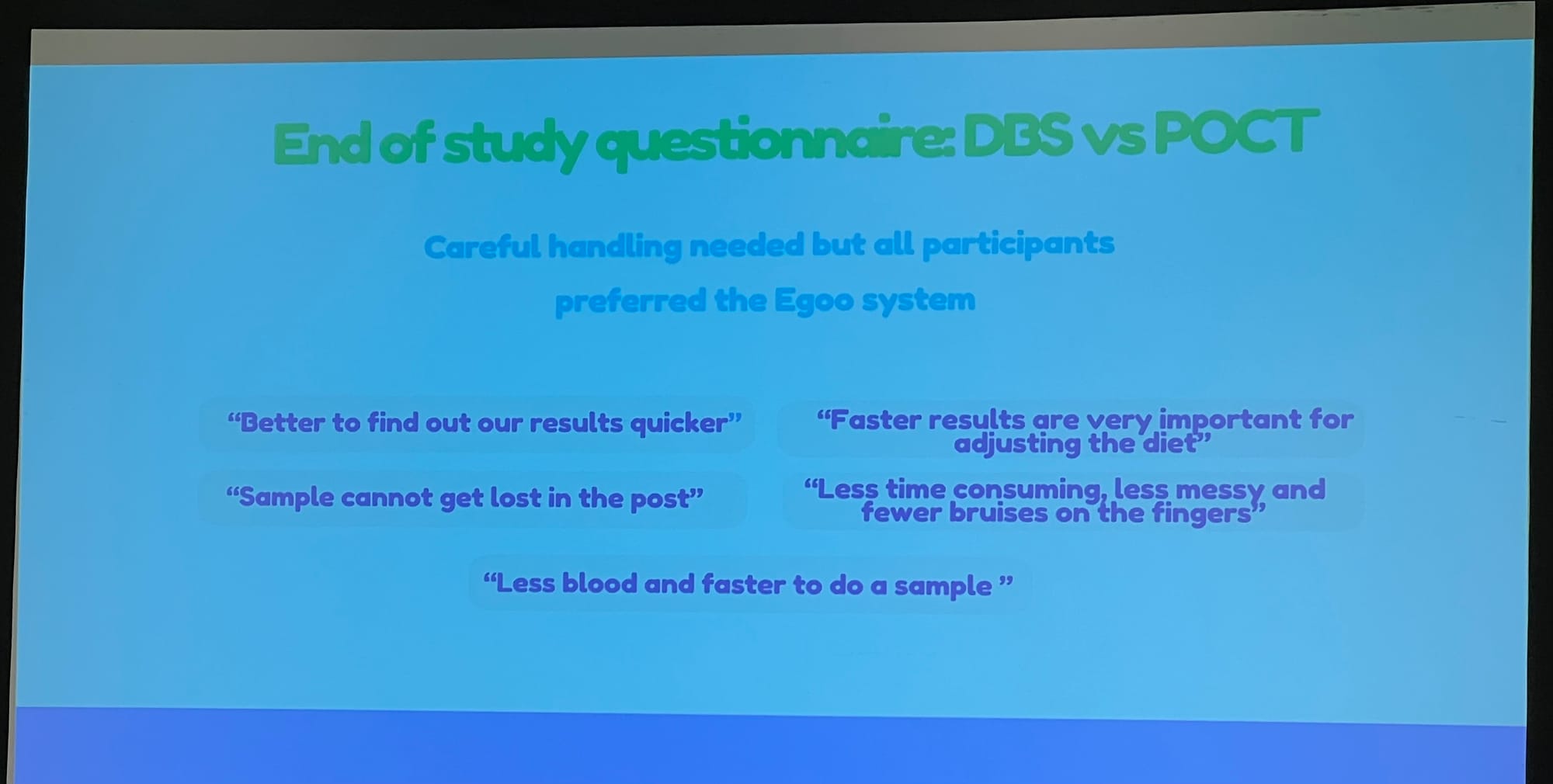
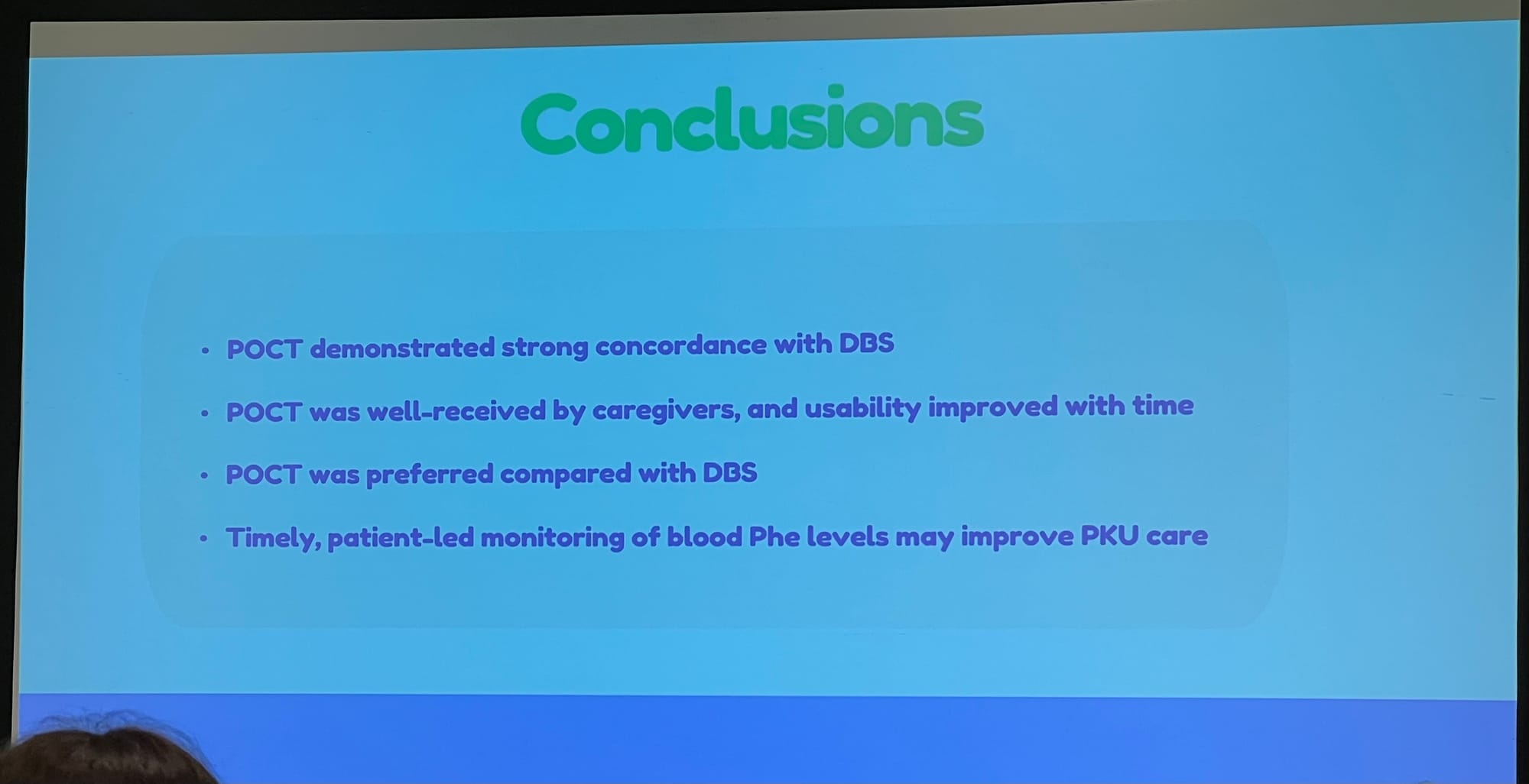
Slides showing: 1: Family feedback from the trail, and 2: Conclusions from using the Egoo (POCT) machine vs current testing (DBS).
These results are encouraging, but there is still a long way to go before the machine is approved in the UK, or by the NHS. **Do note:** the last time I checked (early 2026) this machine was not available to buy privately in the UK either.
Buy me a cuppa ☕ — your support helps keep this blog free, and helps to me write about PKU, brain injury & mental health.
[Buy Pauline a cuppa ](https://donate.stripe.com/14keYi5dp9E26Oc9AA?ref=pigpen.page)
### Psychology update, Megan Staines
Megan Staines gave an update on her research into PKU and Neuropsychology.
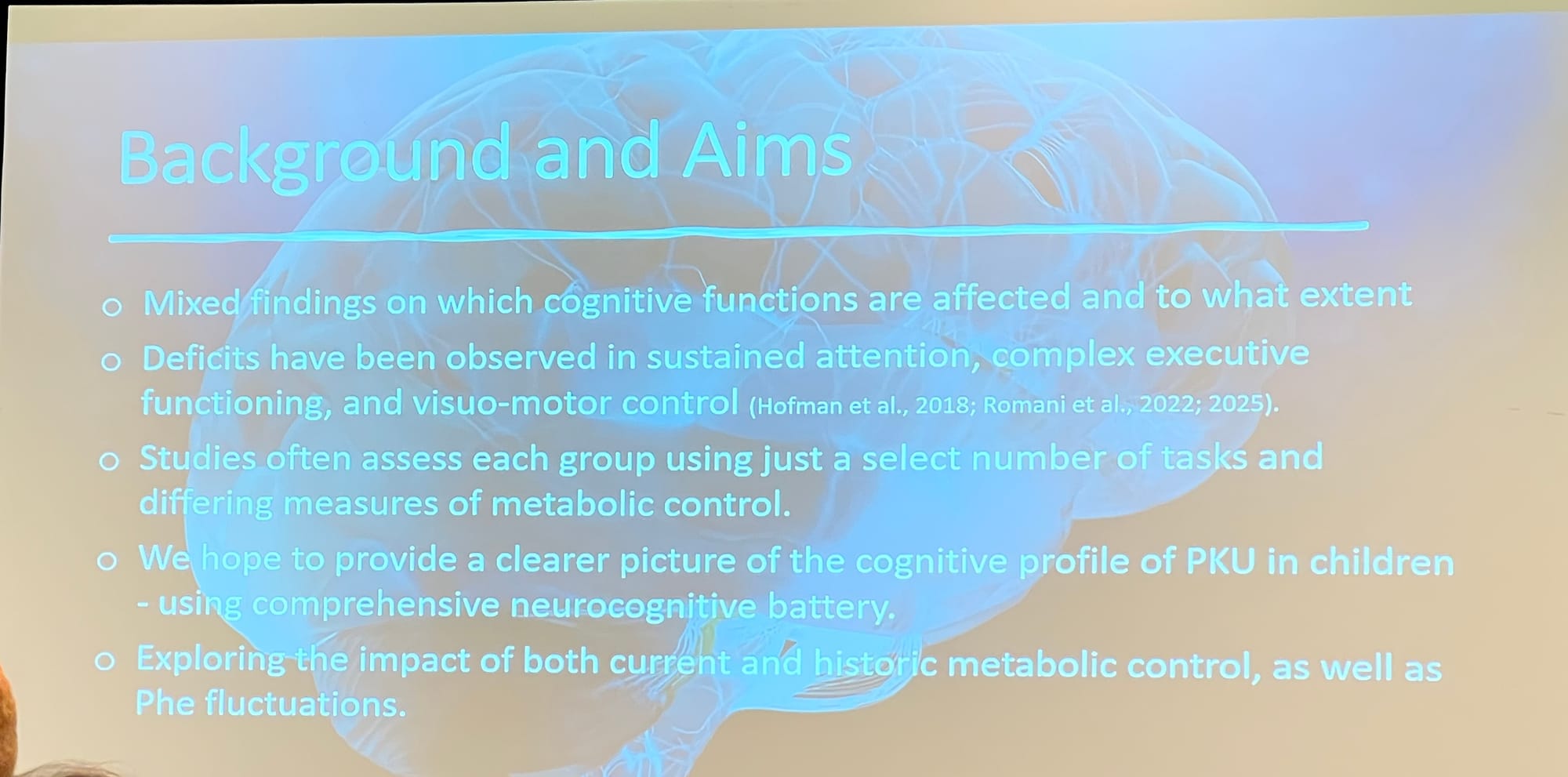
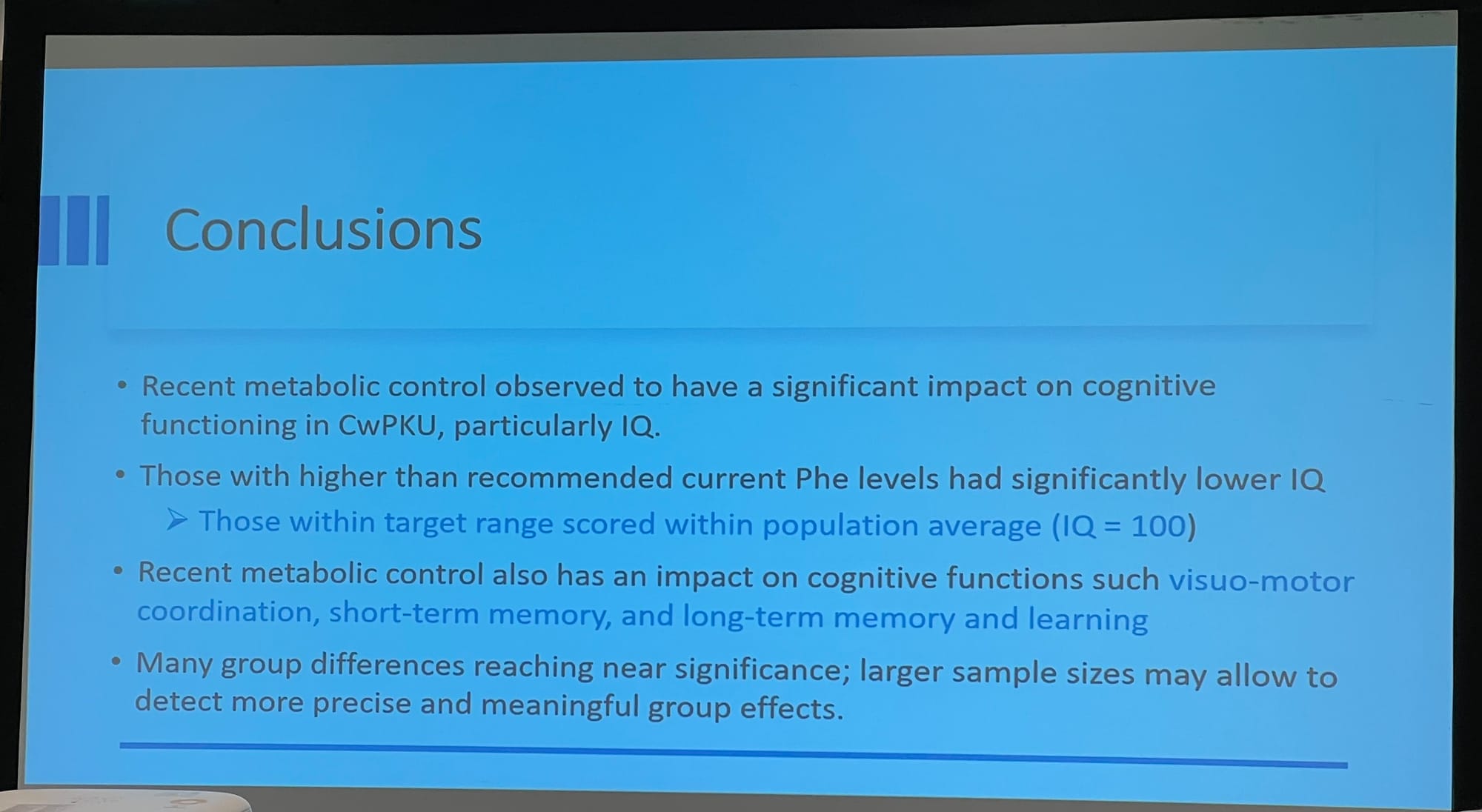
Slide 1: Background & aims for the study, and 2: conclusions.
### PKU, Exercise, & quality of life
Annie Skidmore gave a much anticipated update on her research into PKU and Exercise.
**Stop Press: Annie is running the London Marathon this weekend! (26 April 2026)**
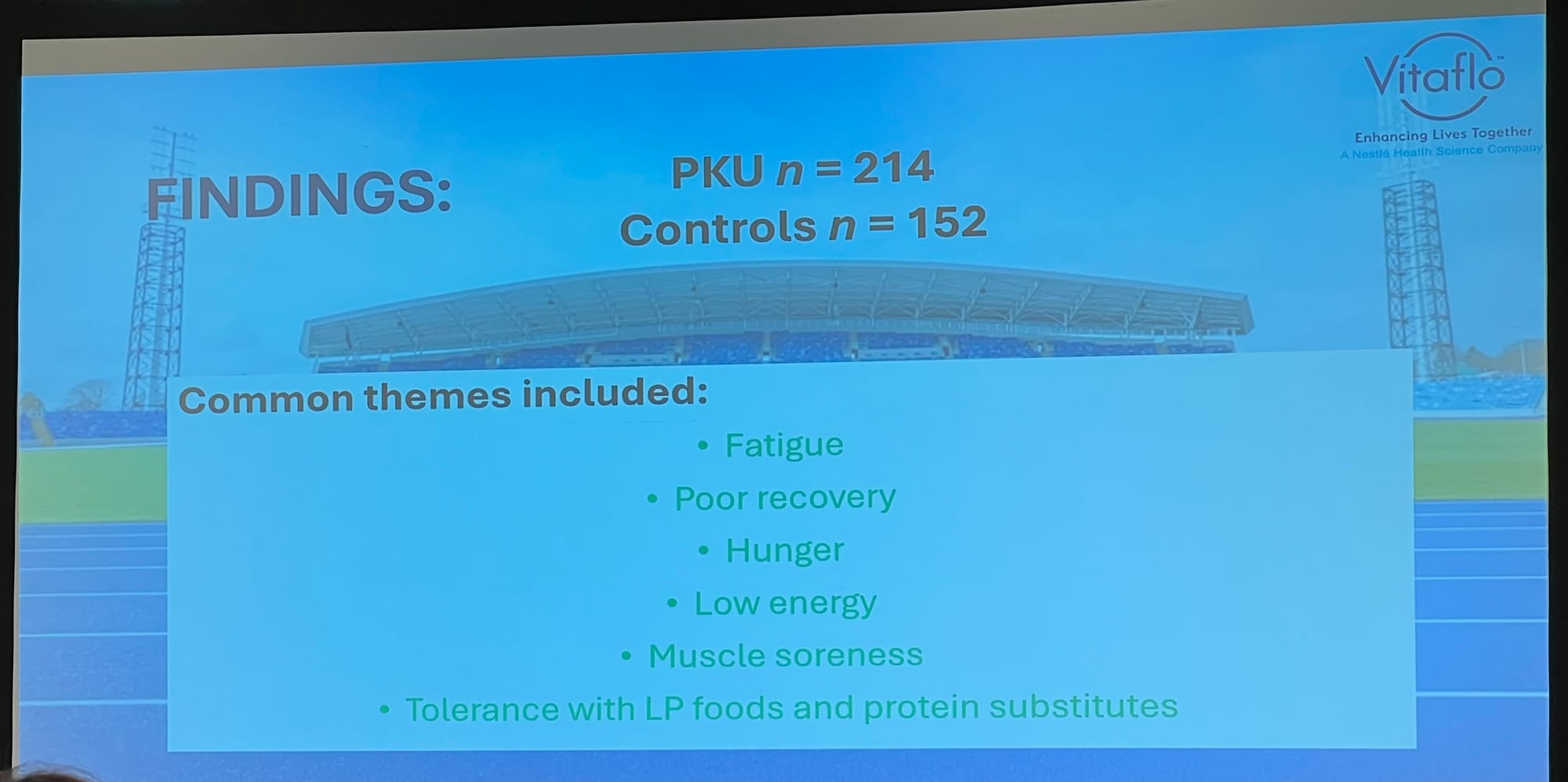
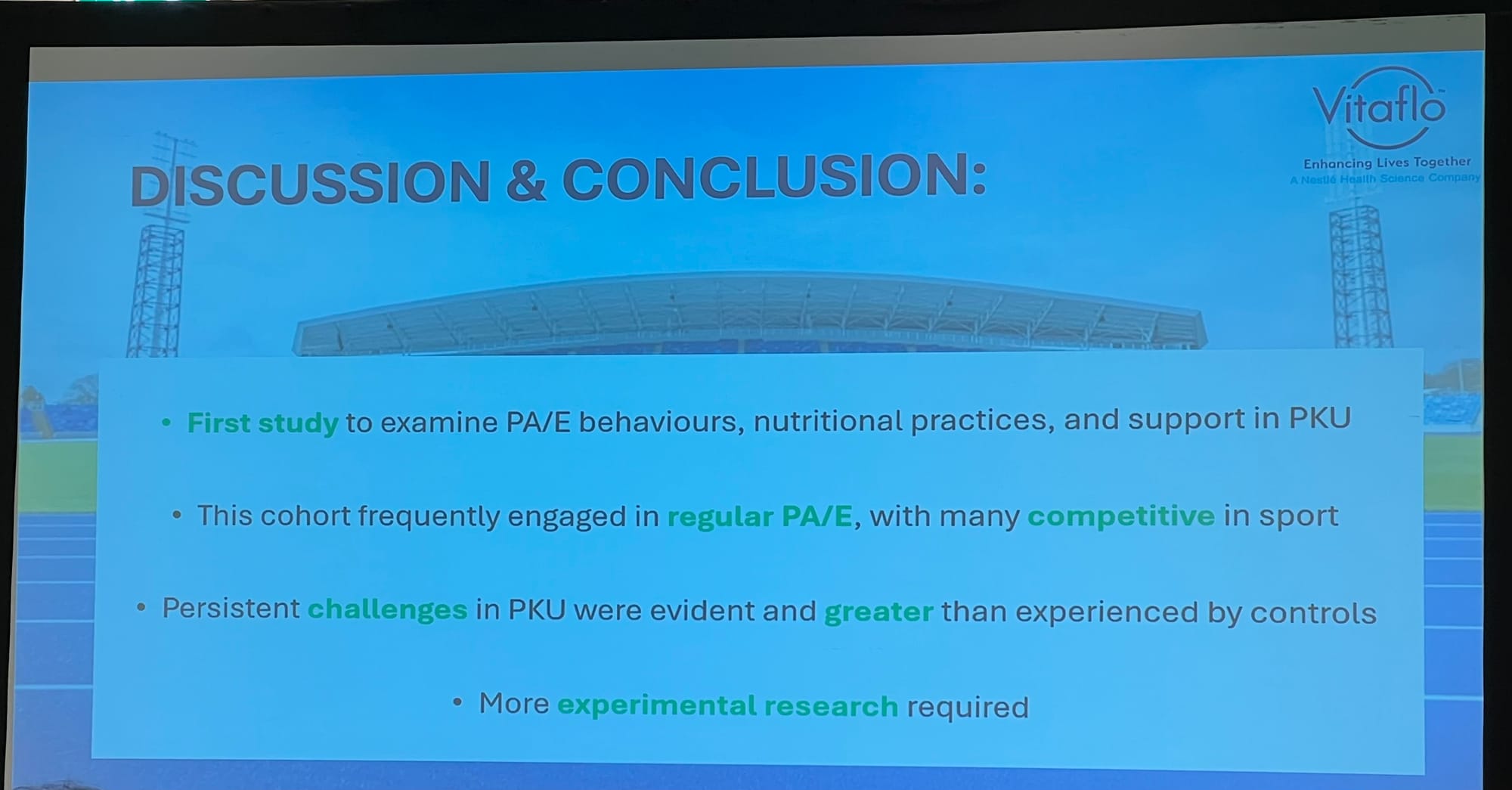
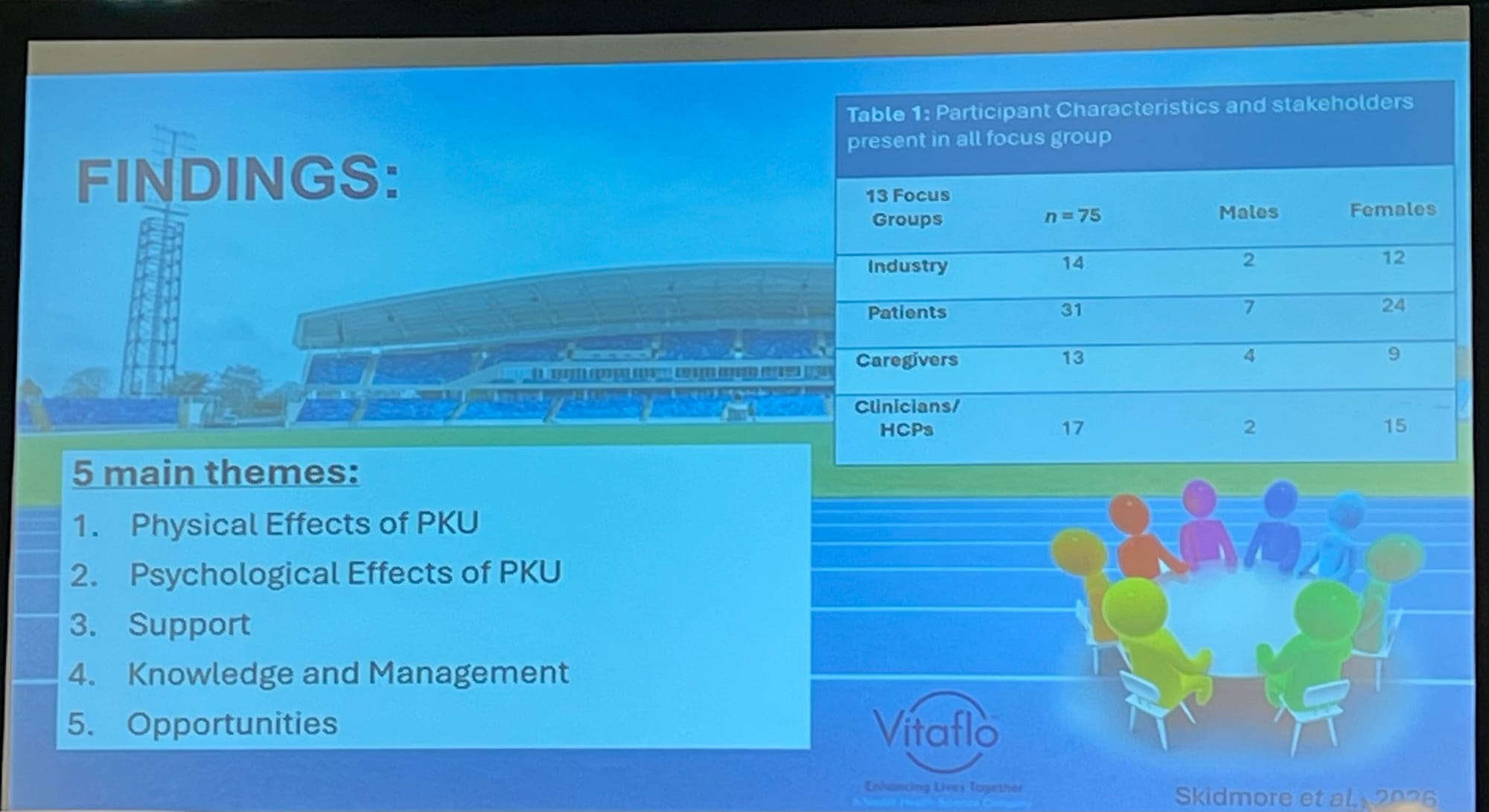
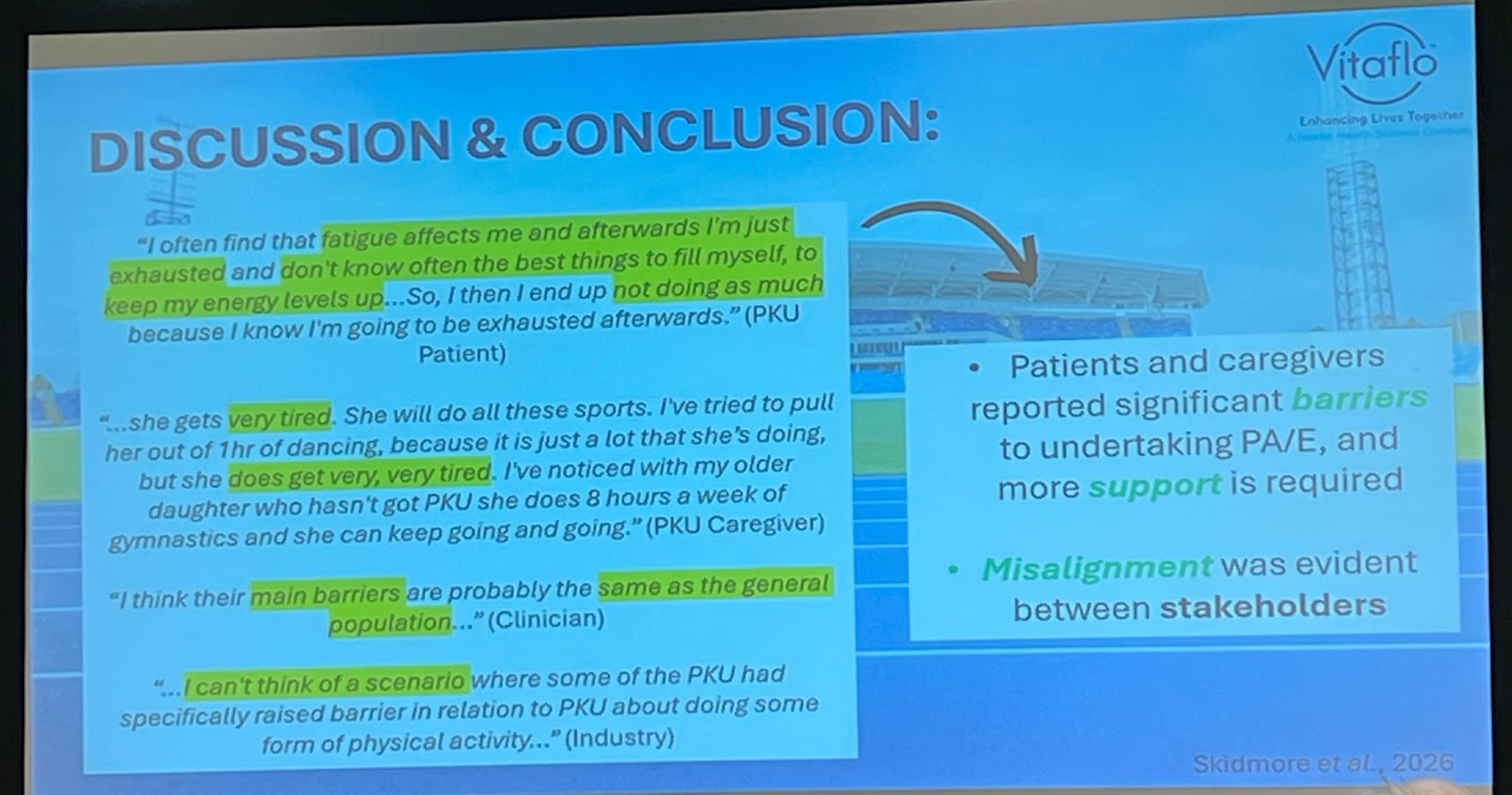
Slides on Annie Skidmores work into PKU and Physical Activity & Exercise (PA/E).
Annie’s most startling finding so far was that many with PKU reported significant barriers to Physical activity and needed support.
> However, most people in a position to provide that support **did not see the barriers, and missed the opportunity to provide support**.
### PKU and the gut microbiome
Catarina Rodrigues gave a presentation on her planned research into PKU & poo—to the giggles of the young (and not so young) in the audience.
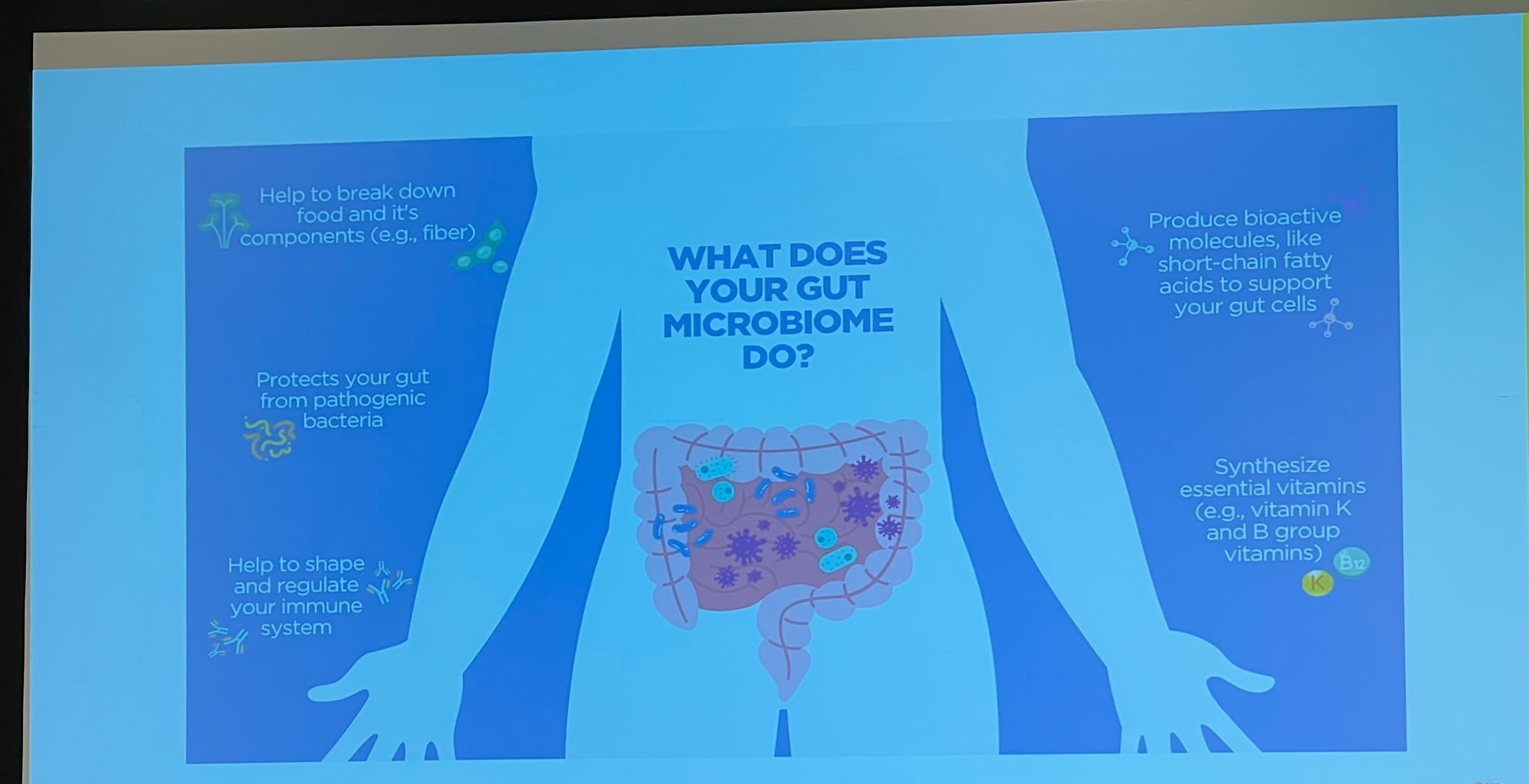
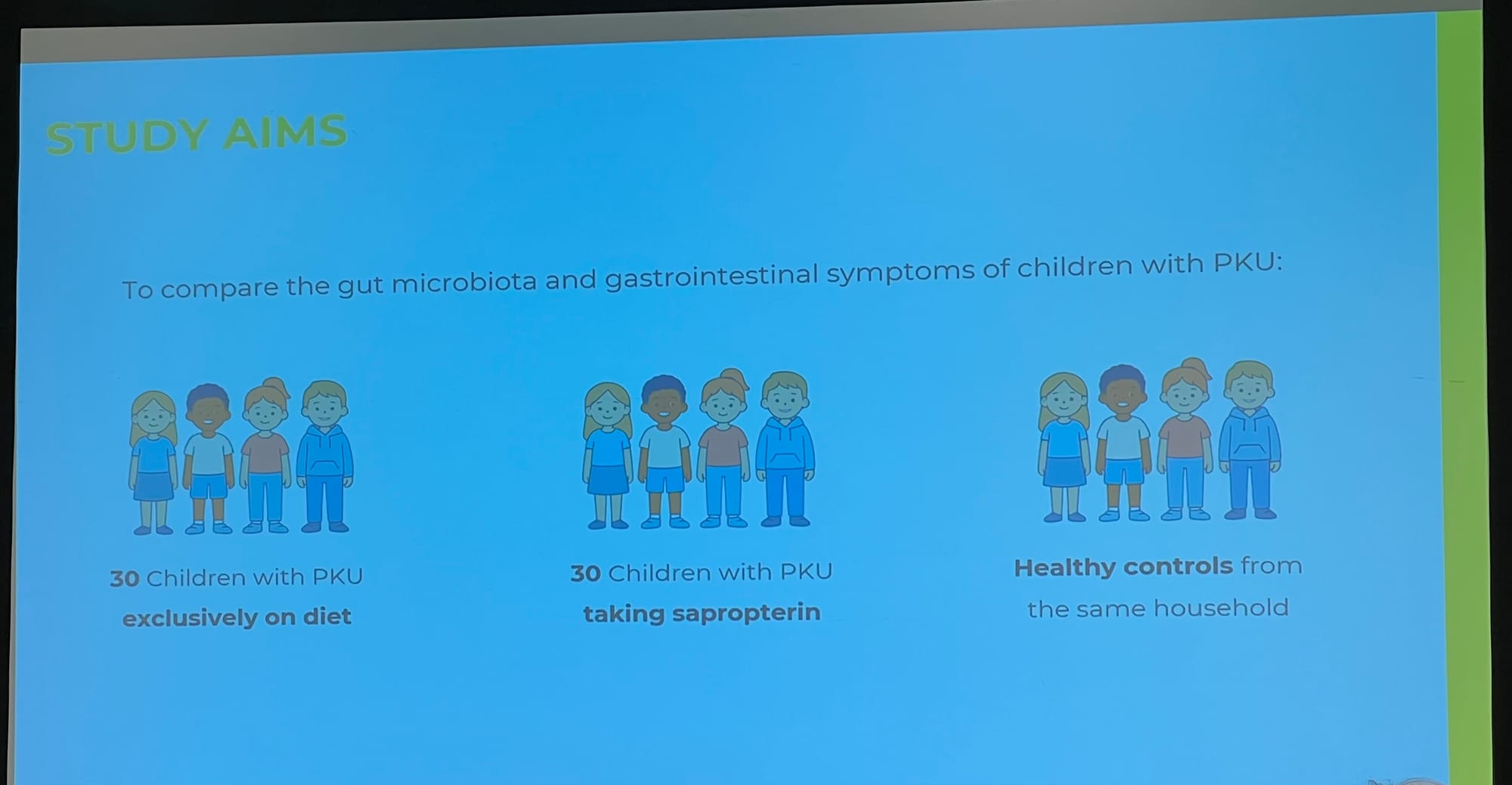
Slides 1: Detail on the importance of the gut microbiome, and 2: the scope of the study.
## Please help with updates
This was such a busy conferece that I missed some sections. If you are willing to help fill in those gaps then please get in touch!
## Join the community
Get early updates, recipes and your free gift.
Join us
Email sent! Check your inbox to complete your signup.
No spam. Unsubscribe anytime.
### April 2026 news
URL: https://www.pigpen.page/april-2026/
Last updated: 2026-04-22T09:13:36.000Z
## PKU news
### NSPKU Food lists 2026
The NSPKU have plenty of resources for those of us with PKU, including [downloadable photo books of UK foods](https://nspku.org/documents/?wpdmc=dietary-info&ref=pigpen.page), with protein amounts. These include school lunch box and snack ideas, along with themed books on seasonal treats or specific cuisines.
### PKU in Canada, no longer forgotten
Tristin at PKU Notebook reports on “[two announcements that]([https://www.phenylcetonurie.ca/p/deux-nouvelles-qui-donnent-de-lespoir?utm%5C%5Fsource=substack&publication%5C%5Fid=3096512&post%5C%5Fid=190448853&utm%5C%5Fmedium=email&utm%5C%5Fcontent=share&utm%5C%5Fcampaign=email-share&triggerShare=true&isFreemail=true&r=464qfe&triedRedirect=true]%28https://www.phenylcetonurie.ca/p/deux-nouvelles-qui-donnent-de-lespoir?utm%5Fsource=substack&publication%5Fid=3096512&post%5Fid=190448853&utm%5Fmedium=email&utm%5Fcontent=share&utm%5Fcampaign=email-share&triggerShare=true&isFreemail=true&r=464qfe&triedRedirect=true%29), taken together, send a clear message: phenylketonuria is no longer a forgotten disease.”
### PKU conferences reminder
The NSPKU conference in mid-April is a sell-out.
> *I’ll be co-hosting the PKU Adult workshop with Paul McKeller, *please join us* for the 10am session!*
Their next meeting will be in Northern Ireland, date not announced yet.Other conference dates:
- **NPKUA conference in Chicago**. The NPKUA’s community conference will run from Thursday, July 16 through Sunday, July 19 in Chicago. Find out more at: [NPKUA Conference](https://www.npkua.org/community-conference/?ref=pigpen.page).
- **ESPKU conference in Copenhagen**. The 40th [E.S.PKU Conference](https://www.espku.org/conferences/e-s-pku-conference-2026/?ref=pigpen.page) #ESPKUConference2026 will take place in Copenhagen, Denmark 🇩🇰 from 22 to 25 October 2026! Booking not yet open, I’ll report when it is available.
Buy me a cuppa ☕ — your support helps keep this blog free, and helps to me write about PKU, brain injury & mental health.
[Buy Pauline a cuppa ](https://donate.stripe.com/14keYi5dp9E26Oc9AA?ref=pigpen.page)
## Brain news
### Seek help early on for brain injuries
I include this article because my long recovery after brain shows how important it is to get help early. Fellow brain injury survivor and local Headway manager Jamie Higgins discusses [how and where to find help](https://nrtimes.co.uk/brain-injury-survivors-urged-to-seek-support-earlier-to-improve-outcomes/?ref=pigpen.page).
### UK looks back at Covid
The COVID-19 Inquiry published its third report on Covid, which looked at the impact that the pandemic had on healthcare systems, patients, and healthcare workers. It is a difficult read and noted that Many patients felt lost, confused and isolated. [Find the report here.](https://patients-association.us5.list-manage.com/track/click?u=9dd6577cf3f36af3c2f6682ed&id=f3ce4860db&e=6cfd4af3cf&ref=pigpen.page)
### Headway survey for Brain Injury week
Headway’s Action for Brain Injury Week (ABI Week) will take place 18–24 May 2026\. This year, they are looking at Isolation after brain injury. There is time to feed into this campaign by [completing their surveys](https://www.headway.org.uk/news-and-campaigns/action-for-brain-injury/help-shape-action-for-brain-injury-week-2026/?ref=pigpen.page).
## PigPen news & recipes
March was a busy time off-line for me, as I delved into my next writing project: a fiction trilogy! Any lovers of ***Gothic sci-fi*** out there, get in touch. 🙏
Meanwhile, over on the blog I shared my thoughts on [navigating change, chronic illness, and daily energy limits](https://www.pigpen.page/change-ambiguous-loss-and-spoons/). And, I’ve been enjoying PKU cheese scones in the spring sunshine ☀️.
[PKU Cheese Scone recipe. LowProtein, Phenylketonuria, easy bakingTasty, fluffy, protein-free cheese scone recipe - with pictures and baking tips for people on Low Protein diets like PKU, Phenylketonuria.PigPen | Pauline O'ConnorPauline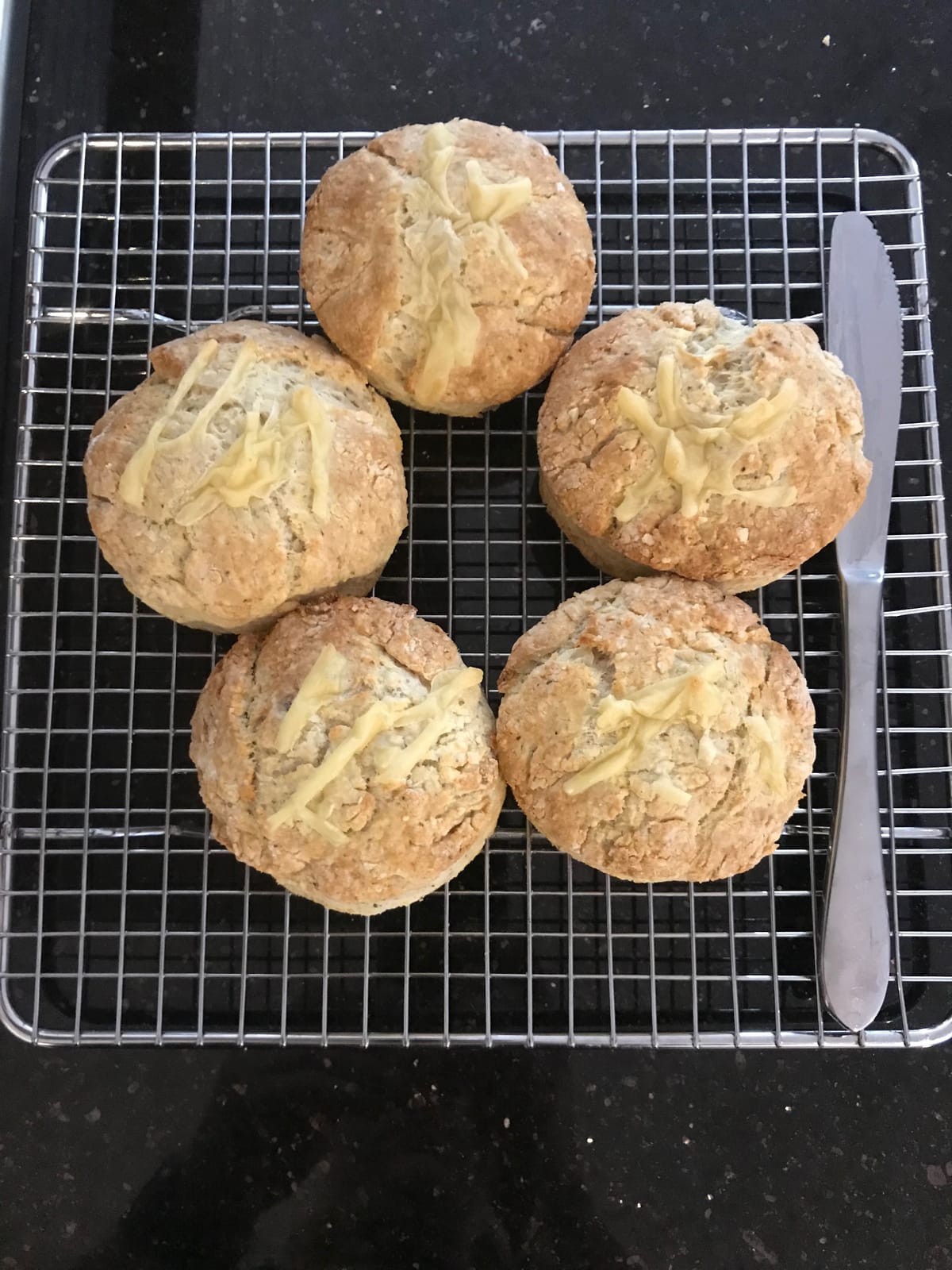](https://www.pigpen.page/cheese-scones-and-tips/)
## Spread the word
If you find value in my newsletters, please share them. You can [find my books](https://bookshelf.start.page/?ref=pigpen.page) at all major retailers. Your support means a lot, and your feedback shapes what comes next. Do get in touch.
Cheers,
Pauline
Newsletter #47
### Welcome, start here!
URL: https://www.pigpen.page/start-here/
Last updated: 2026-04-23T13:39:56.000Z
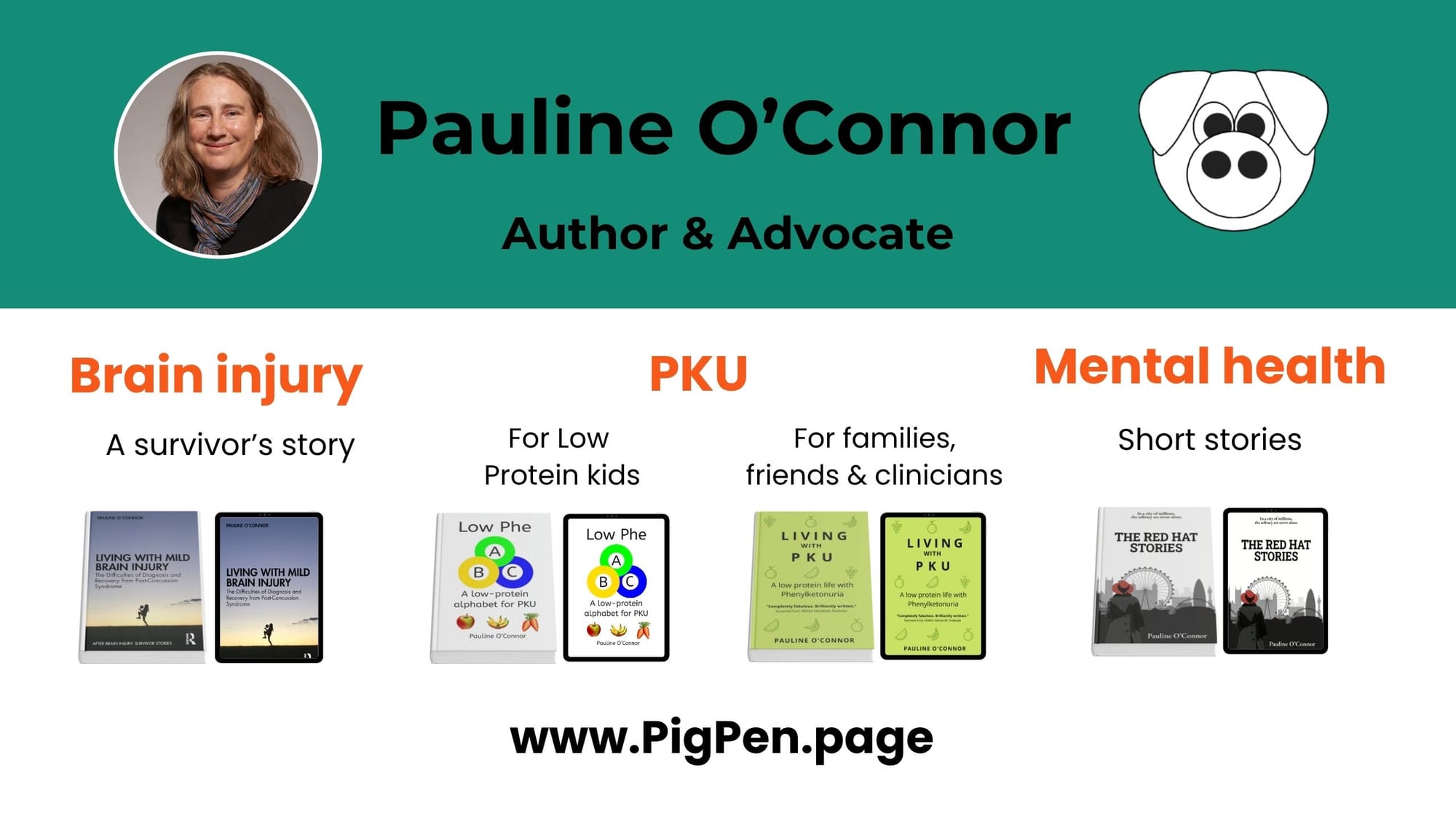
Hullo there. I’m [Pauline O'Connor](https://www.pigpen.page/about-me/), an author and advocate who believes that clarity, compassion, and collaboration make complex conditions easier to live with.
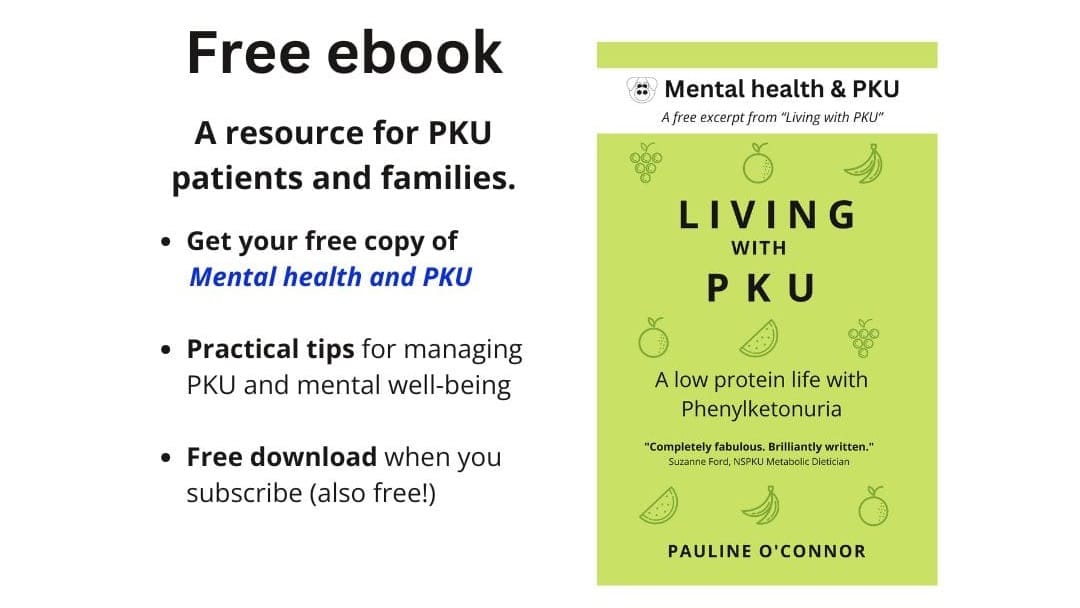
### [**Join the community**](https://www.pigpen.page/#/portal/signup) **for early updates and your free guides**
- 🎁 **Instant access to two free downloads**
• *Mental Health & PKU* — meaningful insight and practical strategies
• *Low Phe Colouring Book* — a fun, printable resource to empower kids with PKU
- 🍲 **PKU-friendly recipes and tips** straight to your inbox
- 🤝 **Community stories and lived experience** you won’t find elsewhere
- 📰 **Practical email updates — never spam, unsubscribe anytime**
## Join the community
Get early updates, recipes and your free gift.
Join us
Email sent! Check your inbox to complete your signup.
No spam. Unsubscribe anytime.
### Explore articles & recipes
Use the [powerful search function](https://www.pigpen.page/) on the home page to find a handy recipe for a one-dish PKU and non-PKU lasagna. (Just type 'lasagna' in the search box.) Or look for articles on mental health.
### Join the conversation:
Sharing your experiences on one of the blogs below.
- Try the [one-dish PKU and non-PKU lasagna](https://www.pigpen.page/pku-and-non-pku-lasagne-in-the-same-dish/) recipe—perfect for shared meals.
- Discover strategies for [managing fatigue after brain injury](https://www.pigpen.page/fatigue-after-abi-boom-and-bust/).
- Find a way out of low mood and [support your mental health](https://www.pigpen.page/follow-a-plan-not-a-feeling-finding-a-way-out-of-low-mood/).
[](https://www.pigpen.page/hello/)
### [Explore my books](https://www.pigpen.page/books/) or [invite me to speak](https://www.pigpen.page/speaking/)
I have books on **PKU, mental health, brain injury**, and **fiction** works. I also regularly presents at national patient conferences and community groups like the NSPKU, patient conferences, and the Women's Institute.
[Find my books](https://bookshelf.start.page/?ref=pigpen.page)
> **If you are looking for a motivational speaker, please** [**contact me**](https://www.pigpen.page/contact/) **with your requirements**.
If you find value in my books, website, or newsletters, please tell a friend. Your support means everything!
**Finally, I’d love to hear from you. Your comments and feedback help shape what comes next, so don’t hesitate to reach out.**
If you enjoy the books, website, or newsletters, please tell a friend. If you have any comments or feedback, [please tell me](https://www.pigpen.page/contact/)
Cheers,
Pauline.
### Share Your Story
URL: https://www.pigpen.page/share-your-story-2/
Last updated: 2026-03-02T16:57:01.000Z
For Rare disease day 2026, people with PKU are sharing their story on PigPen.
### Clair's Story: Caring for a Child Without Phenylketonuria
Clair discusses parenting with PKU, when your child does not have PKU - and the interesting challenges she has faced.
[Parenting with PKU: Raising a child who doesn’t have PhenylketonuriaThe day my baby was born, as well as all the emotions that I felt on finally getting to meet my baby girl, I was so relieved that I had done it. All that hard work I put into my diet for over 2 years had been worth it, she was perfect!PigPen | Pauline O'ConnorPauline](https://www.pigpen.page/when-the-parent-has-pku/)
### Ifan’s Story: Masculinity and the Weight of Expectation
Ifan shares his experience navigating the manosphere, and what that meant for his PKU and mental health.
[PKU, Protein, mental health: Navigating Masculinity’s PressureI’ve never struggled too much with my diet... What has affected me is the mental state the diet puts me in. The constant weighing and measure of every option before me. The anxiety of it.PigPen | Pauline O'ConnorPauline](https://www.pigpen.page/pku-protein-and-pressure/)
### Soheb’s Stories: Moving with PKU, and getting back to the gym
Soheb wrote a series of blogs for PigPen - looking at moving home with PKU, and getting into the gym.
[Moving out can be intimidating, more so if you have PKU. Help is at handMoving out can be pretty intimidating in itself, but when you have PKU, it can feel incredibly intimidating...If you are consideing moving out into a new place, there are a few things you will need to think about carefully.PigPen | Pauline O'ConnorPauline](https://www.pigpen.page/inaugural-guest-post-moving-with-pku/)
## An invitation to Share Your PKU Story on PigPen.page
I believe that every story matters. If you live with PKU or care for someone who does, your voice can help others feel seen, supported, and inspired.
### Why your story matters
Every story adds to our shared understanding of PKU. By contributing, you’ll help others feel less alone and show that PKU life can be full, varied, and hopeful.
### You don’t have to be a writer.
I’d love to read your honest voice and real experience. Stories might cover diagnosis, food, travel, family life, clinics, school…Whatever part of your PKU journey you’d like to share.
If you’d like to share your experience, whether funny, heartfelt, or practical, on my blog, please get in touch. The post can be anonymous, we don’t have to share your name.
[Share your PKU Story and find your Low Protein communityEvery story adds to our shared understanding of PKU. The post can be anonymous, we don’t have to share your name. Join our community and share your story todayPigPen | Pauline O'ConnorPauline](https://www.pigpen.page/share-your-story/)
## Big Ebook Sale
I’m excited to announce that my books will be available as part of a promotion on Smashwords celebrating Read an Ebook Week from March 1 to March 7\. Now’s the perfect time to take advantage of great deals to load up on new ebooks, mine included!
You will find the promo here starting on March 1, so save the link:
[Smashwords – Sitewide Sale](https://www.smashwords.com/shelves/promos/?ref=pigpen.page)
## Spread the word
If you find value in my newsletters, please share them. You can [find my books](https://bookshelf.start.page/?ref=pigpen.page) at all major retailers. Your support means a lot, and your feedback shapes what comes next. Do get in touch!
Cheers,
Pauline
Newsletter #45
## Join the community
Get early updates, recipes and your free gift.
Join us
Email sent! Check your inbox to complete your signup.
No spam. Unsubscribe anytime.
### When the Parent Has PKU
URL: https://www.pigpen.page/when-the-parent-has-pku/
Last updated: 2026-02-26T12:41:48.000Z
## Clair's Story: Caring for a Child Without Phenylketonuria
Having a child when you have PKU is no small feat. You’re warned of the dangers of unplanned pregnancy, and the words given by your doctor are ‘maternal PKU’ and ‘pre-conception diet.’
### Pregnancy with PKU
It’s of course important, high phe in your blood levels is incredibly damaging to any potential pregnancy, however all this talk of doom and an even stricter diet than the one you’re already struggling with is incredibly overwhelming. Especially when it usually starts as soon as you’re transferred to the adult clinic at 16!
Despite all the pressure, when my husband, Chris and I decided we were potentially ready to try for a child, I had done a lot of work on my health, both my diet and my mental health so I could be ready for the challenge that was to come. My dieticians were incredibly supportive and were able to keep me informed of my diet and regular blood levels to keep my health monitored.
### Protein allowances changing during pregnancy
When I discovered I was pregnant my levels were a little on the higher side, so in the space of a few weeks I went from 5 exchanges a day to 3 to 0! I survived on a diet of just fruit, vegetables and prescription food. I can’t lie, it was incredibly boring! Around the 3-4 month stage however I started to have lower and lower levels, until I was given the glorious news that I could increase my exchanges. I got all the way up to 28 exchanges by the end of my pregnancy.
I was very lucky to have a quite trauma-free natural birth and then the day my baby was born, as well as all the emotions that I felt on finally getting to meet my baby girl, I was so relieved that I had done it. All that hard work I put into my diet for over 2 years had been worth it, she was perfect!
### Postnatal care for a PKU mother
However, of course that’s not just the end of the story, happily ever after, the end! I now have an actual human to care for and raise, but now she was out in the world, my little village could help me take care of her. What was most important for me was the post-natal care for myself, recovery from giving birth and without my daughter’s liver working with mine, my levels would soon go rocketing back up.
My family bought over dishes of prescription food & snacks, and my friends helped me get out and about of the house, to keep my sanity and ground me to remember I was still Clair. Of course the tiredness gets to us like any new parents, taking turns with the night feeds, the nappy changes and the cuddles.
### Weaning, as a PKU mother
Then 5 months comes around, and I’m sitting in a family centre room, talking about how you wean a baby from milk to solids, discussing boiling eggs, what meat they can eat, introducing cow milk, and introducing water as an everyday drink. I raise my hand and ask: “what if they get too full from water to have their food?”
The woman gives me a confused look and says that shouldn’t be an issue. The question comes to my head because I remember my parents saying to me about how they would only give me water when I had my substitute drink as it would fill me up too much! I realised I suddenly had to learn how to give a full protein healthy ‘normal’ diet.
### Learning about non-PKU food for your baby
It’s well known that mums with babies/toddlers have a hard time putting themselves and their eating first, too busy running around keeping everyone else fed and alive! For me, I had all the full-on parenting and challenges with weaning, but with the added complication of having to care for my own diet.
The recommendation in weaning is to give them what you are having! It makes sense, you only have to make a little bit extra of your own food and they don’t need special (and overpriced) baby specific food, they just need to try as many foods, textures, and flavours as possible.
However, how does someone who has never boiled an egg, cooked tuna pasta, or made a chicken curry in her life, suddenly figure this out? Not only that, if it’s just me and my daughter, I have to make completely separate meals, with the hope that she does finish it because I can’t hoover up any leftovers like other mums could.
### PKU self-care with a toddler
I found I was cooking less and less for myself and, what’s worse, if I was cutting off the crust of toast for her at the start of a busy day, it was all too easy to pop the crusts in my mouth. Or to test the pasta I was cooking for her by eating bits over and over again. While I had more and more energy for cooking exciting things for my daughter, I had less energy to cook for myself.
So I would either eat something really bad for me or not eat at all. Both are, of course, not ideal. She’s now just over 2 years old and I’m still getting this balance right. I’m making sure my family remind me to eat, my husband helps cook my meals, and I always aim to eat healthier overall. As, even though I can’t eat my daughters' food, my daughter absolutely loves eating my PKU food.
It has been so exciting watching her eat all the food I couldn’t! Before Christmas, we had a kid’s birthday party and it was so lovely to sit at the table and know she could eat anything she wanted on the party table. Definitely worth all the work!
### Own mask first!
The classic metaphor for parenting is when flying, you put your own mask on before you put your child’s on. For PKU parents you have to not only our your mask on, you have to get someone else to make sure it’s actually strapped on, check the O2 amount, and remind you that you’ve not put up your tray properly, before you can even get to your child’s mask! But self-care is still so important, as being on diet (whatever that looks like to anyone!) is the best way I know I can take care of myself, my mental and physical health and therefore be the best parent I can possibly be for my daughter.
[Share your PKU Story and find your Low Protein communityEvery story adds to our shared understanding of PKU. The post can be anonymous, we don’t have to share your name. Join our community and share your story todayPigPen | Pauline O'ConnorPauline](https://www.pigpen.page/share-your-story/)
### PKU, Protein, and Pressure
URL: https://www.pigpen.page/pku-protein-and-pressure/
Last updated: 2026-02-26T15:20:54.000Z
## Ifan’s Story: Masculinity and the Weight of Expectation
**Have you heard of the Manosphere?**
No, it’s not something in the stratosphere that’s parked next to the ozone layer. It’s a collection of ‘guys spaces’ online. Really weird guys, too. The misogynistic type. It’s the sort of primordial soup that toxic behaviours crawled out of.
I had a close encounter of the far-kind, and it did a number on my mental health regarding my PKU. I suppose I’ll share it, if you don’t mind.
But let’s rewind a bit first.
### The mental effects of the diet
Hi, I’m Ifan, a film student from Wales. I have moderate PKU and have been successful enough with sapropterin (Kuvan) for me to continue with it. I’m vocal about my diet and through this have had plenty of help from friends and family over time. Hell, some of my friends can recite the breakdown for me at this point.
I’ve never struggled too much with my diet. It’s typically outside interference like school trips that made things go awry, but that's neither here nor there. What has affected me is the mental state the diet puts me in. The constant weighing and measure of every option before me. The anxiety of it.
This story begins last summer. A group of friends wanted to do something big to celebrate finishing A-levels and the premiere idea was a camping trip. Me and one of my friends were down with going so we packed up a tent and drove out to Tenby.
### What happens when friends bulk up?
I’ve known my mate since we were both around 7, and we had both got places at different universities, so we were dedicated to making this summer a last hurrah for the ages. He had really gotten into bodybuilding as of late. Bulking, endless gym sessions and the whole shebang.
The funniest part of all this was the fact he was now also measuring his protein intake, but of course in a polar opposite way to me. Chicken salads, strange energy bars and protein milkshakes. He had an app where he tracked the labels of everything he ate. It was a funhouse mirror version of myself.
We got on about it. Joked frequently.
But there’s a moment that sticks out in my mind.
### Is this what a "real man" eats?
It’s the second day of the trip. I’m speaking with my friend. Out of curiosity, I ask what he’s eating. He waves an oat bar under my nose. Bold text.
23g of protein.
My whole allowance in one meal. Not even that. A snack? And this is what a “real man” eats? Thoughts bubble up in the back of my mind. If I’m the opposite, then… Well, what exactly does that make me?
Figures stream through my mind. Weight readings at dietician check-ups. Average UK weight statistics. Keto dieting. Every angle, another way that I’m wrong, stunted genetically because of aspects out of my control.
I snap back to my current moment.
“Oh, mate. That’s funny. S’like my entire allowance in one go.”
### The effects can be a slow burn
We chew the fat about it. I don’t think he quite clocks how strange the concept is to me.
Fast-forwards to around September, about a week before I depart for university. I’m in Cardiff for a meeting with my dietician.
It all comes out.
I talk about the anxieties I was feeling about my weight and diet. How it seemed the world was becoming increasingly focused on these sorts of subjects in masculine spaces, how a lot of the students my age were talking about their gym gains and high-protein diets — and the demoralising effect it had on me.
This wave of the manosphere had died down, but the effects were still only receding.
I was reassured. It’s a good thing to be concerned for your weight, but I wasn’t in a bad place. There were actions that could be taken to help, plus a new chapter with university life just around the corner. I was given resources to help me. Recommendations on how to lose weight while on diet if wanted. Dieticians knew a lot about food, who could’ve guessed?
### Diet Anxiety is a scary thing
I’m glad to say that I’ve actually dropped weight recently and the move to university has done wonders to this part of my self-esteem. Managing PKU with the resources provided by the cafeterias on site and the general nature of their vegetarian options is a great boon, and I’ve even met someone on the same course with the condition!
Diet anxiety is a scary thing, especially when you can feel powerless in the macro of it all. I never cut that friend out, but certainly removing myself from discussions of that nature helped me. Simply reminding yourself that your diet isn’t everything and that there are other aspects to you is a strong method of self-reassurance.
**Also, screw toxic expectations**
[Share your PKU Story and find your Low Protein communityEvery story adds to our shared understanding of PKU. The post can be anonymous, we don’t have to share your name. Join our community and share your story todayPigPen | Pauline O'ConnorPauline](https://www.pigpen.page/share-your-story/)
### Share Your Story
URL: https://www.pigpen.page/share-your-story/
Last updated: 2026-02-27T13:00:10.000Z
### **An invitation to Share Your PKU Story on PigPen.page**
I believe that every story matters. If you live with PKU or care for someone who does, **your voice can help others feel seen, supported, and inspired.**
If you’d like to share your experience — whether funny, heartfelt, or practical — [on my blog](https://www.pigpen.page/), please get in touch. The post **can be anonymous**, we don’t have to share your name.
### **Why your story matters**
Every story adds to our shared understanding of PKU. By contributing, you’ll help others feel less alone and show that PKU life can be full, varied, and hopeful.
### **What can you share?**
Please share your short reflections or stories (400–800 words) about living with PKU. You don’t have to be a writer. I’d love to read your honest voice and real experience. Stories might cover diagnosis, food, travel, family life, clinics, school…Whatever part of your PKU journey you’d like to share.
**Here is an example from** [**Soheb’s post**](https://www.pigpen.page/inaugural-guest-post-moving-with-pku/) on PigPen.page:
*“Moving out can be pretty intimidating in itself, but when you have PKU, it can feel incredibly intimidating. Especially if, like myself, you have rarely cooked and had often relied on the help of others to help you manage your PKU (by the way, there is no shame in admitting that).”*
[Moving out can be intimidating, more so if you have PKU. Help is at handMoving out can be pretty intimidating in itself, but when you have PKU, it can feel incredibly intimidating...If you are considering moving out into a new place, there are a few things you will need to think about carefully.PigPen | Pauline O'ConnorPauline](https://www.pigpen.page/inaugural-guest-post-moving-with-pku/)
### **How to share your story**
[Share Your PKU Story + Ts&CsDownload all the details for sharing your story on PigPen.pageShare Your PKU Story + Ts&Cs.pdf278 KBdownload-circle](https://www.pigpen.page/content/files/2026/02/Share-Your-PKU-Story---Ts-Cs.pdf "Download")
- Simply paste your story (around 400–800 words) into [this google form](https://docs.google.com/forms/d/e/1FAIpQLSc6DAoZE5bbFD-CxERRlTksemzo0lk71heCHOyCZXHYcA8QKw/viewform?usp=dialog&ref=pigpen.page) or via the contact link at [www.pigpen.page/contact/](https://www.pigpen.page/contact/) with subject line: **"My PKU Story"**
- I will know your name, you don’t have to share your name on the website.
- Include a short bio of 2–3 lines about where you are, if you follow treatment for PKU and if that is restricted diet, sapropterin, or another treatment.
- You can send a photo (landscape format preferred). Or I will suggest possible images for your story.
> **Tips for a great story** Be yourself, write as if you’re talking to a friend. Focus on one main moment or theme rather than trying to tell everything at once.
### **What happens next?**
Once your story is received, I’ll be in touch within two weeks. The story may be edited for clarity or length (with your approval) before publishing on PigPen.page. If we both agree that your story fits the purpose and values of PigPen.page, it may be published on the website. You’ll be credited as the author and can include links to your social or advocacy work.
### **The legal stuff**
The full terms are on the downloadable PDF above. Briefly, by submitting content to PigPen.page, contributors agree that:
• Their submission may be edited for length, clarity, or tone, with their approval before publication.
• Final publication is at the discretion of the site owner (Pauline O’Connor).
• All opinions expressed in guest submissions are those of the individual contributor and do not necessarily reflect the views of PigPen.page or its affiliates.
• Contributors retain copyright to their words but grant PigPen.page a non-exclusive right to publish and promote the content on the website and social media channels.
• PigPen.page reserves the right to remove or modify content at any time for legal, ethical, or editorial reasons
### **Any questions? Get in touch**
If you’re thinking about sharing your story but not sure where to start, just [drop me a message](https://www.pigpen.page/contact/). **Let’s grow our community, one voice at a time.**
Pauline
## Join the community
Get early updates, recipes and your free gift.
Join us
Email sent! Check your inbox to complete your signup.
No spam. Unsubscribe anytime.
### Lived Experiences of Genomic Testing
URL: https://www.pigpen.page/lived-experiences-of-genomic-testing/
Last updated: 2026-02-26T13:55:15.000Z
**Our Voices, Our Stories**
## Genomics and the UK Sapropterin rollout
Genomic testing is a rapidly evolving field, with new discoveries and treatments emerging at an unprecedented pace. While the clinical and scientific aspects are often the focus, it’s essential to remember that each advancement has profound, life-changing impacts on real people.
In a recent presentation for NHS genomics staff, I shared my personal journey with genomic testing as an adult living with Phenylketonuria (PKU). The feedback was overwhelmingly positive, with attendees describing the session as “incredibly insightful” and “fantastic.” Today, I want to share some of those insights with you, and explore why patient stories are so vital in shaping the future of genomic medicine.
## Introducing PKU
As with any rare condition, assuming a healthcare working is familiar with PKU is a mistake. Occasionally, I have come across someone in a healthcare setting who knows of PKU, or recognises the name. Even then, an explanation is required.
I always explain that PKU is a rare genetic condition which is usually diagnosed with PKU at birth, thanks to newborn screening. And the incidence in the UK is about 1 in 10,000 babies. For over 70 years, the only treatment has been a severely restricted diet, limiting protein intake to just 15% of what most people eat. This is not just challenging; it’s exhausting and socially isolating.
For more on the genetics of PKU, read [The Genetics of PKU](https://www.pigpen.page/the-genetics-of-pku/).
## Genomic Testing: Hope and Heartbreak
When a new drug, Sapropterin, was approved in the UK in December 2021, I was filled with hope. This treatment boosts enzyme activity in some people with PKU—but only about 1 in 3 respond, depending on their inherited genomes. With over 1,000 possible mutations and 500,000 potential responses, the complexity is staggering.
I underwent genomic testing in February 2022, and was told to expect results in six weeks. The system was completely overwhelmed, with many other sharing my hope and the NHS recovering from COVID-19\. Seven months after testing, I learned I was “unlikely” to respond. After 40 years of waiting for an alternative, the news was devastating.
For a deeper dive into my experience, see [Sapropterin Trial: Part 1](https://www.pigpen.page/sapropterin-trial-part-1/).
Buy me a cuppa ☕ — your support helps keep this blog free, and helps to me write about PKU, brain injury & mental health.
[Buy Pauline a cuppa ](https://donate.stripe.com/14keYi5dp9E26Oc9AA?ref=pigpen.page)
### The Emotional Toll of Ambiguity
The process was not just slow—it was inconsistent. My clinic said no drug trial was possible, while others with similar results were offered trials. This inconsistency created a sense of unfairness, turning sadness into anxiety and rage. These emotions could—and should—have been avoided with better communication and consistency.
### Lessons for Genomic Testing Programmes
My experience highlights critical lessons for genomic testing:
- **Consistency is key:** A unified approach to ambiguous results is essential.
- **Communication matters:** Patients deserve clear, timely updates.
- **Data transparency:** My genomic data was not reported to the BIOPKU database, which could have helped others access treatment.
## Looking Ahead: The Power of Patient Voices
Genomics is the most exciting advance in my lifetime. But to realise its potential, **we must do the “small things” well:** plan, communicate, adjust, and iterate.
Patients deserve transparency and a seat at the table.
By sharing our stories, we can shape future engagement and ensure that genomic testing is not just scientifically advanced, but also humane and patient-centred.
**What are your experiences with genomic testing? Share your story in the comments or get in touch.**
[Share your PKU Story and find your Low Protein communityEvery story adds to our shared understanding of PKU. The post can be anonymous, we don’t have to share your name. Join our community and share your story todayPigPen | Pauline O'ConnorPauline](https://www.pigpen.page/share-your-story/)
## Join the community
Get early updates, recipes and your free gift.
Join us
Email sent! Check your inbox to complete your signup.
No spam. Unsubscribe anytime.
### PKU Pancakes
URL: https://www.pigpen.page/pku-pancakes/
Last updated: 2026-03-02T16:56:24.000Z
### Ingredients
- 125g PKU (protein-free) flour
- 1/2 teaspoon baking powder
- 1 teaspoon caster sugar
- 200ml PKU (protein-free) 'milk'
- 20g melted butter
- oil or butter for frying
- Toppings! Lemon and sugar (my favourite) is protein-free. Or try blueberries and measured amounts of whipped cream
The photos show Nutricia products, as that is what I use at the moment. This recipe works with other PKU prescription flours/mixes, and with protein-free plants milks from the shops.
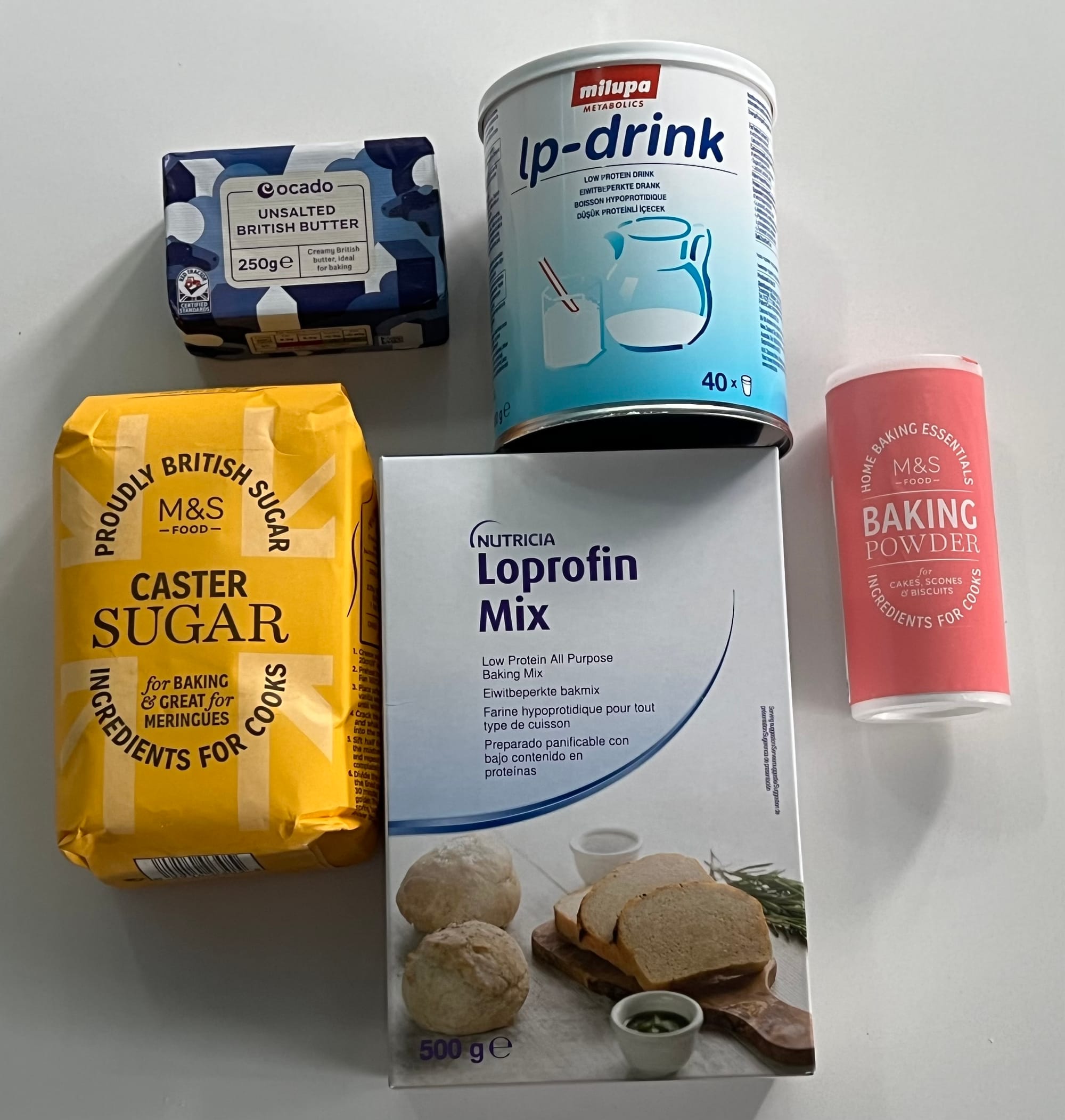
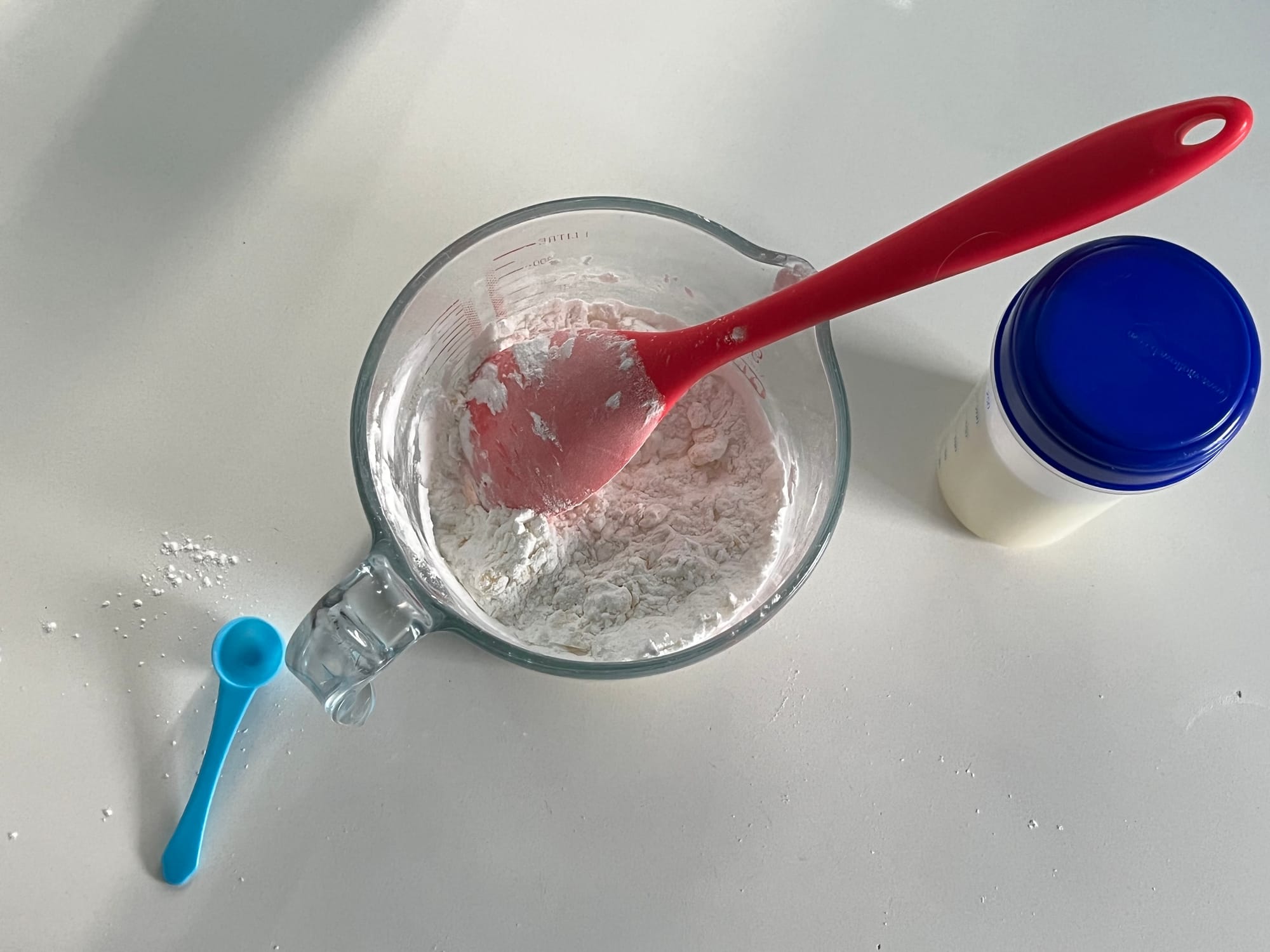
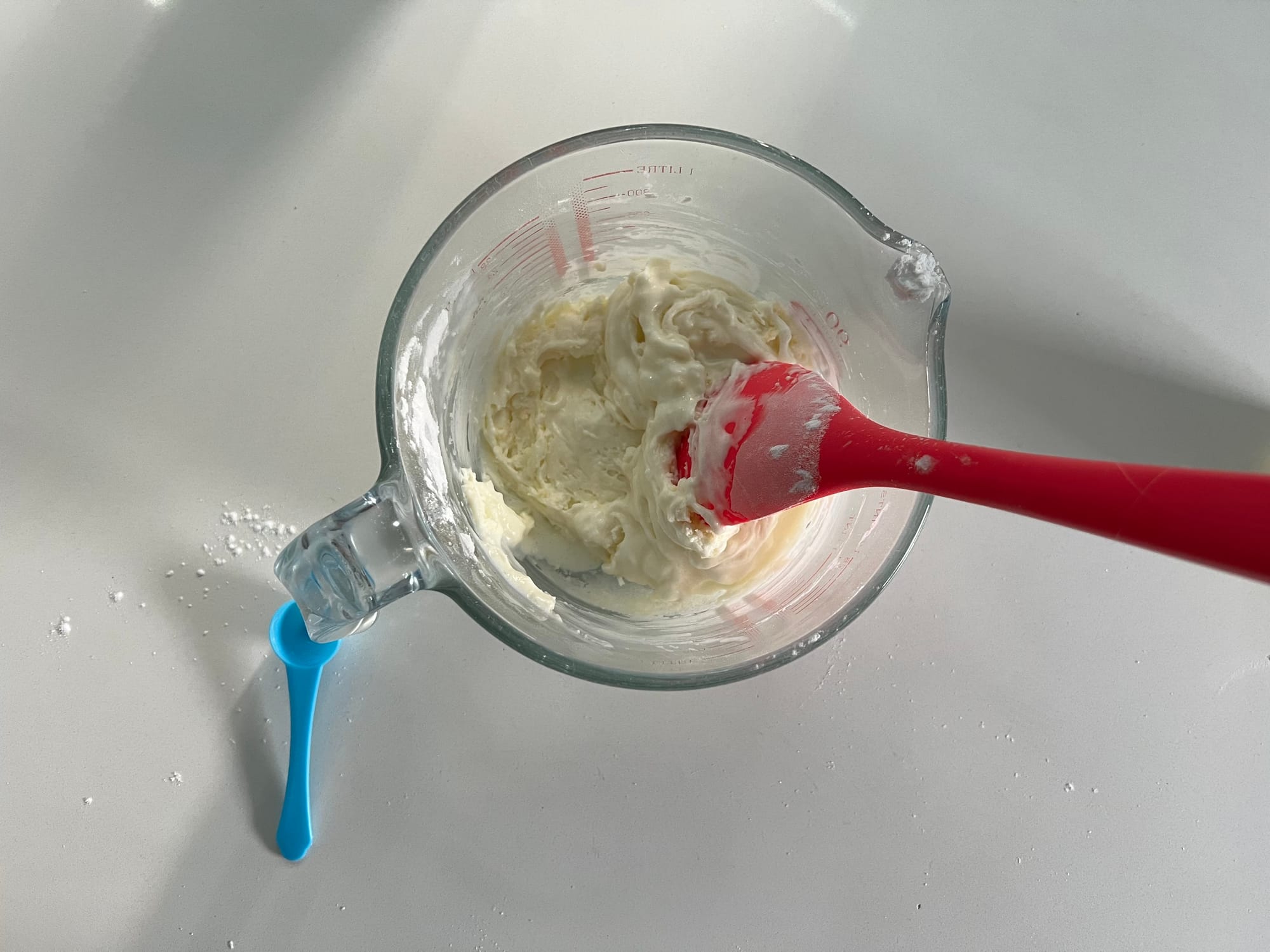
Ingredients, and mixing. Keep going until you get a mixture which flows like the video below.
### Method
1. Measure the flour, sugar, and baking powder into a large jug or bowl.
**Tip: use a jug for mixing, the spout helps reduce mess when pouring.**
1. Gradually mix in the melted butter and the milk, adding a little bit at a time. It will look lumpy at first, but persevere.
**Tip: use a spatula or a spoon, this can reduce lumps.**
1. Mix until you have a batter which drops off the spoon easily, like in the video below. (Note the odd lump, no one is perfect!)
0:00
/0:04
1×
Video showing the 'drop' of a decent pancake batter off the spoon
1. Get your frying pan hot. I always test it with a little drop of pancake batter, like in the left-hand photo below.
2. When your test piece looks ready, remove it (nom!). Pour batter into centre of the pan, it will spread out so don't cover the whole pan.
3. As the pancake cooks, bubbles will form in the uncooked top (middle photo below). When this side of the pancake starts to firm up around these bubbles, it is ready for flipping (photo on the right).
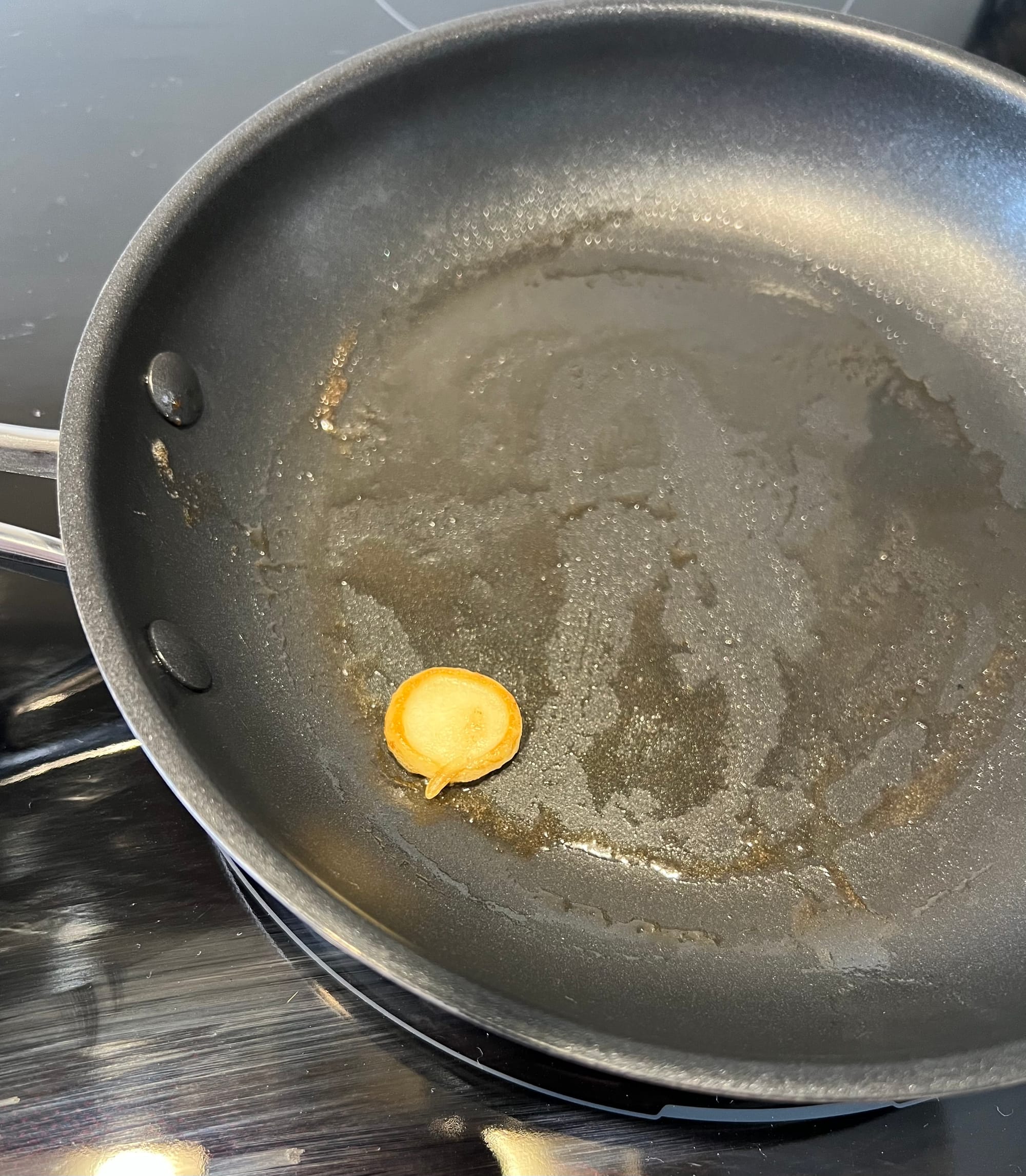
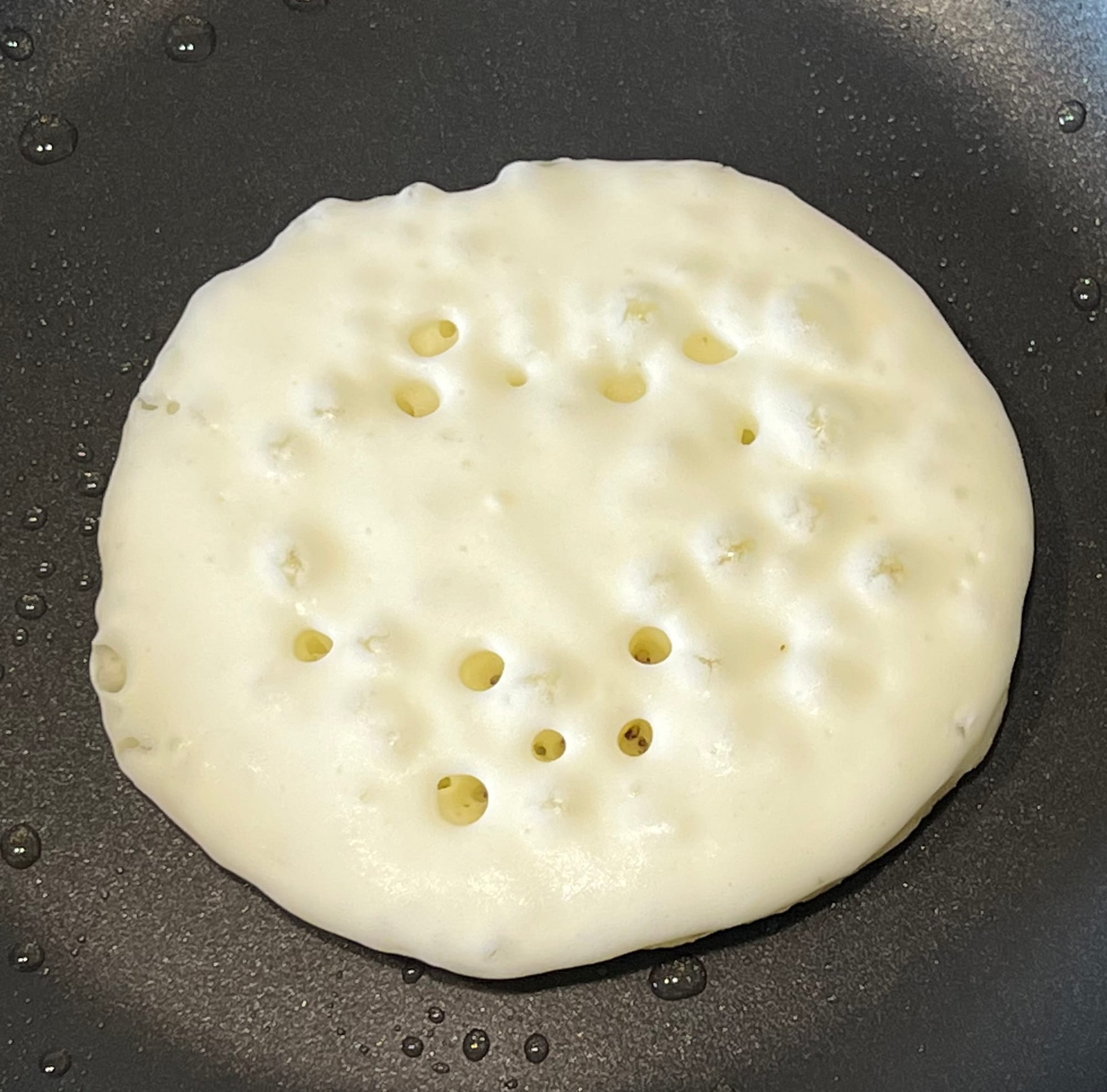
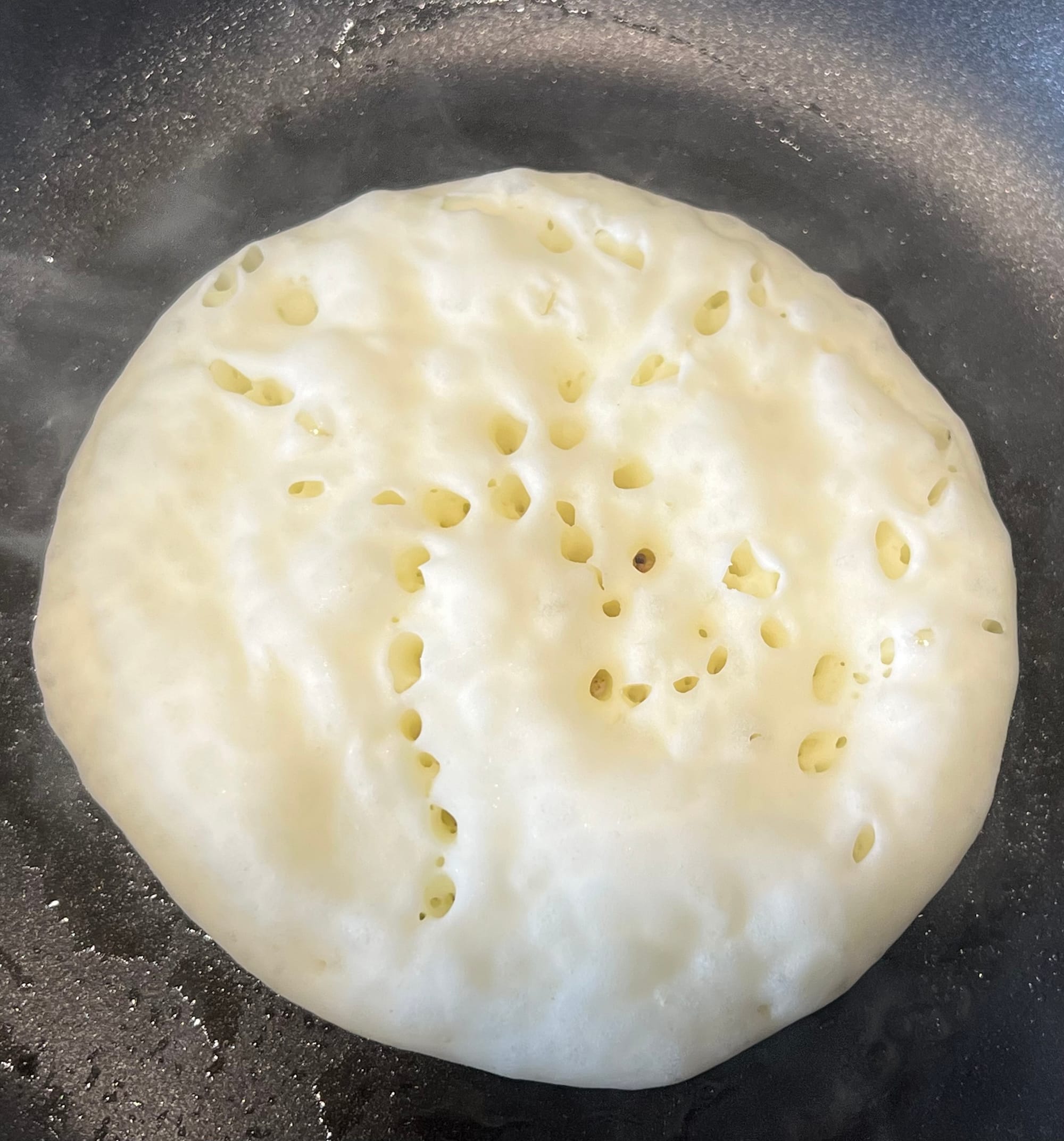
1: Test piece showing pan is hot enough. 2: bubbles starting to form. 3: pancake 'drying up' & ready to flip
1. Toppings time: My favourite is lemon and sugar. Please share your topping ideas below.
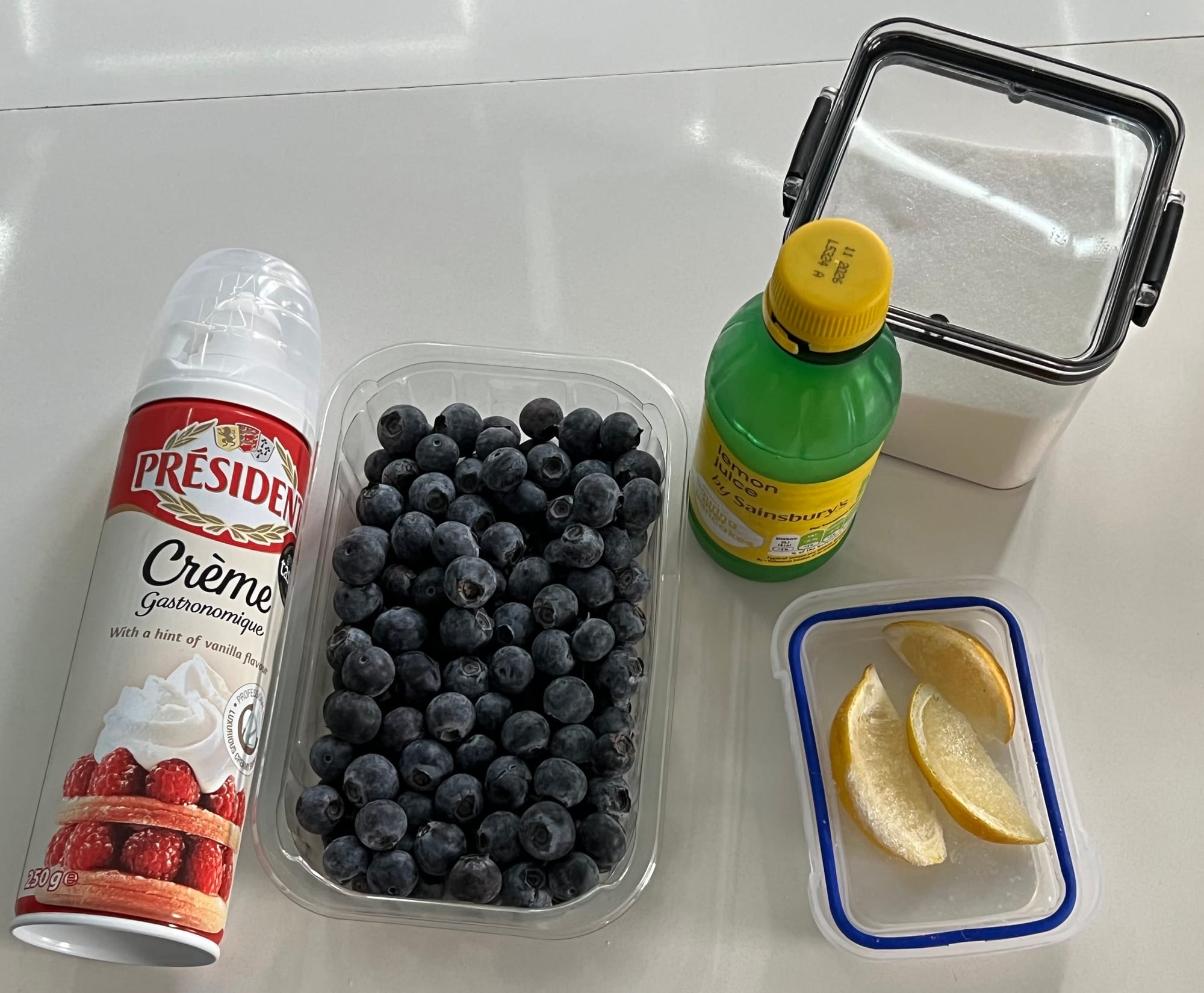
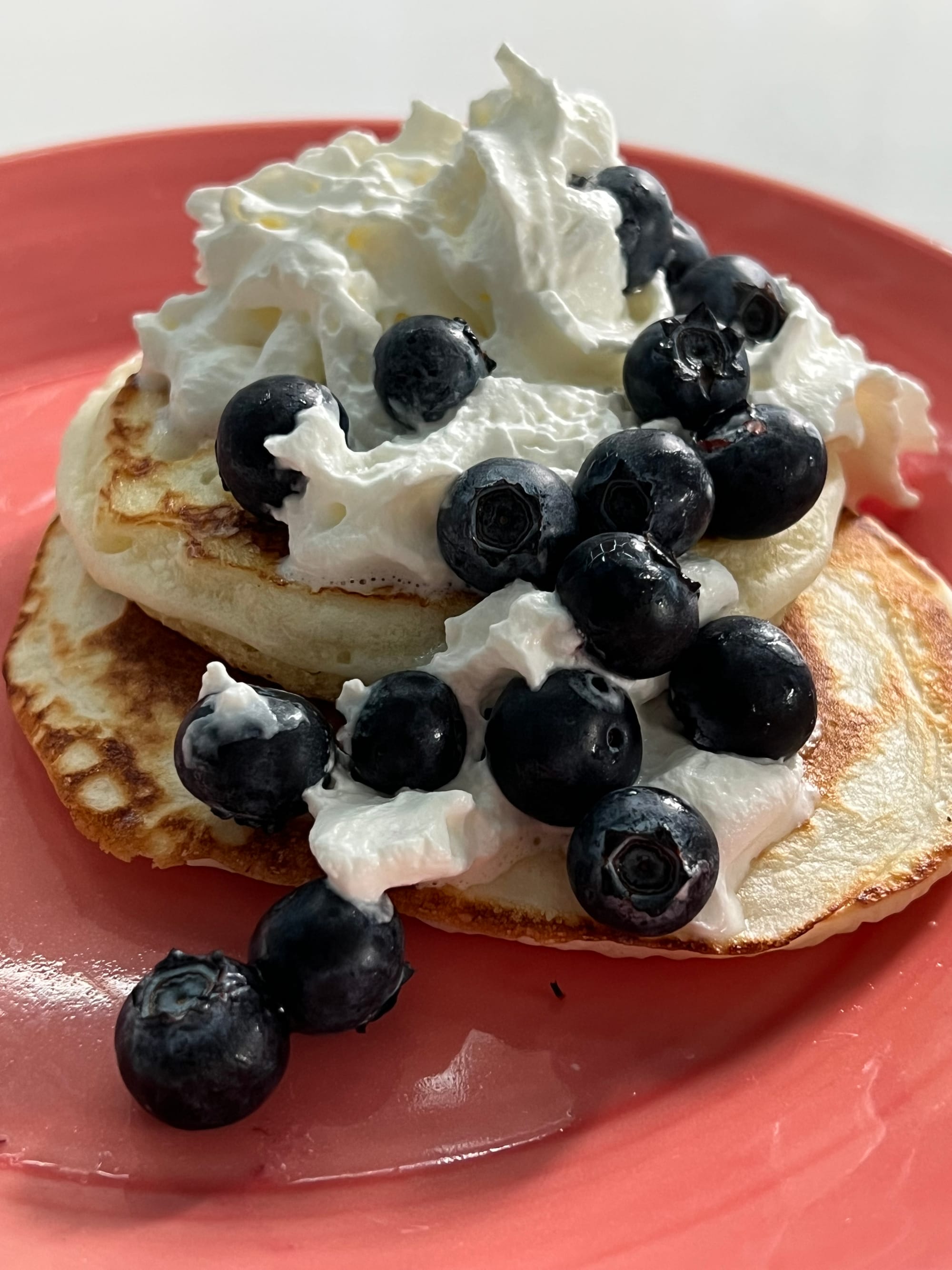
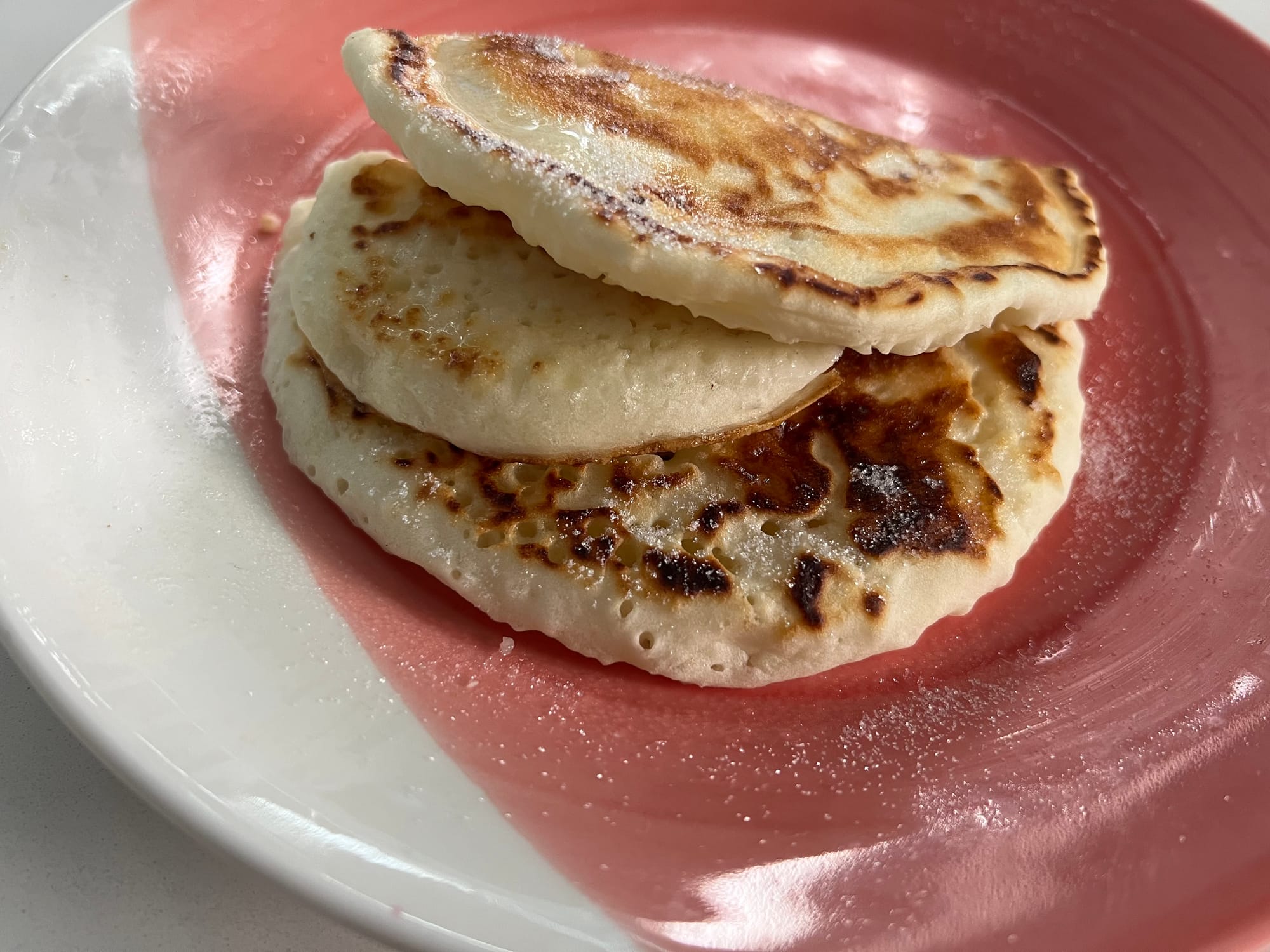
Pancake topping suggestions: Blueberries & cream, or lemon & sugar
## Join the community
Get early updates, recipes and your free gift.
Join us
Email sent! Check your inbox to complete your signup.
No spam. Unsubscribe anytime.
### What is Palynziq?
URL: https://www.pigpen.page/what-is-palynziq/
Last updated: 2026-01-23T11:42:57.000Z
Also known as Pegvaliase, or PAL, or PEG-PAL.
If you’ve been researching treatments for Phenylketonuria (PKU), you might have seen one of these terms. PAL, PEG-PAL, Pegvaliase and Palynziq all refer to the same core treatment method for PKU — a form of **enzyme substitution therapy** usually given by injection.
## **A Quick Reminder: What Is PKU?**
PKU is a rare genetic condition where the body cannot produce enough of the enzyme **phenylalanine hydroxylase (PAH)**, which is necessary to break down the amino acid phenylalanine (phe). Phe comes from protein in foods, and when it builds up in the blood it can damage the brain and nervous system. Traditionally, people with PKU follow a strict low-phe diet to manage levels, often with medical foods and supplements.
[Genetics of PKU inheritance and sapropterin (Phenylketonuria)A simple run down of the genetics of PKU, and how that relates to sapropterin testing. I’m going for the “Explain like I’m five” version here!PigPen | Pauline O'ConnorPauline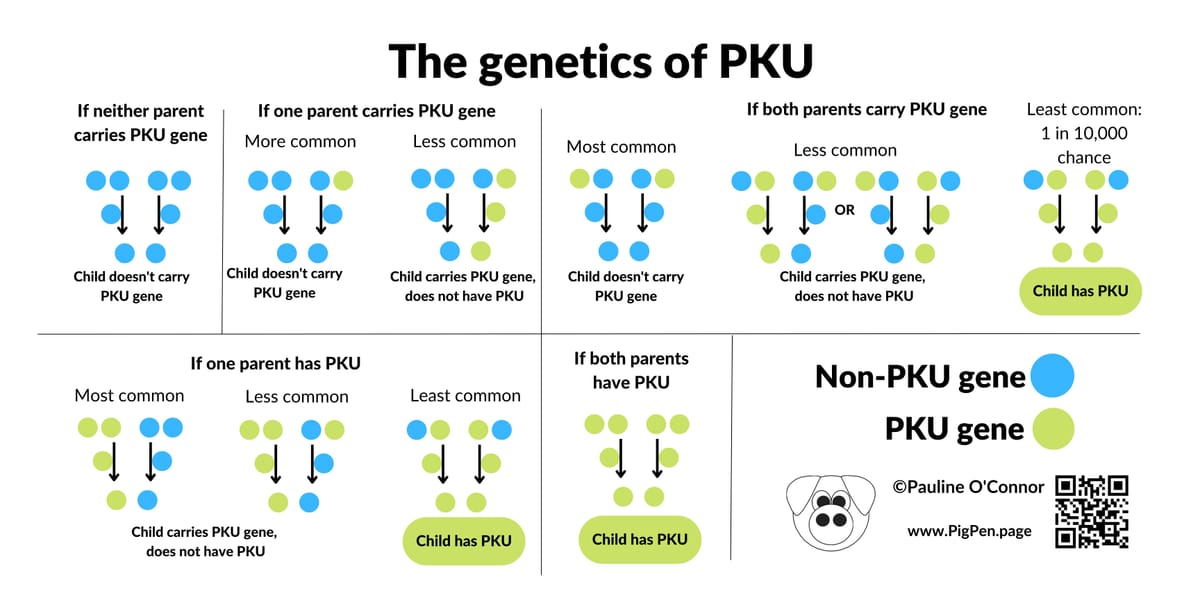](https://www.pigpen.page/the-genetics-of-pku/)
## PAL: the enzyme
PAL stands for **phenylalanine ammonia lyase** — an enzyme found in many plants that breaks down phenylalanine into compounds the human body can easily eliminate. It functions in plants much like PAH (see above) does in humans, but via a different chemical pathway. Because PAL isn’t naturally produced in the human body, it must be given as a therapy to help reduce phe levels.
## PEG-PAL: the stealth enzyme
Adding **PEG** (polyethylene glycol) to PAL creates **PEG-PAL**. PEG is a safe compound commonly used in medicines to shield proteins from the immune system. Without PEG, the body’s immune defenses would see plant-based PAL as “foreign” and destroy it before it could work. PEG acts like a disguise, helping the enzyme persist in the body so it can break down phe.
## Pegvaliase and Palynziq: brand names
BioMarin has developed PEG-PAL into an injectable treatment for PKU. Initially, this was called ‘Pegvaliase’ but it is now called ‘Palynziq’. Essentially, they are brand names for the treatment PEG-PAL; in the same way that Panadol is a brand name for paracetamol.
It is worth noting that BioMarin is the same company which developed Kuvan (sapropterin) - a different treatment which can improve phe absorption in some people with PKU.
## How is Palynziq used?
Palynziq is administered as an injection. The enzyme helps break down phenylalanine in the bloodstream, lowering blood levels and helping prevent the harmful effects of accumulation.
Palynziq is given in escalating doses, usually starting low and increasing over time under medical supervision. Some users have reported that it can take many months before seeing an effect. Use of Palynziq often requires regular blood phe monitoring and careful dose adjustment.
## Where is Palynziq available?
Palynziq is now used widely in the **US.** The **European Union** approved Palynziq in 2019 for people aged 16 and older whose phe levels remain high (above about 600 µmol/L).
The **UK is lagging** behind. The UK left the EU’s centralised approval system after Brexit, so Palynziq requires a separate licence in the UK. According to the UK patient support charity NSPKU, BioMarin has not applied for a UK licence for Palynziq and currently has no immediate plans to do so. Campaigning continues to try to bring this treatment to NHS practice.
## Palynziq effectiveness and side effects.
While it works in theory and in many patients, life is complicated. As noted above, PAL is a plant enzyme which is foreign to the human body. Even with the stealth coating offered by PEG, it still causes problems during treatment. It has side effects similar to those experienced when the human immune system fights a foreign chemical.
**Potential benefits of Palynziq:**
- Reduces blood phe levels for many people who struggle to control phe through diet alone.
- Some studies suggest improvements in neurocognitive and mood symptoms with sustained use.
**Common side effects of Palynziq:**
- Injection site reactions
- Joint pain
- Allergic responses
- Suggestions that it can take time (weeks/months) to work.
## **Where Palynziq Fits in PKU Care**
Palynziq represents one of the few **non-diet medical therapies** for PKU and is considered when dietary and other options (like sapropterin/Kuvan) are insufficient. Patient support organisations stress the importance of access to treatment choice alongside specialist care, education and ongoing research into new therapies.
## **Looking Ahead**
Research into PKU treatments continues, with ongoing clinical studies exploring long-term outcomes, optimal use, and combination therapies including enzyme approaches and gene-based techniques. As understanding grows and global regulatory landscapes evolve, access and options may expand further..
### Twixtmas reading, 2025
URL: https://www.pigpen.page/twixtmas-reading-2025/
Last updated: 2026-01-08T21:03:45.000Z
If you need reading ideas to curl up with while polishing off leftovers, here are a few articles which caught my eye over the year. They didn’t make it into the monthly newsletters simply because there was no room.
The articles don’t fit neatly into categories, but are arranged with **PKU research and interest** at the top; **Rare Disease and advocacy** articles follow; with **Brain, neurological, and mental health** reading at the bottom.
## PKU research and interest
### Progress on at-home phe monitoring
The perpetual gift which never arrives is a step closer this year. [The Egoo machine ](https://www.egoo.health/pku?ref=pigpen.page)has been under-going trials in the UK ahead of (hopefully) gaining approval here. The trials have gone well, and compliance is progressing.
The NSPKU took a machine to Parliament in November to demonstrate the process and discuss the need with MPs. So, while **the machine is not yet available in the UK**, there has been exciting progress. I am watching closely and will report on progress. (Thanks to the Egoo team for putting up with my emails!)
## Join the community
Get early updates, recipes and your free gift.
Join us
Email sent! Check your inbox to complete your signup.
No spam. Unsubscribe anytime.
### How much protein do you really need?
Socials and chats seem to pulse with protein recommendations these days, something of concern for ageing adults with PKU. I’ve been thinking about this for some years as the menopause approaches, so was relived to read [this article in the Economist](https://economist.com/science-and-technology/2025/06/06/how-much-protein-do-you-really-need?ref=pigpen.page). It is behind a paywall, but the gist is:
- WHO recommends 0.83g of protein per kilo of body weight.
- A 2022 review in *Nutrients* noted that a ratio of 1.2g/kg plus resistance training could reduce muscle shrinkage with age.
Reassuringly (despite some influencers suggesting 2g/kg or more) “A meta-analysis published in Sports Medicine in 2022, though, found that **eating more than 1.6g/kg does not lead to further muscle growth**.”
### Research opportunities

Image courtesy of of Emily Fee
Please help Emily, a master’s student, with her research. This research is so important and will help make PKU Life easier in future. It will take a small amount of your time: email her on **feeej@cardiff.ac.uk** if you can help, thank you.
### Newborn screening
[NHS plans to DNA test all babies in England to assess disease risk - BBC News](https://www.bbc.co.uk/news/articles/c1ljg7v0vmpo?ref=pigpen.page). Screening newborn babies for rare diseases will involve sequencing their complete DNA using blood samples from their umbilical cord, taken shortly after birth.
## Rare disease and advocacy reads
### Weight-Loss Drugs
The rise of weight loss drugs has had an effect on how people perceive obesity treatments, specifically that **patients need more than a restricted-diet treatment**. This change in perception needs to be brought to bear on PKU; a rare disease which, for many, is still treated entirely by an incredibly restricted diet first developed over 70 years ago.
I’m still musing on the best way to use this in my PKU advocacy. However, the NSPKU are making a start, with their new campaign for treatments beyond Sapropterin (Kuvan) and the restricted diet on the NHS. If you aren’t already a member, consider starting your new year by joining a patient group actively campaigning for better treatments in the UK. [www.NSPKU.org](https://nspku.org/?ref=pigpen.page)
### How Weight-Loss drugs are redefining the way our bodies work.
This is an [older Guardian article](https://www.theguardian.com/news/ng-interactive/2025/may/17/weight-loss-drugs-altering-views-how-body-brain-work?ref=pigpen.page), given the pace of innovation in the field of weight-loss drugs. I include it here because the final paragraph resonated with me as a patient with a rare disease: “When you don’t understand the disease, it is almost automatic in medicine that we start blaming the patient because we feel uncomfortable”
> “When you don’t understand the disease, it is almost automatic in medicine that we start blaming the patient because we feel uncomfortable”
### Lessons from the Human Genome Project - YouTube
This [video (YouTube link)](https://www.youtube.com/watch?v=qOW5e4BgEa4&ref=pigpen.page) is seven years old now, but I came across it this year during an advocacy course. It is a story of collaboration and sharing which led to **one of the greatest breakthroughs in science - and one which will have treatment repercussions in the future we still don’t fully comprehend.**
“It’s an exciting moment, at the same time it’s just the beginning of what is really a much longer voyage… I think the next 10 years are gonna see some exciting developments.”
### Seeking urgent second opinions - Martha’s rule
Something which may have been missed in the return to school rush. This new initiative ensures that people in hospitals in England can ask for an urgent review of their care. [Every hospital will have a dedicated phone number](https://www.england.nhs.uk/patient-safety/marthas-rule/?ref=pigpen.page) for patients, families, and staff to call to request a rapid review. [Martha's rule rolled out to all acute hospitals in England - BBC News](https://www.bbc.co.uk/news/articles/c8e1zw28766o?ref=pigpen.page)
### Gen Z significantly under-represented in research
“Members of Gen Z – those born between the late 1990s and the early 2000s – are [significantly underrepresented in clinical trials and health studies](https://www.theguardian.com/society/2025/oct/20/low-participation-medical-trials-millions-young-people-risk?ref=pigpen.page).” The Guardian article goes on to argue that Gen Z could miss out on new treatments due to this disparity. There is a new UK-wide registry which makes it easier to join studies ⇨ [https://bepartofresearch.nihr.ac.uk/](https://bepartofresearch.nihr.ac.uk/?ref=pigpen.page)
### Should you take creatine?
Another [article behind the Economist’s paywall](https://www.economist.com/science-and-technology/2025/07/11/should-you-take-creatine?ref=pigpen.page), this one looks at the legal, safe performance enhancing drug usually considered only for muscle-bros and weight trainers. “Creatine works mainly by increasing the amount of energy that muscles can produce.”
And this may not be the only benefit, as studies have reported an increase in cognitive abilities after creatine, and some have noted an improvement in depression symptoms. Most exciting for me are studies in animals (rats) showing creatine assisting brain injury recovery.
Buy me a cuppa ☕ — your support helps keep this blog free, and helps to me write about PKU, brain injury & mental health.
[Buy Pauline a cuppa ](https://donate.stripe.com/14keYi5dp9E26Oc9AA?ref=pigpen.page)
## Brain & mental health
### Adolescence lasts into 30s - new study
A new study which scanned the brains of about 4,000 people, some as old as 90, has revealed four pivotal stages for your brain. [The BBC reported on this](https://www.bbc.co.uk/news/articles/cgl6klez226o?ref=pigpen.page) in November, with brain changes coming at ages 9, 32, 66, and 83.
"The brain rewires across the lifespan. It's always strengthening and weakening connections, and it's not one steady pattern - there are fluctuations and phases of brain rewiring," the lead author of the research, Dr Alexa Mousley (University of Cambridge).
### A new method for diagnosing brain tumours
[The Guardian reports on a new testing method](https://www.theguardian.com/science/2025/may/21/brain-tumour-diagnosis-could-be-made-within-hours-say-researchers?ref=pigpen.page) which could cut treatment times from weeks to hours. It does note, though, that this is very much in development. And thought needs to be given to how patients are then treated. “Faster diagnoses were welcome and reduced the period of uncertainty for patients, the main question was how the new technology could be used to change care.”
### Two strokes, 30 years apart, show a gaping need near-rehabilitation
[Sheila Hale writes in the Guardian ](https://www.theguardian.com/society/2025/may/15/husband-son-stroke-30-years-apart-treatment?ref=pigpen.page)with compelling frankness about nursing her husband and then her son, who each had a stroke decades apart. She describes the shocking lack of change in treatment - particularly in the poor provision of near-rehabilitation provided by the NHS.
“I remain haunted by the people who miss out on precious rehab…39% of stroke patients are abandoned by the NHS after six months. A third remain too disabled to work, many because they believed, or had no choice but to believe, the doctors who wrote off their chances of recovery.”
> "The brain rewires across the lifespan. It's always strengthening and weakening connections"
### Women carry a higher genetic risk of depression
[As the Guardian article notes](https://www.theguardian.com/science/2025/oct/07/women-carry-a-higher-genetic-risk-of-depression-new-study-says?ref=pigpen.page): “We already know that females are twice as likely to suffer from depression in their lifetime than males”. Now it appears there is a genetic role in this disparity. The researchers found 16 genetic variants linked to depression in women, and eight in men.
### Musicians feel pain differently
Playing a musical instrument has long been known to be beneficial for the brain. [An article in The Conversation](https://theconversation.com/neuroscience-finds-musicians-feel-pain-differently-from-the-rest-of-us-265815?ref=pigpen.page) describes how long-term training and experience can shape how we perceive pain. “This is exciting because it might help us understand why some people are more resilient to pain than others, along with how we can design new treatments for those living with pain”.
### Brain puzzles and dementia
[TLDR: they help, but do not prevent dementia. ](https://www.theguardian.com/lifeandstyle/2025/sep/22/is-it-true-that-puzzles-prevent-dementia?ref=pigpen.page)Doing a puzzle engages different to areas of the brain, which stimulates blood flow to those areas, which helps maintain function. Keep up the puzzling, but bear in mind that “We all benefit from a lifestyle aligned with better brain health: prioritising movement, a nutritious diet, and activities that fire up multiple parts of the brain and involve other people.”
### Redefining you after BI
[Why redefining who you are after a brain injury could be the most important aspect of recovery - NR Times](https://nrtimes.co.uk/why-redefining-who-you-are-after-a-brain-injury-could-be-the-most-important-aspect-of-recovery/?ref=pigpen.page)
A clinical psychologist, and a clinical tutor & clinical neuropsychologist write on adjusting to life after a brain injury. The grief for a life no longer possible or which has been irrevocably changes is something which I’ve experienced after brain injury. So I nodded through this article, particularly the conclusion: “redefining your sense of self following a brain injury could be essential for good psychological wellbeing and adjustment following a brain injury.”
### Brain injury in parliament
In December, a Westminster Hall Debate took place in the UK parliament on the ‘Potential merits of a comprehensive acquired brain injury action plan’. The debate is [still available on Parliament TV](https://www.parliamentlive.tv/Event/Index/a12d299d-cc5b-4b69-a3cd-57994ee034fa?ref=pigpen.page).
## Spread the word
I hope you’ve enjoyed this round up. I will be back with the usual monthly emails in 2026.
If you find value in my newsletters, please share them. Your support means a lot, and your feedback shapes what comes next. Do get in touch!
Cheers,
Pauline
Newsletter #42
### NSPKU in Wales 2025
URL: https://www.pigpen.page/nspku-in-wales-2025/
Last updated: 2025-11-21T08:02:08.000Z
Each year, the NSPKU conference brings together researchers, clinicians, and people living with PKU from across the UK. I missed the Spring Event in Scotland, so was determined to make it to Cardiff in the autumn.
This year’s meeting in Wales felt particularly energising, as the community came together over a whirlwind six hours of science, friendship, and lived experience. Below are my reflections and notes from key sessions throughout the day.
### Note: For the latest treatment updates, see
[PKU research update, NSPKU Oct 2025, exciting new treatmentsInsights from Prof. MacDonald’s talk at NSPKU 2025 — Sepiapterin, JNT-517, and more — and what they might mean for adults living with PKU.PigPen | Pauline O'ConnorPauline](https://www.pigpen.page/whats-in-the-treatment-pipeline/)
## Adults Only Workshop
**Dr Carys Marshall** and **Dr Kerry-Ann** – Clinical Psychologists
This session focused on the emotional side of living with PKU — how resilience, frustration, and humour coexist in the same breath. The psychologists reminded us that embarrassing the health boards can sometimes be exactly what’s needed to create change.
One of the psychologists noted, ***“you are all normal human beings dealing with extra.”*** That line stayed with me. The underlying message from the session was to notunderestimate the power of patients. Whether through formal advocacy or small everyday acts of persistence, collective voices matter. As one participant joked, “We’re all on the Welsh PKU bus now.”
## European Guidelines Update
**Dr Gisela Wilcox**
I covered the review of the [EU Guidelines on PKU](https://www.pigpen.page/eu-guidelines-on-pku/) when they first appeared, and it was useful to hear Dr Wilcox highlight practical implications again.
[Review of the European Guidelines on PKU (Phenylketonuria)The guidelines...help inform policy changes and establish the best treatment practices in places where those are still being developed, and to support those in areas where treatment falls short.PigPen | Pauline O'ConnorPauline](https://www.pigpen.page/eu-guidelines-on-pku/)
A few reminders stood out:
- **Dehydration** can cause the body to break down its protein, so consistent fluid intake remains important.
- **People on sapropterin** still need regular clinic contact — changes in diet and metabolism mean treatment isn’t a “set and forget” approach.
Dr Wilcox also discussed the gut and microbiome, where new recommendations suggest screening if gastrointestinal symptoms persist. It’s an evolving field — one that could eventually reshape how we think about PKU management beyond the brain and diet.
## Phenylalanine & the Menstrual Cycle
**Prof. Emma Vardy**
This talk acknowledged what many women with PKU have long experienced but rarely see addressed: hormonal fluctuations can influence Phe levels, appetite, and mood.
Dr Vardy is arranging a new study which will track menstrual cycles alongside blood results may help tailor diet or medication more precisely. The trial is still in the development stage, and I will have more on how to participate as soon as the study is live.
This is a long-awaited study, but definitely a meaningful one.
> ***“you are all normal human beings dealing with extra.”***
## PKU Living: The Welsh Experience
**Panel: Chris, Annelise, Ifan, Heulen, Steve & Vicki** (See main image)
This was one of the most human sessions of the day. The panel shared stories of growing up, parenting, and working with PKU — and how it **doesn’t have to make you different**.
Themes included:
- Relying on others
- Struggles with **body image and fitness** one speaker discussed conversations with a friend who turned to bodybuilding and became very interested in getting high-protein foods.
- Feeling **self-conscious about food** in social settings, but also recognising strength: *“PKU makes me feel stronger.”*
Hearing lived experience presented with honesty and humour is always grounding. It reminds us that clinical advances only matter if they translate into better daily lives.
Buy me a cuppa ☕ — your support helps keep this blog free, and helps to me write about PKU, brain injury & mental health.
[Buy Pauline a cuppa ](https://donate.stripe.com/14keYi5dp9E26Oc9AA?ref=pigpen.page)
## PKU Advocacy: Fighting for Access
**Kate Learoyd** and **Caroline Graham**
The advocacy session was both sobering and motivating. Kate and Caroline highlighted ongoing **concerns across the UK**:
- Basic PKU services remain **under-resourced**
- **Sapropterin rollout** has been uneven
- The community feels **divided**, some benefiting from treatment while others still struggle
- The **cost of living crisis** compounds existing challenges (food costs, benefit cuts, sugar tax)
Kate and Caroline reminded us that the PKU community **has fought before — and won.** It took years to get sapropterin commissioned by the NHS, but persistence paid off.
Their closing message was powerful: “We might need to fight again.” And they are getting ready, with another well attended **PKU in Parliament event** held in November.
The presentation also broke down what it takes to get **new drugs approved by the NHS**:
1. Licensing – is it safe and effective?
2. Cost-effectiveness – for every £1 the NHS spends, what benefit does the patient (and system) gain?
These are some of the hurdles that new treatments like sepiapterin, JNT-517, or even home Phe monitoring devices will soon face.
> **The PKU community has fought before — and won.**
## Closing Thoughts
From psychology to policy, every talk came back to the same truth:
**PKU is not just a metabolic condition — it’s a life lived.**
Science gives us tools, but it’s the *people* who push for progress.
The conference captured that balance — the optimism of new research alongside the realism of advocacy.
As noted above:
### We’re normal human beings dealing with extra.
## Join the community
Get early updates, recipes and your free gift.
Join us
Email sent! Check your inbox to complete your signup.
No spam. Unsubscribe anytime.
### Mushroom & Jackfruit Wellingtons
URL: https://www.pigpen.page/mushroom-jackfruit-wellingtons/
Last updated: 2025-11-14T08:01:37.000Z
This recipe makes four individual, low protein Wellingtons. They are **great for Christmas or Thanksgiving**, yet are so easy that I’ve been making them as a mid-week dinner.
[Low protein recipes for a PKU Christmas or ThanksgivingTips and links to help with a low protein Christmas or Thanksgiving. I’ve included PKU and low protein menu suggestions & recipes.PigPen | Pauline O'ConnorPauline](https://www.pigpen.page/pku-at-christmas/)
This recipe can be protein free using this [simple recipe for low protein pastry](https://www.nutricia.co.uk/patients-carers/recipes/basic-pastry.html?ref=pigpen.page). I have a few exchanges so I prefer to use low protein alternatives from the supermarket.
- [JusRol Gluten-Free Pastry](https://www.jusrol.co.uk/products/gluten-free-puff-pastry-sheets/?ref=pigpen.page) is 40g for 1g protein. (3.5g per wellington)
- [Genius Gluten-Free Pastry](https://geniusfood.com/en-gb/product/puff-pastry/?ref=pigpen.page) is 32g for 1g protein
## Ingredients
- 400g tin of Jackfruit
- 1 roasted red pepper, finely chopped
- 2 sheets of low protein pastry (recipe here, or try the suggestions above)
- 2 Tbsp Olive Oil
- 4 Portobello Mushrooms
- 1 Onion, Finely Chopped
- 3 Garlic Cloves, Crushed
- 2 Tsp Paprika
- 1/2 Tbsp Brown Sugar
- 1/2 Tsp Chilli Powder
- Salt, Pinch
- Black Pepper
- 150g BBQ Sauce
- 100g low protein breadcrumbs
- Glaze with low protein prescribed or plant based ‘milk’, or aquafaba (chick pea water)
## Method
1. Remove the stems from the Portobello mushrooms, hollow out and finely chop the stems.
2. Heat the oil in a pan over a medium heat and gently fry the onion and mushroom stems until soft. Add the garlic and red pepper and fry for a further minute.
3. Drain the jackfruit, then cut it into pieces. Add to the pan along with the paprika, brown sugar, chilli powder, salt, and pepper. Cook until soft.
4. Add the BBQ sauce and heat gently. You can add a little water to the pan if it starts to stick.
5. Once the Jackfruit is soft, use two forks to pull apart. Add the breadcrumbs, then mix well. Season to taste. Spoon the Jackfruit filling into the hollowed out Portobello mushrooms.
6. Cut the puff pastry into eight equal squares, and use two to enclose each stuffed mushroom. Press around the outside of each mushroom. If needed, use some glaze to bind the 2 layers of pastry together.
7. Brush the pastry with the low protein milk then bake at 190C for 25–30 minutes or until golden brown.
Buy me a cuppa ☕ — your support helps keep this blog free, and helps to me write about PKU, brain injury & mental health.
[Buy Pauline a cuppa ](https://donate.stripe.com/14keYi5dp9E26Oc9AA?ref=pigpen.page)
### Did you like this low protein recipe?
Please share your suggestions or tweaks below. (I adapted this from a suggestion on Cooksandco.co.uk, however, the original recipe is no longer available on their website.)
## Join the community
Get early updates, recipes and your free gift.
Join us
Email sent! Check your inbox to complete your signup.
No spam. Unsubscribe anytime.
(edited November 2025)
### RareSummit 25
URL: https://www.pigpen.page/raresummit-25/
Last updated: 2025-11-13T17:22:12.000Z
This was my first RareSummit, and my first visit to the Wellcome Genome Center. My visit started with the familiar mix of anticipation and curiosity. Rare disease events always draw together a unique blend of energy: determination, vulnerability, scientific rigour, and a palpable sense that everyone in the room understands something the wider world often misses. It was a packed day, these were my highlights and **Key thoughts:**
## “Ten Moments” and Ten Years of Change
The day opened with Jo Balfour, CamRARE’s Managing Director, sharing ten moments of impact in CamRARE’s history—an invitation to see how connections made in rooms like this ripple outward into research, policy, and even clinical trials. One example that stuck with me was how Andy Kulina networked his way from the RareSummit 23 to a clinical trial for Phelan-McDermid Syndrome, a rare disease which affects his daughter.
**Key thought:** Exercise that ‘Networking’ muscle! Anyone can do it, and networking gets things done!
> **Andy Kulina networked his way from the RareSummit 23 to a clinical trial**
## Rare Disease Through the Lens of Human Rights
I recognised Dr Lucy McKay immediately, or rather, I recognised her voice. She is the CEO of Medics for Rare Disease, [“a registered charity driving an attitude change towards rare diseases among medical students and doctors in training.](https://www.m4rd.org/?ref=pigpen.page)”. Lucy presents their podcast, a key part of my training soundtrack this summer.
Dr McKay’s session challenged us to consider rare disease not as a niche biomedical subset but as a **human rights issue**. Her words resonated strongly “If you’re not in the rare disease world, you don’t know it exists.” And “No one here is asking for anything more than for their human rights to be met.”
This reframing felt powerful. Many “workarounds” in rare disease aren’t innovations—they’re coping mechanisms for systems that don’t yet protect our rights. The question she posed stayed with me:
**Key thought:** “Are we filling a gap, or finding a workaround for rights not yet recognised?”
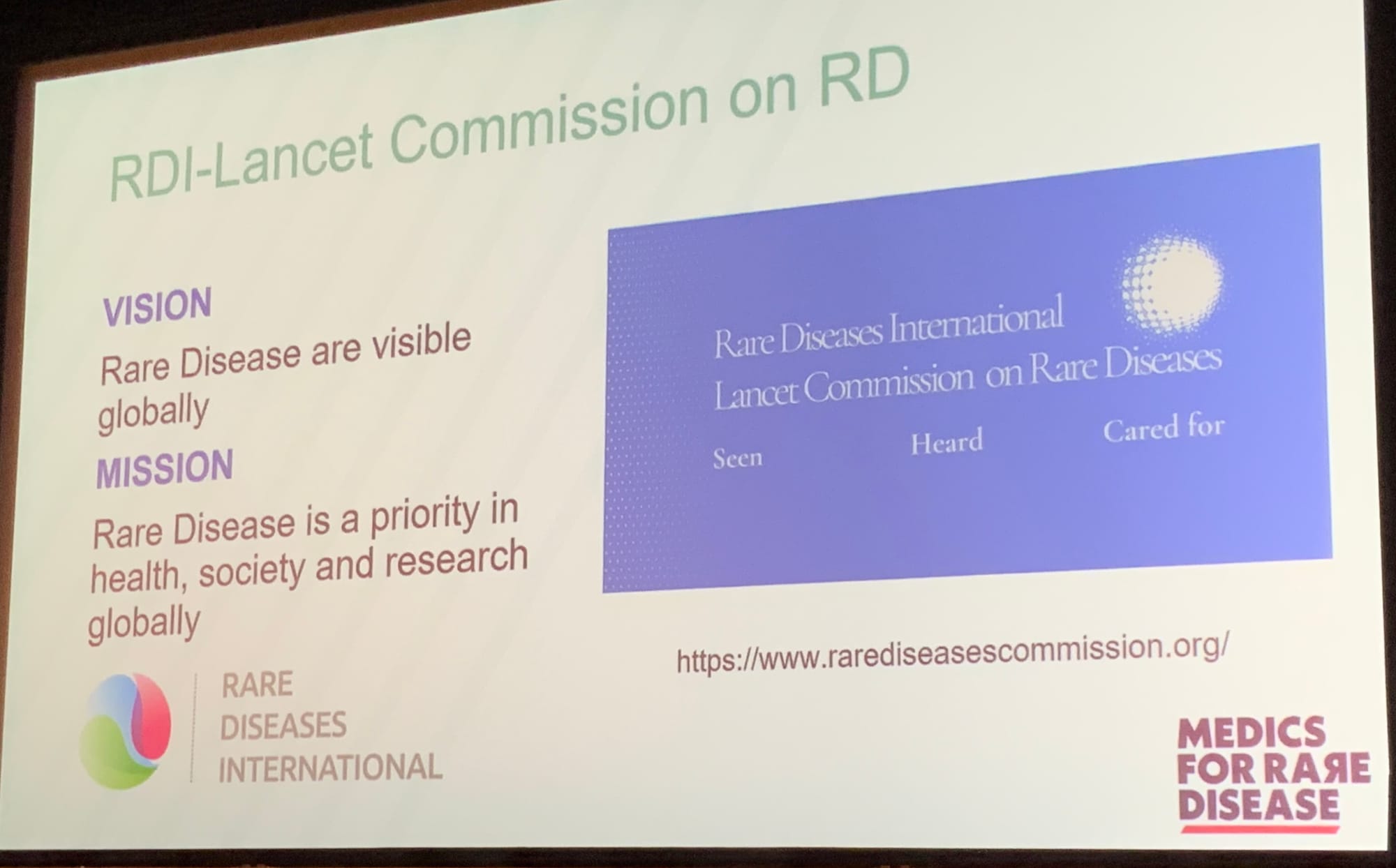
Image of slide presented during Medics for Rare Disease talk.
## Mental Wellbeing: Meeting People Where They Are
The afternoon sessions looked at mental wellbeing and living with rare disease. These were perhaps the most important conversations of the day. The speakers articulated several things which I often see in the PKU and brain injury communities:
- Sometimes living with the rarity is the hardest part.
- Counsellors don’t need to be experts in the condition to support us, they just need to meet us where we are.
- We assume people will advocate for themselves, but many are simply overwhelmed.
- Emotional support at diagnosis shouldn’t be a luxury; it should be standard care.
**Key thought:** Miscommunication happens not just between patient and clinician, but between advocates, educators, researchers, and families too.
Buy me a cuppa ☕ — your support helps keep this blog free, and helps to me write about PKU, brain injury & mental health.
[Buy Pauline a cuppa ](https://donate.stripe.com/14keYi5dp9E26Oc9AA?ref=pigpen.page)
## Closing Thoughts: The Next Decade
The closing panel on the next decade of rare disease innovation was hopeful, ambitious, and—importantly—honest. A few numbers jumped out at me:
- 3,000 ongoing studies, with rare disease second only to oncology.
- By 2035, half of all treatments are expected to be informed by genomics.
- 52% of new rare disease medicines are available in England, well below Germany’s 89%. A large gap and a massive opportunity.
The day ended with this reminder from Emma Green, Chair of Trustees at CamRARE:
**Key thought:** “All of us branching off into our own rare spaces is not going to advance this. When you have an opportunity to raise your voice, please use it.”
## What I’m Taking Away
RARESummit25 was a long, motivating and tiring day. I left with:
- A stronger belief in patient-led research
- A renewed sense of urgency around mental health support
- Practical ideas for my future advocacy
- Encouragement to keep showing up—and keep using my voice
The speakers and guests I spoke with during the day gifted me with a sense of connection with a wider rare disease ecosystem; to a creative space, full of determined, hopeful people. Mostly, **I left feeling less “rare” and more at home.**
Because in that room, surrounded by people working to make rare lives visible, valued, and connected, I felt part of something bigger—something determined, collaborative, and deeply human.
> **“If you’re not in the rare disease world, you don’t know it exists.”**
## Join the community
Get early updates, recipes and your free gift.
Join us
Email sent! Check your inbox to complete your signup.
No spam. Unsubscribe anytime.
### Meta Healthcare’s new low-protein products
URL: https://www.pigpen.page/metas-new-low-protein-products/
Last updated: 2025-11-07T16:24:32.000Z
Trying new low-protein products is always a mix of curiosity and caution. Packaging, taste, texture, and convenience all matter — especially when you’re balancing a carefully managed diet.
Recently, I’ve been sampling several new-to-the-UK PKU-friendly foods available on prescription through Meta Healthcare. Here’s what I discovered about the **Salty sticks** (breadsticks) and **Pizza crackers**. Plus a little test kitchen trial of a **new chicken-substitute**.
***Please note, I was sent early samples. Your prescription items will be in English packaging.***
## Breadsticks
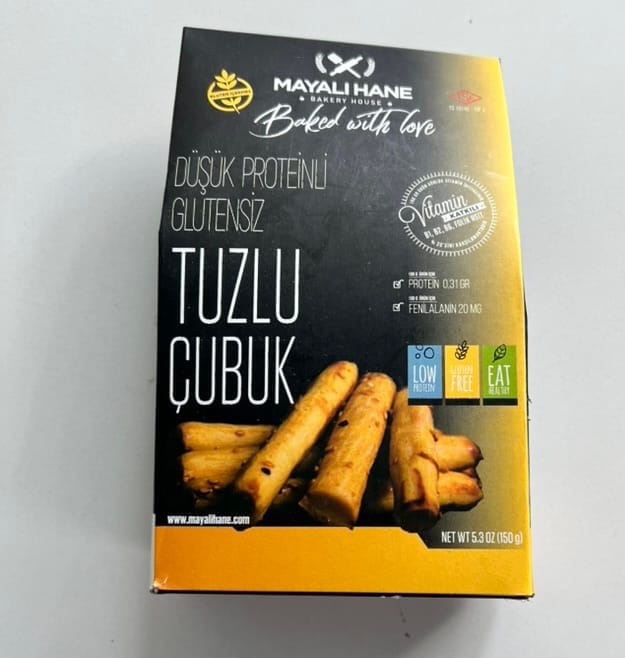
Salty snacks - breadstick. This is the Turkish packaging
These breadsticks were a welcome, easy snack — great on their own or dipped into chutney or other protein-free sides.
Like many long-life breads, they’re a little on the dry side, so pairing them with a dip helps.
**Verdict: A solid staple snack — quick, crunchy, and perfect for conferences or travel kits.**
## Pizza Crackers
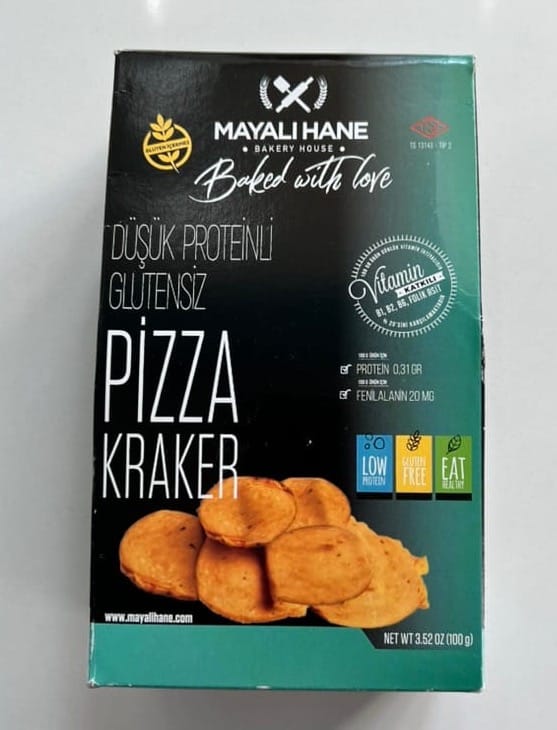
Pizza crackers. the new English packaging is in the main title.
These caught me off guard — I expected a sweet biscuit, but instead got a strong, savoury flavour! The texture is crisp, with a pleasant tomato-herb note that gives a real “pizza snack” feel.
As with the breadsticks, a dip helps balance the dryness. Pairing them with a low-protein cheese dip is a winner.
**Verdict: A satisfying savoury change — strong flavour, good texture, and a refreshing break from sweet snacks.**
Buy me a cuppa ☕ — your support helps keep this blog free, and helps to me write about PKU, brain injury & mental health.
[Buy Pauline a cuppa ](https://donate.stripe.com/14keYi5dp9E26Oc9AA?ref=pigpen.page)
## Coming soon, low-protein chicken substitute
Alongside the new product tests, I tried out the chicken substitute with panko breadcrumbs and gluten-free rolls. As with all burger mixes, I recommend making a thinner ‘patty’ to start, as a thicker patty can be a bit dry.
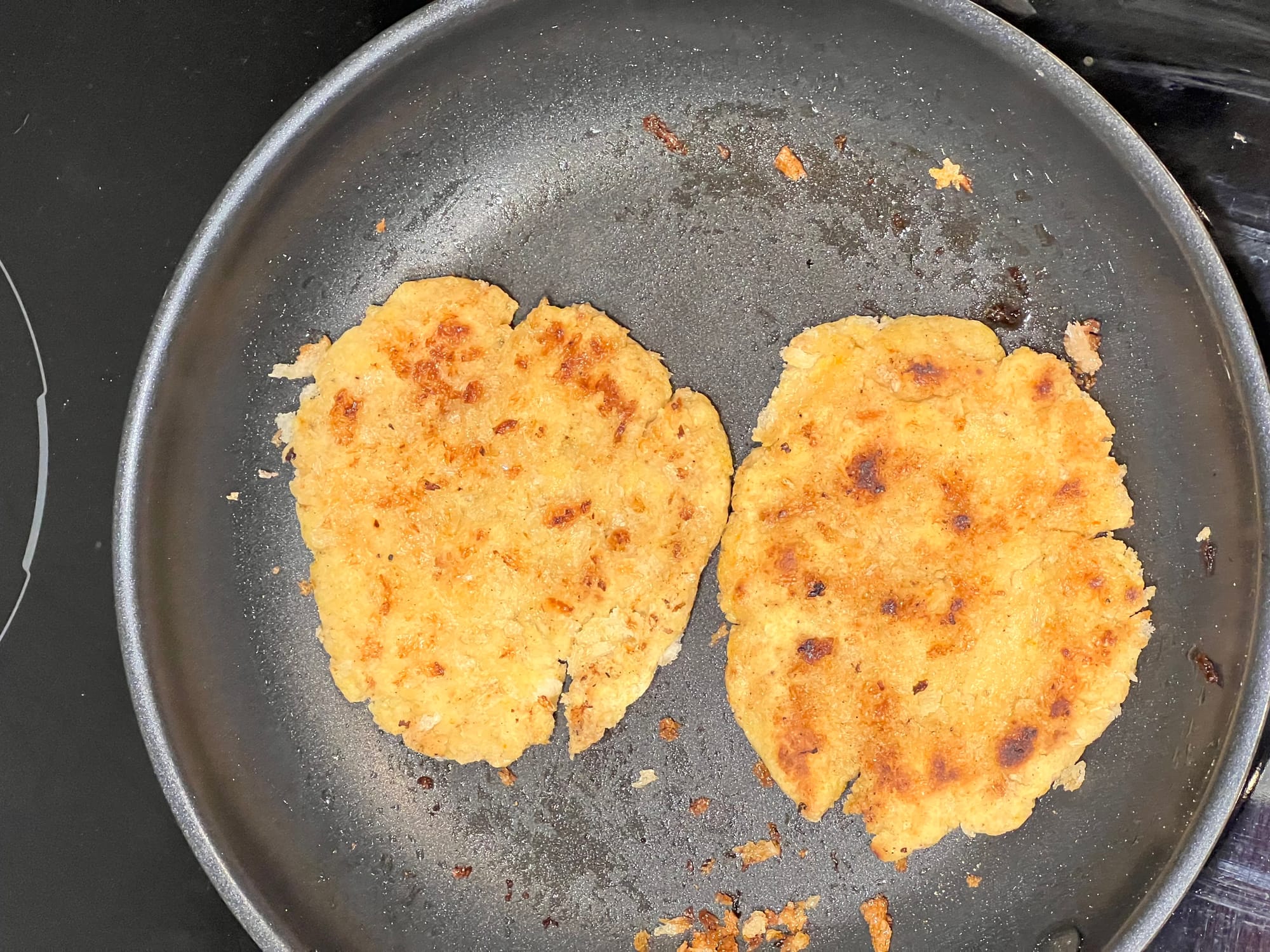
"Chicken' patties frying during the kitchen test.
I did that here, then coated with a small amount of panko breadcrumbs (about 0.5g protein) before frying. The result? Crispy, golden “chicken” burgers that worked beautifully with pickles and ketchup. This had a lovely savoury flavour which was very satisfying.
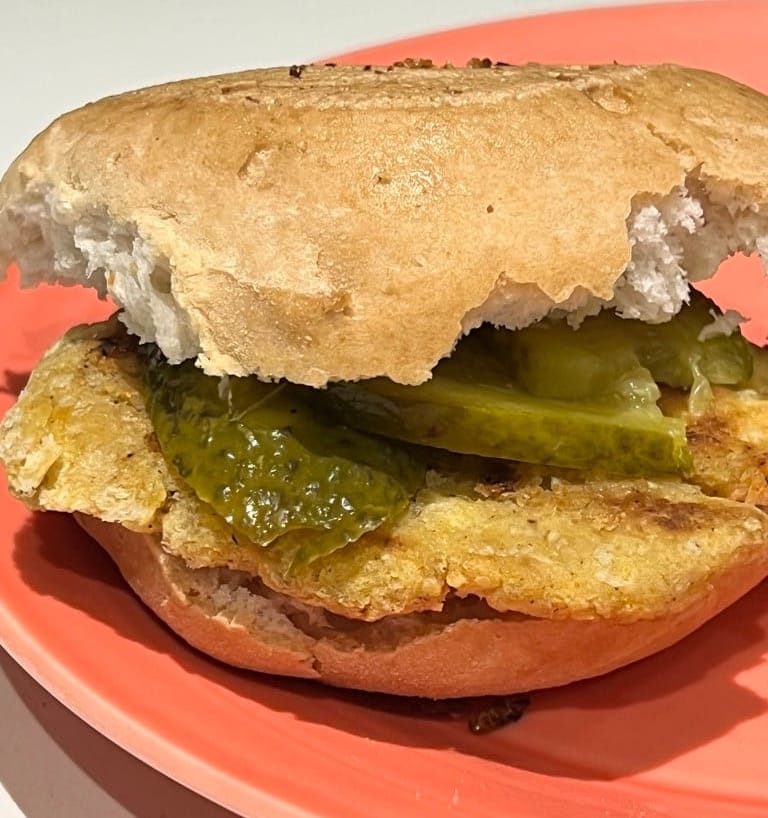
Burger with the chicken substitute
**These are going through product registration and will hopefully be available in 2026.**
## Final thoughts.
It’s encouraging to see more low-protein options reaching UK shelves. Each of these products has its place — whether as a handy snack, a sweet treat, or a base for home experiments. Talk to your dietitian about getting some samples. The codes for prescriptions are:
| | | | |
| ------------------- | ------------------------------------------ | ------------ | -------- |
| **Manufacturer** | **Product full description** | **PIP code** | **Size** |
| Meta Healthcare Ltd | META HEALTHCARE low protein pizza crackers | 435-4296 | 100g |
| Meta Healthcare Ltd | META HEALTHCARE low protein salty sticks | 435-4304 | 150g |
As always, I’m keen to hear from others who’ve tried them. **What did you think? Any recipe ideas or serving tips to share?**
### PKU friendly recipes to try in October
URL: https://www.pigpen.page/pku-friendly-recipes-to-try-in-october/
Last updated: 2025-10-24T14:36:57.000Z
Where the heck did September go? Admittedly I spent most of the month pretending it was still summer. But now the season for simple, warming oven dishes is now upon us.
I’ve been using the oven more in the past year since finding [Rukmini Iyer's ](https://www.rukmini-iyer.com/?ref=pigpen.page)cookbook series. The Green Roasting Tin has many recipes which work well for low-protein diets. As the name suggests, the recipes are vegetable based and focus on roasting entire meals in a single dish.
Some of the meals are not suitable but most can be tweaked for the PKU diet. The husband doesn’t have PKU so I like to use recipes which work for both of us. It is so much easier when everyone eats the same meal. While I’m still working through the book, the below adaptations are already firm favourites.
N.B. I give the brand names for the low Phe or Phe free products which I use. Just trying to be helpful, they don’t pay me. (But if any rep’s are reading and want to get in touch…! )
## Aubergine (eggplant) and fennel gratin with feta style cheese.
Serves 4 - gives 2 Phe/exchanges per portion. Or you can adapt by changing the amount of pine nuts or by using different substitutes for the cheese &/or creme fraiche
### Ingredients
400ml Oatly Creamy Oats Fraiche (4 Phe worth)
2 teaspoons sea salt
Freshly ground black pepper
25g fresh flat-leaf parsley, finely chopped
1 teaspoon grated nutmeg
2 medium aubergines, thinly sliced into rounds
500g fennel, thinly sliced
125g Violife Feta Style Non-Dairy Cheese Alternative (Phe free)
50g breadcrumbs from PKU bread
Optional: 28g pine nuts (4 Phe worth)
1 tablespoon olive oil
### Method
1. Preheat the oven to 180°C fan/200°C/gas 6.
2. Mix the creamy oats fraîche with the sea salt, black pepper, parsley and nutmeg.
3. Place half of the aubergine slices into the dish, followed by half the fennel and half the creamy mix and half of the cheese. Repeat these layers, then scatter the top layer with the rest of the creamy mix and the cheese. Scatter over the breadcrumbs and pine nuts.
4. Drizzle with the olive oil, then transfer to the oven and bake for 45 minutes, until the top is golden brown and crisp, and the gratin is bubbling.
5. Leave to sit for 5 minutes to cool down before serving.
Serving options: We sometimes find that this is enough as a meal but if you need more try serving with a salad or crusty bread to mop up the sauce.
Buy me a cuppa ☕ — your support helps keep this blog free, and helps to me write about PKU, brain injury & mental health.
[Buy Pauline a cuppa ](https://donate.stripe.com/14keYi5dp9E26Oc9AA?ref=pigpen.page)
## Quick roast broccoli with pasta
We regularly knock this up as a mid-week meal. It takes less than 30 minutes, most of which is cooking time. Serves two - give 5 Phe/exchange per portion when served with PKU pasta.
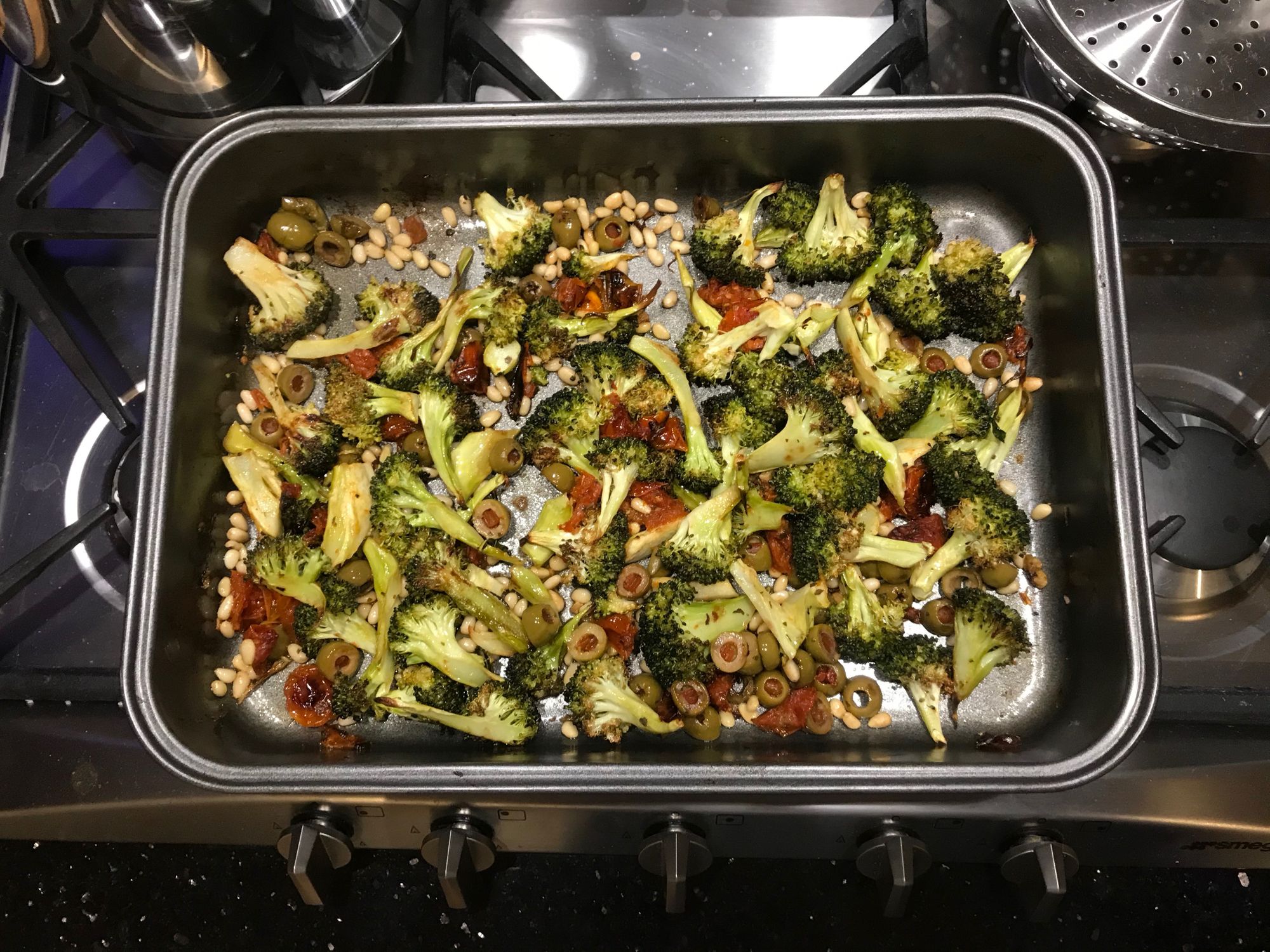
### Ingredients
1 large head of broccoli, cut into small florets (usually 350g so about 6 Phe. Be sure to weigh your broccoli: 60g =1 Phe.)
75g pitted black olives
75g sunblush or sun dried tomatoes
1 tablespoon oil from the sunblush or sun-dried tomatoes
½ teaspoon sea salt
160g pasta. (I cook for 1 PKU and 1 non-PKU so make 80g PKU pasta and 80g normal pasta. See tip below for cooking both in a single pot.)
28g pine nuts (4 Phe worth)
25g fresh basil, roughly chopped
1 lemon, zest and juice
2 tablespoons olive oil
Salt & pepper
### Method
1. Preheat the oven to 180°C fan/200°C/gas 6.
2. Mix the broccoli florets, olives, tomatoes, oil and sea salt in a roasting tin, then transfer to the oven and roast for 15 minutes.
3. Meanwhile, bring a large pan of salted water to the boil, add the pasta and cook for 10-12 minutes. Drain, reserving a few tablespoons of the cooking water.
4. Throw the pine nuts over the broccoli, then return to the oven to roast for a further 10 minutes, until the broccoli is nicely charred and cooked through. Mix immediately with the basil, lemon zest and juice, olive oil and reserved pasta water.
5. Taste and season as needed with salt and black pepper and serve with the pasta.
Did you enjoy these meals or have a favourite twist? Let me know 😄
## Join the community
Get early updates, recipes and your free gift.
Join us
Email sent! Check your inbox to complete your signup.
No spam. Unsubscribe anytime.
(edited Oct 2025)
### What’s in the treatment pipeline
URL: https://www.pigpen.page/whats-in-the-treatment-pipeline/
Last updated: 2025-12-24T15:02:54.000Z
Attending the NSPKU conference is always a mix of hope and cautious excitement, particularly when researchers and clinicians present new treatment pathways. So there was no doubt which NSPKU Conference 2025 session I’d write up first!
**Prof. MacDonald** laid out developments that could mean real change for **everyone** with PKU. In this post, I’m bringing you my notes and reflections to help make sense of where treatments might head next.
## Egoo Machine & Point-of-Care (PoC) Testing
Imagine testing your Phe levels at home — no lab, no waiting! It has been the dream of many with PKU for years. There is at least one commercial machine that is awaiting approval. But, at-home phe readers are not cheap! While challenges remain in obtaining consistently accurate readings, ongoing advancements continue to improve reliability in real-world settings
Professor Anita and her team tested the [Egoo Machine](https://www.egoo.health/pku?ref=pigpen.page) in her clinic, including driving to patient’s homes to get accurate data.
While practical challenges persist, such as air bubbles in pipettes affecting measurement accuracy and complexities in sample handling the underlying concept remains highly promising.
Reliable home testing has the potential to transform daily management of PKU by providing immediate feedback and reassurance.
## Sepiapterin (Sephience) — a new oral BH₄ approach
This is a new treatment, different to the sapropterin (Kuvan) which is the only PKU drug treatment currently available on the NHS.Sepiapterin (Sephience) is another PKU treatment which is available elsewhere but not on the NHS.
Both sepiapterin and saptropterin aim to increase BH4 in the body, which helps to boost the phenylalanine hydroxylate enzyme (PAH) to process phenylalanine (phe). Sapropterin is a form of BH4 itself. [Sepiapterin is a building block of BH4,](https://www.ema.europa.eu/en/documents/overview/sephience-epar-medicine-overview%5Fen.pdf?ref=pigpen.page) which helps the body to make its own BH4.
This is why both are enzyme cofactors (helping to boost the PAH), but also why they work differently in different people.
**Key takeaways about sepiapterin:**
- Roughly *twice as effective* as sapropterin in certain cases
- It can increase dietary phe allowance for those already on sapropterin
- Excitingly, it seems to work for 60% of people with PKU (sapropterin only works for about 30%)
- Regulatory application expected around **late 2026**, though real-world access will take longer
This gives hope, particularly for those who do not respond to sapropterin, who’ve long felt left behind in PKU therapeutic development.
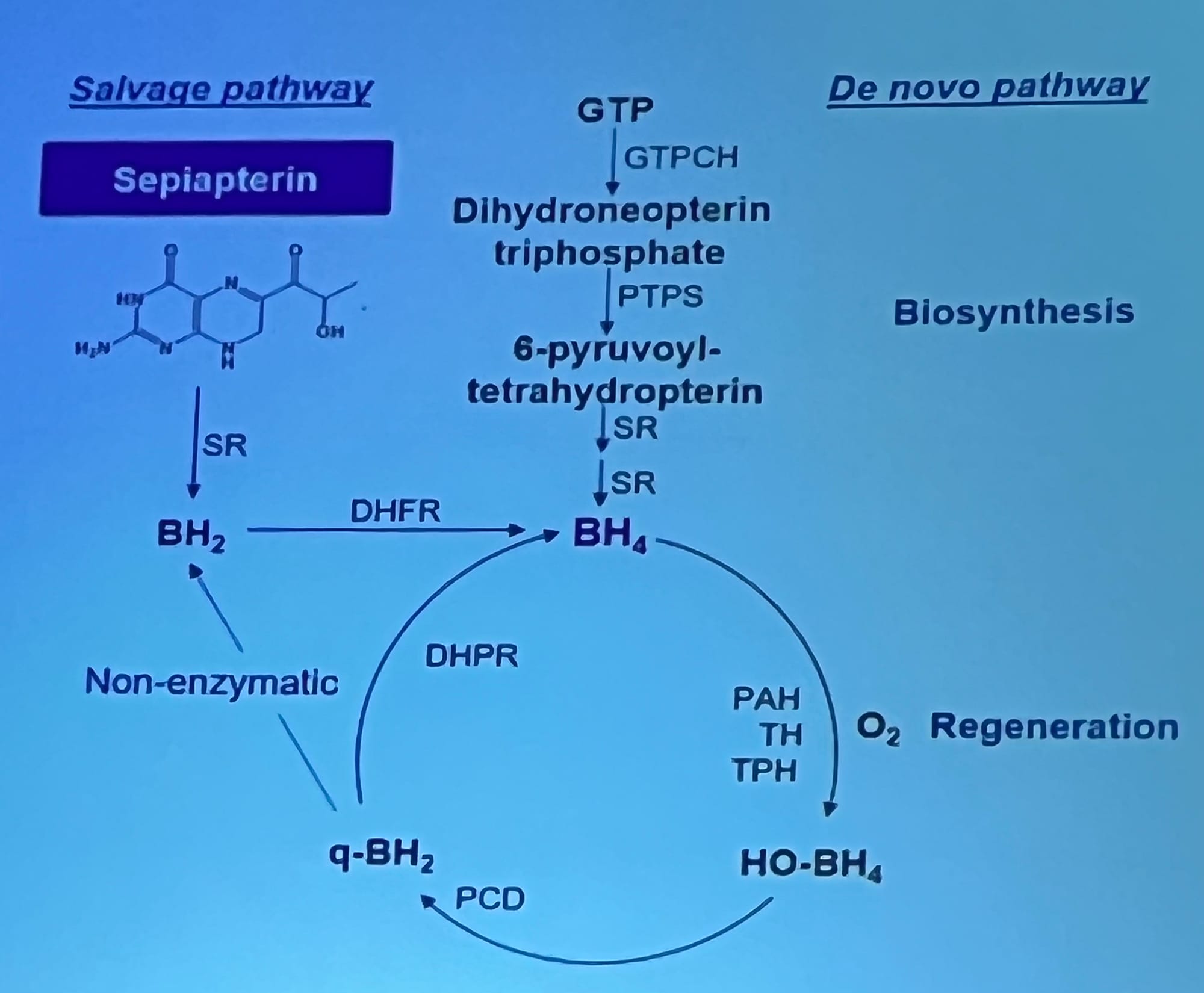
Above: One of the most striking slides showed the **“salvage pathway”** and **“de novo pathway”**, illustrating how **Sepiapterin** feeds into the BH₄ regeneration cycle — providing another route for phenylalanine (Phe) breakdown.
## Getting kidneys involved
Professor Anita discussed two other exciting drugs, both of which work via the kidneys. Currently, the kidneys reabsorb 95% of the excess phe in the blood of someone with PKU.
The idea behind these drugs is to prevent the kidneys from reabsorbing this excess phe. Basically, instead of the excess phe going back into the blood as it does now, these drugs mean the kidneys will remove it in the urine.
### JNT-517 and MZE782
Not inspiring drug names so far, but the treatments by Otsuka (former) and Maze Therapeutics (latter) are exciting.
**What we know so far:**
- Works **across all PKU types**, independent of genotype
- A massive increase in phe removed from the body in urine
- **Phase 3 trials for JNT-517** are underway globallyThe UK are expected to take part in an adolescent trial next year.
- Researchers are in discussions with **Maze therapeutics about Phase II trials soon**.
## Reflections — What this means for us
After this talk, I'm left feeling a cautious optimism. None of these treatments are quick fixes, and access often trails discovery, but every step forward matters.
A few thoughts I’m left with:
1. **Access matters** — Sepiapterin’s data looks excellent, but until it’s approved and funded, it remains out of reach.
2. **Combination therapies** could define the next era — imagine pairing Sepiapterin with a drug like JNT-517.
3. **Ease of use counts** — Egoo’s challenges show that even great science must work in everyday hands.
4. **Advocacy is crucial** — Knowing about trials is one thing; pushing for UK inclusion and NHS uptake is another.
## Closing Thoughts
I’ll be following these developments closely — particularly when UK trials begin.
For anyone living with PKU, these emerging treatments represent not just medical innovation, but the possibility of more flexibility, less restriction, and maybe even a little more normality.
**Do these developments make you excited, or are you worried about how changes might affect you? Please share your thoughts.**
### Four quick ‘school-night’ dinners
URL: https://www.pigpen.page/four-quick-school-night-dinners/
Last updated: 2025-10-24T14:50:21.000Z
We’ve all had days when work, school, or simply life means dinner becomes an afterthought. These four recipes are here for those nights — quick to make, PKU-friendly, and flavourful.
Three recipes are Phe-free; the fourth has **2.5 g Phe per adult portion**, with optional additions if you need more.
> Three recipes are Phe-free; the fourth has **2.5 g Phe per adult portion**, with optional additions if you need more.
## Roasted courgette & aubergine.
### Phe-free
Scaled for two adult portions as a main meal. **Fridge to plate in under an hour**, most of that is oven time.
1 aubergine
2 large (or 4 medium) courgettes
4 Tbsp olives, stoned & chopped
6 Tbsp grated **PKU cheese**. (I use Violife Prosociano Wedge.)
2 Tbsp chopped rosemary (or 1/2 tsp dried)
4 Tbsp **PKU bread crumbs** (I blitz up a slice of PKU bread.)
Salt & black Pepper
Olive oil
1. Set oven to 180C.
2. Mix the olives, rosemary, cheese, and breadcrumbs. Season with salt and pepper.
3. Cut the courgettes and aubergine in half lengthways and score the cut surfaces deeply, but taking care not to go through.
4. Place courgettes snugly, cut side up in small roasting tin then rub with a little olive oil on the cut surface.
5. Cover with prepared olive & cheese mix, pressing down but not compacting the mix. Trickle a little more olive oil.
6. Bake for 45 mins to an hour, until sizzling. Serve with a side salad if you feel the need though it can be a big meal on its own. Goes well with mayonnaise/salad cream, bbq sauce, tomato sauce, chilli sauce…
We all have those days when we have been hard at work, school, or play and have completely forgotten about getting dinner on the table. Here are a few quick, easy dinners to satisfy the taste buds and the PKU diet.
## Join the community
Get early updates, recipes and your free gift.
Join us
Email sent! Check your inbox to complete your signup.
No spam. Unsubscribe anytime.
## Easy fennel pasta
### Phe-Free
Scaled for two adult portions. **Fridge to plate in half an hour**.
1 fennel bulb
1/2 onion, diced
1-2 cloves garlic
160g **PKU pasta**, (or 80g per person. See my post on [cooking PKU and non-PKU pasta at the same time](https://www.pigpen.page/tips-for-pku-and-non-pku-pasta/).)
1/4 cup wine (or 1 Tbsp white wine vinegar if cooking for kids)
1 Tbsp lemon juice
Parsley
Salt & Pepper to taste
1. Get a pot of water on the stove for your pasta. I went into cooking PKU pasta on a [previous blog](https://www.pigpen.page/tips-for-pku-and-non-pku-pasta/) if you need tips.
2. Cut off the top stalks and rough bottom of the fennel bulb. Wash and dry the bulb. (If any of the outside is bruised or browned, gently cut it off without hacking through the bulb.) Cut the bulb in half, then shave or thinly slice the fennel.
3. Sweat fennel, onion, and garlic in pot with lid on for about 10 mins, stirring often.
4. When your pasta has 6 mins to left go, add wine to fennel mix and turn up the heat to boil off the alcohol.
5. When the pasta is cooked, drain it. Then add lemon, salt and pepper to fennel mix and serve with pasta.
## Quick roasted broccoli & pasta
### 2.5 Phe per person
The broccoli is 1 Phe for 60g. A 300g head of broccoli for two people results in **2.5 phe per portion**. The pine kernels are an optional extra if you need to boost Phe to make up more exchanges.
This recipe is for two people and is ready from **fridge to plate in about half an hou**r. Give it a go, it is the second recipe here: [https://pigpen.page/pku-friendly-recipes-to-try-in-october/](https://www.pigpen.page/pku-friendly-recipes-to-try-in-october/)
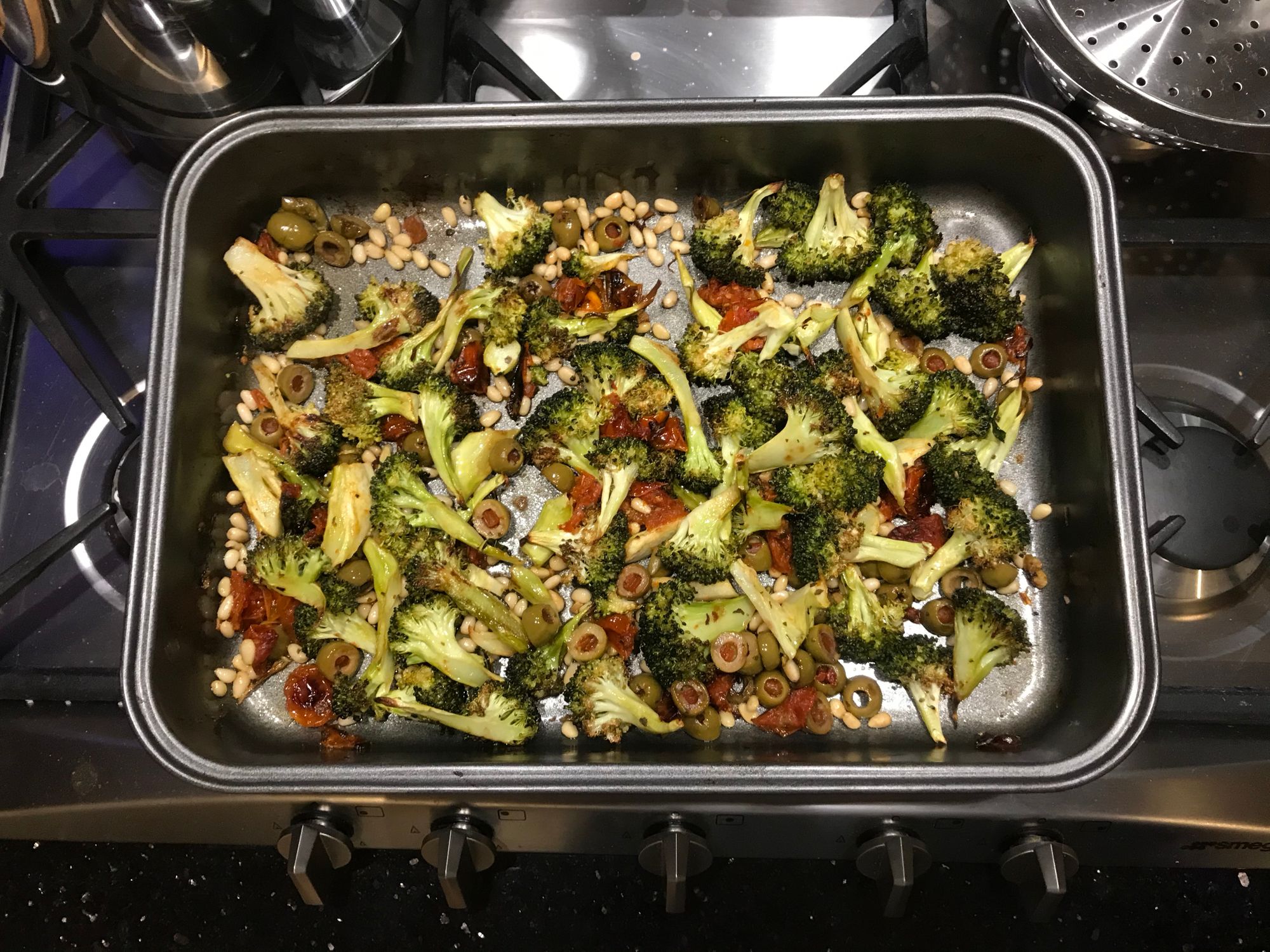
Quick roasted broccoli straight out of the oven. Note pine nuts added to boost Phe exchanges
## Two-in-one Lasagne
### Phe-free
This one takes more work, however, he reward is four huge adult sized portions which can feed both PKU and non-PKU-ers. I suggest trying it out on a weekend for the first time as it can be fiddly.
Once you are used to it, it can be a handy mid-week dinner. We make it early in the week which gives us a full meal plus leftovers. [https://pigpen.page/pku-and-non-pku-lasagne-in-the-same-dish/](https://www.pigpen.page/pku-and-non-pku-lasagne-in-the-same-dish/)
Buy me a cuppa ☕ — your support helps keep this blog free, and helps to me write about PKU, brain injury & mental health.
[Buy Pauline a cuppa ](https://donate.stripe.com/14keYi5dp9E26Oc9AA?ref=pigpen.page)
(edited Sept 2025 )
### Falling Forward
URL: https://www.pigpen.page/ultra-running-for-pku/
Last updated: 2025-07-25T10:00:30.000Z
## How Ian Spriggs Turned a Bucket‑List Marathon into Ultra-Running
At 7am on 28 July, PKU dad Ian Spriggs will start his epic run from Bristol to Newcastle, raising money for the NSPKU. This will last ten days, 110-ish hours of foot‑time, and roughly 370 miles of running. How did he come up with this crazy idea?
## A bucket-list bet
Back in 2013, Ian had a conversation about “bucket lists” with his teenage daughter, Molly (who has classical PKU). He blurted: “I’ve always wanted to run a marathon.” At that point, Ian had never run a day in his life.
His companions laughed, and said, “unless you get up and do something about it, it isn’t going to happen.” That proved to be the push Ian needed, and he signed up for an online running club and for a local marathon. Ian knew enough to know that he didn’t know enough, so he asked for help.
> “unless you get up and do something about it, it isn’t going to happen.”
One of the first people to respond was Sharon, a regular runner happy to offer her advice. As training progressed, her advice was invaluable and Sharon declared, “I’ll just run the marathon with you.”
## Marathon meetings
Ian had no idea how much that first marathon would change his life. He had only ever intended to run a single marathon. Until Sharon challenged him to run one in under 4 hours. So they signed up for another marathon, and then another.
It turned out that Sharon, his new running companion, was already an ultra-runner. (For the un-initiated, ultra-running is any run longer than the traditional marathon distance of 26.2 miles, or 42 km). As the marathon count grew, so did their friendship. And soon, they were married!
## Ian’s greatest hits
Running became an integral part of Ian’s new life. And the challenges grew. “It just creeps up on you…because you think, ‘I wonder if I can do 30 miles’. Before you know it, you are running stupid distances.”
If Ian fell into ultra-running accidentally, there can be no doubt about his commitment. In fact, he struggled to work out how many miles, and charity fundraisers, he and Sharon have completed over the years. Their best guess is an astonishing **1113 miles and £11987 for charity.**
> "Before you know it, you are running stupid distances."
| **Year** | **Event** | **Distance (miles)** | **£ Raised** |
| --------- | --------------------------------------------------- | -------------------- | -------------- |
| 2018 | Thames Path 100 | 100 | £1,075.00 |
| 2020 | Fairy Fancy Dress Marathon | 26 | £1,184.04 |
| 2020 | Washing Line Lockdown Marathon | 26 | £1,326.00 |
| 2020 | Sharon’s Race Across Scotland | 170 | £285.00 |
| 2021 | Deadwater 6-Day Ultra + Turkey Fancy Dress Marathon | 261 | £1,855.00 |
| 2022 | Hadrian’s Wall Path | 73 | £1,267.00 |
| 2023 | GOSH–RVI (London to Newcastle) | 361 | £4,395.00 |
| 2024 | Race Across Scotland | 96 | £600.00 |
| **Total** | — | **1,113 miles** | **£11,987.04** |

## What is Ian’s ultra-running secret?
“I don’t even enjoy this running lark,” Ian admits. “I just pick something that is way beyond what I should be able to do, and then… I wonder if I can do that.”
When challenged, he also claims that he doesn’t get the ‘runner’s high’ either.
“I can’t wait to get to the halfway point, even on a six-mile run. If I get to half way, at least I’m on the way home.”
That changes the moment someone steps in and jogs alongside him. Having a running companion helps Ian to find the joy in his runs. The first thing he does when planning an ultra run is reach out to companions who might join him for a few miles along the way.
## Ian’s fundraising advice
To Ian, it is all about challenging himself to do something bigger than the last run. The remarkable challenges are also a big part of the fundraising.
“People don't give a monkeys if I go and run a marathon because I do them all the time… There's always got to be something new, something exceptional. I mean, 372 miles…that's huge.”
> “I don’t even enjoy this running lark,”
And Ian is always thinking ahead. He limits ‘monster runs’ to every two years, so friends don’t get fundraising fatigue. But his notebook is already filling with 2027 ideas—watch this space.
## Ready to back Ian’s Bristol to Newcastle Challenge?
- Drop a fiver in the pot → https://www.justgiving.com/page/ian-spriggs-3
Can’t donate? Share the link, meet him on the road, or just shout encouragement online. Every step counts.
**Cheer Ian on in person:** (Times are approximates, as they depend on Ian’s feet)
Bristol Southmead — 28 July 6:30 to 7am
Birmingham Children’s Hospital — 31 July 10-10:30am
Liverpool Alder Hay — 2 August 10:30 — 11am
RVI Newcastle — 6 August, Hoping to finish at midday (12)
**Join Ian along the way**
Ian is still seeking people to meet for a small jog along the way. You can see his planned route and support him at: [https://www.justgiving.com/page/ian-spriggs-3](https://www.justgiving.com/page/ian-spriggs-3?ref=pigpen.page)

### Fennel and orange salad
URL: https://www.pigpen.page/fennel-and-orange-salad/
Last updated: 2025-07-18T09:12:17.000Z
Adapted from a published recipe (wish I could remember where!)
## Shaved fennel salad with orange-coriander dressing
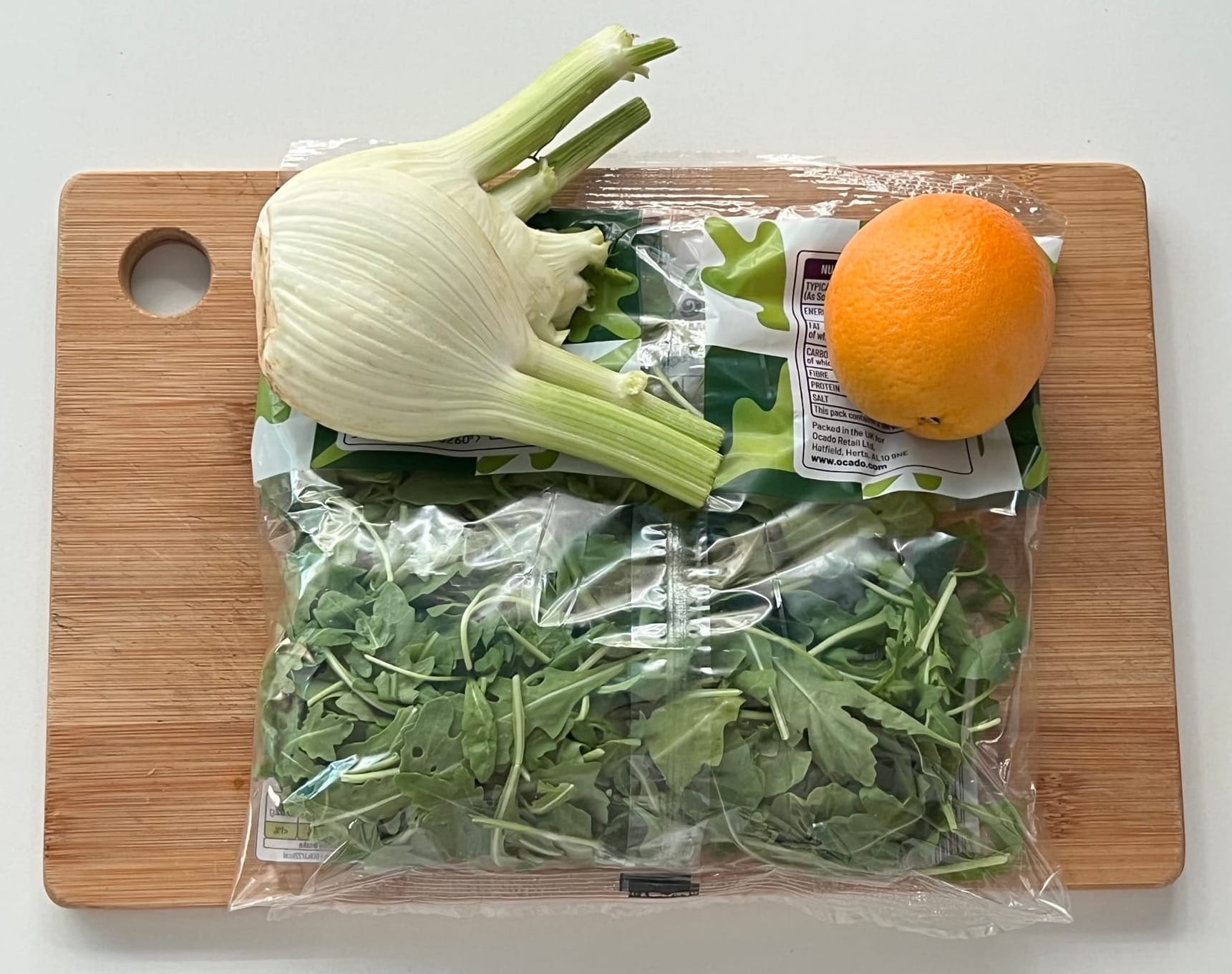
The main ingredients: fennel bulb, an orange, and rocket leaves. By Pauline O'Connor
### Ingredients
1 medium sized fennel bulb
Juice of one orange, or 2tbsp orange juice
1/2 a lemon, or 1 tablespoon of lemon juice.
salt to taste
75g rocket leaves. (This is 2g of protein or use other salad leaves if you want a protein-free salad.)
**For the dressing**
2 medium oranges (you can use the one which you juiced above)
1/2 medium lemon, or 1tbsp lemon juice
4 g coriander seeds
2 g black pepper seeds
8 leaves basil
salt to taste
30 ml extra virgin olive oil
### Method
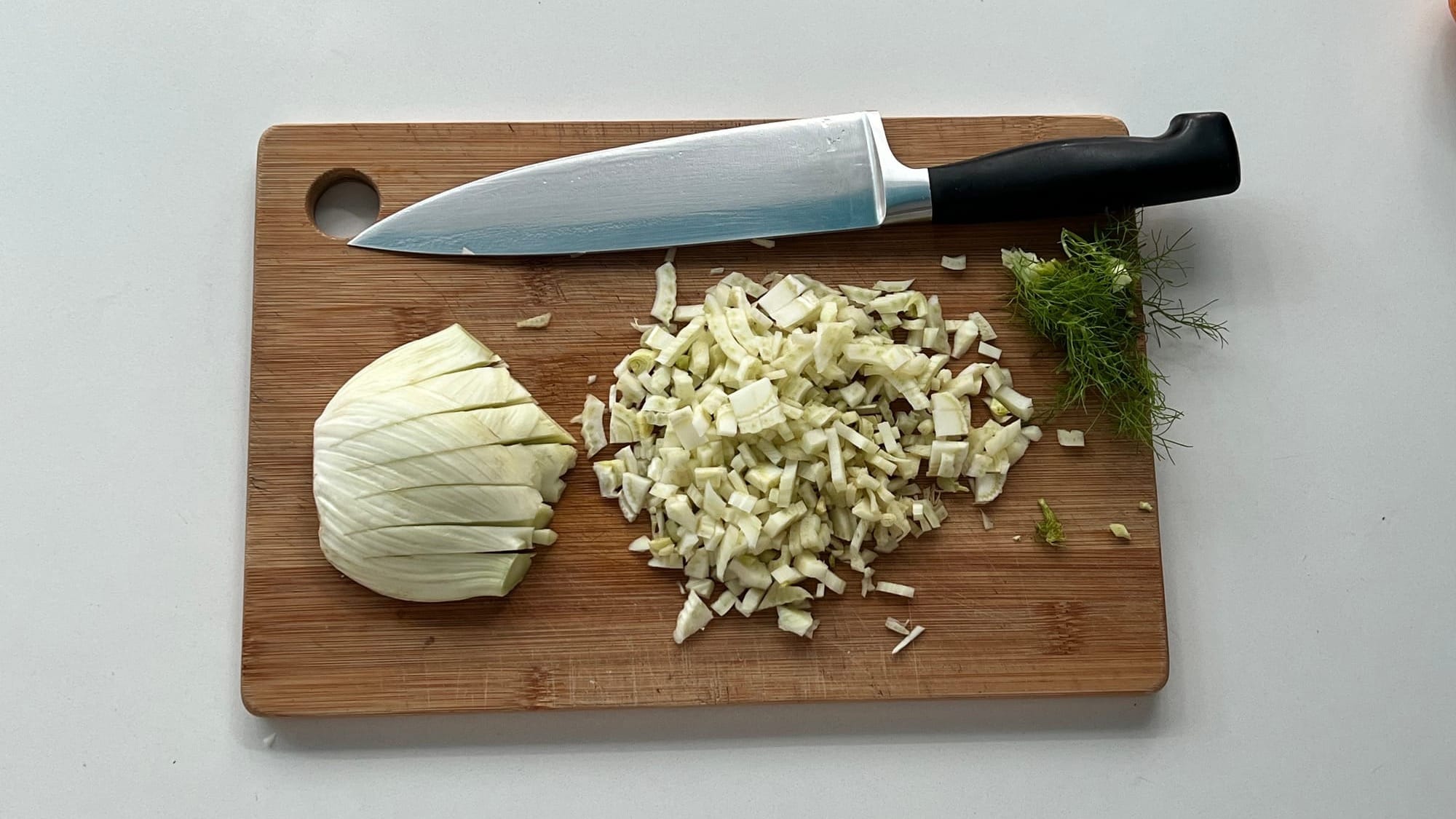
Chopping the fennel bulb. Note the green fronds reserved on the right. By Pauline O'Connor
Wash the fennel and cut it in half from bottom to top. Shave the fennel with a mandolin or thinly slice with a good knife. Place it in a container with a lid.
Mix the orange and lemon juices over the shaved fennel and season with the salt. Cover, then marinate the ingredients for 1-hour in the fridge.
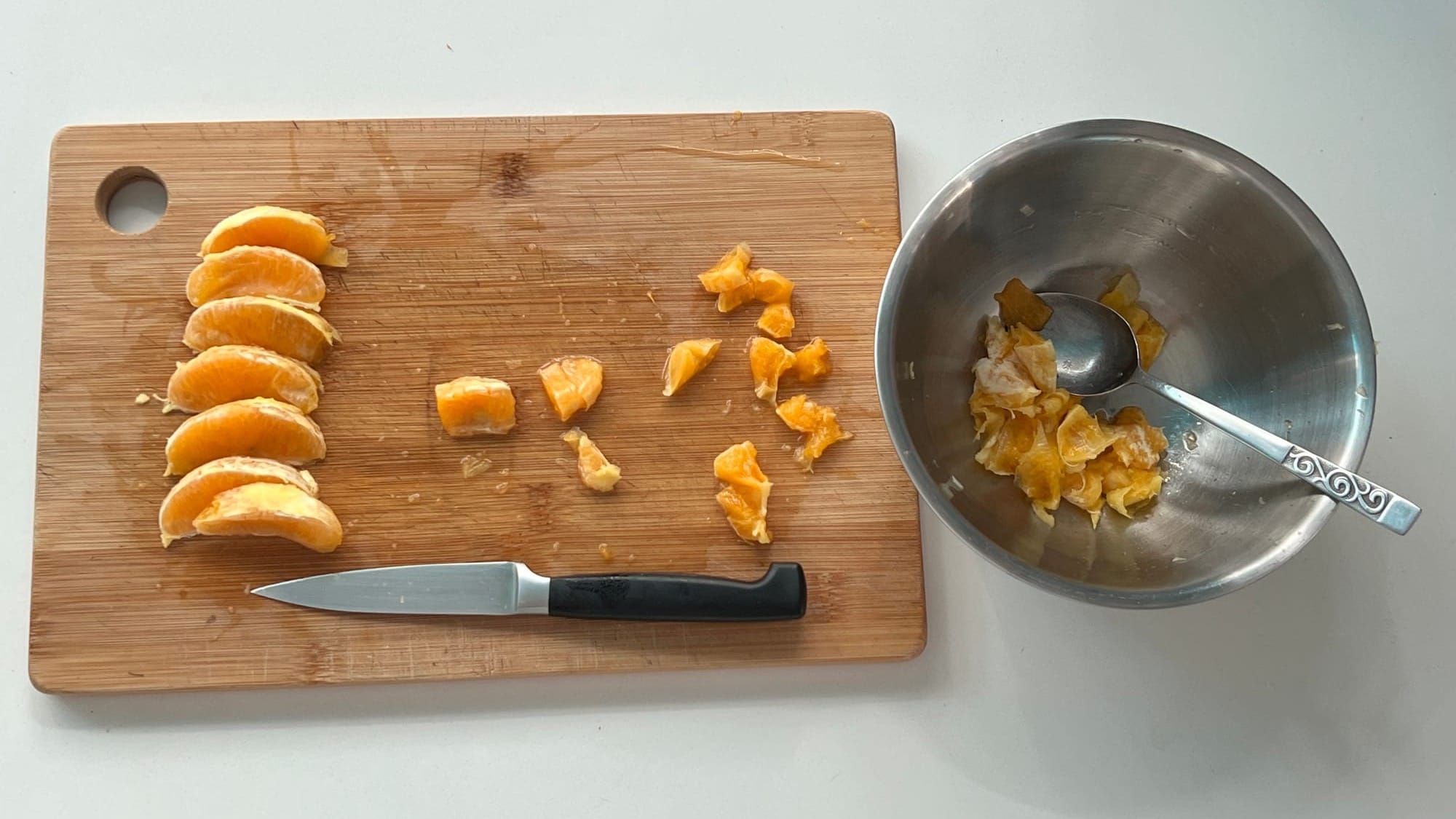
Preparing the orange for the dressing. By Pauline O'Connor
To make the dressing, peel the orange and divide into segments. With a knife, remove the skin of each orange segment to create small slices of orange with only the fruit. Then cut each segment into 3-4 pieces and add to a small bowl.
Squeeze in one tablespoon of lemon juice and season with a pinch of salt, cracked black pepper and cracked coriander seed. Add the olive oil. Finely chop the basil and add to the bowl. Mix well and set aside.
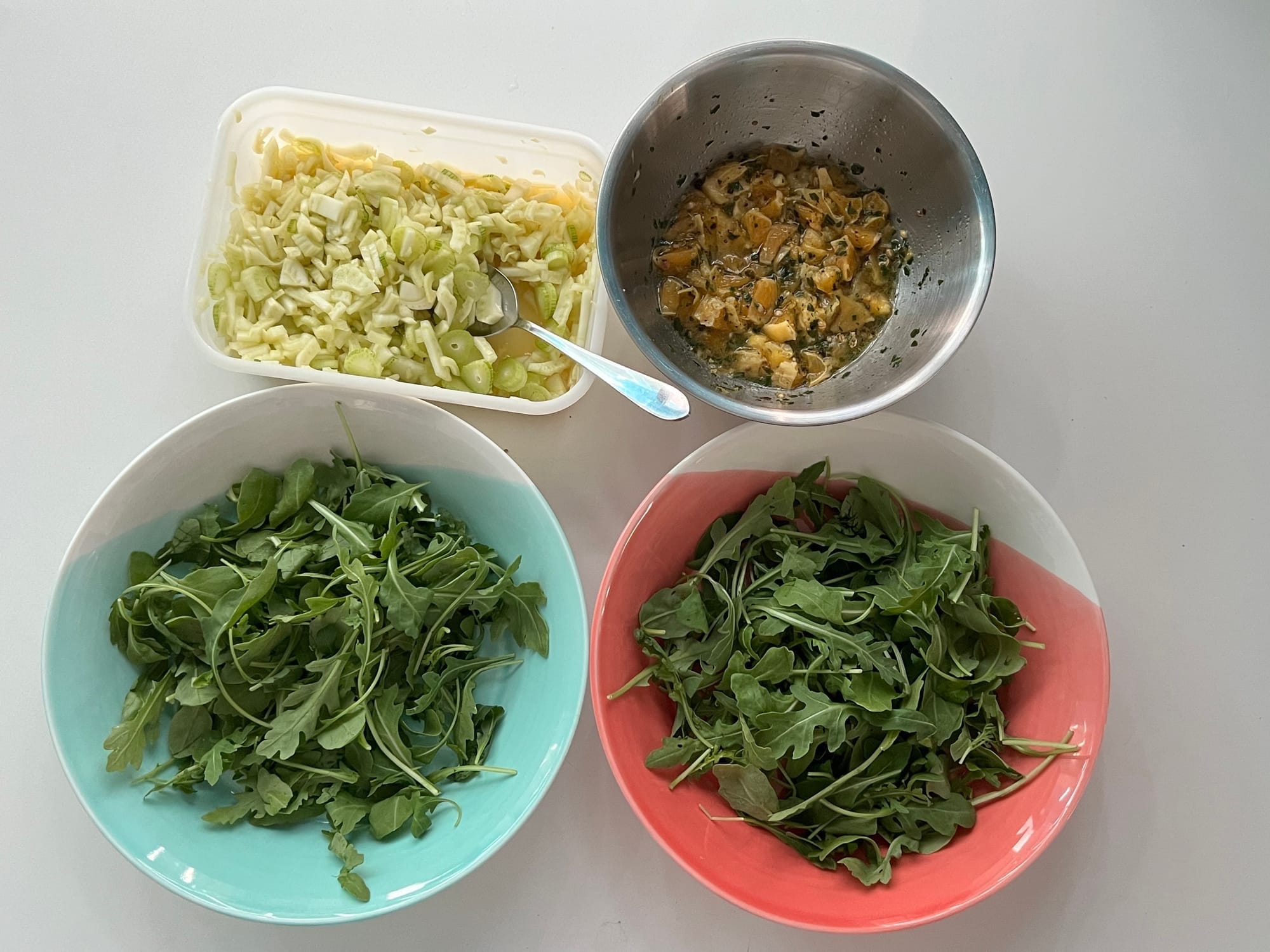
Assembling the meal. Marinated fennel (top right), orange dressing (top left), plates with rocket (bottom). By Pauline O'Connor
Arrange the washed rocket leaves on serving plates. When the fennel is marinated, spoon it over the rocket. Add the orange dressing and reserved fennel fronds, then serve.
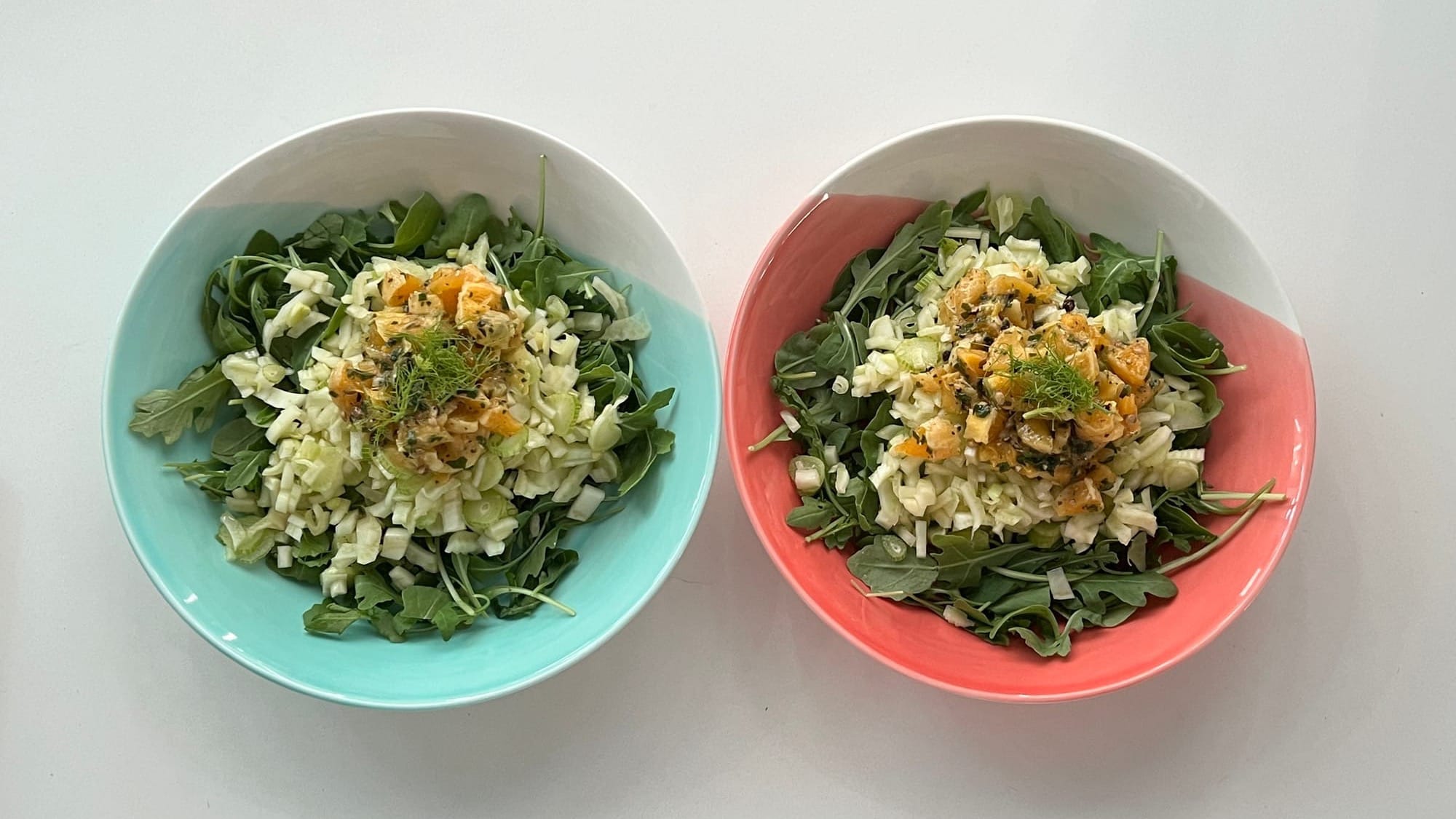
Fennel and orange salad, ready to eat! 1g protein per serving. By Pauline O'Connor
### I hope you enjoy this recipe, please let me know or add your suggestions!
### Endurance training with PKU & brain injury
URL: https://www.pigpen.page/endurance-training-with-pku-brain-injury/
Last updated: 2025-07-11T09:46:51.000Z
I’m training to walk 24 miles in one day — that is about 40 km, or 9 hours walking. This challenge is in memory of my dear friend Dara, and will take place on the first anniversary of her passing. The walk is organised by Marie Curie, a charity which provides palliative and end-of-life care in the UK. This isn’t just a meaningful tribute—it’s also a very personal challenge as someone with PKU and a history of mild brain injury.
## Why This Walk Matters
Dara passed away after a long battle with breast cancer. One of the things she spoke of was her gratitude to those in her local hospice who supported her and her family through this most challenging of times. Marie Curie are a charity which provides expert care to anyone, whatever the illness.
I committed to this walk because I want to mark the first anniversary of Dara’s passing in a way that felt special to me. My friends and I chose this walk because we wish to help other people and families who are facing the end of a loved life. Walking in Dara’s name, with the blessing of her family, honours her memory and celebrates the humanity in those who care for us when we need it most.
## My Real-Life Training Plan
Living with PKU means juggling the restrictions of a low-protein diet therapy with the demands of every day metabolism. Throwing in an endurance challenge means I need to double-down on ensuring I’m getting enough energy and nutrition without exceeding my protein limit. I also struggle with fatigue after brain injury, which can bring on migraines.
This means the right fuel is key to both training and walk day miles. I’m still looking for the right protein-free walking snacks — **there are only so many bananas I can carry! So, any suggestions would be much appreciated**
To date: my longest walk is 14 miles (ca. 23 km), which took 5 hours.
As summer progresses, I plan to take:
- Short, frequent walks to manage both physical and mental fatigue
- A small (clinic approved) increase in my PKU substitute
- more experiments with protein-free snacks and drinks
I also want to work on my expectations and allow more flexibility. If a plan collapses mid-week, I hope to see it as a regroup—not failure.
## More Than Just Miles
Beyond the miles, this journey is about proving that PKU, brain injury recovery, and hope can coexist on tough days. It’s a message of persistence.
I would love your support and suggestions as I carry on training! I do monthly updates from the trail, and you can find out more at [https://www.justgiving.com/page/pauline-oconnor-1](https://www.justgiving.com/page/pauline-oconnor-1?ref=pigpen.page).
### **Please** Share your encouragement & Spread the word!
### Thank you.
### 372 Miles for PKU
URL: https://www.pigpen.page/bristol-to-newcastle-2025/
Last updated: 2025-08-29T09:35:14.000Z
> One Man. 10 Days. An epic challenge.
## Bristol to Newcastle
At 7am on 28 July, PKU dad Ian Spriggs will jog out of the car park at Southmead Hospital, Bristol and point his battered trainers north. Ten days, 110-ish hours of foot‑time, and roughly 370 miles later, he hopes to trot through the doors of the Royal Victoria Infirmary, Newcastle, the hospital that has supported his daughter Molly since birth.
It’s a stretch of tarmac, tow‑path and trail most of us only see through a windscreen—yet Ian will cover every metre on foot to raise money for NSPKU.
## Why This Run Matters
The NSPKU is a patient charity which funds dietary materials, research, and peer networks that support families like Ian’s who are managing a life with PKU. Ian is no stranger to raising money for the NSPKU. His efforts over the last decade have **raised over £11,000** for the charity, which has supported many families with PKU in the UK.
Exactly one month after PKU day, Ian will start his epic journey — let us hope the weather is cooler for him! PKU Day is 28 June.
## Please support Ian!
> Ian’s runs have already banked over £11,000 for the charity; this one could push him well past £15 k.
## How You Can Help
### Donate
Ian’s JustGiving page is live ➜ [https://www.justgiving.com/page/ian-spriggs-1722771249493](https://www.justgiving.com/page/ian-spriggs-3?ref=pigpen.page)
### Share this email to raise awareness—and funds!
###
Cheer Ian on in person
(Times are approximates, as they depend on Ian’s feet)
- Bristol Southmead — 28 July 6:30 to 7am
- Birmingham Children’s Hospital — 31 July 10-10:30am
- Liverpool Alder Hay — 2 August 10:30 — 11am
- RVI Newcastle — 6 August, Hoping to finish at midday (12)
> Please pick a checkpoint, wave a banner, run a mile, hand over a banana, or cheer wholeheartedly
## Join Ian along the way
Ian told me that there is nothing better than people meeting him along the way, and jogging with him for a mile or two on the road.
“It is the best thing!” Ian told me. “When someone trots beside you, you stop inventing excuses to quit.”
He is still seeking people to meet for a small jog along the way. You can see his planned route and support him at: [https://www.justgiving.com/page/ian-spriggs-3](https://www.justgiving.com/page/ian-spriggs-3?ref=pigpen.page)
### PKU kids books
URL: https://www.pigpen.page/pku-kids-books/
Last updated: 2026-01-06T16:15:44.000Z
## Low Phe ABC & Colouring books
[Find these fun kids books](https://books2read.com/u/bzw1dG?ref=pigpen.page)
The Low Phe series is a collection of engaging books **designed especially for children with Phenylketonuria.** The series includes a full-colour ABC book, black-and-white Colouring book, and ebooks.
> Fullof foods which are considered protein-free for PKU in the UK, and have been checked by PKU clinicians.
## Low Phe ABC**:** A low-protein alphabet for PKU
The ABC book has colourful illustrations and easy-to-follow words, makes learning about low-protein foods fun and exciting. This is a full colour book available in both small paperback (32 pages) and in ebook.
## Low Phe Colouring**:** Low-protein colouring for PKU
The companion colouring book is a creative way for kids to explore their low protein foods and learn about safe fruits and vegetables! This is a black and white book available as a printed paperback (32 pages). Or you can purchase a PDF which allows you to print the colouring-in pages many times over.
> Whether you’re just starting your journey, or looking for a playful way to reinforce healthy eating habits, the Low Phe series is **the perfect companion for young readers with PKU**.
[Find these fun kids books](https://books2read.com/u/bzw1dG?ref=pigpen.page)
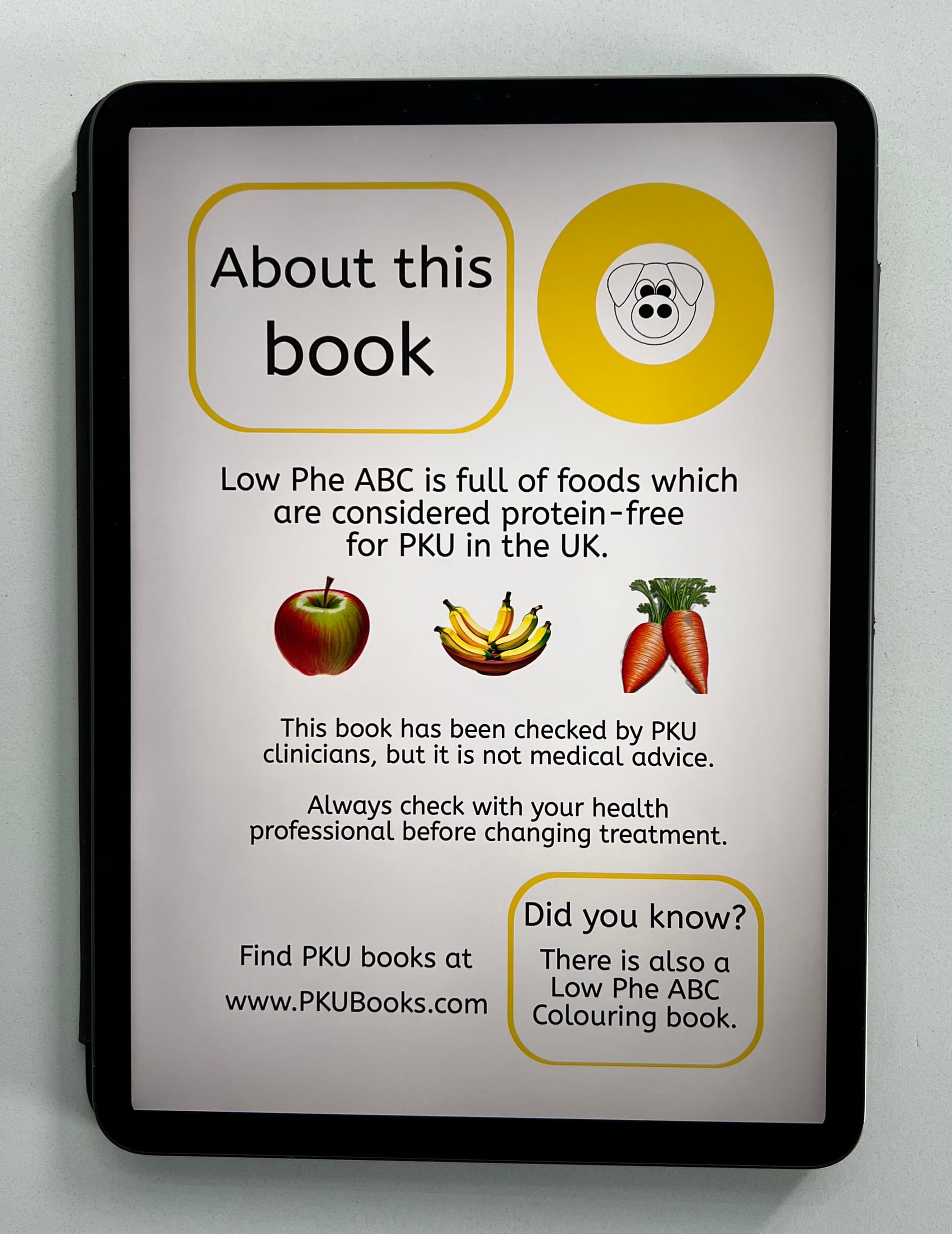
### Rare Creatives’ Lives
URL: https://www.pigpen.page/rare-creatives-lives-event/
Last updated: 2025-06-06T10:51:36.000Z
### [Catch up on YouTube](https://www.youtube.com/watch?v=miuzmwNEGHs&ref=pigpen.page)
**Celebrate PKU Awareness Month with "**[**Rare Creatives’ Lives: Storytellers on Rare Disease in the Arts**](https://www.linkedin.com/events/rarecreatives-lives-storyteller7327788292572069888/theater/?ref=pigpen.page)**".**
**All guest creatives either have PKU, or have PKU in the family:**
- Kevin Alexander (US), Producer, Writer, Videographer
- Kurt Sensenbrenner (US), Director, Producer, Cinematographer
- Pauline O’Connor (UK), Author, Publisher
- Jennifer J. Brown (US), Author, Publisher
- With Host:Lillian Isabella (US), Storyteller, Playwright, Producer
**The panel will discuss:**
- Who first inspired them to become creatives?
- What are their creative processes like now?
- How their storytelling shares rare disease lived experience?
- Advice for those who dream of a creative career?
- Why storytellers can spark advocacy in a rare disease community?
### [](https://www.linkedin.com/in/ACoAAAodTXMBHWPC7OVT8uPHH-bMiIlFTMWZJgk?ref=pigpen.page)[Kevin Alexander](https://www.linkedin.com/in/kevinalexander/?ref=pigpen.page)
Kevin is an adult living with PKU. His documentary "My PKU Life" is about his experience with PKU, and a short film "For Katy" illustrates the impact of a delayed PKU diagnosis and importance of newborn screening. He currently writes for his website, [PKUJournal.com](http://pkujournal.com/?ref=pigpen.page), is a volunteer for the National PKU Alliance, advocate with the Louisiana Metabolic Disorders Coalition, and member of the International Society of Neonatal Screening.
### [](https://www.linkedin.com/in/ACoAAAgFEWsBzeIq-DD5iHgKzDupKORC9ly1cIc?ref=pigpen.page)[Kurt Sensenbrenner](https://www.linkedin.com/in/ksensenb/?ref=pigpen.page)
Kurt is a freelance director, producer, and cinematographer who happens to have PKU. In 2017, his documentary “From Mass to the Mountain” aired on PBS and helped cause legislative change in Eastern Panama. In 2020, Kurt created an animated-documentary-comedy series about living with PKU, “The Low Phe Life”. Twelve episodes and 40+ screenings later, he’s in negotiations for a third season!
### [](https://www.linkedin.com/in/ACoAADgVYggBjU7AKaaZqF48oRv-dv9gJL3Uyo0?ref=pigpen.page)[Pauline O'Connor](https://www.linkedin.com/in/pauline-o-connor-pigpen/?ref=pigpen.page)
Pauline is an author of fiction and non-fiction, and a patient advocate. She campaigns for brain injury survivors and for those diagnosed with the rare disease, phenylketonuria (PKU). Her book “Living with PKU: A Low Protein Life with Phenylketonuria” (2022) is a valuable resource for adults and teens with PKU, or for families new to the disorder.
### [](https://www.linkedin.com/in/ACoAAAEr7yMBcEluV8seLmuBKR5LNDYcjRH5lMg?ref=pigpen.page)[Jennifer Brown](https://www.linkedin.com/in/jenniferbrownphd/?ref=pigpen.page)
is an independent author and publisher, her latest book “When the Baby Is Not OK: Hopes and Genes”, is a memoir on childbirth and parenting of two daughters diagnosed with PKU. She has a PhD in genetics from SUNY Stony Brook, and is a mentor for people living with PKU and their caretakers, at the National PKU Alliance.
### [](https://www.linkedin.com/in/ACoAAAQNu%5F4BLzwKpt05oydm3OHdE1nOGVtZGkA?ref=pigpen.page)[Lillian Isabella](https://www.linkedin.com/in/lillianisabella/?ref=pigpen.page)
Lillian is a playwright, producer, and performing artist from The Bronx. She holds a BFA in Theatre from NYU, Tisch School of the Arts. Lillian uses verbatim documentary theatre as a vehicle to amplify ‘other’ voices and transmute personal pain into collective power. Recent productions include, PRIMORDIAL (The Tank - Core Production / NYC), HOW WE LOVE/F\*CK (Cherry Lane Theatre / NYC – Finalist, Screencraft Film Fund), THAT’S HOW ANGELS ARRANGED (Metropolitan Playhouse / NYC).
### [Catch up on YouTube](https://www.youtube.com/watch?v=miuzmwNEGHs&ref=pigpen.page)
### Low-protein Waldorf Salad
URL: https://www.pigpen.page/low-protein-waldorf-salad/
Last updated: 2025-05-29T14:47:16.000Z
### Ingredients:
1 red apple
1/2 stalk celery (optional)
20 g PKU friendly feta cheese, diced or crumbled
6g pinenuts or walnuts (1g protein, be careful weighing out nuts!)
Handful of fresh rocket
Olive oil
Lemon juice
Salt & pepper to season
1. Core & dice the apple. Put this into a large bowl and sprinkle with a tiny bit of salt to bring out the flavour while you prepare the rest of the salad.
2. Dice the celery and the cheese then mix into with the apple with the pine nuts and rocket. Drizzle with olive oil and lemon juice.
3. Mix and taste to see if it needs more salt & pepper.
**Optional extras**
I will often add in a few bits which I have in the fridge. So far, the following have made great additions to change the meal up a bit:
- diced avocado
- plant-based & [low-protein 'salmon'](https://biffs.co/our-food/?ref=pigpen.page)
- raisins or sultanas
- diced orange
## Share your low-protein food ideas
I am always interested in more low protein and protein free lunch ideas. Share your ideas by replying to the email, or commenting below.
## Sign up for PigPen: Pauline O'Connor, author & advocate.
Pauline O'Connor. Author & advocate for PKU, brain injury, & mental health.
Subscribe
Email sent! Check your inbox to complete your signup.
No spam. Unsubscribe anytime.

## Tip Pauline
This blog runs on your support.
[Buy Pauline a cuppa ☕](https://donate.stripe.com/14keYi5dp9E26Oc9AA?ref=pigpen.page)
### The Memory: we that are left
URL: https://www.pigpen.page/the-memory/
Last updated: 2025-05-29T14:50:19.000Z
(From [*The Red Hat Stories*](https://www.pigpen.page/the-red-hat-stories/), by Pauline O'Connor. Published 2024.)
Third of September 2014\.
The date was everywhere. Screened in bright lights on the departure board. Printed on the newspaper that lay on the train seat in front of him. Does no one else see it?, he wondered. Does no one else remember?
That morning, the radio announcer hadn’t paused after reading out the date. They had just carried on with the headlines, as if the date didn't matter.
A nudge from someone brushing past caused the old man to grasp for a handhold. The transgressor, a young woman, tossed a belated “excuse me” over her shoulder. The train started to move. The man picked up the paper, and lowered himself into the seat.
Seventy-five years ago today it had started. The day Chamberlain announced the news they all feared: "this country is at war with Germany”. Surely people would remember the date. It wasn’t the worst day of his life. But it led directly to the one that was, as surely as death follows life.
An announcement interrupted his thoughts, and he listened carefully. The monotone voice confirmed he was on the correct train. Reassured, he felt his leg stop shaking. He was on his way and had secured a seat.
When had catching a train become such a trial? He couldn’t say, but it didn't used to be so hard. He hadn’t always woken early to check the route umpteen times. Maybe his granddaughter was right. Maybe ninety was too old to be travelling on his own.
Simply checking the running times is harder these days. How to work the Internet, or write a text to get departure times? You used to pick up a printed timetable and the trains ran at those times. You could set your watch by them. Now the station was full of announcements and screens covered with confusing messages. There was no one around to help any more.
He was old, of course. Hearing aids and walking sticks had replaced the bravado of his youth. But that didn’t seem enough to account for all the changes. No, people have changed too. That young woman who had pushed past, for example. People used to have manners, and would wait rather than shove along. That woman wouldn’t help anyone.
It wasn’t just her; no one seemed to have manners any more. It was as if they were all locked in their own little world, not noticing the others around them. Not remembering what some had given. When was the last time anyone had said “thank you”? He couldn’t seem to remember that either.
> Not remembering what some had given
As he watched the woman, the train went into a tunnel. The lights flickered as the wheels screamed over the points. The woman’s red hat seemed to come alive as yellow light skittered across it. The man’s breath caught and his pulse quickened. The screaming of the metal grew unbearable, and so like those twisted engines. Blackness encroached, and he was lost to that hectic night once more.
It was supposed to be a routine flight. A night raid on a suspected bomb factory in northern Germany. Straight flights, keep in formation, deliver the payload and back in time for bacon & eggs. Until that cold February night.
The target was sighted and the bomb dropped. Not a direct hit, but effective enough. Evans had been improving in the last couple of raids. The captain ordered the run home and had just promised another round in the airfield bar.
A massive impact came with no warning. The plane was smashed sideways, and he was thrown against the fuselage. There was a terrible screech of metal, the engines roared and sputtered. The plane started to spin downwards, always down.
He was shouting into the radio, god knows what he was saying. Whatever had been drilled into him during training. The floor flew up to meet him, and his world exploded into darkness.
Coming up out of the void, he heard a roar of flames and the pinging of hot metal. Someone was shouting and someone else screaming. There was something on his temple, and a stabbing pain which nearly knocked him out again. The terrible screams stopped, and he could hear now that the shouts were edged with terror. Slowly, unwillingly, he formed the noise into words. They were shouting his name. He forced his eyes to open.
The world was still black, but edged with flickering light. High above him, shadows swirled against the stars. There were brief flares of explosions. The shouts stopped, and the view above was blocked by a familiar face. “Thank god you’re awake. The captain is bad, but Bexley and Hunter didn’t make it. We thought you wouldn’t either, but you must have a thick skull under there.”
Evans thrust a canteen into his hand and disappeared. After a sip, he lay back. The last he remembered was hitting his head. He felt gingerly around the throbbing pain. There was a bandage, which didn’t seem to be doing much to stop the blood. His blood.
He took a deep breath and sat up. The world swam, but he gritted his teeth and waited for it to settle. He had been pulled free from the blazing hulk of metal which used to be the plane. Over to the right, where the screams had come from, were two disturbing shapes. He caught his breath as the world threatened to go black again.
> Bexley and Hunter didn’t make it
Bexley and Hunter didn’t make it. He couldn’t think of that now. Needed to keep himself together. We were on a mission. We got the target. Bexley and Hunter didn’t make it.
We were headed home. We were shot down. Bexley and Hunter didn’t make it.
We were still over Germany. Bexley and Hunter didn’t make it.
We are still in Germany. Bexley and Hunter didn’t make it.
We are still in Germany.
We have to move.
I have to move.
I have to get up.
Now!
The old man jerked to his feet and lost his balance. Disorientated from the vivid memory, he realised he was in a train carriage, but couldn’t remember why. He was leaning against a young woman who had caught his fall. She was looking at him, asking if he was OK.
“Yes” he croaked. Then he cleared his throat and assured the woman that he was fine. They sat down again. The woman offered him some water, which he gratefully accepted. The old man recovered his breath and composure while the train rumbled on. The woman returned to her book, losing herself into the story.
Bexley wouldn’t have sat here watching her. He’d have been straight over. Never lost a chance to talk to the ladies, did Bexley. With so many on the go, he’d never managed to keep a lady either. Hunter and Evans teased him about that. Well, teased and admired him for it. Bexley would grin back. “It’s a gift lads, what can I say?”
The woman smiled as she read something amusing. I was wrong about you, he thought. The lads would like you, too. You’d probably like them, you’d like their jokes. Well, maybe not Hunter’s jokes. No one liked those.
But the lads are all gone now. You won’t know them, or what they did. I wish you knew them. I’d like to tell you about them.
The train jostled into a station and the young woman stood. She nodded at him, then turned and left the train. Her red hat bobbed past the window and was gone. The old man sighed: “They shall not grow old”.
> They shall not grow old, as we that are left grow old.
From [*The Red Hat Stories*](https://www.pigpen.page/the-red-hat-stories/), by Pauline O'Connor. Published 2024.

Cover for "The Red Hat Stories"

## Tip Pauline
This blog runs on your support.
[Buy Pauline a cuppa ☕](https://donate.stripe.com/14keYi5dp9E26Oc9AA?ref=pigpen.page)
### Living with Mild Brain Injury
URL: https://www.pigpen.page/mild-brain-injury-3/
Last updated: 2025-06-24T14:33:27.000Z
## The Difficulties of Diagnosis and Recovery from Post-Concussion Syndrome
## [*Read a free sample of Living with Mild Brain Injury*](https://www.amazon.co.uk/Living-Mild-Brain-Injury-Post-Concussion-ebook/dp/B08QXQ587P/ref=sr%5F1%5F1?crid=1PH4Y4OWGD90C&dib=eyJ2IjoiMSJ9.kPkn643zpPMNU068LCqNEw.RgH9TEkj9f6YNXuQjmx0h5YRmLnl4Nwtc%5FkpJgsB3wE&dib%5Ftag=se&keywords=living+with+mild+brain&qid=1750772728&sprefix=living+with+mild+brain%2Caps%2C61&sr=8-1&asin=B08QXQ587P&revisionId=4023334b&format=3&depth=1&ref=pigpen.page)
### A vivid memoir of concussion, recovery, and rediscovery.
This compelling memoir charts Pauline’s real-life experience—with symptoms, misdiagnosis, and a hidden bleed following a football tackle. Combining diary entries, clinic notes, and raw emotion, it offers invaluable insight for survivors, families, and healthcare professionals.
> "⭐⭐⭐⭐⭐ I was engrossed, and read the book in a day."
[Buy now](https://books2read.com/u/mezJ1Y?ref=pigpen.page)
### Who it's for:
- Brain injury survivors
- Loved ones and carers supporting someone with mild TBI
- Neurorehabilitation professionals
- Brain Injury awareness advocates and organisations
### What you’ll discover:
- Common hidden concussion symptoms
- Pitfalls in diagnosis and uneven recovery paths
- Impact on relationships, work, and identity
- A roadmap to resilience, informed by lived experience
### Author Insight
> *"I wrote this to share my journey* of *an invisible* condition*—and to show that a happy life is still possible."*
### Praise for *Living with Mild Brain Injury*
###
“**Incredibly vivid**… this book will be of great benefit to professionals, survivors and their families alike.” **Dr Neil Parrett*, MA(hons), DClinPsy, PgDip, CPsychol. Consultant Clinical Psychologist (Neurorehabilitation)*
⭐⭐⭐⭐⭐ "A **brilliantly written, and emotional** narrative of the author's struggles following a concussion during a football match... I was engrossed and read the book in a day. The book shows that even so called "mild" brain injury is anything but mild, especially to the person affected by it." *MrK via Amazon.*
⭐⭐⭐⭐⭐ "I found it to be a deconstruction of all the ways the brain helps us out as well as a reconstruction of the author's mental health and wellbeing, I was instantly gripped and found it **incredibly fascinating**." Solomon *via Amazon*
### Buy the Book:
- [Paperback](https://books2read.com/u/mezJ1Y?ref=pigpen.page)
- [eBook](https://books2read.com/u/mezJ1Y?ref=pigpen.page)
- [Read a free sample](https://www.amazon.co.uk/Living-Mild-Brain-Injury-Post-Concussion-ebook/dp/B08QXQ587P/ref=sr%5F1%5F1?crid=1PH4Y4OWGD90C&dib=eyJ2IjoiMSJ9.kPkn643zpPMNU068LCqNEw.RgH9TEkj9f6YNXuQjmx0h5YRmLnl4Nwtc%5FkpJgsB3wE&dib%5Ftag=se&keywords=living+with+mild+brain&qid=1750772728&sprefix=living+with+mild+brain%2Caps%2C61&sr=8-1&asin=B08QXQ587P&revisionId=4023334b&format=3&depth=1&ref=pigpen.page)
[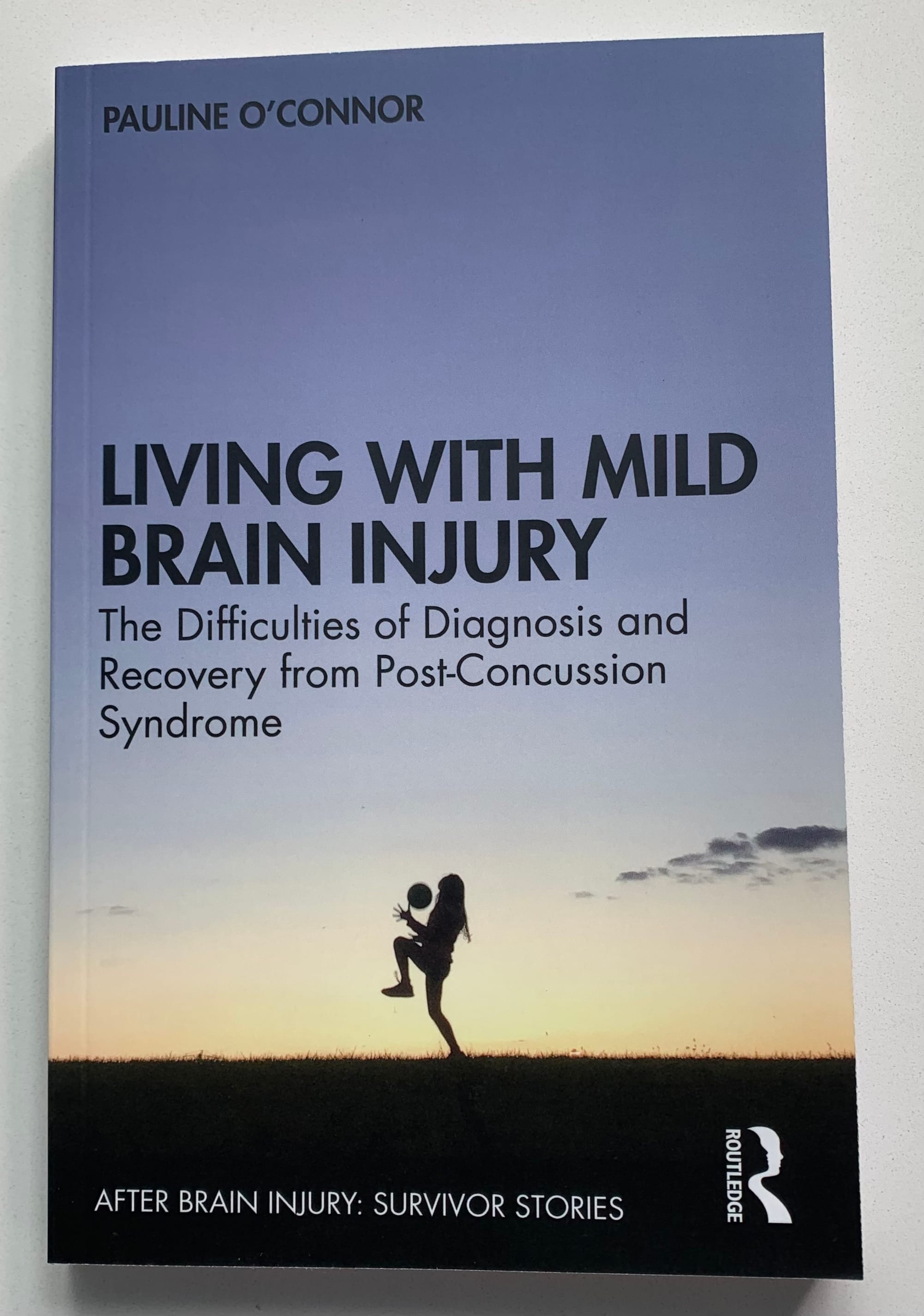](Living with Mild Brain Injury: available in paperback and ebook.)
### The origins of PKU treatment
URL: https://www.pigpen.page/origins-of-pku-treatment/
Last updated: 2025-04-25T13:09:21.000Z
PKU was discovered in 1934, but was considered untreatable for decades. Then, a team at the Birmingham Children’s Hospital took up the challenge. Prof. Anita MacDonald showed me round the BCH for an afternoon of PKU legends, both past and present.
## Mary and Sheila Jones
Birmingham Children’s Hospital (BCH) set up a screening programme for PKU in the early 1950s. The team had a positive result on their third test, a young girl named Sheila. Sheila’s mother, Mary, knew that something was impairing the development of her third child. Concern led her to her local doctor, who in turn referred Sheila on to the Birmingham Children’s hospital.
> Mary's persistence drove the doctors to develop a treatment for PKU
The clinical were thrilled to have discovered a patient with this condition so quickly in their trial. Mary Jones was more interested in a treatment for her daughter, and simply would not accept that there was no therapy for this rare condition. It was her persistence which drove the doctors to develop a treatment for PKU.
## Remembering Sheila, the first patient treated for PKU
In 2023, the European Society for Phenylketonuria and Allied Disorders Treated as Phenylketonuria (or E.S.PKU) held its annual conference in Birmingham to commemorate 50 years of a treatment for PKU. A [plaque commemorating Sheila](https://bwc.nhs.uk/news/plaque-unveiling-at-birmingham-childrens-hospital-to-honour-pioneering-patient-and-team-that-helped-change-lives-10061?ref=pigpen.page), her mother Mary, and the clinical team was unveiled at the BCH during the conference.
Professor Anita MacDonald told me of the desire to ensure that the legacy of Sheila and the BCH team would be recognised for future PKU generations too. The plaque was unveiled by Sheila’s brother, Trevor Jones, who said that even he was not aware of “how big a contribution Sheila and my mum made around the world, I’m so in awe of them.”
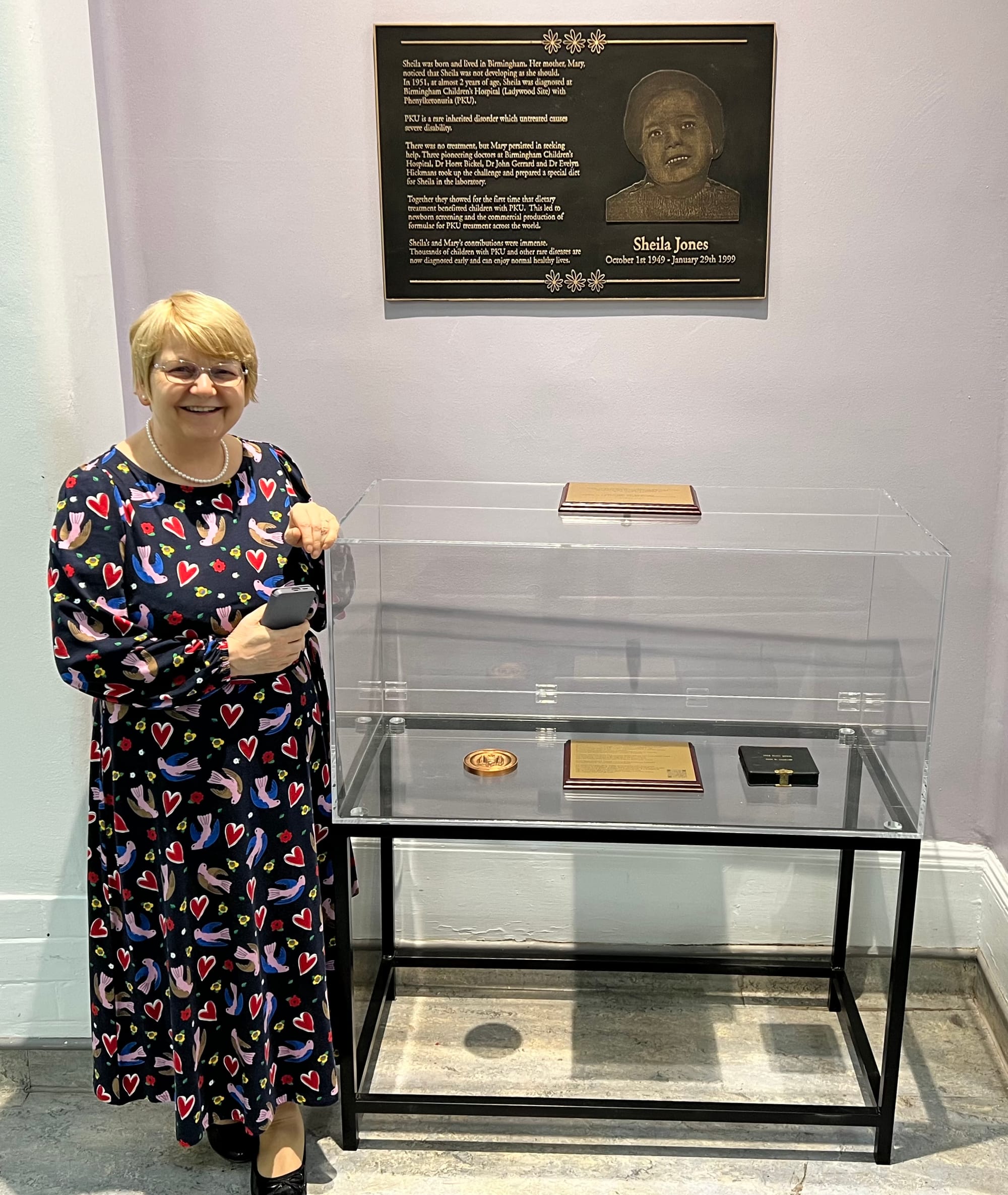
Professor Anita MacDonald with the plaque commemorating Sheila Jones, and Dr. Gerrard's John Scott Medal.
## The BCH team working on a treatment for PKU
Dr Evelyn Hickmans had established the Biochemistry laboratory at Birmingham Children’s Hospital in 1923\. Dr Hickmans was a formidable lady who poured her knowledge and experience into setting up the BCH laboratory in the inter-year wars.
Dr Horst Bickel had a PhD in Aminoaciduria, or the study of unusual proportions of amino acid indicators in urine. This meant he also had knowledge of the chromatographic techniques required to measure them. It was Bickel who would operate the charcoal filtration system used to synthesise the first treatment for PKU. (See below.)
Dr John Gerrard worked at BCH following wartime service in the Royal Army Medical Corps. He was part of the team developing the PKU treatment before leaving for a career in Canada.

Citation of Dr Hickmans' John Scott Medal, displayed in Birmingham Children's Hospital Metabolic lab.
## The John Scott Medal
Drs Gerrard, Bickel, and Hickmans received the prestigious John Scott medal in 1962 for their work on developing a PKU treatment. (Pictured in the title photo.) The John Scott Medal was created in 1816, to be presented to men and women whose inventions significantly improved the ["comfort, welfare, and happiness of humankind](https://thejohnscottaward.org/1951-2010.html?ref=pigpen.page)". Previous recipients include Marie Curie, the Wright Brothers, and Nikola Tesla.
## Removing phe from the diet
Adjusting the amino acid level in food was not entirely unprecedented. A method for removing phe from natural protein had been developed in the United States. This was achieved by first breaking a natural protein down into the constituent amino acids, and then filtering out the phe. However, this was the first time anyone had attempted to remove phe from food for the purposes of treating PKU. Fortunately, there was a source of expertise in the UK.
Dr Louis Woolfe worked at Great Ormond Street Hospital. He had experience of breaking down a milk protein into constituent amino acids to treat malnutrition. Dr Woolfe had already realised his technique may be useful in treating PKU, but had yet to find an opportunity to do so. When contacted by the team at Birmingham Children’s Hospital, he shared his expertise with Dr Hickmans and her team in the hospital laboratory.
## Filtering out protein
The team filtered a protein derived from milk through activated charcoal to remove phenylalanine. This was a messy job, and Bickel was banished to the hospital basement when the formula needed to be prepared. The milk was filtered through a Professor-MacDonald-sized glass column (see photo below), which removed some amino acids, including phe. The other essential amino acids were added back into the formula to provide a complete, if unpleasant, treatment for Sheila.
Prof. MacDonald presents the laboratory equipment used to make the first treatment for PKU.
## The legacy at BCH
> A worthy reminder of the thousands of lives improved by the efforts of these pioneers in PKU treatment.
Many thanks to Professor MacDonald for her turn as a charming and knowledgeable tour guide (another talent for the CV!). This homage to the home of PKU treatment was of personal importance for me and my family. It was also a worthy reminder of the thousands of lives improved by the efforts of these pioneers in PKU treatment.
I was touched to see that BCH do commemorate their legacy in the halls of a bustling hospital. The history sits comfortably with the cutting-edge research and trials undertaken in a modern clinic, which continues to be a model of excellent for PKU treatment.
However, the living legacy of PKU legends such as Hickmans, Bickel, Gerrard, Wolfe, Guthrie, Cockburn, MacDonald, and the hundreds of other clinicians treating PKU and rare diseases remains the multitude of lives they have touched and improved.
### Financial Support
URL: https://www.pigpen.page/financial-support/
Last updated: 2025-06-23T13:14:26.000Z
Helen Morris presented at the Metabolic Support UK conference on financial support available in the UK. Not all the advice was relevant to PKU, however, a low-protein diet is used to treat several metabolic conditions.Check if you are be eligible for extra support!
## The need for support
Helen reported that enquires about finding financial support from families with IMDs in the UK had quadrupled over the last year. For this reason, the first session in the MSUK annual conference was dedicated to an overview of benefits and eligibility. You can find more about the MSUK and their conference here.
## What support am I eligible for?
The most common benefits available to the IMD community are:
- [DLA (under 16s)](https://nspku.org/benefits/?ref=pigpen.page)
- Personal Independence Allowance (PIP)
- Carers Allowance
- Universal credit
- Other benefits available to those on the above.
The best place to seek help are Benefit calculators, as these often suggest benefits you can claim which are linked to your current allowances.
## Benefits Calculators
These are independent, free, and anonymous. They will check the benefits you might be entitled to, and how these might vary with a change of circumstance.
- [Policy in Practice better off calculator](https://www.betteroffcalculator.co.uk/login?ref=pigpen.page)
- [entitledto benefits calculator](https://www.entitledto.co.uk/?utm%5Fsource=BAdviser&utm%5Fmedium=referral&utm%5Fcampaign=GovUK)
- [Turn2us benefits calculator](https://benefits-calculator.turn2us.org.uk/?ref=pigpen.page)
It is worth checking these if you are already received benefits, as many people who care for others with a benefit may be entitled to the Carers allowance.
## Tips for applying
- Fill in the forms in pencil first, or write your answers on another piece of paper initially. This means you can refine them or correct mistakes without needing new forms.
- Take your time, and be thorough. Think of everything required in each step of the day. You might want to tackle one thing at a time.
- Keep a copy of your forms! 8/10 people who are appealing have not kept a copy of their form, which hinders their appeal.
- Turn2Us has information to help you when applying for PIP. [https://pip.turn2us.org.uk/](https://pip.turn2us.org.uk/?ref=pigpen.page)
## MSUK and NSPKU are there to help
If you have any questions, the MSUK team are there to help.[https://metabolicsupportuk.org/support-information/contact/](https://metabolicsupportuk.org/support-information/contact/?ref=pigpen.page) Plus, they have online resources, including information on how the latest budget might affect those with IMDs.
The NSPKU has a confidential phone line to help with PKU, and you can find out more at: [https://nspku.org/benefits/](https://nspku.org/benefits/?ref=pigpen.page)
## Finding support in other countries
**Ireland:** [**PKU Association of Ireland**](http://pku.ie/?ref=pigpen.page)
**Europe**: [ESPKU](https://www.espku.org/?ref=pigpen.page) \- The European Society for PKU and allied disorders treated as PKU. A grouping of national and regional associations which were created by parents across 31 countries. Find your national or regional organisation here**:** [https://www.espku.org/who-we-are/interesting-stuff/](https://www.espku.org/who-we-are/interesting-stuff/?ref=pigpen.page)
**USA:** [NPKUA](https://www.npkua.org/?ref=pigpen.page) \- National PKU Alliance
**Canada:**[CanPKU](https://canpku.org/?ref=pigpen.page)
**Australia & Aotearoa/NZ:** [ASIEM](https://www.hgsa.org.au/asiem?ref=pigpen.page) \- Australasian Society for Inborn Errors of Metabolism
### What is PKU?
URL: https://www.pigpen.page/what-is-pku/
Last updated: 2025-06-10T09:53:06.000Z
I have been asked to explain PKU many times; by friends, colleagues, teachers, hospitality workers… I’ve even briefed medical staff on the ins & outs of PKU. A world in which everyone has their speciality can reduce awareness of other conditions.
This means that I often consent to medical students joining my clinic appointments. Patient to clinician time is key to understanding rare diseases. During one of these sessions, my doctor asked: ‘Pauline, how would you describe your PKU to my colleague?’
## Describing PKU
*Deep breath in*: “I have inherited a mutated gene meaning my body cannot produce a particular enzyme which breaks down an essential amino acid. Amino acids are the building blocks of protein, so I have to dramatically restrict the amount of protein I eat every day.
If I eat too much protein, the amino acid builds up in my blood like a toxin affecting my neurological and central nervous systems. Ultimately, too much protein in my food can lead to brain damage.”
> I have to dramatically restrict the amount of protein I eat every day.
At this point most people say “**Woah, what did you call it again!”** Or I might say: “You know that warning on the back of soft drink cans ‘May contain Phenylalanine’? Well, it’s me they are warning.”
## Sign up for PigPen: Pauline O'Connor, author & advocate.
Pauline O'Connor. Author & advocate for PKU, brain injury, & mental health.
Subscribe
Email sent! Check your inbox to complete your signup.
No spam. Unsubscribe anytime.
## Foods not allowed on a low-protein diet
- Meat
- Fish, including Shellfish
- Eggs
- Cheese (some new vegan cheese is ok, but not all vegan cheese)
- Nuts and Seeds
- Flour-based foods (bread, cakes, biscuits etc.)
- Soya & Tofu
- Quorn
- Any medicine or food containing Aspartame (an artificial sweetener)
It is complicated, and the list goes on. Usually, someone interrupts to exclaim, “What do you actually eat?”
## What do you actually eat with PKU?
“Well, I’m allowed to eat most, but not all, fruit and vegetables. There are medically produced pasta and rice substitutes which I get on prescription. There is also a medical flour allowing me to bake my own bread. To supplement this diet, I need to take prescribed supplements every day which make sure I get things like iron and calcium as I can’t have meat & dairy.”
> This isn't a choice, PKU is not a lifestyle diet. It is a critical medical condition.
At some point during this explanation, someone will ask: "Why you can’t eat all that?"
"Because I’ll get brain damage."
"Yeah, but, like, why can’t you save up and have a steak one night?"
"Nope, it doesn’t work that way."
"What if it is a special occasion? Like, just take one night off!"
"This isn't a choice, it doesn't work that way."
"Yeah, but…"
"I can’t have a day off. It doesn’t matter whether it is your birthday or Christmas. If I eat too much protein, then it will build up in my blood to levels which harm my brain."
For some reason, even though this isn’t my fault, I will then say "sorry".
## PKU is nobody's fault
**It is nobody’s fault that we were dealt this hand.** There was nothing our parents or grandparents did, or didn’t do. It just is what it is. And it sucks. All we can do is make the best of it, and press for better treatments.
## Support for Living with PKU
There are patient organisations which help to support people with PKU and actively promote new research and treatments.
**UK:** [**NSPKU**](http://www.nspku.org/?ref=pigpen.page) **\-** The National Society for Phenylketonuria
**Ireland:** [**PKU Association of Ireland**](http://pku.ie/?ref=pigpen.page)
**Europe**: [ESPKU](https://www.espku.org/?ref=pigpen.page) \- The European Society for PKU and allied disorders treated as PKU. A grouping of national and regional associations which were created by parents across 31 countries. Find your national or regional organisation here**:** [https://www.espku.org/who-we-are/interesting-stuff/](https://www.espku.org/who-we-are/interesting-stuff/?ref=pigpen.page)
**USA:** [NPKUA](https://www.npkua.org/?ref=pigpen.page) \- National PKU Alliance
**Canada:**[CanPKU](https://canpku.org/?ref=pigpen.page)
**Australia & Aotearoa/NZ:** [ASIEM](https://www.hgsa.org.au/asiem?ref=pigpen.page) \- Australasian Society for Inborn Errors of Metabolism
My posts about PKU are all collected[ here.](https://www.pigpen.page/tag/pku/)
\*First published 1 May 2019, updated 28 February 2025.

## Tip Pauline
This blog runs on your support.
[Buy Pauline a cuppa ☕](https://donate.stripe.com/14keYi5dp9E26Oc9AA?ref=pigpen.page)
### Publishing paths
URL: https://www.pigpen.page/publishing-paths/
Last updated: 2025-03-17T10:47:12.000Z
Jane Friedman’s chart on “[The Key Book Publishing Paths](https://janefriedman.com/key-book-publishing-path/?ref=pigpen.page)” has been updated for 2025-2026\. It highlights the many routes to publication, and prompted me to reflect on my experiences with traditional and self-publishing.
## The Reality of Publishing Today
Publishing is a tough industry, and the average author’s income is declining. The [ALCS survey](https://www.alcs.co.uk/news/why-writers-are-at-a-loss-for-words/?ref=pigpen.page) of primary occupation authors (those who spend at least 50% of their time writing) found that earnings dropped to just £7,000 per year in 2022—well below minimum wage. This makes understanding all publishing options even more important.
I have experience with both traditional and self-publishing. My first book was picked up by an academic publisher, while I self-published my second due to its niche subject and my established presence in that field. This mix of approaches makes me a **hybrid author** (not to be confused with a *hybrid publisher*, which, as reported in the last summer’s issue, is often a scam.)
## Lessons from Traditional Publishing
My first book was published by Routledge on December 30, 2020—right in the middle of a Level 4 lockdown. Not an ideal time for a launch! Unfortunately, I had no control over the timing. This was my biggest lesson from traditional publishing: as a new author, you have very little say in the process.
### Navigating the Publishing Contract
Knowing my inexperience, I joined The Society of Authors for contract advice. Their team counselled that academic publishing contracts offer minimal control and low royalties. They advised me to focus on why I wanted my book published, rather than on any financial rewards. This was disheartening but realistic.
This book was a memoir, written during my recovery from a brain injury. I had searched for a book which might help me to understand the experience, but found none. So, I wrote my own. I wanted to help other patients, and their families, and to offer clinicians insight from the patient’s perspective.
Academic publishing seemed like a good fit due to its reputation and global reach. However, the contract allowed the author little control, and the royalty percentage was in single digits. Again, I was assured that this was standard for an unknown author negotiating an academic publishing contract.
One key piece of advice from The Society of Authors proved invaluable: they helped me remove a “first refusal” clause. Had I left it in, I would have been contractually obligated to submit all future books to Routledge first, limiting my options.
### Beyond the Manuscript: The Author’s Responsibilities
Another lesson I learned was that submitting a manuscript was just the beginning. As the author, I was responsible for:
- Collecting copyright permissions
- Ensuring bibliography, references, and footnotes were correct
- Producing the index
- Formatting the above to the publisher’s specifications
While I could hire help for these, any costs spent on these were mine to bear.
Routledge provided a copy editor, and I checked the files over several days. However, during copyediting, the book’s formatting was altered. It took multiple rounds of edits to fix—a time-consuming process.
### The Marketing Burden
On publication, my book was listed in catalogues, and I received a promotional flyer and an email signature. Everything else—PR, networking, pitching articles, applying for awards, and social media marketing—was up to me.
It is important that all authors, whether traditionally or self-published, realise they will have to do some marketing.
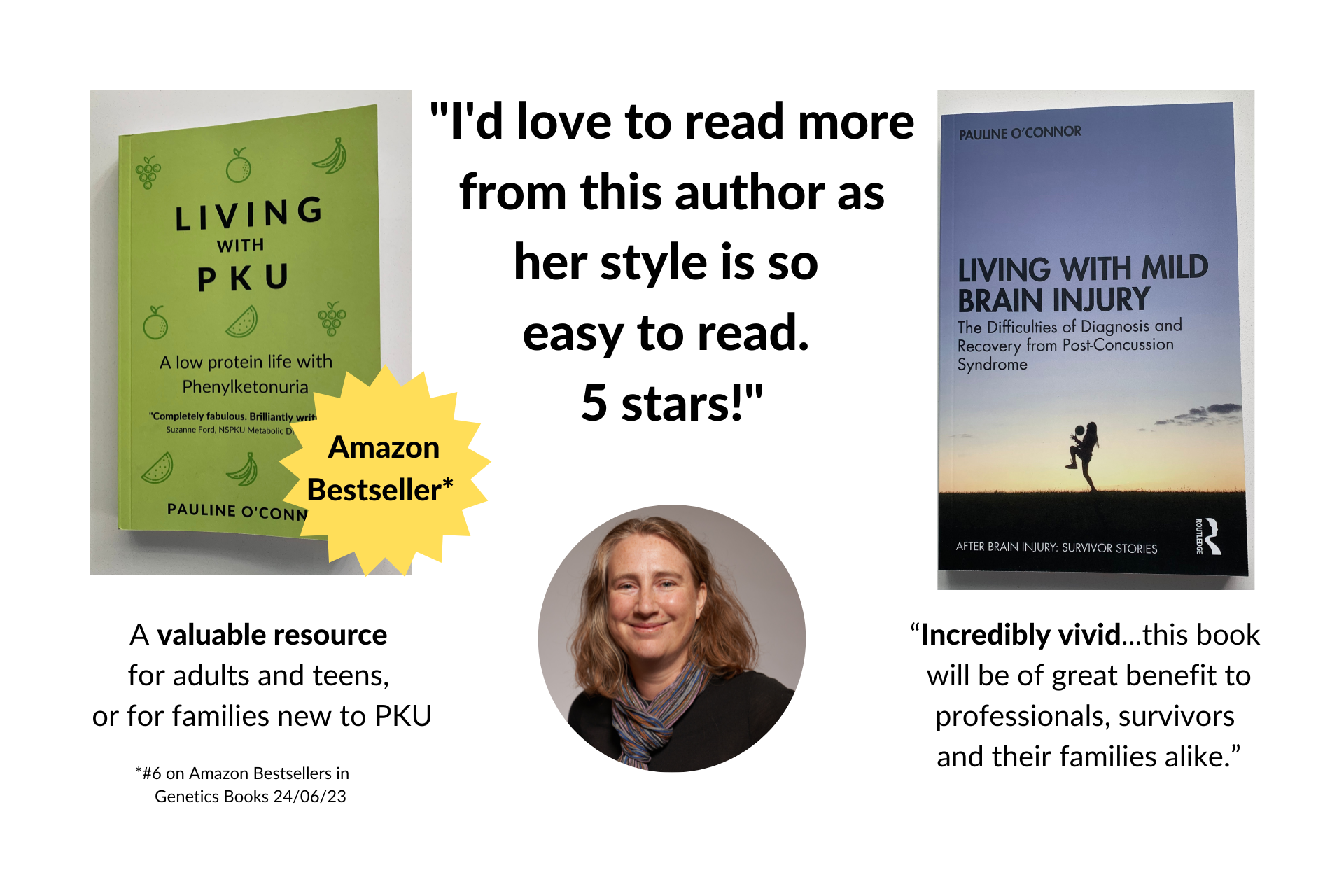
Example of marketing required for both traditional and self-published books
## Why I Chose Self-Publishing for My Second Book
Born with a rare disease, I naturally gravitated toward writing a second memoir on that subject. After years of advocacy, I was well known in this community, and had been producing content for the national magazine in this area for nearly a decade. This made self-publishing a clear choice.
If my first book was a crash course in writing a non-fiction book, the second was a steep learning curve in publishing itself.
### The Self-Publishing Learning Curve
I spent months researching:
- Book printing (bleeds, file formats, cover requirements)
- Distribution (catalogues, trade publications, library hubs)
- Analytics (metadata, publishing trends, royalties, and pricing models)
Meanwhile, I still hadn’t been paid for my first book. It took 15 months to receive my first royalty check from Routledge. In contrast, my self-published book earned the same amount in just 15 days, with the money in my account within weeks.
### Comparing the Financial Realities
My traditional publishing royalties are paid annually, meaning if my book sells during the New Year’s self-help boom, I won’t know until 15 months later. In contrast, self-publishing provides real-time sales tracking. I can analyse trends, evaluate marketing strategies, and adjust my approach accordingly.
## The Power of Data and Transparency
While the learning curve for self-publishing is steep, I’ve found the transparency invaluable. Having control over sales data, marketing, and royalties has been empowering. Each publishing path has its challenges and rewards. Whatever path you choose, make sure it aligns with your goals.
### Was this helpful? Please let me know if you want more on publishing.
### When the baby is not OK
URL: https://www.pigpen.page/when-the-baby-is-not-ok/
Last updated: 2025-09-19T10:41:59.000Z
## A memoir of Motherhood and PKU.
### “When the Baby Is Not OK: Hopes & Genes” by Jennifer J. Brown
J.J. Brown is a US-based public health advocate, author, and a mother of two daughters with PKU. A scientist and geneticist she worked with the first female Nobel Prize winner who did not share the prize. Genetics worked in mysterious ways to bring Jennifer a very personal stake in the world of rare disease and PKU. She discusses this win her new release, now available in ebook, paperback, and hardback.
## “What if the baby is not OK?”
Out of nearly four million who get newborn screening each year, about 12,000 babies are diagnosed with a "rare disease" in the US alone. Jennifer J. Brown's daughters were two of them. It was in their genes.
As a student who thought about being a scientist first, and becoming a mother second, the news changed her life forever. This intimate memoir of pregnancy, childbirth and raising special kids revises the story of what to expect with hope. By turns heartbreaking and horrifying, educational and inspiring, here is a raw and remarkable journey of triumph and acceptance.
> “A powerful and unflinching memoir interwoven with a wide-ranging social history, offering a compelling examination of motherhood, medical care, and genetic heritage through the lens of PKU.”
## Reviews for “When the baby is not OK”
I was grateful to receive an advanced copy of this book, and wow. It is a powerful and unflinching memoir interwoven with a wide-ranging social history, offering a compelling examination of motherhood, medical care, and genetic heritage through the lens of PKU.
**“Advocacy begins and ends with fighting for those you love. I believe this book will become a healing presence for anyone who reads it.”**
*Kevin Alexander, Vice President of Louisiana Metabolic Disorders Coalition, Host of Never Give Up: A Rare Disease Podcast*
**“A truly fascinating insight into genetic disorder, phenylketonuria (PKU), written by an author who knows how to put over the ‘complex’ in an accessible, interesting and compelling way. Highly recommended!”**
*The Wishing Shelf*

The author, Jennifer J. Brown
## About JJ Brown
J.J. Brown is a public health advocate and author of mystery, speculative fiction, noir fiction and poetry books infused with a passion for nature, science, and family. Her fiction books address current medical, mental health and environmental issues. Her nonfiction works in health and medical education are published as Jennifer J. Brown, PhD in professional journals. She is a mentor for caretakers and people living with phenylketonuria, PKU, at the National PKU Alliance, NPKUA. When not writing, J.J. Brown enjoys time with her daughters, her companion rabbits Belinda and Maxi, and parakeets Sweety and Penelope. Originally from the Catskill Mountain region of New York, J.J. Brown lives in New York City.
## Find “When the baby is not OK”
US Hardcover: [https://www.amazon.com/dp/B0DTF4B5DB](https://www.amazon.com/dp/B0DTF4B5DB?ref=pigpen.page)
UK Hardcover: [https://www.amazon.co.uk/dp/B0DTF4B5DB](https://www.amazon.co.uk/dp/B0DTF4B5DB?ref=pigpen.page)
**Ebooks**
UK Kindle: [https://www.amazon.co.uk/When-Baby-Not-OK-Hopes-ebook/dp/B0DT7MZ7YL](https://www.amazon.co.uk/When-Baby-Not-OK-Hopes-ebook/dp/B0DT7MZ7YL?ref=pigpen.page)
UK Kobo: [https://www.kobo.com/gb/en/ebook/when-the-baby-is-not-ok-hopes-genes](https://www.kobo.com/gb/en/ebook/when-the-baby-is-not-ok-hopes-genes?ref=pigpen.page)
US Kindle: [https://www.amazon.com/dp/B0DT7MZ7YL](https://www.amazon.com/dp/B0DT7MZ7YL?ref=pigpen.page)
US Barnes & Noble: [https://www.barnesandnoble.com/w/when-the-baby-is-not-ok-jennifer-j-brown/1146869011](https://www.barnesandnoble.com/w/when-the-baby-is-not-ok-jennifer-j-brown/1146869011?ref=pigpen.page)
US Kobo: [https://www.kobo.com/us/en/ebook/when-the-baby-is-not-ok-hopes-genes](https://www.kobo.com/us/en/ebook/when-the-baby-is-not-ok-hopes-genes?ref=pigpen.page)
CA Kindle: [https://www.amazon.ca/When-Baby-Not-OK-Hopes-ebook/dp/B0DT7MZ7YL/](https://www.amazon.ca/When-Baby-Not-OK-Hopes-ebook/dp/B0DT7MZ7YL/?ref=pigpen.page)
CA Kobo: [https://www.kobo.com/ca/en/ebook/when-the-baby-is-not-ok-hopes-genes](https://www.kobo.com/ca/en/ebook/when-the-baby-is-not-ok-hopes-genes?ref=pigpen.page)
Cover of "When the baby is not OK" by Jennifer J. Brown
### Metabolic Support UK
URL: https://www.pigpen.page/metabolic-support-uk/
Last updated: 2025-02-14T14:14:41.000Z
MSUK supports people and families with Inherited Metabolic Disorders (IMDs), like PKU, since 1981\. Think NSPKU, but for all IMDs.
## Started by patients, now global
Similar to the NSPKU, MSUK was started by a family trying to find information about their child’s rare disease. However, MSUK encompasses all IMD’s, of which PKU is the most common. This small team supports:
- more than 40,000 people,
- with over 500 conditions,
- in 195 countries.
## MSUK Conference 2024
The MSUK conference was a free, one day event held in Birmingham. The event kicked off with a presentation on the financial support which families with rare IMDs might be eligible for in the UK. I have reported on this in a separate blog.
## Genomics & you
This joint session looked at the future role for Genomic medicine in the NHS. Thankfully, there was also a simplified explanation of the difference between a gene, a genome, genetics, and genomics.
- A **gene** is a specific sequence of coding DNA for a single molecule.
- **Genetics** is the study of heredity, and the function and composition of single genes.
- A **genome** is the complete genetic information for an organism (e.g., for a whole human).
- **Genomics** is the study of the complete information for an organism, and includes both genes and other DNA.
As an example, each person’s genome is about 0.1% different from anyone else. However, that small percentage equates to about 3 million differences in the DNA, and gives us all the variety in humanity.
### Genomics in the NHS
There is a branch of the NHS called the NHS Genomic Medicine Service (GMS). They plan to embed genomic technology into the NHS to improve health at a personal and societal level. They plan to deliver genomic testing for improved outcomes in IMDs. (They are working on genomics in other areas, like cancers, but I will stick to the stuff on IMDs in this blog.)
Tony Thorburn is chairing a group to ensure that patients have a voice in the process. He is working to improve patient trust in AI in healthcare through communication, transparency, and improving the accuracy of AI predictions.
### Genomics and nurses
Philandra Costello took over the presentation. Her role is to embed genomics in healthcare for nurses to accelerate the development of genomic medicine in the NHS. Of particular interest is the field of **Pharmacogenomics,** or how a person’s DNA affects their response to medicines.
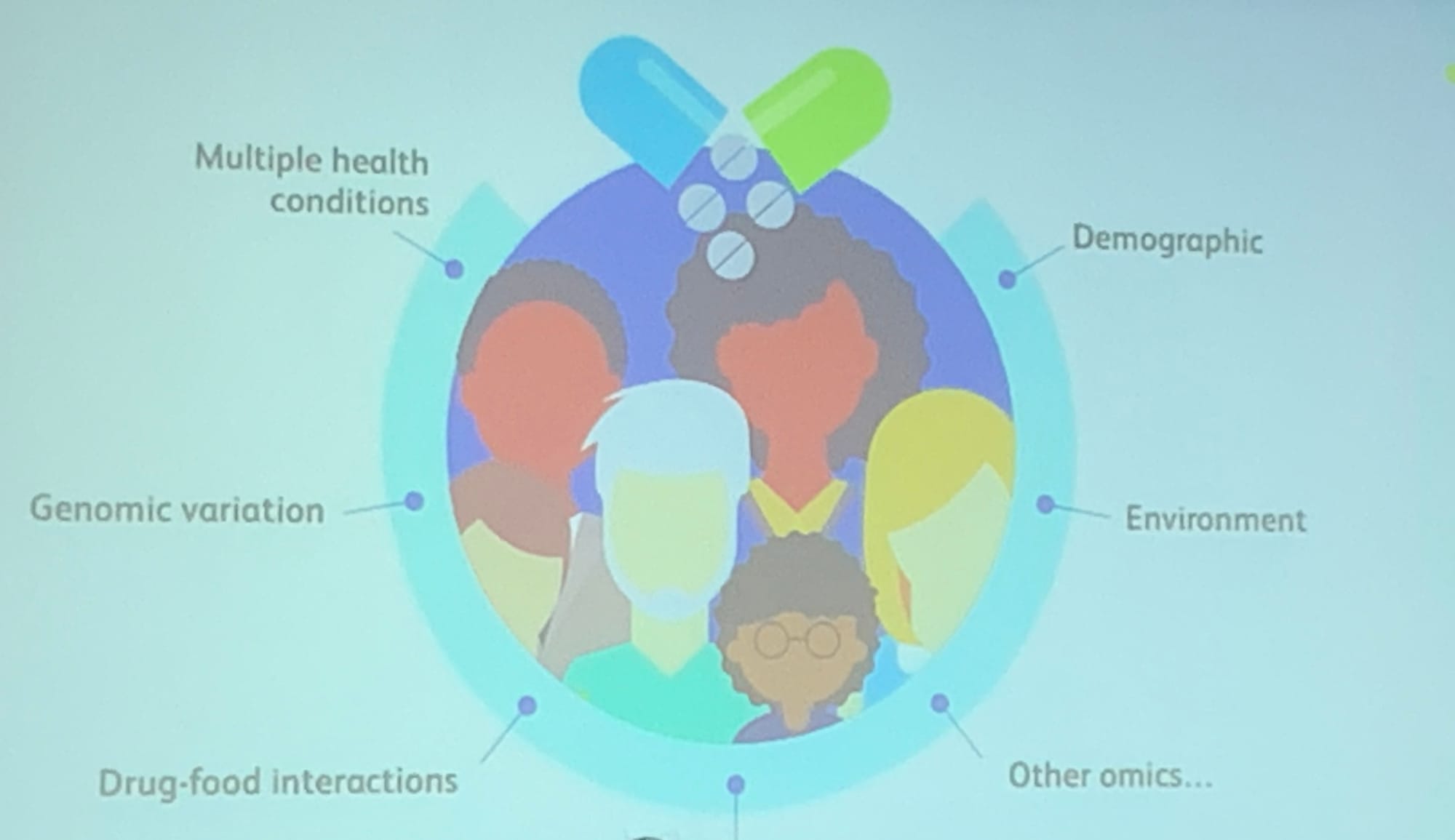
Factors which modify the efficacy of medicine. The bottom, missing, factor is ‘drug interaction’.
## The Generation Study
There was a fascinating talk by Dr David Bick of Genomics England on their Generation Study. This is a project which aims to test the placenta to test babies at birth for 200+ conditions. At present, newborn screening in the UK only tests for 9 rare conditions.
I do hope this project goes ahead. You can register your interest, and find more information at [https://www.generationstudy.co.uk/](https://www.generationstudy.co.uk/?ref=pigpen.page).
## March 2025
This was my first visit to the MSUK conference, and it won’t be my last. It isn’t often that PKU is the most common condition being discussed, and it was lovely to meet a wider community and share our experiences. The plan is to meet in Stoke-on-Trent in March.
**You can find more news from MSUK, and sign up for their monthly newsletter, at:** [**https://metabolicsupportuk.org/news-and-events/**](https://metabolicsupportuk.org/news-and-events/?ref=pigpen.page)
### Share your challenges of Living with PKU
URL: https://www.pigpen.page/paid-research-1/
Last updated: 2025-01-31T17:32:47.000Z
Hullo there,
Breaking news (as at January 2025). Would any of you be interested in **paid** market research on the challenges of living with PKU. The online session is 90 minutes, and you will receive £100 compensation for your time.
**You need to be UK based, and**
- **over 18, and have PKU;**
- **Or be caring for a child (aged 12 to 17) with PKU.**
You will be asked about living with PKU, the symptoms, and the impact it has on your life. There will be no promotion, selling, or medication involved. The session will take place in early 2025,
### Mention this referral
If you take part, **please use Pauline O’Connor as a reference.** I will then receive a small referral fee which will go towards my next PKU book - one for the kids this time!
### Please register your interest by clicking on the link below:
https://eu.panelfox.io/s/HZTL004PKUROUTING
### PKU Mac & Cheese
URL: https://www.pigpen.page/pku-mac-cheese/
Last updated: 2025-01-10T12:33:38.000Z
This makes 4 large servings, and the leftovers last 2-3 days in the fridge. You can freeze portions after cooking.
**15 minutes prep, 30 minutes baking time.**
### Ingredients
Plenty of boiling water
250g dried PKU macaroni
30g butter (2 Tbsp)
50g PKU flour (3 Tbsp
500ml PKU-friendly milk
250 PKU-friendly grated cheese
1 tsp mustard powder (optional)
1 tsp grated horseradish or finely chopped garlic (optional)
Salt
**Panko breadcrumbs** add a lovely crunch to the top of this dish. However, they do add protein. You can crumble toasted PKU bread into crumbs for the topping. Or use panko breadcrumbs if your protein tolerance allows.
### Cook the pasta
Cooking the pasta is the time sink here, so the first thing to do is put the kettle on. Once the kettle boils, pour the water into a large saucepan and bring it to a rolling boil.
Add a teaspoon of salt, then the pasta, and set a timer for 2 minute less the cooking time on the pasta. (I usually set it for 9 minutes & adjust as necessary.)
> [**Click here for tips on cooking PKU pasta**](https://www.pigpen.page/tips-for-pku-and-non-pku-pasta/)
### Make the sauce
While the pasta cooks, take a second saucepan and melt the butter over a low heat. Mustard powder adds an extra 'cheesiness'. Horseradish or garlic add extra flavour too. If you are using any of these, add them now and mix well into the melted butter.
Next, add the flour and mix to a lump-free paste. Gradually add the milk and mix in between additions to avoid lumps. The sauce will gradually thicken. When all the milk is in, it is:
### Cheese time!
There are many types of vegan cheese available now, be sure to select one which suits your protein requirements. Add 200g of the low-protein grated cheese. Retain the rest, you will use it soon.
### Assemble & bake
While you've been doing all this, your macaroni has been cooking nicely. When it is cooked, drain it and combine with the sauce. Tip it all into a large oven dish, or 4 individual dishes (must be oven-proof!)
Sprinkle over the remaining cheese. If you are using breadcrumbs, add them too. Bake at 200C/180C fan/gas 6 for 30 minutes. Let it sit about 5 mins before serving, as this makes it easier to scoop out.
### Did you enjoy this Mac & Cheese, or have any tweaks? Let me know 😄
##
### Ginger and dark chocolate cookies
URL: https://www.pigpen.page/ginger-and-dark-chocolate-cookies/
Last updated: 2024-12-20T21:54:44.000Z
Delicious, chewy ginger and chocolate cookies with an orange hint. These are low protein and protein-free options for PKU and other restricted diets.
## Protein levels and products used
If you use protein free flour and milk substitute then the protein in this recipe comes solely from the chocolate chips. I offer a few calculations below. If you have PKU/protein-free chocolate, [Vitabite](https://www.vitaflo.ca/sites/g/files/lpfasj526/files/2021-04/vitabite-datasheet-en.pdf?ref=pigpen.page), then you can make these very low protein, possibly protein free.
I used regular dark chocolate chunks and found that 100g was quite a lot for this recipe. Also, 100g dark chocolate chunks = 9g of protein. If you get the recommended 24 cookies out of the mix then each cookie is 0.4g protein.
**My recommendation:** I chose to halve the amount of chocolate chunks to 50g. That meant each cookie was 0.2g of protein. (Under PKU UK guidelines, two cookies would be half an exchange.)
## Tips & suggestions
The initial recipe called for a lot of chocolate, which I halved (see above). I also tried to make these healthier cookies by reducing the sugar and oil. The full amounts were slightly horrifying when I weighed them out. My reduced amounts worked well, and I have listed these below. If you want the full unadulterated experience, the original recipe is linked at the bottom.
This makes for a very loose cookie dough, but don’t be alarmed. The original chef noted: This cookie dough will be wetter than a normal dough and will spread on the trays but should make a chewy cookie. I found that letting the dough sit for a few minutes before spooning out helped.
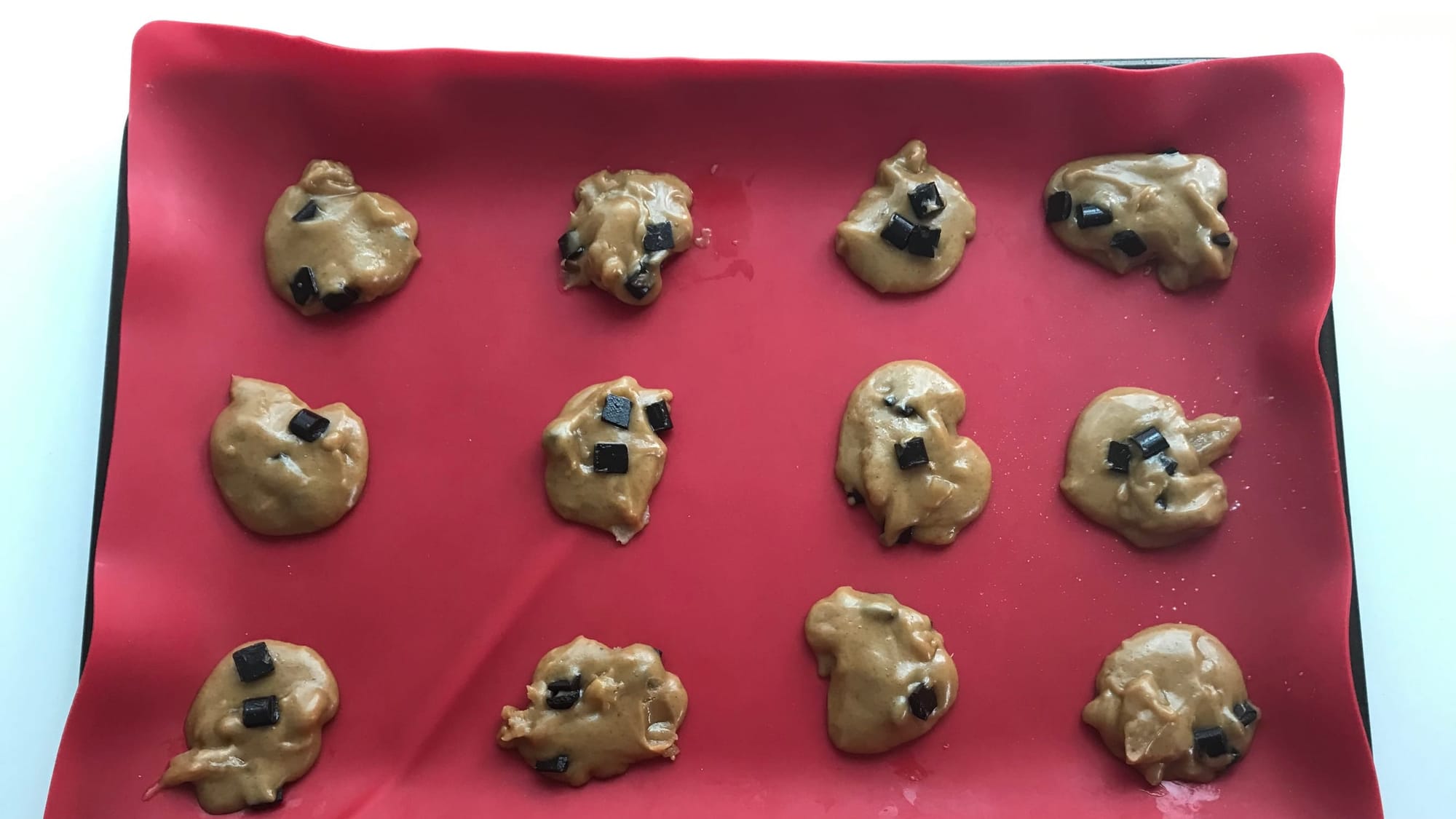
The cookies before baking, showing the wet dough and spacing suggestion.
## Ingredients
- 50g golden syrup
- 75g light brown soft sugar or 40g dark brown soft sugar
- 60ml almond or corn oil. (I just used vegetable oil from the cupboard, olive oil is not recommended for this recipe as it affects the taste)
- 1 tsp vanilla extract
- 60ml PKU friendly milk or milk substitute
- 210g PKU friendly flour
- ¼ tsp baking soda
- ¼ tsp salt
- 100g candied ginger, chopped into small chunks (or add to a good food processor with your flour and blitz)
- 50g dark chocolate chunks or Vitabite
- Zest of 1 orange (I didn’t have an orange handy, so added 1tbsp of orange juice).
## Method
1. Preheat the oven to 180C/350F/gas mark 4 and line a couple of large baking trays with baking parchment or a silicone baking sheet.
2. Blend the golden syrup, sugar, oil, vanilla extract and milk until smooth.
3. In a separate large bowl, mix the flour with the baking soda and salt, then stir in the wet ingredients until just combined.
4. Add in the candied ginger, chocolate and orange zest. (This is where I let the dough sit for a few minutes.)
5. Dollop teaspoons of the batter on to the prepared baking trays, spacing well apart
6. Bake in the preheated oven (in batches, if necessary) for 10–15 minutes, until the cookies’ edges are golden brown and the centres are puffy.
7. Leave to cool for 10 minutes or so before moving onto a wire rack. They’ll set harder as they cool, so don’t worry if they’re soft just after baking.
**Source:** adapted from Ruby Tandoh via The Guardian.
Please tell me in the comments if you try them, or have further tweaks.
### Eating out with PKU
URL: https://www.pigpen.page/eating-out-with-pku/
Last updated: 2024-12-11T23:34:26.000Z
The end of the year brings parties, events, and more opportunities to eat out. This can mean more challenges for those of us following a low-protein diet. Here are a few tips for eating out, plus some recommendations.
## Equal treatment for metabolic disorders
A few years ago, a co-worker was organising the office Christmas party. As part of the usual special dietary requests, they asked the venue to cater for my PKU. The venue suggested that I bring my own food. I was mortified, my colleague was outraged.
The venue was informed that this response wasn't acceptable, and if they wanted our company to use their catering, they would cater for everyone. This showed me that people with PKU or other low protein diets should receive good service for their money, the same as everyone else.
## Tip one - you are worth it
I used to think: “the diet is my problem, so I'll just deal with it and not make a fuss.” Actually, most people are happy to help, if you have the confidence to just ask. There are fewer refusals than you’d think. Refusal to help is increasingly rare in the world of social media and online reviews.
Remember that in the rare event that you are refused, you can always look elsewhere. I have found that the odd looks, and occasionally unexciting 'pasta and tomato sauce' dishes, have been far outweighed by the fantastic experiences.
> "a Michelin-starred chef loved the challenge of a low-protein diet, and developed a 7-course degustation menu"
## Amazing experiences with PKU
There have been several occasions when my dining experience has excelled that of my companions. One Michelin-starred chef loved the challenge of a low-protein diet, and developed a 7-course degustation menu just for me. Another chef in my home town used to love it when I booked, as he could do something new. This was assuming that I called at least two days in advance so he could buy market fresh produce just for me. This leads me to:
## Tip two - planning
If you can, contact venues and those catering in advance. If you have a holiday, a special night, or a wedding coming up, don’t leave it until the last minute. Restaurants like at least a week’s notice, whereas it is best to contact wedding caterers promptly.
- **Be prepared for your call,** I like to check online menus before calling, so I can suggest tweaks to dishes. It lets the caterers know that they don’t have to start from scratch.
- \*\*Be polite and clear, \*\*kitchens are busy places, so ask if calling at another time, or sending an email would be easier.
- **Template email** Below is an example of the email which I send to caterers. Ask your PKU dietician for help to adjust it to meet your dietary requirements before using it.
Caramelised conference pear on waffles with lemon gel and toffee sauce from Half Cup, London.
### Example email when booking with a low-protein diet
Dear …,
I would like to book a table for a special event and have strict medical dietary requirements, which I hope you will be able to accommodate.
I am on a medicated low protein diet and cannot eat meat, fish, shellfish, bread, tofu, legumes and soya, nor eggs. I am also not allowed dairy products — though small amounts of butter and cream in sauces is fine.
Please do let me know if this will be possible. I am happy to speak to a member of your team about adapting some of your current dishes.
With best regards,
**Remember:**
- Show this to your dietician first to ensure it meets your needs.
- I always use 'medical' in the first line to show that this is not a fad diet.
- Emphasise if it is a large party or a special occasion.
- If it is local, say you are looking for a great restaurant to book frequently.
## Look online for recommendations
Don't overlook exciting places to eat just because you can't find them. Wiki-travel listings of vegetarian restaurants led me to a tiny restaurant in Bruges, Belgium. The dining space consisted of 4 tables in the front room of the chef’s home, and I would never have found it without the reviews. I was able to order a three-course set dinner without having to change anything. I never thought that would be possible.
As vegan and vegetarian diets are becoming more popular, caterers are becoming accustomed to plant-based diets. And we are no longer the customers asking for meal tweaks. The menus at these recommendations will change, do check before visiting.
#### [Dishoom](https://www.dishoom.com/food-drink/?ref=pigpen.page)
Dishoom has branches across London and in Manchester, Birmingham, Edinburgh, Brighton, Oxford, and Cambridge. The NSPKU team recently highlighted the [Dishoom jackfruit biryani recipe](https://www.theguardian.com/food/2019/sep/07/four-classic-indian-recipes-dishoom-chaat-dal-salad-jackfruit-biyani-chicken-makhani-curry%0A?ref=pigpen.page) as one to try at home.
#### [Leon](https://leon.co/?ref=pigpen.page) & [Wagamama](https://www.wagamama.com/?ref=pigpen.page)
Branches UK-wide, with plenty of options for those on 10g/day or over.
> I would love to have more examples on here - please share your recommendations in the comments below!
### Low protein books
URL: https://www.pigpen.page/low-protein-books/
Last updated: 2026-02-06T12:48:13.000Z
A selection of low protein books for adults and children. Gift ideas for those new to PKU and inherited metabolic disorders. Plus, a free gift for subscribers.
## [Free copy](https://www.pigpen.page/hello/) of Mental health & PKU
I’ve released the mental health chapters from Living with PKU as a free download because I feel we need a conversation around the effects which managing a rare disease has on our quality of life.
Subscribers can download it directly from , or subscribe for free to get your copy.
[](https://www.pigpen.page/#/portal/signup)
Close up of cover for Mental health & PKU
## For the whole family:
This is a membership rather than a book - but it is worth it for the magazine and supporting diet information provided by the NSPKU.
I highly recommend joining a patient organisation where you can **find your PKU community.** It only costs £20 for the whole family for a year. [Membership is open to anyone](https://nspku.org/membership/?ref=pigpen.page), including those with PKU, their families, friends and associates. Family memberships receive
- A membership pack.
- Reduced rates for the annual NSPKU family conference. (The UK PKU event of the year!)
- Full colour News and Views magazine which is published quarterly.
- Plus, your subscription supports their work, including investigating phe content in foods.
Join today or find out more at [https://nspku.org/membership/](https://nspku.org/membership/?ref=pigpen.page)
> **I highly recommend joining a patient organisation where you can find your PKU community.**
## For children:
Here are a few picture books to help children to understand PKU and low protein requirements:
### [Badgerman's PKU Journey](https://www.amazon.co.uk/Badgermans-PKU-Journey-Susan-Waplington/dp/B0BVCWR6BQ/ref=sr%5F1%5F1?dib=eyJ2IjoiMSJ9.KY3Mxtk6FOeHEiHKv3hpYYvDo%5FxhPPnnTac-iJEGvpU.0xlEjGysApkt4-jn0fEiK4nROVrtSZ9klF7o13eCIS4&dib%5Ftag=se&nsdOptOutParam=true&qid=1732025754&refinements=p%5F27%3AMs+Susan+Waplington&s=books&sr=1-1&text=Ms+Susan+Waplington&ref=pigpen.page)
The story of Badgerman was created by Susan Waplington, who has had PKU all her life. The book was inspired by the idea that children with the condition needed some way of understanding what is happening to them. Published 2023.
### [The Adventures of Ruby Pricklebottom: Ruby Has PKU](https://www.amazon.co.uk/Adventures-Ruby-Pricklebottom-Book-Has/dp/1532878788/ref=sr%5F1%5F4?crid=2E7B3IQEOSFSD&dib=eyJ2IjoiMSJ9.zj9zXjYDRqzwHAD3vqqQnf6wq8DD7fRho9aiJNiV7qm8y837gYkzQ4lEkT4RavNt0d7SH%5FhS9%5FEpsIfpJBkp7iFN4x%5FCO6%5FpRY93UA4tIgntiJlj86Jkyzyn0CpBtn4136wDH3pEGBhOR1J94K21q4rwy0NJODxRbJ8yoolt4AjxgNbHUr2YjbRVK-VMEfaP1iNu26QIz1qQMH5sK%5FReA3V1QO8HFcQGteI%5Fl1fDAS%5F%5FhW6%5FdCpjhpzUdvUVmKi5RpTV2mAaRGmy9Ux5BWRi9M8R5HFEFk6RA41j31NyRC0.4-O7y93%5Fd4QN-cIVGbw-2v7ElCRkswMYKGBRgeL4d0U&dib%5Ftag=se&keywords=pku&nsdOptOutParam=true&qid=1732025643&sprefix=pku%2Caps%2C76&sr=8-4&ref=pigpen.page)
After finding out that Ruby was born with the rare metabolic disorder, Ruby and her family must learn how to manage the PKU diet in order to keep Ruby healthy and happy. Follow the Pricklebottoms’ journey from diagnosis to first day of school, and find out how Ruby manages to be extraordinary! Published 2016.
## For older humans.
### [Sheila: Unlocking the Treatment for PKU](https://www.amazon.co.uk/Sheila-Unlocking-Treatment-Anne-Green/dp/185858714X?ref=pigpen.page)
Sheila’s story is the founding story of current PKU and low protein treatments. The contribution which Sheila and her mother, Mary, made to modern medicine is immense; it led to the introduction of newborn screening and worldwide treatment for PKU. Sheila’s story will be important to people with PKU, their families, health professionals and readers interested in the history of medicine.
### [Memoirs Of My Journey To Motherhood : With Maternal PKU](https://www.amazon.co.uk/Memoirs-My-Journey-Motherhood-Maternal-ebook/dp/B0CY5J2DSJ/ref=sr%5F1%5F33?crid=39DQ3EDOPI1TK&dib=eyJ2IjoiMSJ9.GeaX0SvCRoHfHxqrOJIbEpNacgj4f4YghOMVu3ZkB07L8Yv1RJ3wdBgBwUf4EFagMo5P4xHEKbt-kfktmuYoLg.%5FBQIyCQ%5FZP7uAbG6wgwKnuDSe9Gy5C3Ynik4QP4lMFI&dib%5Ftag=se&keywords=pku&nsdOptOutParam=true&qid=1732029441&sprefix=%2Caps%2C47&sr=8-33&ref=pigpen.page)
NB: This is a new book and I have not yet read it, though it has been recommended by a trusted reviewer.
The author says: “This powerfully emotional memoir includes blogs and journal entries that I kept during my pregnancy, in the hope that one day I could share them to inspire other women like me and to teach others to not give up on their dreams.”
### [Living with PKU: A low protein life with Phenylketonuria](https://pigpen.start.page/?ref=pigpen.page)
Yes, my own book. ) A valuable resource for adults, teens, or families new to PKU. This book explains PKU in clear and simple language, and offers practical advice. In this honest account, I share my experience and mistakes to help others navigating the difficult dietary treatment.
> **"Completely fabulous. Brilliantly written."** Suzanne Ford, NSPKU Metabolic Dietician
[Find the PKU book at Amazon, Barnes & Noble, Kobo, & more...](https://books2read.com/PKUBook?ref=pigpen.page)
- or preview[ **for free**](https://www.amazon.co.uk/Living-PKU-protein-life-Phenylketonuria/dp/1739635612/ref=tmm%5Fpap%5Fswatch%5F0?%5Fencoding=UTF8&qid=1655632207&sr=8-1&asin=1739635612&revisionId=&format=4&depth=1&ref=pigpen.page),
- or **request it** at your local bookshop or library (this helps me out too!)
### PKU at Christmas
URL: https://www.pigpen.page/pku-at-christmas/
Last updated: 2025-11-14T09:42:50.000Z
Tips and links to help with a low protein Christmas or Thanksgiving. I’ve included menu suggestions & recipes, but let’s start with making the festive season friendlier to those on restricted diets.
Some say that Christmas or Thanksgiving is all about the turkey, which may leave someone on a low protein diet feeling left out. This means we may need to think a little differently.
## Thinking differently about Christmas
Even outside the rare disease community, I don't often find people who actually have turkey at Christmas or Thanksgiving. Friends frequently discuss the merits of various other dishes. This increasingly means vegetarian main courses like beetroot wellington or a nut roast.
> **"Simply talking about the low protein food first can mean the world to a child!"**
Our family's Christmas dinner was always “the low protein dish and the NZ lamb”. (Note the word order, simply talking about the low protein food first can mean the world to a child!) I would have my own stuffed vegetables, as this meant I had something to carve at the table too.
Recently, the increasing availability of low protein pastry and cheese has allowed me to try new dishes. I hope the links and ideas below will inspire your low protein dinners.
## Ideas for a low protein Christmas main
Three suggestions for a PKU or low protein Christmas centrepiece. The required skill level ranges from a little tricky to easy, and two can be made in advance.
### [Squash and blue cheese Wellington](https://www.bbcgoodfood.com/recipes/squash-blue-cheese-wellington?ref=pigpen.page)
A bit tricky, but can be made in advance and popped in the oven on the day. This was a hit with people who weren’t on a restricted-diet too! **Make it low protein with the following switches:**
- Low protein ‘blue cheese’. Honestly tasty blue - 50g is 1g protein. Or if you can find Violife blue cheese, that one is exchange free.
- Use your prescribed milk substitute, use a low protein plant milk, or aquafaba (chick pea water) rather than egg to bind & glaze.
- Do not include the pecans.
If you follow the above switches, and [make your own low protein pastry](https://www.nutricia.co.uk/patients-carers/recipes/basic-pastry.html?ref=pigpen.page), the protein will only come from the cheese substitute. Alternately, JusRol Gluten-Free Pastry is 40g for 1g protein, while Genius Gluten-Free Pastry is 42g for 1g protein.
**Tips:**
- [This recipe makes a large Wellington](https://www.bbcgoodfood.com/recipes/squash-blue-cheese-wellington?ref=pigpen.page) which will serve six as a main. I suggest halving the recipe or making two small ones.
- You can make this in advance, as it will freeze for up to two months.
- Don't use a defrosted packet of frozen butternut squash, it was too wet and led to very soggy pastry. Definitely don't do this if you are freezing the dish again.
### [Mushroom & Jackfruit Wellingtons](https://www.pigpen.page/mushroom-jackfruit-wellingtons/)
Easier than the full wellington above, but best made fresh. This recipe makes four individual Wellingtons. They are great for Christmas or Thanksgiving, yet are so easy that I’ve been making them as a mid-week dinner.
### [Aubergine ratatouille](https://www.bbcgoodfood.com/recipes/ratatouille?ref=pigpen.page)
This recipe is an easy option for big occasions. It is already low protein, needing no substitutes or switches. However, I’m a lazy cook, so tend to ignore steps 3 & 4, and just use a can of chopped tomatoes instead. It will then need to cook for an extra 10-15 minutes. This makes for a dish with more sauce, perfect for scooping up with garlic bread, or for yummy leftovers.
### [Baked Aubergine with minted courgettes](https://www.bbcgoodfood.com/recipes/baked-aubergine-stuffed-roast-pumpkin-feta-walnut-minted-courgettes?ref=pigpen.page)
While researching this article, I came across a new idea which I haven’t tried yet. This will require **only two tweaks to make it low protein,** including:
- Using a low protein cheese, [like this one](https://www.violife.com/en-gb/our-products/blocks/greek-white-block?ref=pigpen.page).
- Not using the ‘handful of walnuts’.
Buy me a cuppa ☕ — your support helps keep this blog free, and helps to me write about PKU, brain injury & mental health.
[Buy Pauline a cuppa ](https://donate.stripe.com/14keYi5dp9E26Oc9AA?ref=pigpen.page)
### Trimmings
Sadly, there is little we can do about the protein content of roast potatoes. 60g of potato is 1g of protein, and I always save an exchange to ensure roasties on Christmas Day.
There are plenty of low-protein vegetables for roasting options including sweet potato, sprouts, parsnips, carrots, turnips, pumpkins & squash, beetroot, celeriac, fennel, garlic, onions & shallots, peppers (aka bell peppers, capsicums), swede...
## Christmas breakfast & snacks
I love pancakes for breakfast, and love these [‘Santa Pancakes’](https://www.vitafriendspku.co.uk/pku/recipe/santa-pancakes?ref=pigpen.page) from Vitafriends. In New Zealand, Christmas Day is in mid-summer. My Christmas breakfast as a child was exotic fruits like melon, pawpaw (papaya), and mango. These are great breakfasts on Thanksgiving or Christmas when plenty of calories lie ahead.
Low protein snack ideas include avocado dips, sun-dried tomatoes, dried fruits - raisins, crystallised ginger, dried pineapple, dried papaya. Christmas shopping for me always includes speciality fruit jellies to go with the chocolate covered gingers.
> **These are great breakfasts on Thanksgiving or Christmas when plenty of calories lie ahead**
If you are a baker, then the low protein food specialists have plenty of ideas for Christmas treats, including [mince pies](https://www.nutricia.co.uk/patients-carers/recipes/mince-pies.html?ref=pigpen.page), which I’ll be trying out this year. I’m a fan of ginger so always make these [Christmas ginger biscuits](https://www.rivercottage.net/recipes/christmas-tree-biscuits?ref=pigpen.page) with PKU flour. Of the suggested decorations, the icing, cherries and currants are low protein. But they never last long enough in this house to make decorating worthwhile!
### Low protein shopping for Christmas & Thanksgiving
If you want to spend less time in the kitchen, social media feeds from the PKU and low protein communities are full of snack and meal ideas which are available in the supermarkets or speciality food stores.
- [Promin have a dedicated low protein](https://prominpku.com/product-category/christmas-treat/?ref=pigpen.page) Christmas treats shop.
- [Alternative Stores](https://alternativestores.com/collections/low-protein-pku?ref=pigpen.page) has a dedicated page for low protein foods.
With any luck, this blog has provided inspiration for Christmas Day. My main tip is to ensure you have plenty of low protein treats around to allow the traditional gorging with less of the guilt. And Christmas isn’t all about food, so I hope you enjoy the season in other ways too!
### Please share your ideas below:
## Join the community
Get early updates, recipes and your free gift.
Join us
Email sent! Check your inbox to complete your signup.
No spam. Unsubscribe anytime.
### Fragrant carrot soup
URL: https://www.pigpen.page/fragrant-carrot-soup/
Last updated: 2024-11-14T16:51:31.000Z
A low protein (possibly protein-free depending on your regime) curried carrot soup for chilly days. Makes an easy PKU meal with 10 mins prep and 30 minutes cooking time.
## Ingredients
- 150g chopped onion (about 1 large onion)
- 2 cloves of garlic, crushed (or 2tsp from a jar of crushed garlic)
- 500g peeled and chopped carrots (I prefer mine unpeeled, it worked)
- 50g butter (The original recipe called for 150g! I used a third of that and the recipe seemed fine)
- 1tsp cumin seeds
- 1tsp curry powder
- 300ml chicken stock, use a PKU friendly one from [the NSPKU booklets](https://nspku.org/download/branded-exchange-free-foods-list/?ref=pigpen.page)
- 500ml water
- 1 bouquet garni (this is not a cupboard staple for me, I used 3 bay leaves).
- Coriander leaves to garnish.
## Method
1. Melt butter in a saucepan, then add the onions, garlic, and carrots. Cook on a heat low enough that the onions do not colour (e.g., a low-medium heat) for five minutes.
2. Meanwhile, add the cumin seeds to a dry pan and toast. Pay attention as this only takes a minute or two on a medium heat.
3. Add the cumin seeds and curry powder to the carrots and cook for two minutes. Then add the stock, water, and bouquet garni or bay leaves. **Top tip**: count in your bay leaves, then you know how many to remove later.
4. Bring the soup to the boil, then add a little salt. Reduce the heat and simmer the sou for 30 minutes.
5. Remove from the heat and pick out the bouquet garni or bayleaves. Blend carefully, check to see if it needs salt or pepper. Then, reheat if needed, and serve.
**Source:** Michael Caines [via The Guardian](https://www.theguardian.com/food/2021/jan/21/top-chefs-favourite-homemade-soups-from-curried-carrot-to-creamy-sweet-potato?ref=pigpen.page). There are a few more PKU friendly soups in this article to try.
### Let me know what you think in the comments below.
### Ensuring prescriptions on the NHS
URL: https://www.pigpen.page/ensuring-prescriptions-on-the-nhs/
Last updated: 2025-01-17T15:09:46.000Z
How I responded when my GP surgery asked if I still need my PKU supplement and foods, with example email.
## Do you require these prescriptions?
It was a normal Monday morning when I got the call from a staff member at my doctor’s surgery asking if I “really need the PKU supplement and foods this month? Only they are a little expensive…”
I’ve heard rumours of others being questioned over prescribed medicines. However, this was the first time a GP had questioned my PKU supplies. The temptation to respond with “are you being serious right now!” was pretty strong.
Challenges to our treatment regime shouldn’t happen. Sadly, this isn’t an ideal world. These questions are annoying and exhausting, and it is important to be firm and clear in your response.
> The temptation to respond with “are you being serious right now!” was pretty strong.
## Remain firm, and clear
I replied with “Yes, I absolutely do. This is an incurable condition, I will always need the prescribed PKU medicine and foods for special medical purposes, and the items cannot be bought elsewhere.”
This was enough for the surgery, who confirmed they would go ahead with this prescription this month. Whew! Then they said I would be getting a call to check this every month. Again, WTF? I didn’t say that, instead I asked why they were questioning my treatment regime. It turns out, this wasn’t a doctor or nurse, but someone who was employed to check on all prescriptions. This was just someone doing their job.
## PKU patients do have back up
I hid my sigh at needing to explain, again!, and told them: “PKU is inherited and there is no cure. We would just be having the same conversation every month. Is there any way that you can just note that I will always need them? Can my clinic email you with the details so we don’t have to have this call again?”
In the end, the surgery received an email from both me and my PKU clinic. I sent them the details of the NSPKU and attached the [NSPKU leaflet for GP Surgery staff](https://nspku.org/wp-content/uploads/2020/01/NSPKU%5FA4%5FGP%5Finfo%5Fleaflet%5F6.pdf?ref=pigpen.page). There is an example of my email below.
## PKU foods received — so far!
Since this incident, I have received my monthly PKU prescriptions on time and in full. Importantly, I haven’t (yet) had another call from the surgery. My PKU clinic have followed up with me to ensure I haven’t had further problems. And I know that the NSPKU is always there if I require more back up.
> Have you had similar problems? Or found a different solution?
Hopefully, you won’t have the same difficulty. If you do, here is my example email and links which might help:
## Example email regarding PKU prescriptions
I confirm that I will always need the prescribed PKU medicine and foods for special medical purposes. PKU (Phenylketonuria) is an inherited genetic condition with no cure, and the items cannot be bought elsewhere.
I have included further information below on PKU, and the prescription items, from the National Society for PKU which may be of interest. They are a lovely team and their helpline is open if you have questions.
You have letters from my PKU metabolic clinic on file detailing my needs. Please continue these prescriptions which I require every month.
### Have you had similar problems? Or found a different solution?
I'd love to hear about your experiences and how you have solved it, or are you still having difficulties with accessing your prescriptions? Please let me know in the comments below 😄
### Join the conversation!
URL: https://www.pigpen.page/join-the-conversation/
Last updated: 2026-01-02T15:30:44.000Z
Connect with like-minded individuals, share your life hacks and recipes!
## Activate your free membership
If you’ve been receiving my emails for a while, then you are already in! Simply click the log in link at the top of the page and enter the email you signed up with email. Then check your inbox for a verification link, and join the conversation.
## Joining is a breeze!
Just enter your email, check your inbox for a verification link, and you’re in.
[**Sign up today** ](https://www.pigpen.page/newsletter/#/portal/signup)and start contributing to the conversation—don’t miss out on the fun! If you have any questions, we’re here to help. Feel free to reach out.
I can’t wait to hear your thoughts and ideas,
Pauline.
### The Red Hat Stories
URL: https://www.pigpen.page/the-red-hat-stories-2-2/
Last updated: 2025-06-24T16:11:14.000Z
[Support the author: buy direct & save (US & UK only)](https://21de0a-fe.myshopify.com/?ref=pigpen.page)
[Find it on Amazon, Shopify, Kobo, & many more](https://books2read.com/u/4XWDoL?ref=pigpen.page)
### An anthology, by Pauline O’Connor
Missed the successful Kickstarter? This is available now in ebook and paperback.
> “My favourite read of the year.”
0:00
/0:30
1×
Book trailer for The Red Hat Stories (no sound). Cover and artwork by Katherine Powell.
> “I loved the way you told the story of the woman in the Red Hat as a thread through all the short stories.”
*The Red Hat Stories* explore the connection between strangers, the assumptions we make, and how overlooked encounters have unforeseen effects.
**London, a city of millions where even the solitary are never alone.**
The bustling spaces host fleeting interactions between strangers, each with their own troubles. A homeless man wrestles with his demons, a woman braves the outside after illness, a witness is troubled by a predatory encounter, a businessman is forced to do community service, a woman grieves the love of her life; all are affected by the actions of a stranger in a red hat. **Who is she, and what is her story**
> “It's just brilliant.”
This short story anthology is my first fiction book, and I was thrilled when the Kickstarter funded within five days! I began writing this small collection back in 2006\. Having grown up in a rural area of New Zealand, the idea for these stories emerged after I immigrated to London. I was people-watching and entertained myself creating stories about the different characters around me. This led to the questions: Who are we to each other? What do interactions with strangers tell us about ourselves.
> “My personal favourite was the redemptive path followed by the investment banker Charles.”
### Find your favourite Red Hat Story.
[Find it on Amazon, Shopify, Kobo, & many more](https://bookshelf.start.page/?ref=pigpen.page)
###
### Adults’ experience of PKU clinic
URL: https://www.pigpen.page/adults-experience-of-pku-clinic/
Last updated: 2024-08-08T16:36:00.000Z
Dr Fatma Ilgaz from Hacettepe University in Turkey gave the final presentation at the NSPKU 2024 conference. Dr Ilgaz reported the findings from a survey of adult PKU patients.
## PKU is no longer a paediatric disease
The presentation held important lessons on how Adult PKU patients feel about their clinics. However, the critical message came at the start of Dr Fatma’s presentation when she stated: PKU is no longer a paediatric disease.
> **PKU is no longer a paediatric disease.**
From discovery, through initial development of restricted diet therapy, to the clinical trials on new treatments toady, the focus of PKU practitioners has been on children. Though there have been good reasons for this emphasis, it was a relief to hear a clinical researcher to declare this to a packed room. This acknowledgment is needed as, although the condition is the same, adult PKU have different experiences than in childhood. Further, there are clinical trials available to children, from which adults are excluded.
> **Although the condition is the same, adult PKU have different experiences than in childhood.**
## Survey of PKU adults
The survey was conducted online over winter 2021-2022, a time when many in the UK felt isolated during Covid-19 lockdowns. The 74 respondents aged over 18 lived across the UK, and were mostly female. The majority were adults with PKU, though some caregivers did respond too.
Key aims of the survey:
- Is the medical care provided by adult hospitals / clinics accessible and sufficient?
- What do adult PKU patients expect from clinics, compared with the support and care they receive?
- What are the barrier and motivation of attending clinics as an adult
## PKU clinic attendance in adults
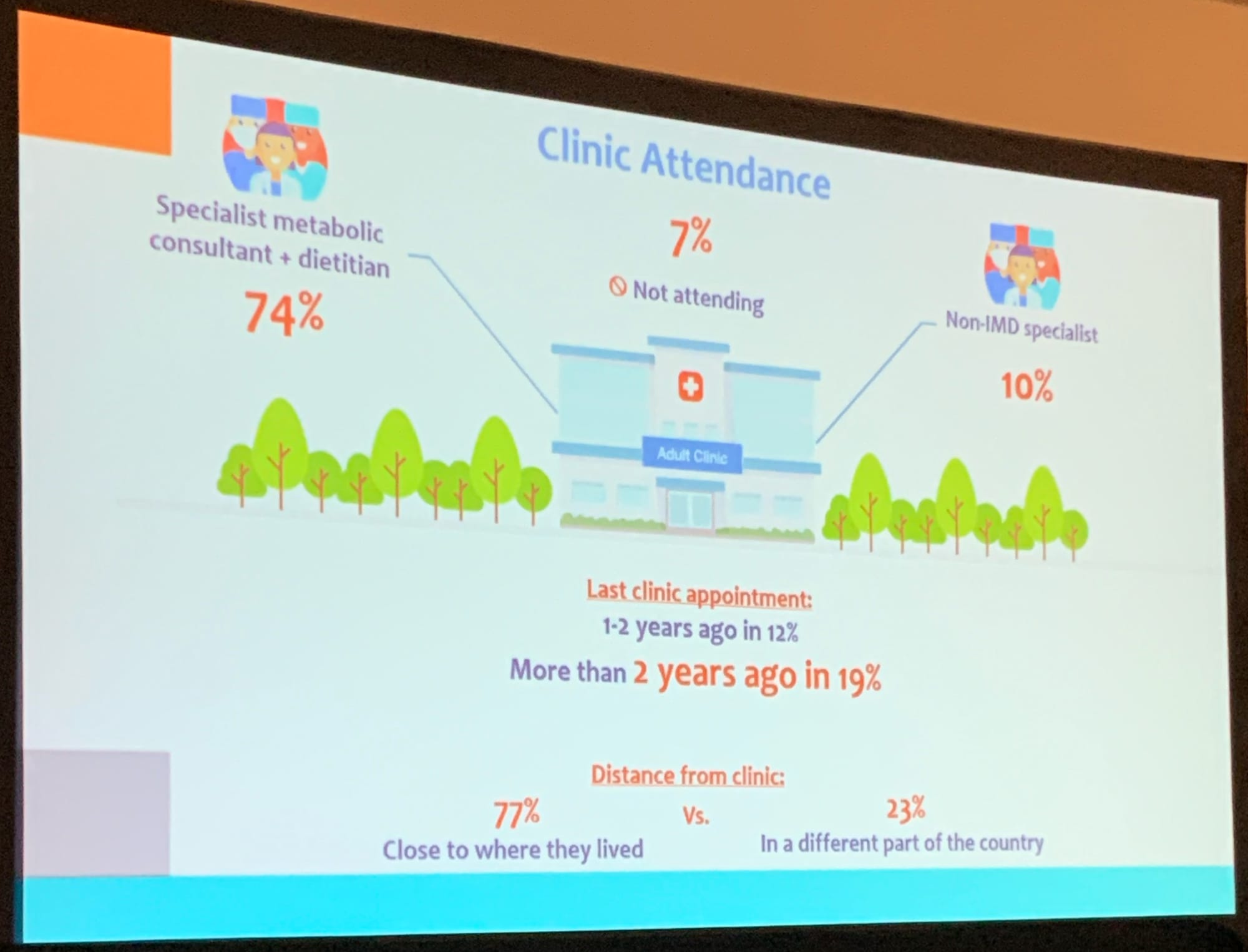
PKU clinic attendance in the UK
The vast majority of the responding PKU adults, 3 in 4 were currently seeing a specialist metabolic consultant. That may be due to self-selection, perhaps those adults who were already engaged with PKU are more likely to respond to a survey.
### Barriers to PKU clinic attendance
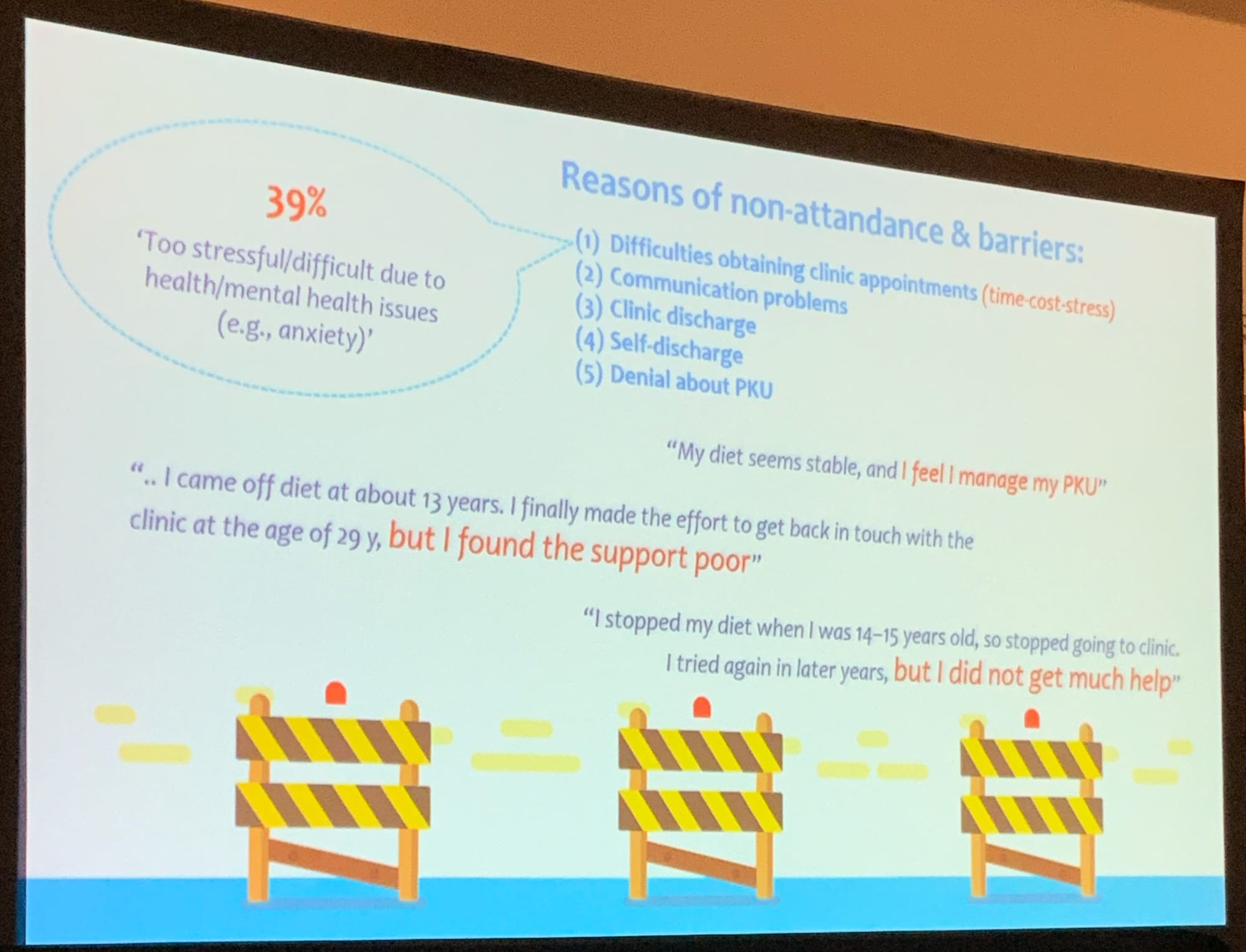
Reasons for non-attendance and barriers to PKU clinics in the UK
There were five key barriers to clinic attendance identified as part of the survey. The main barrier was the difficulty in obtaining appointment. This was not only due to time and financial restraints, but also because of the stress and anxiety involved in the process.
1. Difficulties obtaining clinic appointments
2. Communication problems
3. Clinic discharge
4. Self discharge
5. Denial about PKU
The wording for that last reason comes from the researchers. I do wonder why that wording was chosen when the example given is from the patient’s perspective: “I feel I manage my PKU”.
## Coexisting medical issues
The survey asked about the other medical issues which adults with PKU manage alongside their PKU. While an enviable 6% of respondents reported no co-existing conditions, the survey found that:
- 53% of adults with PKU, particularly females, have weight issues
- 42% have a tremor or hand shakes
Other significant co-existing conditions reported were:
Oral health, sleep disturbances, digestive problems, nutrient deficiencies, joint pain, dizziness, and bone health issues.
## Services at a PKU clinic
There was a wide discrepancy in the services which UK adults received at their PKU appointments. This indicates that the [anticipated EU Guideline recommendation](https://www.pigpen.page/eu-guidelines-on-pku/) on a standard level of care during each clinic visit is needed in the UK too.
Further, it appears that females had more detailed clinic review. One of the take home messages from the survey (see bottom slide) was that the care of women of reproductive age is prioritised over that for males.
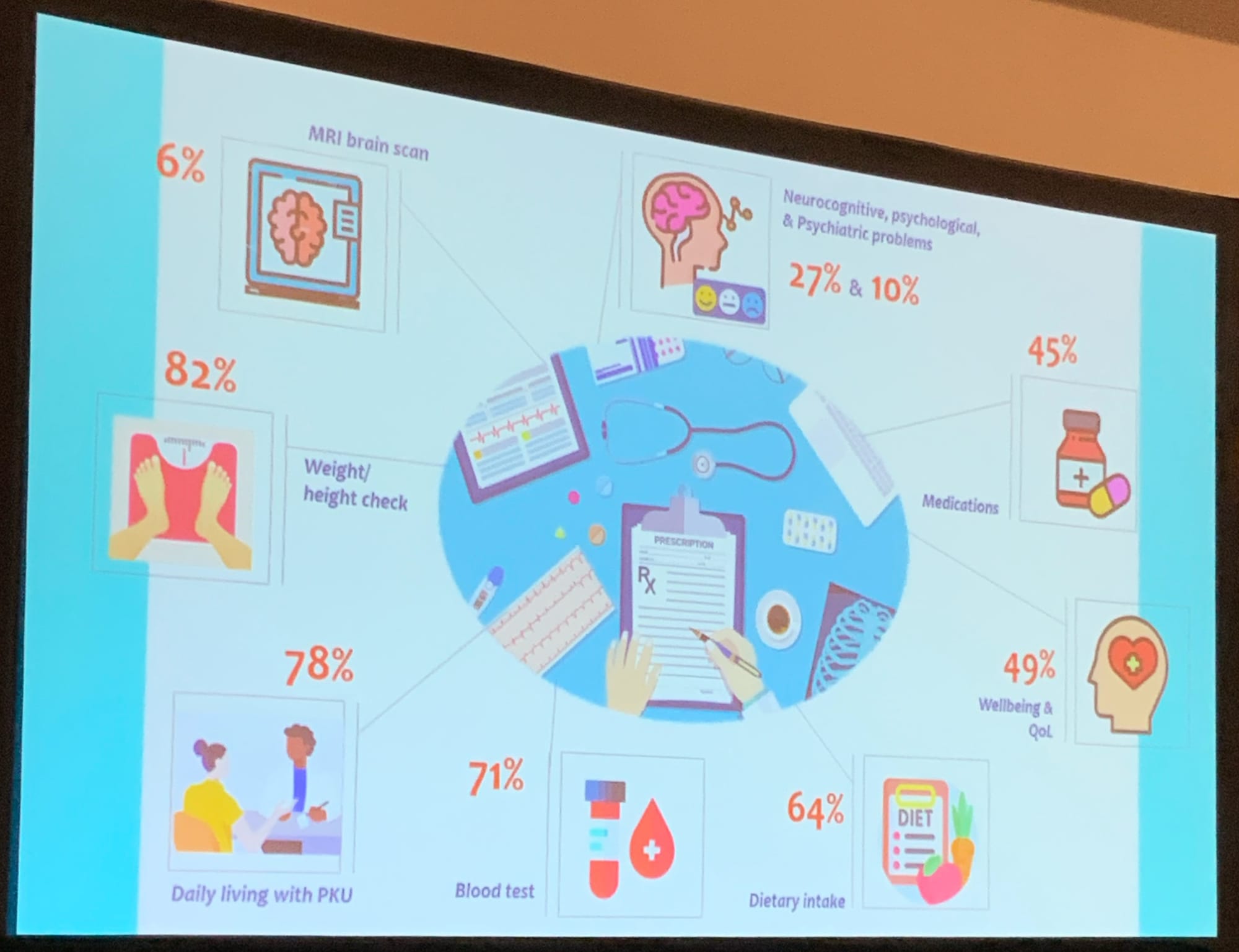
Services offered at PKU adult clinics in the UK. Weight and height are frequently discussed
Those surveyed reported the following frequency of services at clinic:
- 82% received a weight / height check
- 78% discussed their daily living with PKU
- 71% had a blood test on the day
- only 64% of respondents discussed their dietary intake during clinic, an odd outcome for a restricted diet therapy, while 41% reviewed their medications
- 49% discussed their wellbeing and quality of life
- Fewer than a third of respondents reported discussing neurocognitive, psychological, or psychiatric concerns.
Blood phe monitoring at home
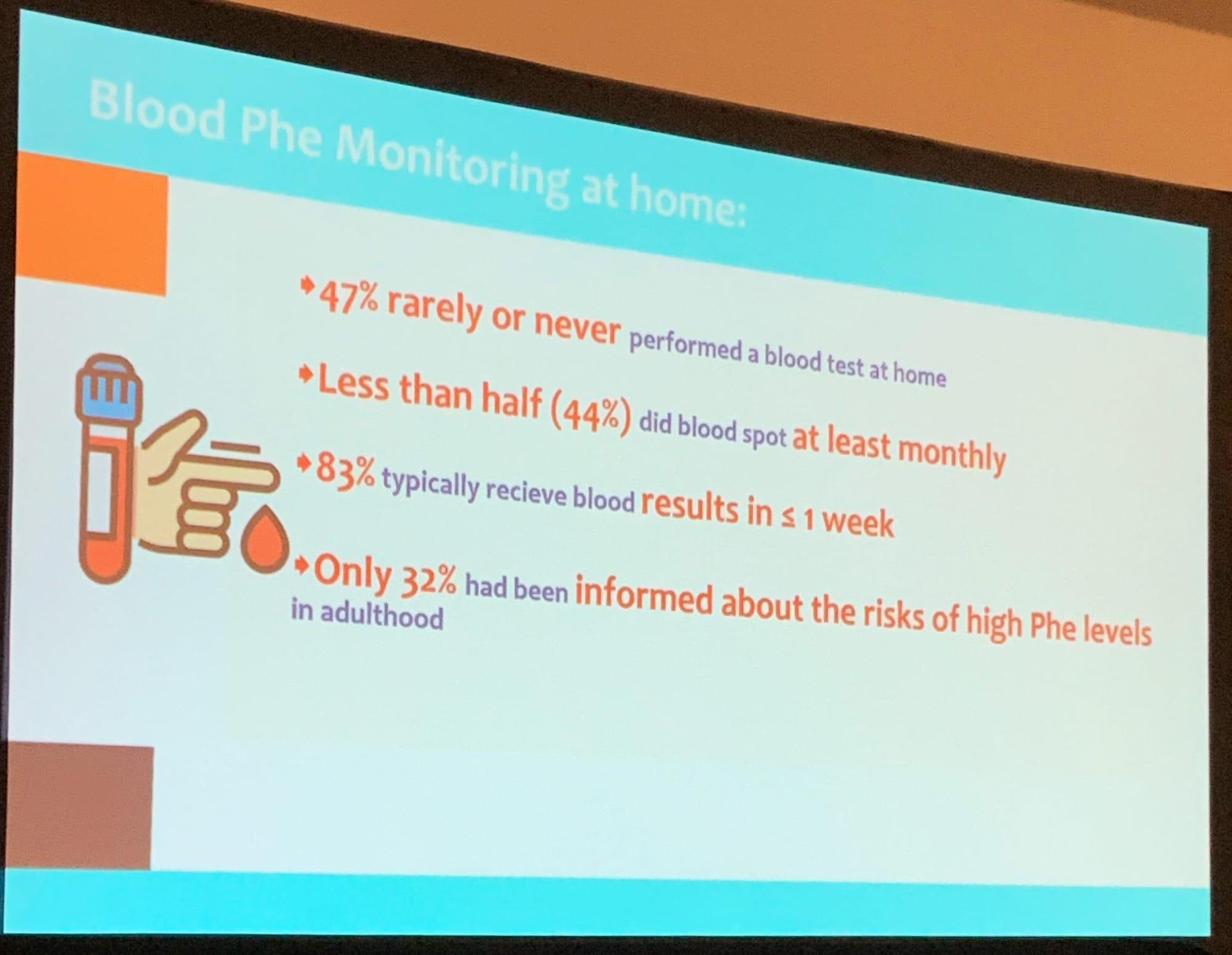
Blood phe monitoring in PKU adults in the UK. only 32% had been informed of the risks of high phe levels.
The survey provides further, convincing, evidence that an at-home blood phe monitoring machine is much needed. More than half of respondents rarely, or never, performed a test at home. This is likely linked to the alarming stat that **only 32% of adults had been warned of the risk of high phe levels in adults.**
## Key findings which need attention
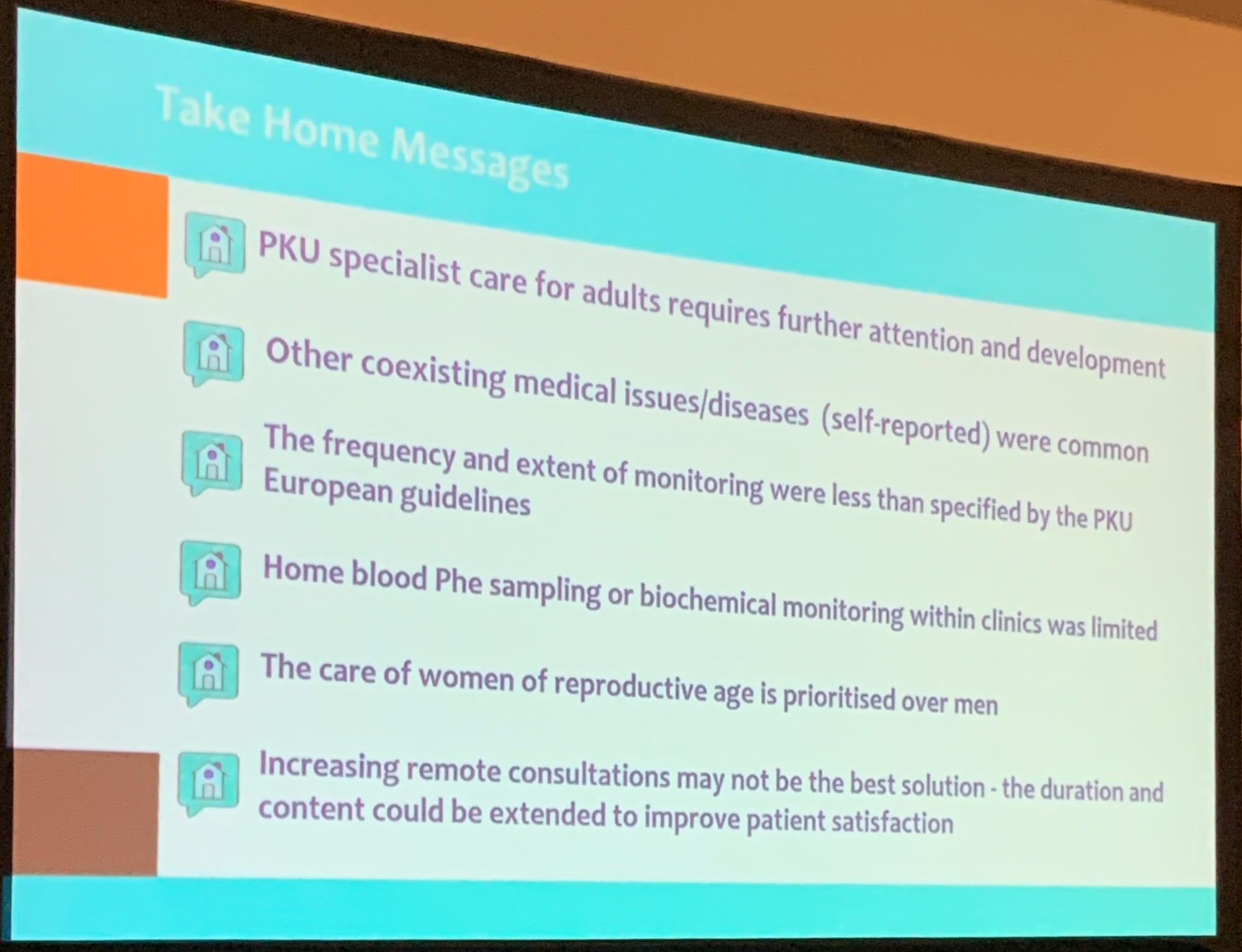
Specialist PKU care for adults in the UK requires further attention and development, particularly for men.
- Specialist care and education for adults needs development
- Co-existing medical issues were common
- Services do not meet those specified in the EU Guidelines
- Education of blood phe level risks and monitoring is needed.
- The care of women of reproductive age is prioritised over men
- Remote consultations do not appear to meet patient needs.
> **The care of women of reproductive age is prioritised over that for males.**
## Are you currently attending a PKU clinic?
Let me know if how you feel about PKU clinic care in the comments below.
### Rare Minds Workshop
URL: https://www.pigpen.page/rare-minds-workshop/
Last updated: 2024-08-06T19:48:17.000Z
Mental health for adults living with PKU.
In October 2023, I chaired a workshop at the European Society for Phenylketonuria and Allied Disorders Treated as Phenylketonuria (ESPKU) conference called [Starting the Conversation](https://www.pigpen.page/starting-the-conversation/). The workshop was limited to adults with PKU only, and the packed room was proof that the concept was welcome.
Starting the Conversation was about strengthening the voice of adult PKU in our national societies. My fellow panel member and I wanted a space where adults with PKU felt able to hold an open discussion about managing PKU as adults, and to collect data about adult concerns in real time.
## A voice for PKU adults
The workshop used MentiMeter, interactive presentation software, to display questions regarding ageing, the struggles of staying on diet as an adult, careers & PKU, socialising with PKU, and ensuring representation within the national societies. We found three immediate and three long-term areas for national organisations to work on.
The area needing critical support, which could be worked on immediately, was **better mental health support.** The NSPKU wasted no time in contacting a mental health charity specialising in supporting those with rare diseases — [Rare Minds](https://www.rareminds.org/?ref=pigpen.page).
> **The NSPKU wasted no time in contacting a mental health charity specialising in supporting those with rare diseases—Rare Minds.**
## Rare Minds on Living with PKU
Louise Brooks ran a workshop for adults at the NSPKU conference in 2024\. At the same time, Rare Minds ran a workshop on supporting carers for children with PKU. There was a good response, with full rooms for both workshops.
Given the nature of the material, it is difficult to reproduce it. But it will be interesting to see how the partnership between NSPKU and Rare Minds progresses in future events.
### All of our voices, together
URL: https://www.pigpen.page/all-of-our-voices-together/
Last updated: 2024-08-06T19:29:59.000Z
This was the second juicy session on policy and campaigning at the NSPKU 2024 conference. The political landscape in the UK has changed dramatically since the presentation, meaning **Kate Learoyd and Caroline Graham’s** rallying cry carries more importance.
> **People living with PKU, and their families & friends, are often more experienced at campaigning than they think!**
## The fight for sapropterin
The fight for sapropterin (Kuvan) took 11 years, and the jumbled roll-out has left both jubilation and disappointment across the country. Research into new treatments continues (more here), and the PKU community may need to fight again for access to new treatments. There is certainly a case to advocate for fair access to the treatments and support currently available.
Kate and Caroline compared campaigning for PKU to living with PKU:
- working within a system which doesn’t accommodate you,
- having to explain PKU at every turn
- a need to advocate for support and treatment
This means that people living with PKU, and their families & friends, are often more experienced at campaigning than they think!
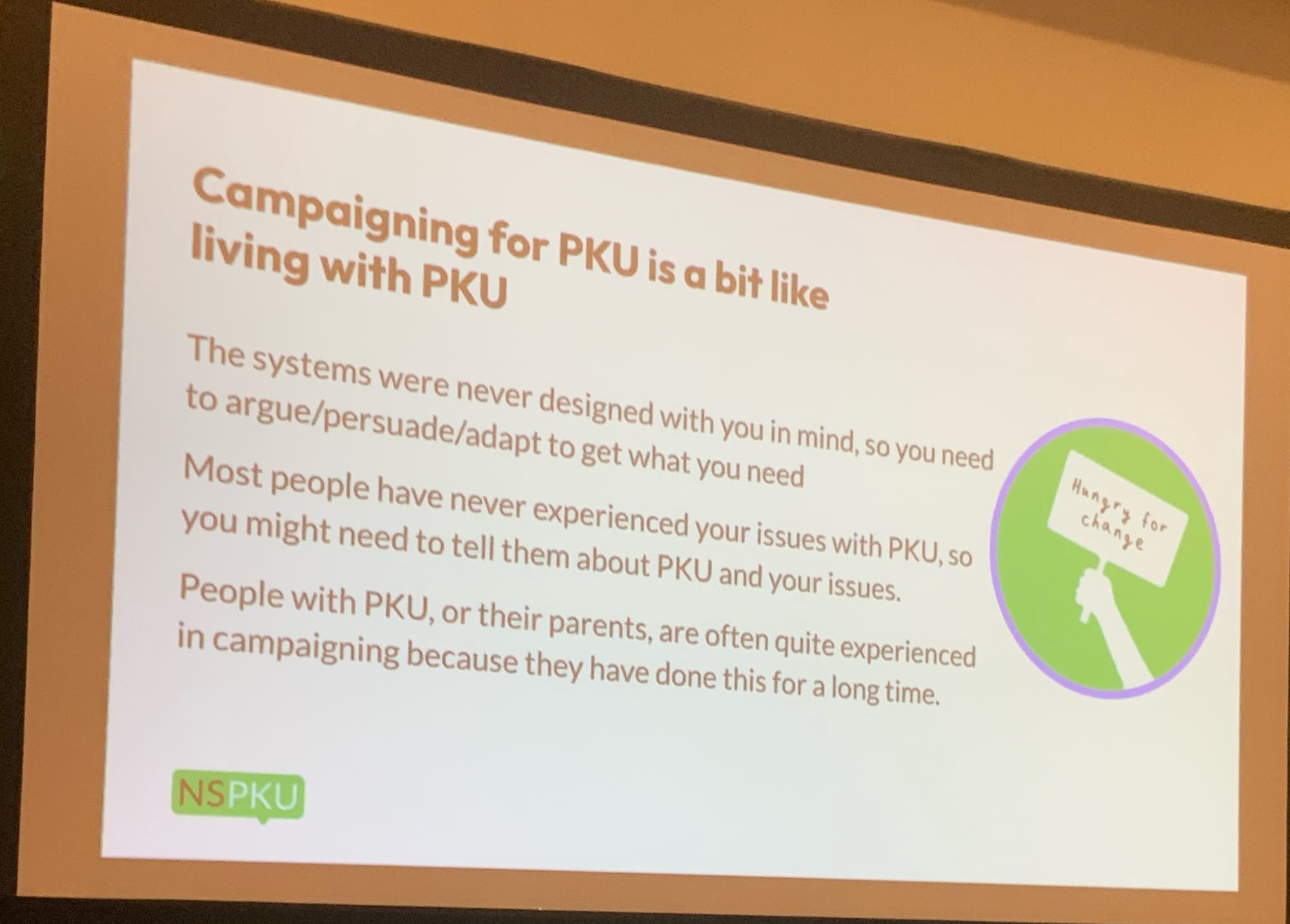
## Lessons for future campaigns
The fight for sapropterin means the NSPKU team now know a great deal about the licensing process. This bodes well for future campaigns. As does the experience, which shows that the advocacy of patients tipped the balance.
## 5 key lessons learned
- Honest campaigning from home is powerful.
- Don’t be ashamed, don’t be invisible, don’t be silent.
- Awareness of PKU is not enough
- Respect different experiences of PKU
- We don’t know enough about PKU.
> **The advocacy of patients tipped the balance.**
## A campaign case study
Kate and Caroline discussed the need to maintain and build on the relationships and connections made during the long sapropterin campaign. Politicians are the first advocates for local campaigns and are there to work for their constituents. This means that relationships with politicians and policymakers are critical.
Chris Cassidy organised a patient-led campaign for access to sapropterin in Northern Ireland. Politics in Northern Ireland is rarely simple, and has been in upheaval over the last few years. Chris navigated this and brought MPs and Members of the Legislative Assembly from all parties together to work with and support the PKU community. A fantastic example of the work which can be done in difficult circumstances. As a result of his campaign, the people of Northern Ireland got access to sapropterin despite the Northern Ireland Assembly being closed.
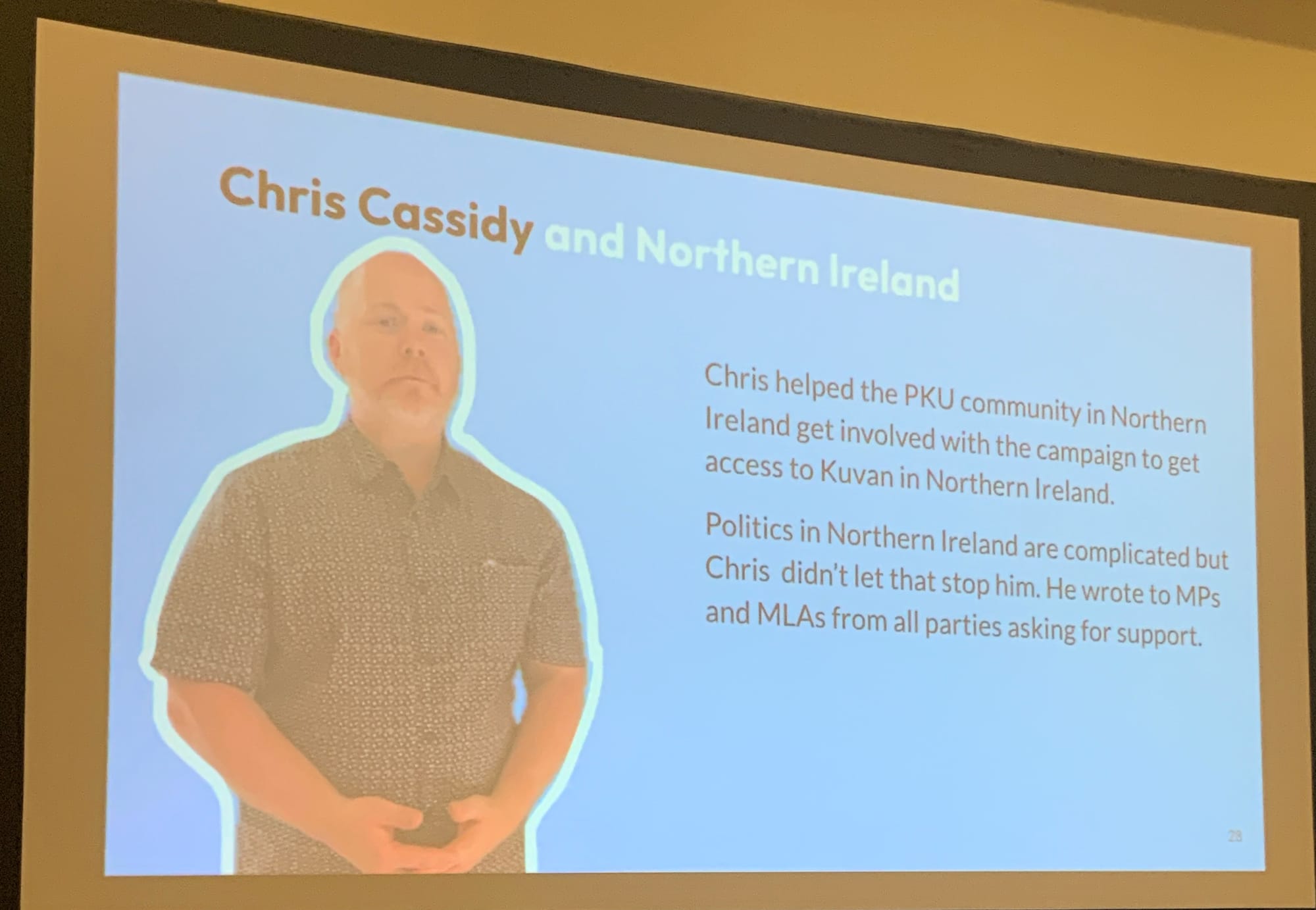
## PKU in Parliament
As I write this in July 2024, a record number of over 350 new MPs are being inducted into the UK Parliament. Each one is a potential new advocate for PKU. There is an All Party Parliamentary Group (APPG) for PKU, which played a critical role in the fight for sapropterin.
As Kate said, “APPG’s are not about politics. MPs leave that at the door and work for their constituents.” We can write to our MPs and ask them to join, or remain in, the APPG for PKU.
This is how the campaign for sapropterin started, with patients writing to their MPs asking for help. Please do the same now, as the PKU community is stronger when we fight together, and our voices are being heard.
As the NSPKU team said: “We cannot be invisible again.”
## What does the NSPKU do?
(YouTube Video) [https://www.youtube.com/watch?v=QP9t-DIFhRk](https://www.youtube.com/watch?v=QP9t-DIFhRk&ref=pigpen.page)
### PKU United panel
URL: https://www.pigpen.page/pku-united-panel/
Last updated: 2024-08-06T19:28:28.000Z
A patient panel discussion on Living with PKU was held at the NSPKU conference in May 2024\. Chaired by Polly O’Connor, and with heartfelt thanks to the panel for sharing their experiences and difficulties with the packed conference hall. Annie Skidmore, Jasmin Port, Richard Farquar, and Miriam Bier: your courage was much appreciated.
> **This year, the panel was called PKU United. Because we are stronger as a united community.**
## Recognising common and unique experiences with PKU
One of the consistent highlights of NSPKU conferences over the years has been the patient panel. This year, the panel was called PKU United. Because we are stronger as a united community.
The panel reflected on the fact that people with PKU are now not all on the same treatment. Some may have had a wonderful few years experimenting with new treatments and opportunities. Others may have had a very difficult time discovering that certain new treatments are not available, or effective for them.
## Strength in our PKU numbers
We need the PKU community to be a safe place to celebrate, commiserate, and campaign together. The first step is to acknowledge that there are now different treatment experiences within our community. Basically, change is happening.
Hopefully, change will be for the better, that is certainly what the NSPKU campaigns are about. What is certain is, now more than ever, we need to know we are not alone. And that takes work. We need to work on our ties to ensure we can help each other remain a cohesive, supportive and forceful patient community.
It is impossible to replicate the full discussion in a blog post. So I will finish with my answers to the concluding questions.
> **We need to work on our ties to ensure we can help each other remain a cohesive, supportive and forceful patient community.**
## The best thing about PKU for you in the past two years
The effect which the approval of sapropterin as a treatment on the NHS has been marked for many families. The effect on the future of PKU treatment in the UK can be harder to see, but it cannot be underestimated.
For the first time ever, the NHS and NICE have admitted that people with PKU need a treatment beyond diet. The restricted diet treatment has saved many lives since it was developed in 1953\. But it is a difficult treatment to follow every day of your life with no respite. For the NHS to admit that a treatment beyond diet is needed, and must be allowed, is a gigantic step. One which opens the doors for other possible future treatments.
## The Worst thing about PKU
Sapropterin testing. Not simply because of the disappointment of it not working for me, but the gruelling process. I was effectively on a scientific trial for two years which trying to manage daily life and the effects of PKU. Only now, out the other side, do I appreciate how much of a toll it took on me, my family, and my friends. I will always be grateful for the opportunity to trial a new treatment, but wow it was hard!
## My hope for the future of PKU
Now that there is finally an admission that restricted diet therapy cannot and should not be the only treatment for PKU available on the NHS, I see a bright future ahead. It will take time for new treatments to be developed and trialed in the UK; however, there is now precedent and established practice for this to happen.
We, as a PKU community, need to campaign together to ensure that lessons are learned from the current role out, and so that others do not need to wait years for a possible treatment. (Side note: if anyone can explain why adults are not allowed on the sepiapterin trials currently being undertaken in the UK, please get in touch. This feels like a discrimination case waiting to happen!)
### Sitemap / tags
URL: https://www.pigpen.page/sitemap/
Last updated: 2024-10-24T10:09:53.000Z
Pauline O'Connor (PigPen) articles on PKU, Brain Injury, mental health, Phenylketonuria, concussion, TBI, ABI, Rare Disease, anxiety, & much more.
[**Advocacy**](https://www.pigpen.page/tag/advocacy/)
[**Brain injury**](https://www.pigpen.page/tag/brain-injury/)
[**Concussion**](https://www.pigpen.page/tag/concussion/)
[**Low Protein**](https://www.pigpen.page/tag/low-protein/)
[**Mental health**](https://www.pigpen.page/tag/mental-health/)
[**News**](https://www.pigpen.page/tag/news/)
[**PKU**](https://www.pigpen.page/tag/pku/)
[**Recipes**](https://www.pigpen.page/tag/recipes/)
[**Writing**](https://www.pigpen.page/tag/writing/)
### Lived Experiences of Sapropterin
URL: https://www.pigpen.page/lived-experiences-of-sapropterin/
Last updated: 2026-01-02T15:31:09.000Z
The NSPKU conference, held from 17-19 May 2024, included several updates on forthcoming research. These are my notes from the session by **Giana de Sousa, Lead Paediatric IMD dietitian, Nottingham & NIHR researcher.**
Gina de Sousa, a Children’s Metabolic Dietitian and PhD researcher at the University of Nottingham, is gathering the views of healthcare service users and professionals regarding the UK roll out of sapropterin (Kuvan, BH4) treatment for PKU. This is in preparation for a study with the working title: **SAPHIRE**—Sapropterin Application for PKU Healthcare Insights in England research to guide our future
Gina presented at the NSPKU Conference in May, and I have included a selection of slides from her presentation below (apologies for the angle, it was a packed hall). She is planning a PhD [“to collect information about the rollout and response testing for sapropterin treatment in England since its availability on the NHS for all ages in 2021](https://forms.office.com/pages/responsepage.aspx?id=7qe9Z4D970GskTWEGCkKHtA4JGF6eVtNuMdLE6Fz7AVUNzY0SUNKTlhXMzBHNTZOSTBYWlIyNUxVUy4u&ref=pigpen.page)”.
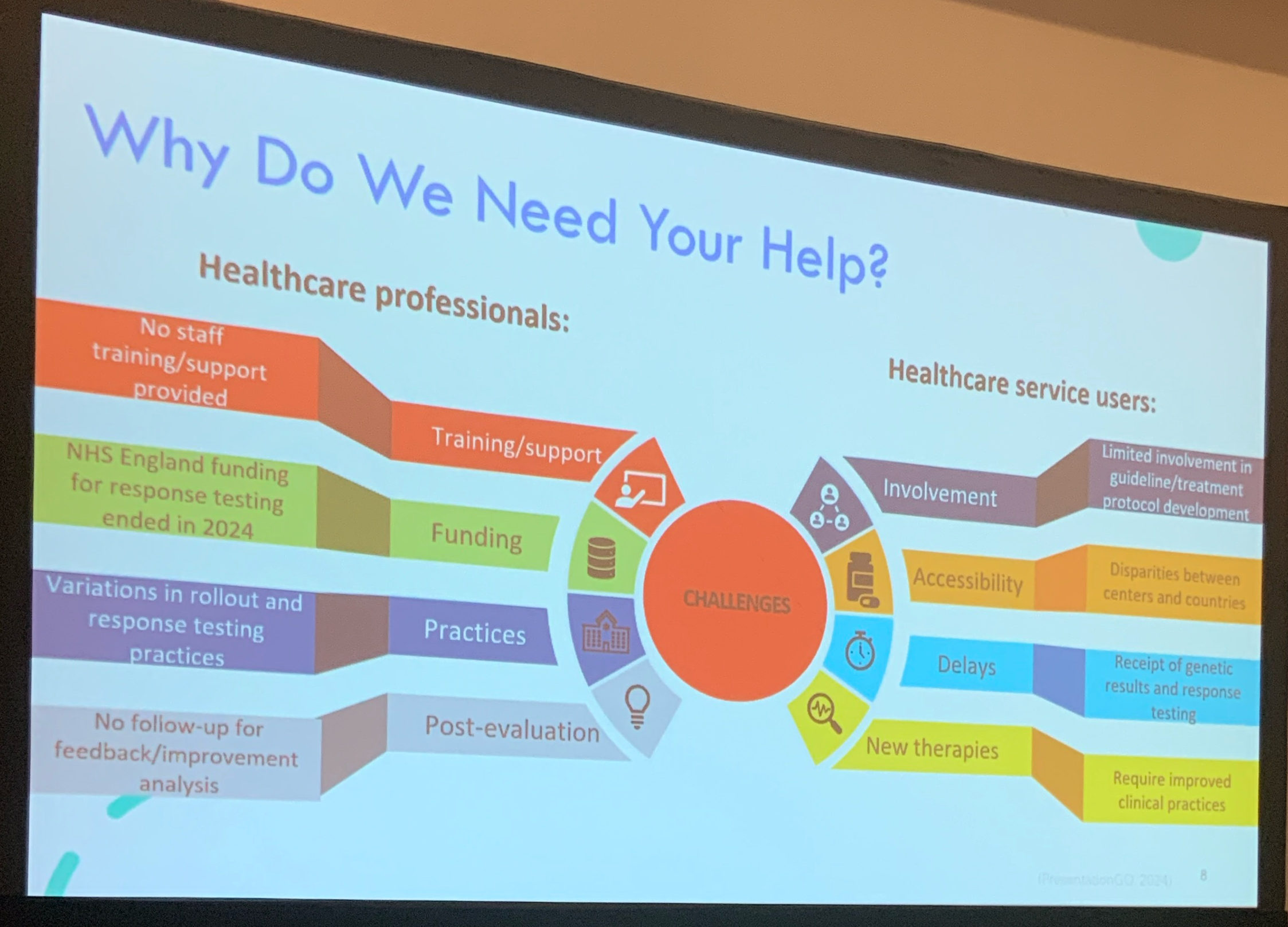
The researchers need your help.
Many readers will be familiar with the problems of the sapropterin rolls out. Gina noted that a key concern was the lack of formal training for staff. Further, many staff members were expected to do the rollout work on top of current workloads.
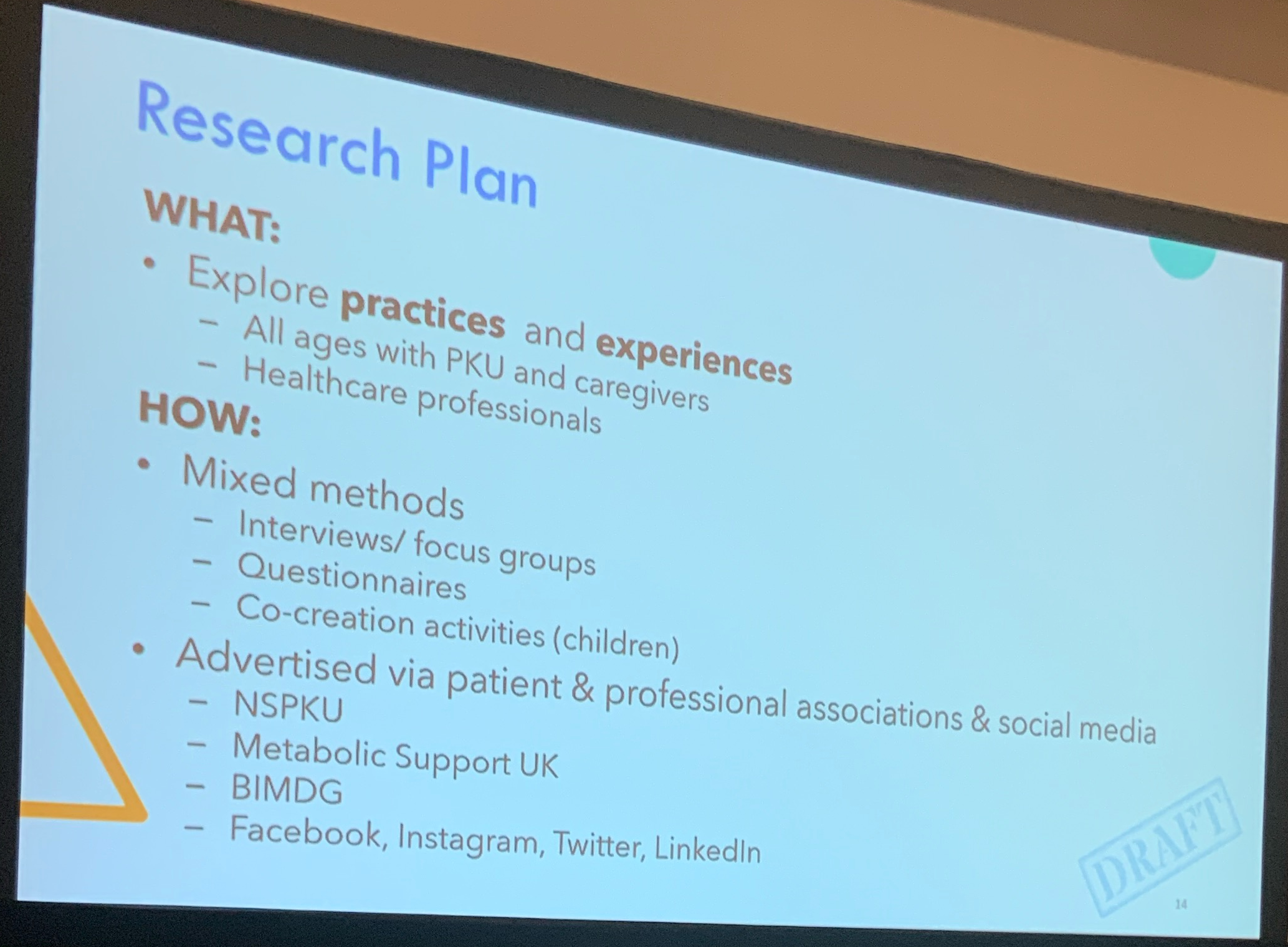
The research plan
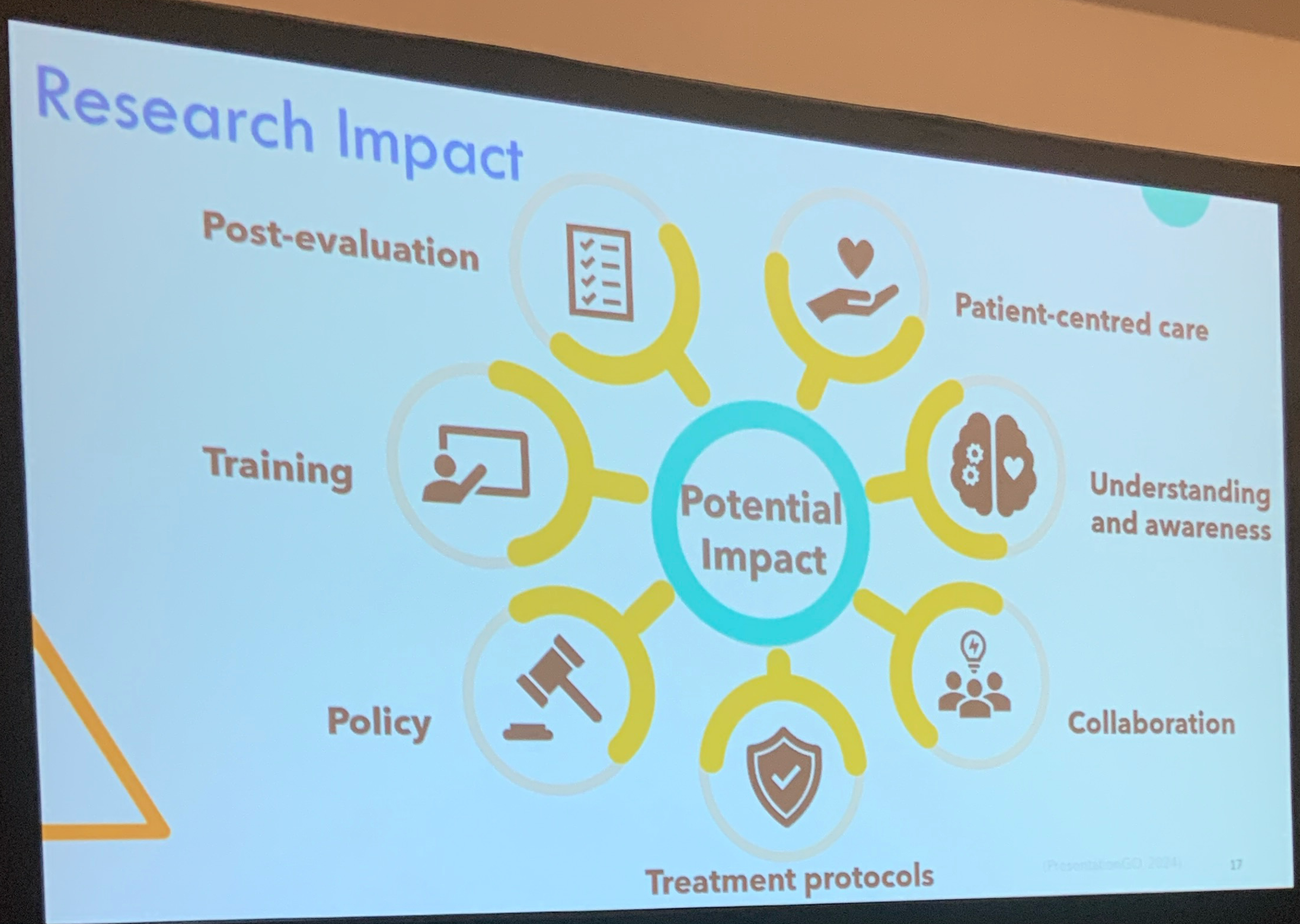
The research impact
As Gina said, we need to be ready for the next new treatments. There are more details on the [survey website](https://forms.office.com/pages/responsepage.aspx?id=7qe9Z4D970GskTWEGCkKHtA4JGF6eVtNuMdLE6Fz7AVUNzY0SUNKTlhXMzBHNTZOSTBYWlIyNUxVUy4u&ref=pigpen.page), a Google form. There are 15 questions, and it should take about 10–15 minutes to complete. All responses will be strictly anonymous.
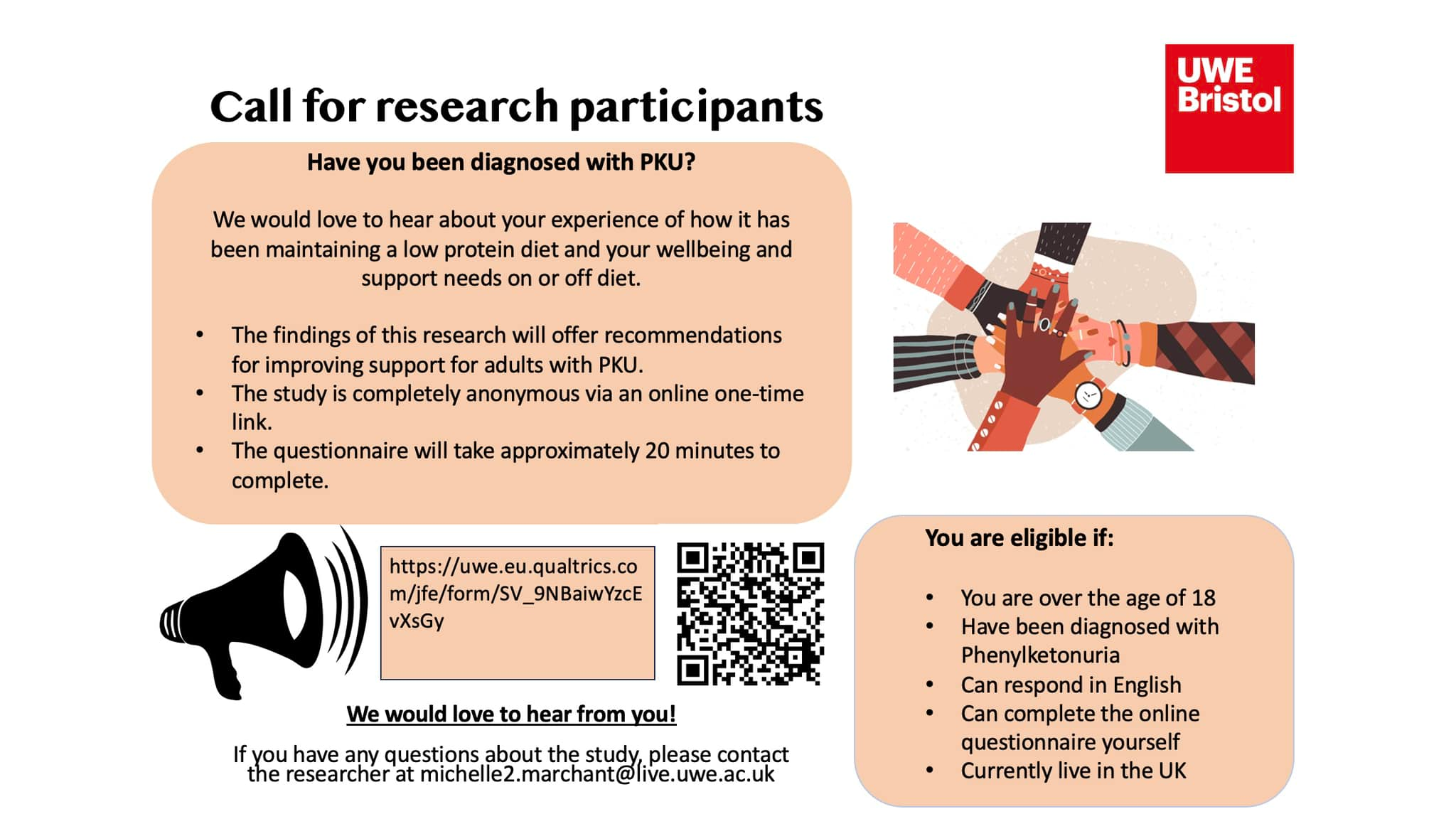
**Please get involved**, as Gina’s work will improve the system — and help us to be ready for the next new treatments.
### #PKUDay2024
URL: https://www.pigpen.page/pkuday2024/
Last updated: 2024-07-23T12:39:47.000Z
PKU Day is a chance for this rare disease community to raise awareness of this inherited metabolic condition, Phenylketonuria (PKU). June 28th was chosen as it marks the birthday of two important figures in the history of PKU.
In the 1950s, Dr Horst Bickel helped to develop a treatment for PKU. In 1960, Dr Robert Guthrie developed a simple, accurate test for national screening. Both of these developments drastically improved the diagnosis and treatment of those born with PKU.
## Help PKU research — now!
The recent NSPKU conference shone a spotlight on new research, and clinical trials in the UK, which you can support for PKU Day 2024.
### Sepiapterin trials, children only
Sepiapterin is a drug similar to sapropterin (Kuvan), but which works in a slightly different way. This means it is likely to be effective for more people with PKU — you can [read more about sepiapterin here](https://www.pigpen.page/pku-future-treatment-update/).
There are currently trials on sepiapterin in the UK, in both London and Birmingham. However, these trials are all on children only. I do not know why, and am keen to discover how such age discrimination is allowed to exist.
If you would like to learn more, ask your clinic about possible trials near you. I suggest asking even if you are an adult with PKU. We need to establish a demand for trials regardless of age.
### Sapropterin (Kuvan) survey
Gina de Sousa, a Children’s Metabolic Dietitian and PhD researcher at the University of Nottingham, is gathering the views of healthcare service users and professionals regarding the UK roll out of sapropterin (Kuvan, BH4) treatment for PKU.
There are more details on the [survey website](https://forms.office.com/pages/responsepage.aspx?id=7qe9Z4D970GskTWEGCkKHtA4JGF6eVtNuMdLE6Fz7AVUNzY0SUNKTlhXMzBHNTZOSTBYWlIyNUxVUy4u&ref=pigpen.page), a Google form. There are 15 questions, and it should take about 10–15 minutes to complete. All responses will be strictly anonymous.
Please get involved, as Gina’s work will improve the system — and help us to be ready for the next new treatments.
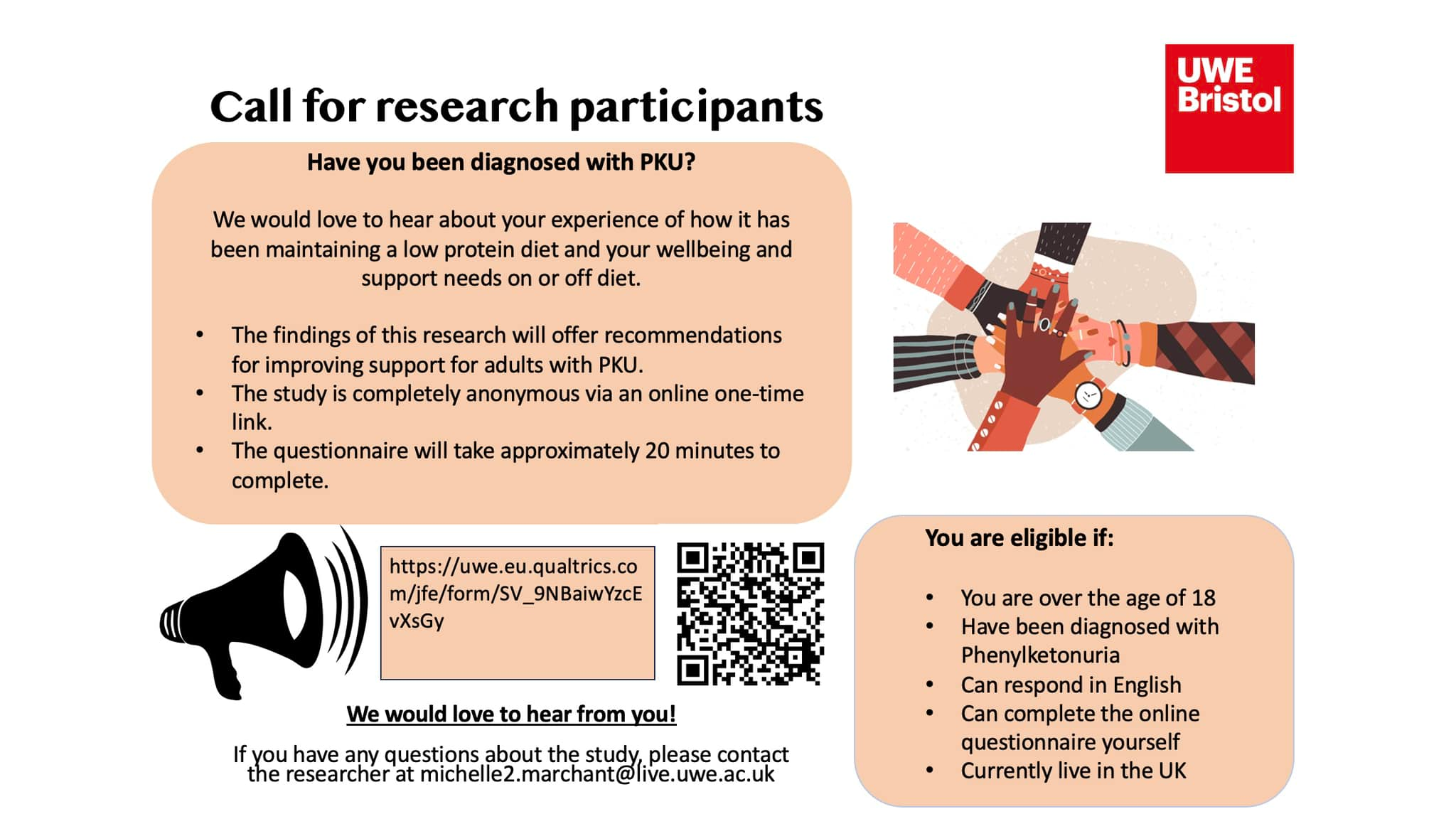
### Quality of life survey
This research survey is asking about the lived experiences of eating behaviours on the restricted diet therapy, psychological wellbeing, and support needs in adults with PKU.
The research is run by Michelle Marchant from the University of the West of England, Bristol. The survey is here, and the results will be anonymised. It took me about 20 minutes to do a good rant…
[https://uwe.eu.qualtrics.com/jfe/form/SV\_9NBaiwYzcEvXsGy](https://uwe.eu.qualtrics.com/jfe/form/SV%5F9NBaiwYzcEvXsGy?ref=pigpen.page)
## Sport, exercise, and physical activity in PKU
Back to Birmingham for a research project run by Annie Skidmore, & Lewis Gough, Associate Professor in Nutrition and Physiology, of Birmingham City University.
The research project has three aims:
- To identify perspectives of quality of life and participation rates in physical activity and exercise behaviours in PKU patients.
- To explore perspectives on physical activity, exercise, and nutrition habits differ among PKU adults, caregivers, industry, and clinicians.
- Also, to understand barriers and facilitators for patients with PKU to perform exercise.
The study consists of three parts: an online survey looking at physical activity and exercise participation, a second quick survey about quality of life, and then an in-person focus group.
**You have the option to take part in as little or as much as you wish**
Participation survey: [https://app.onlinesurveys.jisc.ac.uk/s/bcu/pku-survey](https://app.onlinesurveys.jisc.ac.uk/s/bcu/pku-survey?ref=pigpen.page)
Quality of life survey: [https://app.onlinesurveys.jisc.ac.uk/s/bcu/who-quality-of-life-survey](https://app.onlinesurveys.jisc.ac.uk/s/bcu/who-quality-of-life-survey?ref=pigpen.page)
### Raise awareness this PKUDay2024
Whether you chose to participate in some active research, fundraise for charities, or tell just one more person about PKU — I hope you have a super PKU day on June 28, 2024.
### Review of the EU Guidelines on PKU
URL: https://www.pigpen.page/eu-guidelines-on-pku/
Last updated: 2024-08-05T16:16:17.000Z
In the first of two juicy sessions on policy and campaigning, Prof. Anita MacDonald OBE, Consultant Metabolic Dietitian at Birmingham Children’s Hospital, gave us a reassuring and sometimes sobering insight into the first revision of the European Guidelines for PKU.
(You can find more from the[ 2024 NSPKU conference here](https://www.pigpen.page/tag/conference/).)
The guidelines, published in 2017, aimed to optimise PKU treatment across the bloc. Between 2017 and 2024, they were accessed 73,000 times from countries around the globe. The accompanying dietary handbook, published in 2020, has been downloaded 78,000 times.
## What are the European Guidelines for?
Professor MacDonald noted that the documents were especially useful in countries without established support. This was our first sobering moment of the presentation—a reminder that PKU is not tested for in some countries, leaving undiagnosed families to struggle. In other countries, the cost of healthcare or difficulties accessing treatment mean that even those diagnosed are unable to access the necessary care.
One of the key reasons for having the guidelines is to help inform policy changes and establish the best treatment practices in places where those are still being developed, and to support those in areas where treatment falls short.
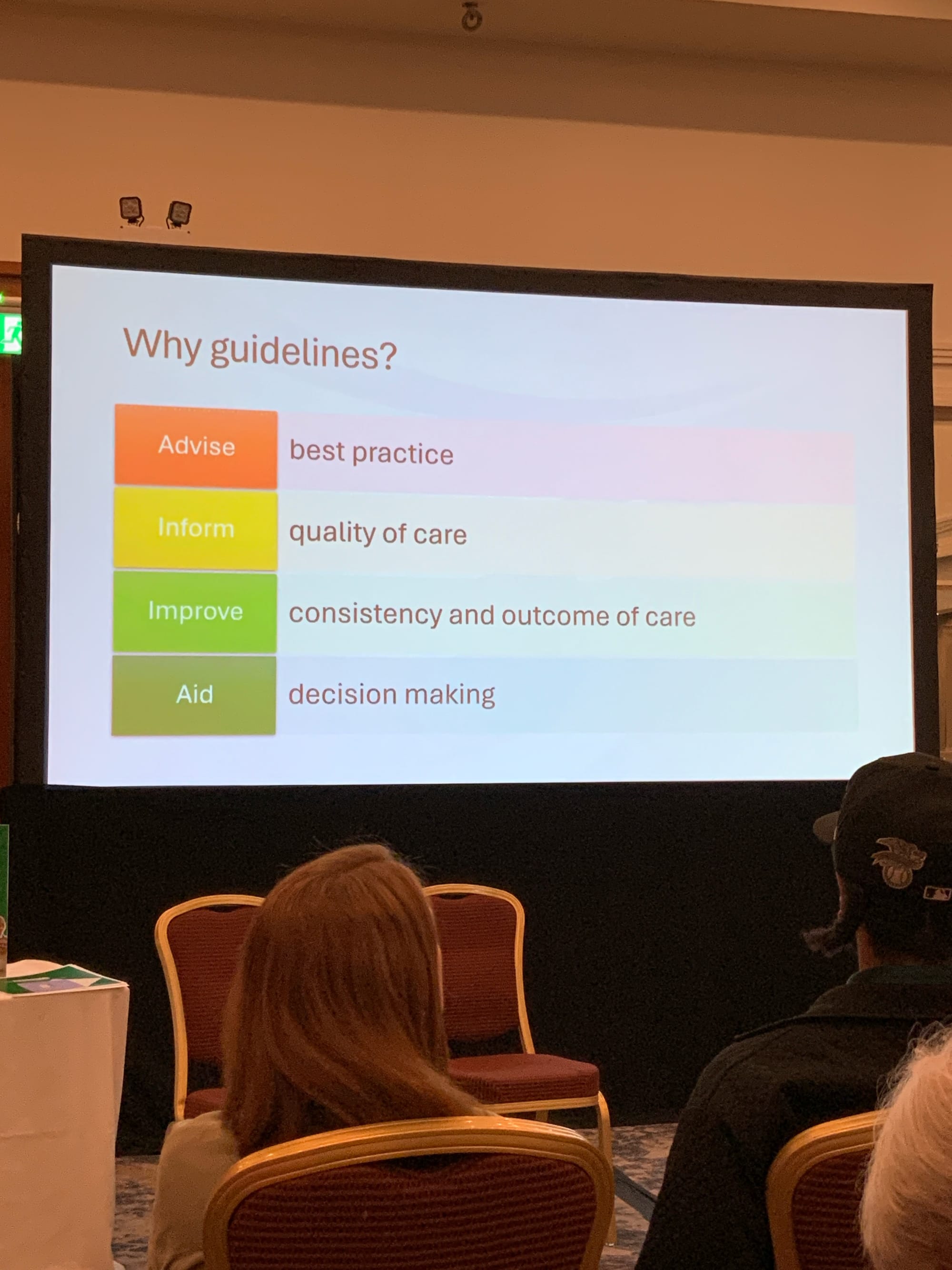
The European Guidelines for PKU advise best practice, inform quality of care, improve consistency and outcomes of care, and and with decision making.
## Why Review the European Guidelines on PKU?
The guidelines caused controversy when first published, particularly regarding the recommended levels of phenylalanine (phe) in the blood. Critics of the guidelines were invited to contribute to this first review.
There is also the obvious reason that research has moved on markedly in the last decade. The guidelines are seven years old at the time of this first review. But the research which fed into them was conducted at least a decade ago.
## How Will the Review Be Conducted?
The experts contributing to this review were assigned to one of four working groups, each focusing on different areas:
- All aspects of Nutrition,
- Comparing treatment outcomes and blood phe target ranges,
- Treating maternal PKU and those with a late diagnosis,
- Diagnostic techniques and pharmacological treatments (like pegvaliase or sapropterin)
The groups systematically reviewed all research up to 2020\. This included looking at the methodology and outcomes in each paper used for each guideline. The review will also ensure that each guideline has quality evidence backing it up. Each guideline must receive at least 75% consensus by all the experts for it to be accepted into the final guideline paper.
### Possible guidelines
**Note: The review is ongoing, these are not confirmed at the time of publication!** I include them here to demonstrate the scope of the guidelines.
**Blood phe levels**
There will continue to be guidelines regarding the levels of phe in the blood. It is likely that recommended phe levels for children and teenagers remain as:
- Under 12 years = 120-360umol/L;
- 12–18 years = 120-600umol/L
However, the recommended levels for adults over 18 are still causing controversy. Key findings which are being considered in the review include:
- Adult blood phe has been shown to influence brain function, and;
- keeping levels under 600umol/L does have less negative influence on the brain
- However, recent studies (Aitkenhead, 2021; and Feldmann, 2019) have found normal brain functions at higher levels in some adults.
**Time considerations**
There is a sobering addition to the debate for older adults with PKU: *“it is unknown if there will be enhanced sensitivity to phe in ageing brains.”* (MacDonald, presentation to NSPKU conference, May 2024.)
There may also be a recommendation that laboratories should report any blood phe results within two working days of receiving the sample. It discovered that this is not happening for some in the UK, even allowing for postal delays which are beyond the control of both patient and labs.
Blood phe levels and reporting is an active area of discussion for the review’s experts, and it will be interesting to see the final guideline.
**Refugees and PKU**
There is likely to be a recommendation that refugees from countries without newborn screening are checked for PKU. This is likely to be a guideline without controversy, I think all can agree it will be of benefit to both refugees and their new societies.
**Annual Clinic review**
One of the working groups is looking at clinics, and there may be a recommendation that all PKU patients are seen in clinic at least once a year. This may be something which those on diet in the UK take as a given, but there are countries where this is not standard practice. This recommendation may include a standard level of care during each visit:
- checking on height & weight;
- test to check blood phe, and other protein levels;
- tests to establish levels of other nutritional markers, like vitamins.
**Neuropsychological assessment**
This is a guideline with strong support from the experts, and so is likely to be confirmed in some form. As someone with access to a neuropsychologist through my PKU clinic, I fully support this sentiment and hope that it is included in the upcoming guidelines.
One suggestion was for routine assessments throughout development and into adulthood, including:
- testing of IQ and executive functions;
- checking for ‘non-optimal’ metabolic control;
- reported problems in the education or the workplace;
- actively assessing the patient’s quality of life;
- actively looking for mental health, behavioural, or social problems with referrals where needed.
There were calls for all of those with PKU to have access to a metabolic physician, a dietitian, and a neuropsychologist.
**Healthy eating and exercise**
There were several draft guidelines relating to healthy eating and exercise with PKU. Again, these are draft guidelines, so we do not know what the final recommendations will be. However, it was noted that:
- there is no evidence that the PKU diet causes people to be overweight or obese, but;
- as more people in general are becoming overweight, there is a similar increase in the number of people with PKU who are overweight, meaning;
- people with PKU need clear, preventative lifestyle strategies to prevent weight gain, similar to those lifestyle changes needed in the wider population.
As part of this, people with PKU should be encouraged to have active lifestyles, or take up sports, including assistance with getting adequate nutrition and energy. Professor MacDonald noted some key points here:
- people with PKU should not avoid sports because of PKU;
- ideally, take our supplements at least three different times, spaced event across the day;
- taking one of these supplements within an hour after exercise can help to refuel.
**PKU foods, dentistry, and associated costs**
The guidelines will also look at the specialised foods for PKU. There will likely be a recommendation that all specialised foods must meet the dietary limits on fat, sugar, and salt guidelines as that for regular foods.
Tied into this, the experts were also looking at dental care. They have found good evidence that people with PKU are at increased risk of teeth problems. This means encouraging those with PKU or those caring for kids with PKU to have good dental routines and to seek advice early.
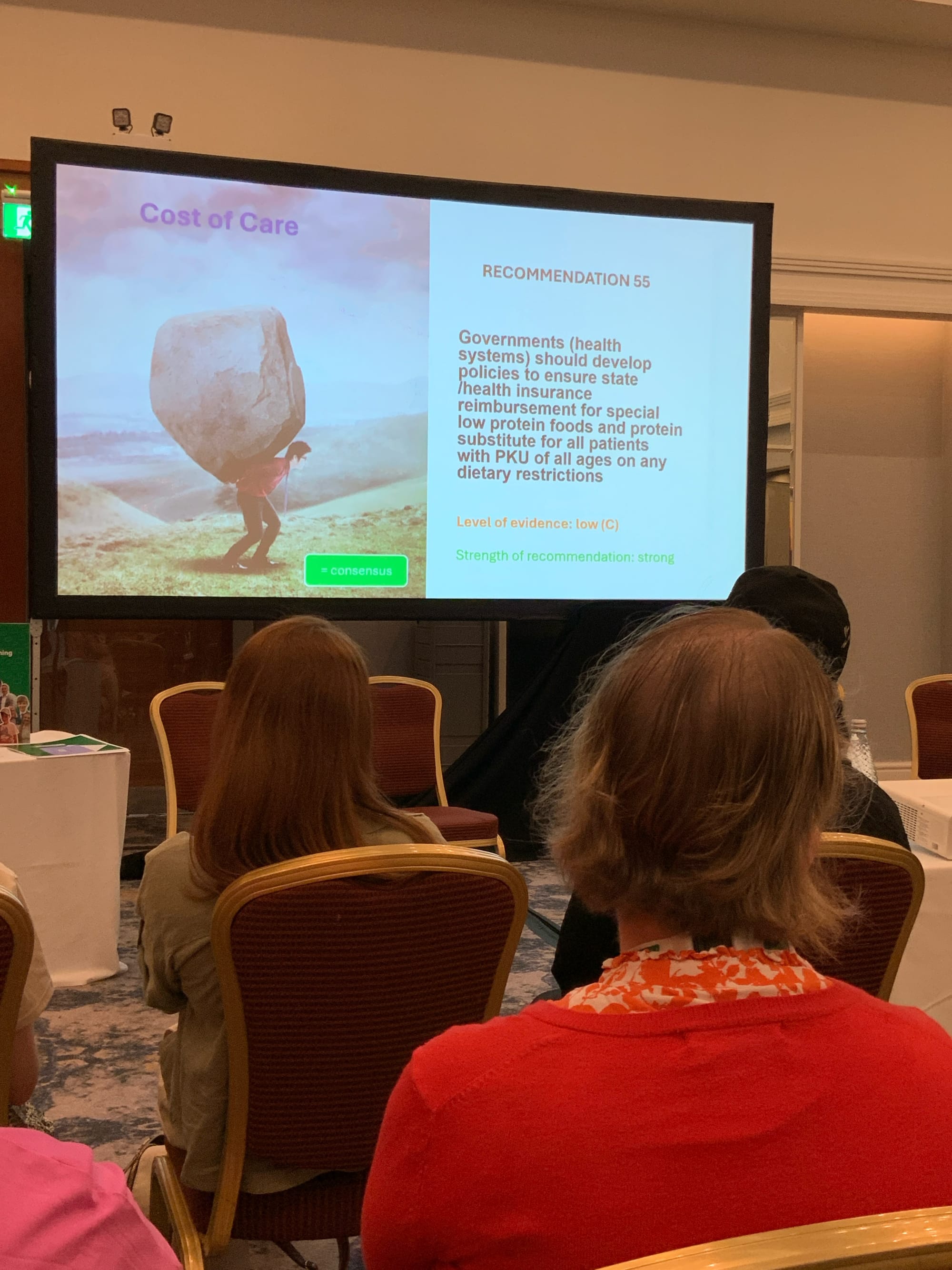
In the UK, the NHS covers the cost of most PKU supplements and specialised foods. This is not the case across Europe, and is an area under review in these guidelines. There is likely to be a recommendation that states across Europe should reimburse people with PKU for these essential medical supplies.
**Treatments beyond the PKU restricted diet & sapropterin**
I finish this round up with a look at a draft recommendation close to my heart, and one with strong support from the experts. The review is likely to recommend that those over 16 who are struggling on either the restricted diet or sapropterin (hullo!) should be offered treatment with pegvaliase. (This is the injection known as Palynziq, and [you can find out more about it here](https://www.pigpen.page/what-is-pal/).)
This is great news! But those of us in the UK cannot get too excited. While pegvaliase has been available in the EU for some years now, the UK is no longer in the EU (insert expletive here).
The makers of pegvaliase have pointed out that it is unlikely to be available in the UK anytime soon. So, while a recommendation on this is welcome, there will still be much campaigning for those in the UK.
The NSPKU is already on the case, and I’ll report on that in the next blog.
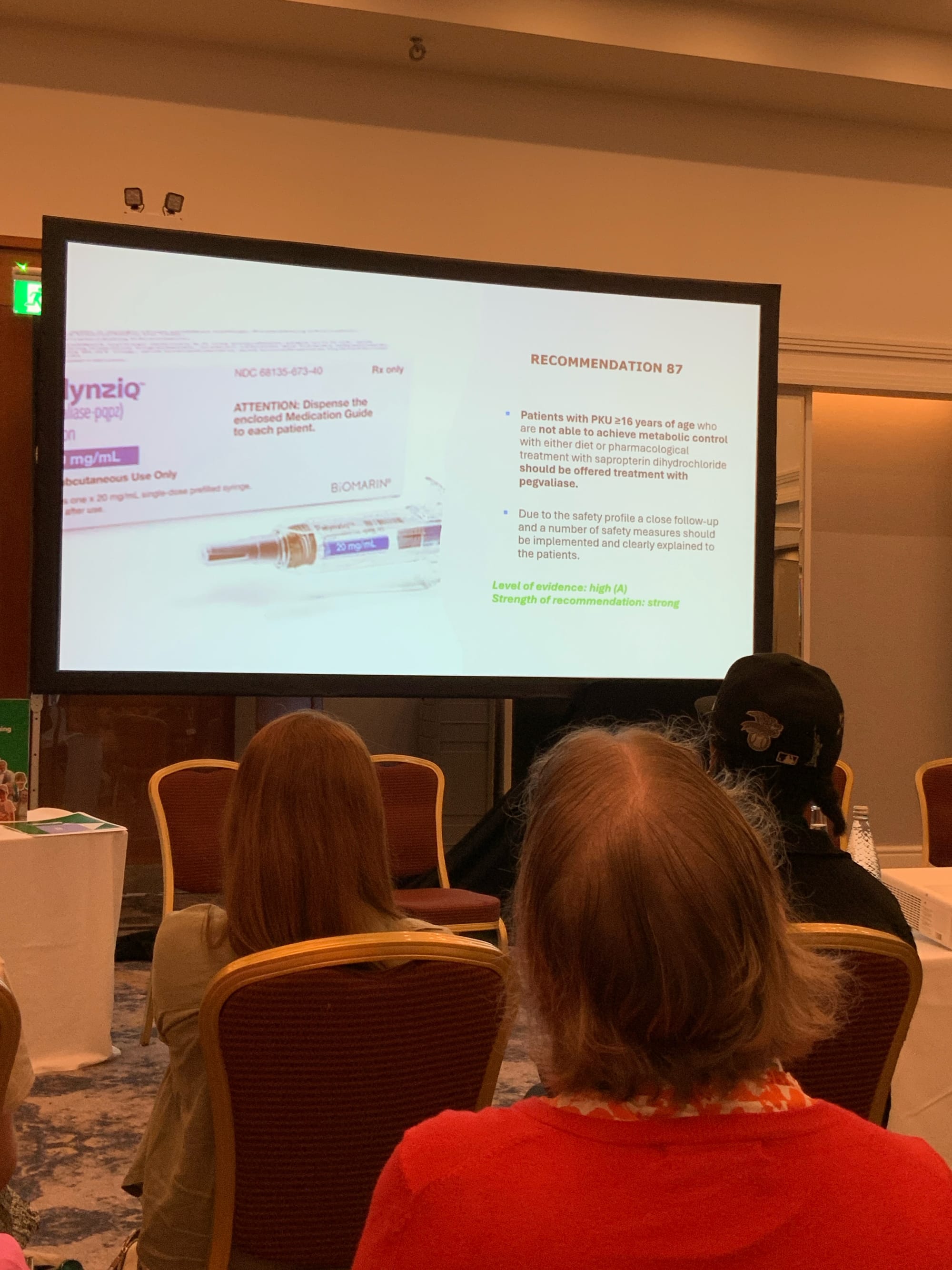
### Brain Injury News, June 2024
URL: https://www.pigpen.page/brain-injury-news-june-2024/
Last updated: 2024-06-27T13:53:06.000Z
A monthly selection of news and events related to concussion, head injuries, TBIs.
## Manifesto for brain injury
Headway UK has jumped into the election campaign by challenging the parties with their ‘five key asks’. Headway wants to see:
- increased understanding and awareness of brain injury,
- an end to the neuro-rehabilitation postcode lottery,
- investment in local brain injury re-ablement services,
- enhanced support for brain injury survivors’ loved ones,
- and a reform to social care making it equitable and sustainable.
You can find out more, including how to get involved in their campaign, [on their website](https://www.headway.org.uk/news-and-campaigns/news/2024/headway-launches-general-election-manifesto-calling-for-urgent-action-for-brain-injury/?ref=pigpen.page).
## Research opportunity 1: TBI Lived Experience
Would you like to help shape the future of TBI research? Join the TBI-LEAG group! This group’s intention is to welcome individuals with first-hand experience of Traumatic Brain Injury (TBI), such as survivors, caregivers, family members, and interested professionals, to actively participate in the progression of research in the field.
By signing up, you will receive brief quarterly newsletters about the research happening in TBI, along with notifications of active research studies that you can get involved in either as a participant or in an advisory capacity. To sign up or to find out more, please email: lucia.li@imperial.ac.uk
## Research opportunity 2: Mood impact after brain injury
We know that low mood and depression are common after brain injuries such as traumatic brain injury, stroke, and encephalitis, and this can impact our day-to-day activities.
However, planning and organisation abilities after brain injury can also impact mood. This research study is looking at ways to improve mood after brain injury by taking part in rewarding activities such as contacting a friend, hobbies, or other activities you find rewarding. This University of Oxford research study takes place online using MS Teams. You will meet with a researcher once a week for 3 weeks to plan activities together.
This research is targeted towards adults with a brain injury and low mood. Contact Andrea at Andrea.kusec@ndcn.ox.ac.uk or at 07935 242445 if you are interested in taking part.
## Problems with prescriptions?
Have you been affected by the reported difficulties with ADHD and medications? The Royal Pharmaceutical Society wants to hear from patients who have been impacted by medicine shortages. They have created an [online survey to collect experiences of patients](https://forms.office.com/Pages/ResponsePage.aspx?id=YTwZmY1ldkCVLwfDRaO-l22J7hNy2lJCoq-OOf-S8s9UMVc1NkVNOFFDSjFWVURPOThRMkxXWlRDTi4u&ref=pigpen.page) and the impact of shortages. If you’ve had trouble getting your medications, be sure to shout about it!
## What do you think of PIP?
The government is concerned that too many people will have access to PIP (yes, really!) and has opened a consultation on “the sustainability of the current model”.
Many people with brain injury may receive PIP as a result of their injuries. This is your chance to [provide feedback in a rather bureaucratic survey](https://forms.office.com/Pages/ResponsePage.aspx?id=6fbxllcQF0GsKIDN%5Fob4wy4AdhV04YtOnxNXoi82ciFUN00yS0lJSTgzOVNaUzI1TVpYRkZGN1RUQSQlQCN0PWcu&ref=pigpen.page). But stick with it, and let’s get our voices heard.
### PKU News, June 2024
URL: https://www.pigpen.page/pku-news-june-2024/
Last updated: 2024-06-27T13:55:40.000Z
A monthly selection of news and events related to Phenylketonuria (PKU)
## PKU Unity, the Chair’s notes on the 2024 NSPKU patient panel
I was honoured to be asked to chair the annual patient panel at this year’s NSPKU conference: **PKU Unity.** This was my introductory speech:
“One of the consistent highlights of NSPKU conferences over the years has been the patient panel. This year, the panel is called PKU United. Because we are stronger as a united community.
> We need the PKU community to be a safe place to celebrate, commiserate, and campaign together.
The panel will introduce ourselves shortly, and we are going to spend the next forty minutes reflecting on the fact that people with PKU are now not all on the same treatment. Some may have had a wonderful few years experimenting with new treatments and opportunities. Others may have had a very difficult time discovering that certain new treatments are not available or effective.
We need the PKU community to be a safe place to celebrate, commiserate, and campaign together. The first step is to acknowledge that there are now different treatment experiences within our community. Basically, change is happening.
Hopefully, change will be for the better, that is certainly what the campaigns are about. What is certain is, more than ever, we need to know we are not alone. And that takes work. We need to work on our ties to ensure we can help each other remain a cohesive, supportive and forceful patient community.”
## PKU future treatments update & PegPal
The NSPKU conference kicked off with a look at treatments beyond diet and sapropterin. The first two speakers were looking ahead to ‘what is in the pipeline.’ These were fascinating sessions on advances in technology and discoveries in trials which are at the edge of what we know about PKU. I wrote about [the sessions on future treatment here](https://www.pigpen.page/pku-future-treatment-update/).
My previous primer about the ‘PKU injection treatment’ variously known as [PegPal, Pegvaliase, or Palynziq may also be of interest](https://www.pigpen.page/what-is-pal/).
I will be posting further blogs on the sessions. As some of these involved sensitive data, I’m checking with the presenters before posting publicly.
## Problems with prescriptions?
There was plenty of anecdotal discussion regarding shortages of supplements and special foods on prescription at the conference. We need to be able to collate this information before it can be acted on. With perfect timing, the Royal Pharmaceutical Society wants to hear from patients who have been affected by medicine shortages.
They have created an [online survey](https://forms.office.com/Pages/ResponsePage.aspx?id=YTwZmY1ldkCVLwfDRaO-l22J7hNy2lJCoq-OOf-S8s9UMVc1NkVNOFFDSjFWVURPOThRMkxXWlRDTi4u&ref=pigpen.page) to collect experiences of patients and the impact of shortages. If you’ve had trouble getting your food, be sure to shout about it!
## What do you think of PIP?
The government is concerned that too many people will have access to PIP (yes, really!) and has opened a consultation on “the sustainability of the current model”. Plenty of people with PKU have been through this process with varying levels of success. This is your chance to [provide feedback in a rather bureaucratic survey](https://forms.office.com/Pages/ResponsePage.aspx?id=6fbxllcQF0GsKIDN%5Fob4wy4AdhV04YtOnxNXoi82ciFUN00yS0lJSTgzOVNaUzI1TVpYRkZGN1RUQSQlQCN0PWcu&ref=pigpen.page). But stick with it, and let’s get our voices heard.
## Reading:
[**Imagine getting life-saving drugs to sick people without relying on big pharma? We may have found a way.**](https://www.theguardian.com/commentisfree/article/2024/may/16/imagine-getting-life-saving-drugs-to-sick-people-without-relying-on-big-pharma-we-may-have-found-a-way?ref=pigpen.page)
This article on medical research will certainly be of interest to PKU patients.
“If we can stop treating people as commodities and instead recognise that transforming patients’ lives is priceless, then we can ensure that more life-saving treatments are reaching those who desperately them.”
### PKU future treatment update
URL: https://www.pigpen.page/pku-future-treatment-update/
Last updated: 2024-07-03T11:43:34.000Z
The NSPKU conference held from 17-19 May 2024 included an update on possible new treatments for PKU. These are my notes from the sessions on sepiapterin, mRNA, gene therapy, solute carrier 6, and options for PegPal.
## Part 1: Sepiapterin
**Dr Anupam Chakrapani, Consultant IMD Paediatrician, Great Ormond St Hospital NHS Foundation Trust**
The conference opened with a look at a new treatment for PKU, which sounds deceptively similar to sapropterin (Kuvan), but which is likely to work for more people: Sepiapterin. (For a simple explanation of on why sapropterin doesn’t work for everyone, see [https://pigpen.page/the-genetics-of-pku/](https://www.pigpen.page/the-genetics-of-pku/))
### Both sepiapterin and sapropterin are protein ‘chaperones’
Many of you will have felt like a ‘protein chaperone’ most of your life, but we are talking about pharmacological chaperones here. These are substances which can occur naturally within the body or administered as a medication. In PKU, both sepiapterin and sapropterin assist the metabolism of phe by increasing the amount of BH4 in the body. BH4 does occur naturally in the body, and sepiapterin adds BH4 if a form similar to the body’s BH4\. The BH4 in sapropterin, however, is in a form which needs to be converted before working. This is one of the reasons why it doesn’t work in two thirds of patients.
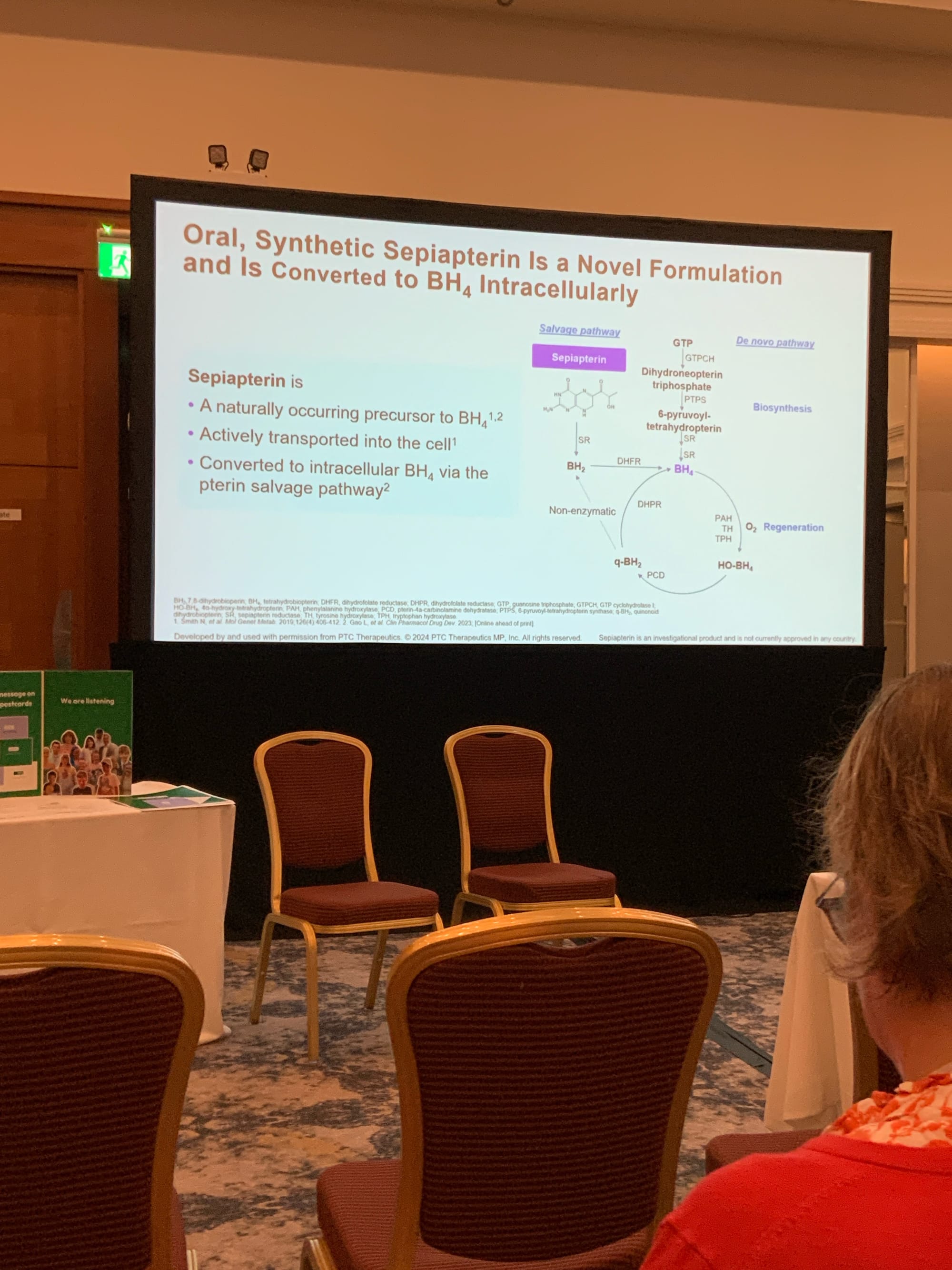
### Sepiapterin in trials in the UK
The team have been undertaking small feeder trials. I reported on these in my January 2023 newsletter when these were reported at only paediatric clinics. I have enquired again about adult participation and will report back when I hear. ([Subscribe to the monthly update](https://www.pigpen.page/newsletter/))
The team found that many of those with blood phe levels over 360 before the trial were able to reduce phe levels below that recommended guideline thanks to the trial. They also found that sepiapterin was especially effective in classical PKU, compared with sapropterin on average. The trial also found that sepiapterin was well tolerated, though there were some side effects (nausea, headaches and other effects similar to those produced by sapropterin).
## Part 2: mRNA, gene therapy, & more
**Prof Tarekegen Geberhiwot, Consultant Metabolic Physician, University Hospitals Birmingham NHS Trust**
Professor Geberhiwot took the stage to update the conference on several possible treatment areas which he has been working on. Please note, all of these treatments are currently only being trialed in mice or in small numbers of humans at present.
### Gene therapy
This involves taking a relatively safe virus, adenovirus, and modifying it with the enzyme phenylalanine hydroxylase (PAH). A reminder that PAH is the enzyme which breaks down phe in humans, and which is missing or in low levels in those with PKU.
This modified virus would be administered to the liver in a PKU patient, where it would assist in the metabolism of phe. However, it is important to note that the process may trigger an immune response which would need treatment. Further, this treatment is unlikely to work in children as the liver is still growing, meaning the initial dose is outgrown quickly. Furthermore, it is possible that as the liver regenerates over time, the original dose could be lost in adults too.
### Oral administration of PegPal
PegPal is the medical name for the medicine in Palynziq, the injectable PKU treatment currently in use. (In the same way that paracetamol is the medicine in the brand name Panadol.) PegPal is a plant enzyme called phenylalanine ammonia lyase, which we will call PAL. This enzyme performs the same job in plants, metabolising phe, that PAH performs in humans.
PegPal is therefore a plant enzyme which is injected into humans to try to process phe. PAL is likely to trigger the immune system, so it is coated with a substance (the PEG) to try to hide it from the body.
Professor Geberhiwot reported on trials where PegPal is taken as a tablet form rather than as an injection. This might appeal to many, but the trial showed only a small fall in phe levels. However, it was found to be safe, so expect to hear more about this in future.
### Solute carrier family
This was an entirely new one for me, and I found my notes were thin as I was attempting to follow the presentation. If anyone has a better understanding, then please get in touch! This is a treatment which lowers blood phe by encouraging the kidneys to expel more phe in the urine. As I understood it, the treatment method is similar to that used in some diabetic treatments, and has been shown to be safe in humans. But it has only been shown to work in PKU in mice so far. I will update if I hear more.
### mRNA therapy
You may be familiar with the term mRNA, as this is a therapy method which is used in vaccines for Covid. There is a quick breakdown of the location and role which mRNA plays in our cells below.
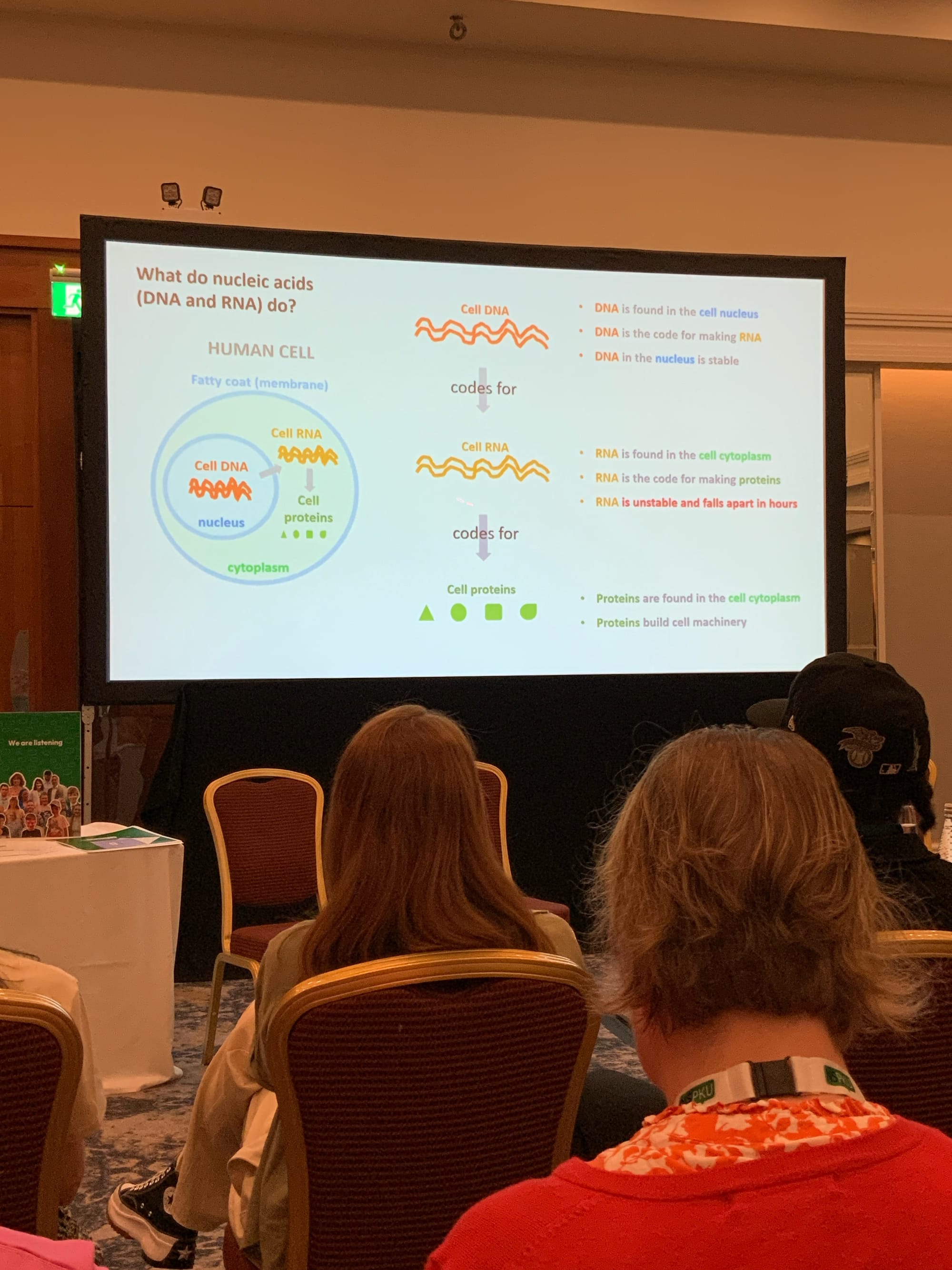
The professor pointed out that the mRNA used here was still very unstable. There were other drawbacks too. Notably, the treatment was currently by drip only, and reductions were only for a few days.
In conclusion, there are numerous studies going on. PKU is an exciting field of active research.
### Brain injury news, May 2024
URL: https://www.pigpen.page/brain-injury-news-may-2024/
Last updated: 2024-05-31T16:28:28.000Z
A monthly selection of news and events related to concussion, head injuries, and TBIs.
## Tragic news from a rugby match
A [33-year-old man has died](https://www.nzherald.co.nz/sport/rugby/beachlands-maraetai-rugby-club-player-dies-following-auckland-game-injury/DXDQT6F4TNFB5EFSDWY2SG6QKY/?ref=pigpen.page) after receiving a knee to the head in a rugby match in New Zealand. This awful news has shaken the wider rugby community, and the cause is reported as a bleed in the brain.
This was described as a freak accident by those on the scene. Yet, it comes at a time when [World Rugby is being sued](https://www.theguardian.com/sport/2023/nov/19/rugby-union-players-legal-action-over-head-injuries-to-be-heard-in-high-court?ref=pigpen.page) over the devastating effects of repetitive brain injury. And more professionals in a [wide number of sports](https://www.theguardian.com/sport/2024/mar/31/ronda-rousey-i-never-wanted-to-talk-about-concussion-it-felt-like-a-weakness?ref=pigpen.page) are talking about the effects of head injury, so we cannot say that this sad accident happened in a vacuum.
## Mood impact after BI
We know that low mood and depression are common after brain injuries such as traumatic brain injury, stroke, and encephalitis, and this can impact our day-to-day activities.
However, planning and organisation abilities after brain injury can also impact mood. This research study is looking at ways to improve mood after brain injury by taking part in rewarding activities such as contacting a friend, hobbies, or other activities you find rewarding. This University of Oxford research study takes place online using MS Teams. You will meet with a researcher once a week for 3 weeks to plan activities together.
This research is targeted towards adults with a brain injury and low mood. Contact Andrea at [Andrea.kusec@ndcn.ox.ac.uk](mailto:Andrea.kusec@ndcn.ox.ac.uk) or at 07935 242445 if you are interested in taking part.
## BI & depression, BBC 5Live
Headway UK reports their Chief Executive Luke Griggs discussed early rehabilitation after BI on BBC Radio. The discussion included “new research that could help to prevent depression and other mental health conditions impacting people from the point of sustaining a brain injury.”
[https://www.headway.org.uk/news-and-campaigns/news/2024/exploring-the-link-between-brain-injury-and-depression-with-bbc-radio-5-live/](https://www.headway.org.uk/news-and-campaigns/news/2024/exploring-the-link-between-brain-injury-and-depression-with-bbc-radio-5-live/?ref=pigpen.page)
## Getting a covid vaccine
The UK booking system for this spring’s COVID-19 boosters is now open for those who are eligible for them. This year, those eligible include people aged 75 and over by 30 June 2024, older adult care home residents, and immunosuppressed individuals aged six months and over.
Book a slot to get vaccinated as soon as possible via the NHS website, on the NHS App or by ringing 119 free of charge. [Getting a COVID-19 vaccine.](https://patients-association.us5.list-manage.com/track/click?u=9dd6577cf3f36af3c2f6682ed&id=56069e61ac&e=6cfd4af3cf&ref=pigpen.page)
### PKU news May 2024
URL: https://www.pigpen.page/pku-news-may-2024/
Last updated: 2024-05-31T16:09:39.000Z
A monthly selection of news and events related to Phenylketonuria (PKU).
## PKU Awareness Month
May is PKU Awareness month and in the UK we are celebrating with the annual [NSPKU conference](https://nspku.org/nspku-50th-annual-conference-and-agm-2024/?ref=pigpen.page) (more on this below). PKU folk in the US are encouraged to participate in the [NPKUA’s Move Your Pheet](https://www.npkua.org/News-Events/2024-MOVE-YOUR-PHEET?ref=pigpen.page) challenge — raising funds and heart rates in May.
It is important to remember that PKU doesn’t magically get easier in May, something which I reflected on in 2021 — [PKU Awareness month 2021.](https://www.pigpen.page/pku-awareness-month-2021/) But, this is a chance for us to find our community, as more people are sharing, online or in person, about their PKU.
## NSPKU Conference
Rooms are booked, speakers being contacted, recipes are being tested, and excitement is building as the UK PKU world descends on an unsuspecting [Warwickshire in mid-May](https://nspku.org/nspku-50th-annual-conference-and-agm-2024/?ref=pigpen.page). I’m excited to learn about the latest in PKU research, which I hope others share on the blog and socials asap. I’m also a little nervous as have been asked to chair a panel, I hope I can do justice to the panelists!
In preparation, I will clear some space for the legendary swag and product samples which the food companies generously offer. And have started a list of questions of my own (creatine supplements, Sepiapterin for adults…). I have also reformatted the [PKU book](https://www.pigpen.page/books/) and hope to offer that via Shopify soon. If you do have any books, I’d be thrilled to personalise and sign them for you at the conference!
If you are new, please say hullo, as I love to meet new faces. I’ll be in the cartoon dinosaur, or puffin t-shirt!
## MSUK Clinic Visits & conference
Metabolic Support UK (MSUK) are a world-wide organisation for Inherited Metabolic Disorders (IMDs), including PKU. They are a small team who punch above their weight, and you may see them in the waiting room at your next clinic: their next visits are:
Evelina: Monday the 13th of May
GOSH: Thursday the 6th of June.
The MSUK will hold their conference from Friday 8th — Saturday 9th November, London. [Not sure what to expect? See their previous events here!](https://metabolicsupportuk.us20.list-manage.com/track/click?u=25c0d8f49b4348c1c7a344aca&id=5a46454bba&e=59d1ae37d9&ref=pigpen.page)
## PKU Activity weekend
**NSPKU’s Edale Activity Weekend 5th – 7th July 2024**. This weekend is open to children with PKU between the ages of 8 – 12 years.
The NSPKU arrange for experienced metabolic dieticians who lead the weekend supported, by other adults who care for children with PKU and young adult volunteers who have PKU themselves and who attended Edale when they were children.
The weekend includes a wide selection of activities: - mountaineering, raft building, weaselling (going under big boulders), abseiling, canoeing, leap of faith, archery, assault course… This is a fantastic opportunity for children to have a great weekend, mixing with other children who also have PKU and making lasting friendships. Please email info@nspku.org for more details or booking.
## On the socials
### PCU Blogue
Looking for a massive online resource with recipe & product ideas, managing PKU and fitness, and honesty about living with PKU? Check out Tristan’s blog at [https://phenylcetonurie.ca/category/articles-in-english/](https://phenylcetonurie.ca/category/articles-in-english/?ref=pigpen.page). Tristan lives in Quebec, and writes about PKU in English and French (Québécois). His slick videos and thoughtful content are definitely worth a look. You can find out more about him [here](https://phenylcetonurie.ca/2019/11/17/back-to-canpkus-pku-quebec-day/]?ref=pigpen.page), and subscribe to his newsletter [here](https://phenylcetonurie.ca/en/?ref=pigpen.page).
### PKU Awareness 2024
Will I manage a post about PKU every day in May? It is quite a challenge — here is the first one: [https://pkutalk.com/@poconnor/112366596785695880](https://pkutalk.com/@poconnor/112366596785695880?ref=pigpen.page)
**How will you contribute to PKU Awareness this month? Large or small, every little helps, and** [**please let me know how you get on**](https://www.pigpen.page/contact/)
### Kickstarting The Red Hat Stories
URL: https://www.pigpen.page/kickstarting-the-red-hat-stories/
Last updated: 2024-08-28T18:11:40.000Z
I'm thrilled to share that the Kickstarter campaign for *The Red Hat Stories* has fully funded! The response has been overwhelming, and I'm grateful for the support.
The campaign is successfully funded! You can get your [copy direct from the author,](https://21de0a-fe.myshopify.com/?ref=pigpen.page) or [from Amazon](https://www.amazon.co.uk/Red-Hat-Stories-anthology-ebook/dp/B0D92B1SL4/ref=sr%5F1%5F4?crid=20XB6HEGCJVO3&dib=eyJ2IjoiMSJ9.tm4WAF6DC4HHJerWqDidb%5FmA3s5l7%5FKSBCL4FLpfiRq0g17ZOtB4ijYdSHbi34T8IpbBtbckJkYT2%5Fe7VFAw1KDTbYWTW3-fj4lRAzG1vdPwTkCCSiLM2Tag-m-lE6gVfVjBZFNQRQUoVNQrwpHXZwGabcHIaMMe0ltKCsSG0ZPclgUD9gz2KgRdqFiKXO7jV-LxQgkgo0YMd6tEmWJ28yXVSV0ut%5FP56ZjA1gToV8g.oXs-RwyEzFvqBvj9TKuNOA8G-gfy-5HJUqcLQB%5FqTP0&dib%5Ftag=se&keywords=the+red+hat+stories+book&qid=1722874761&sprefix=the+red+hat+stories+book%2Caps%2C63&sr=8-4&ref=pigpen.page).
This short story anthology is my first fiction book, and the choice to try a Kickstarter was strategic. My first book was traditionally published, and I self-published the second. Crowdfunding was another model to strengthen my knowledge of the publishing options. Also, as my first two books were non-fiction, I hope the campaign will help these stories to reach a wider audience.
Around 40% of Kickstarter campaigns reach their funding goal. I hoped to be one of them, but never dreamed it would succeed in less than 5 days. Thank you so much for all your support.
A key factor in the campaign's success has been the exceptional work of my friend Katherine Powell. As the creative force behind the book cover and marketing assets, she captured the essence of "The Red Hat Stories" in the cover design.
[The campaign will run until May the 4th (Star Wars Day!).](https://www.kickstarter.com/projects/328522180/the-red-hat-stories?ref=pigpen.page) If you haven't already, check the Kickstarter page for "The Red Hat Stories." Meanwhile, I will be working hard on the all important finishing touches.
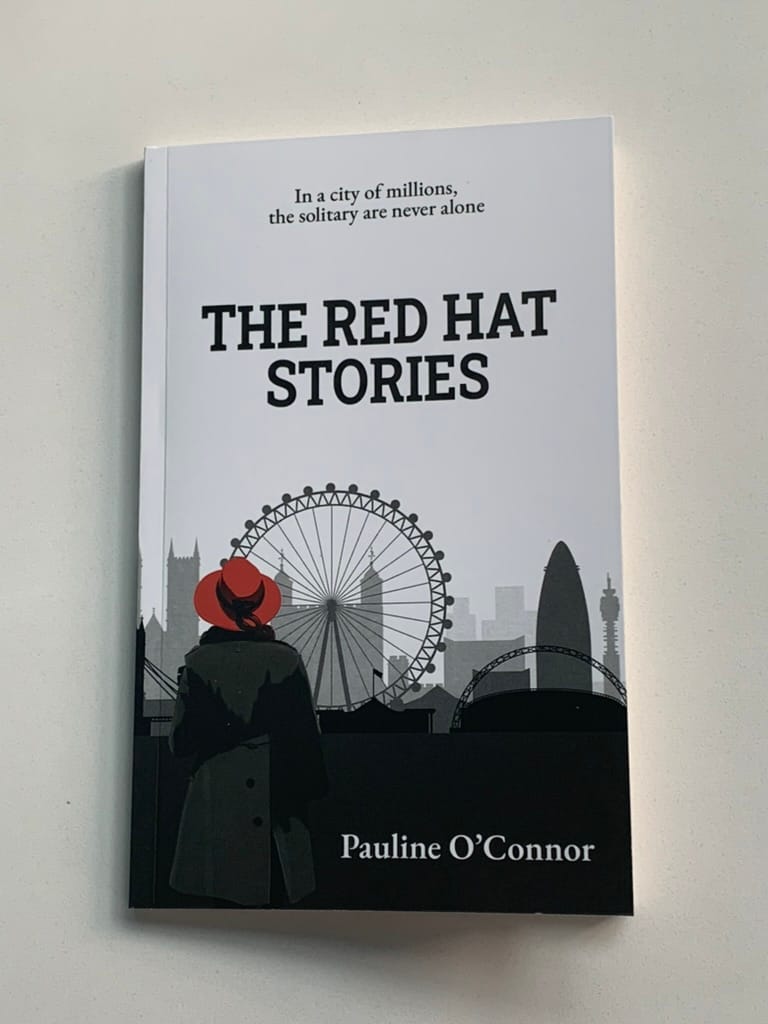
### Speaking at the WI
URL: https://www.pigpen.page/speaking-at-the-wi/
Last updated: 2024-06-27T13:57:15.000Z
Authors can speak at local Women’s Institute (WI) meetings for a speaker fee, and often sell books afterwards. This post will take you through how that works.
## Why do speaking gigs as a traditionally published author?
Contrary to popular belief, the majority of traditionally published authors do not earn a living from royalties alone. The median earning for authors in the [UK is now £7,000 per year](https://www.create.ac.uk/blog/2022/12/07/uk-authors-earnings-and-contracts-2022-a-survey-of-60000-writers/?ref=pigpen.page).
There is plenty of money in publishing, but it is certainly [not evenly distributed.](https://www.alcs.co.uk/news/why-writers-are-at-a-loss-for-words/?ref=pigpen.page) Many authors supplement their income by speaking at events, or doing school visits to promote and sell their books.
My debut book was published by a global publisher in 2020\. I dreamed of steady royalties helping me to write more, instead I discovered how much work an author is expected to put into marketing their book. (I put about the same amount of work into marketing my traditionally published book as I do my self-published title).
## The WI speaker audition
The WI produces a list of speakers from across the UK, which is made available to local groups. A prospective speaker must pass an audition to be included on this list. March 2023 marked the nerve-wracking audition where I presented my narrative to WI representatives. Positive feedback on the day was much appreciated, and I was soon notified that I had passed.
The next speaker list would be produced in 2024 and my talk on brain injury awareness would be included. Despite the delay, I received several bookings from representatives who had been there on the day. Many of those who contacted me said they were pleased to be booking someone speaking about a hidden, but widespread, injury.
## Raising awareness
Beyond the financial aspect, these engagements are a vital channel for me to raise awareness about brain injuries and how they affect women. Every talk I have done has revealed people in the audience impacted by brain injury: either they have an injury themselves or are caring for a family member. Often, others in their group, whom they might have known for years, have no idea.
This is the point of these speaking events for me. Opening people’s eyes to the prevalence of brain injury in our society using my story as the starting point. I am yet to sell a book after an event, but many have spoken to me of the impact of my story. The joy of raising awareness remains the linchpin, with book sales serving as a delightful bonus.
## Another source of author income
To fellow authors seeking avenues beyond royalties, I encourage you to explore speaking at local groups; such as the WI or the U3A. They are a powerful platform not just for income, but for raising awareness and connecting with communities. Reach out to local groups, audition, and let your voice resonate where it matters most.
### Neuro Navigators
URL: https://www.pigpen.page/neuro-navigators/
Last updated: 2024-08-28T16:59:35.000Z
I discovered the Neuro Navigators at a session at the [ABIL](https://abil.co.uk/?ref=pigpen.page) November 2023 forum held at [Irwin Mitchell, London](https://www.irwinmitchell.com/?ref=pigpen.page). This presentation from Shona Falkner Mesner and Gerry Owusu-Gyamfi of [South East London Neuro Navigation service (SELNNS)](https://www.guysandstthomas.nhs.uk/our-services/south-east-london-neuro-navigation-service-selnns?ref=pigpen.page) showed that a large gap in ABI care was being addressed.
## How Neuro Navigators help people with Brain Injury
Shona and Gerry explained that Neuro Navigators help patients to understand the process of neurological rehabilitation. The navigators can also personalise the experience for each patient, which ensure the patient receives the best care. This also helps to streamline and efficiencies in the service.
## The role of Neuro Navigators
As Gerry said, the Neuro Navigators work to identify the right place, in the right service at the right time. They also advocate for both the patients and the services, and help to monitor patients who are on the waiting lists.
> "...the right place, in the right service at the right time."
The slides from their presentation are linked below, courtesy of ABIL. Briefly, the Neuro Navigators also:
- provide continuity of contact for the patients
- coordinate discharges and services in the community.
- perform an educational role within local health services on appropriate neuro-rehabilitation pathways.
## Finding a Neuro Navigator
SELNNS are based in South London, though there are services around London. Referrals to the services can be made from hospitals, GPs, or by a self-referral - directly from the patient.
[**Presentation courtesy of SELNNS and ABIL. Links directly to a PDF**](https://abil.co.uk/wp-content/uploads/2023/10/NN-Presentation-ABIIL-1-Nov-23.pdf?ref=pigpen.page)
### Starting the Conversation
URL: https://www.pigpen.page/starting-the-conversation/
Last updated: 2024-09-17T11:19:29.000Z
In October 2023, I chaired a workshop at the [ESPKU conference in Birmingham](https://www.espku.org/?ref=pigpen.page). This workshop would not have happened without the support of the NSPKU and ESPKU teams, and the critical support from other adults with PKU.
> This workshop began with the aim of strengthening the voice of adult PKU in our national societies.
## PKU adults in patient organisations
The workshop involved a year of planning by several adults with PKU, who began discussing the idea during the [2022 NSPKU conference](https://nspku.org/nspku-conference/?ref=pigpen.page). We wanted a space where adults with PKU felt able to hold an open discussion about managing PKU as adults, and to collect data about adult concerns in real time.
Many national societies were founded as family organisations, with a critical emphasis on maternal PKU & children. As PKU patients aged, we felt the events catered to us less. This workshop began with the aim of strengthening the voice of adult PKU in our national societies.
## Creating a safe space for conversation
At the start of the workshop, attendees were asked to turn off their phones and to not share, record, or take photos in the room. This was to ensure a safe place for people to discuss issues without fear of judgement. The workshop used [MentiMeter, interactive presentation software](https://www.mentimeter.com/?ref=pigpen.page), to display questions regarding ageing, the struggles of staying on diet as an adult, careers & PKU, socialising with PKU, and ensuring representation within the national societies.
A panel of four adults with PKU from across Europe led discussions on each point. The attendees were encouraged to participate in the discussion and post responses on MentiMeter to aid our data collection. These responses were shown anonymously in real time, which often aided the discussions.
> We found three immediate and three long-term areas for national organisations to work on.
## How to support PKU adults
The room was packed with little standing room available. Two sessions were planned, but all participants eagerly arrived for the first session. This was a blessing, as it allowed us to overrun and take the time needed for the discussions. A need for both more space and more time will be a top priority at the next workshop!
We found three immediate and three long-term areas for national organisations to work on. In the short term, more advice and support with socialising, travelling and in the workplace & career planning. While making plans to support people in the long term with mental health, aging difficulties and providing more social events. This may mean working with clinics to ensure these concerns are addressed.
## Key requests from PKU adults
- better mental health support (from mild symptoms like anxiety and stress to deeper mental health issues)
- better travel/supplement support
- more in-depth understanding of the effect of phe levels on our careers
- better socialising support
- more questioning about concerns with PKU and ageing, particularly and the effects on our brain & body as we age
- improved social networks, provide opportunities for PKU folks to meet, both online and in person
## Selected results
(Those which can be reported succinctly. The participant's age range was 22-51.)
### Does PKU affect your chosen career?
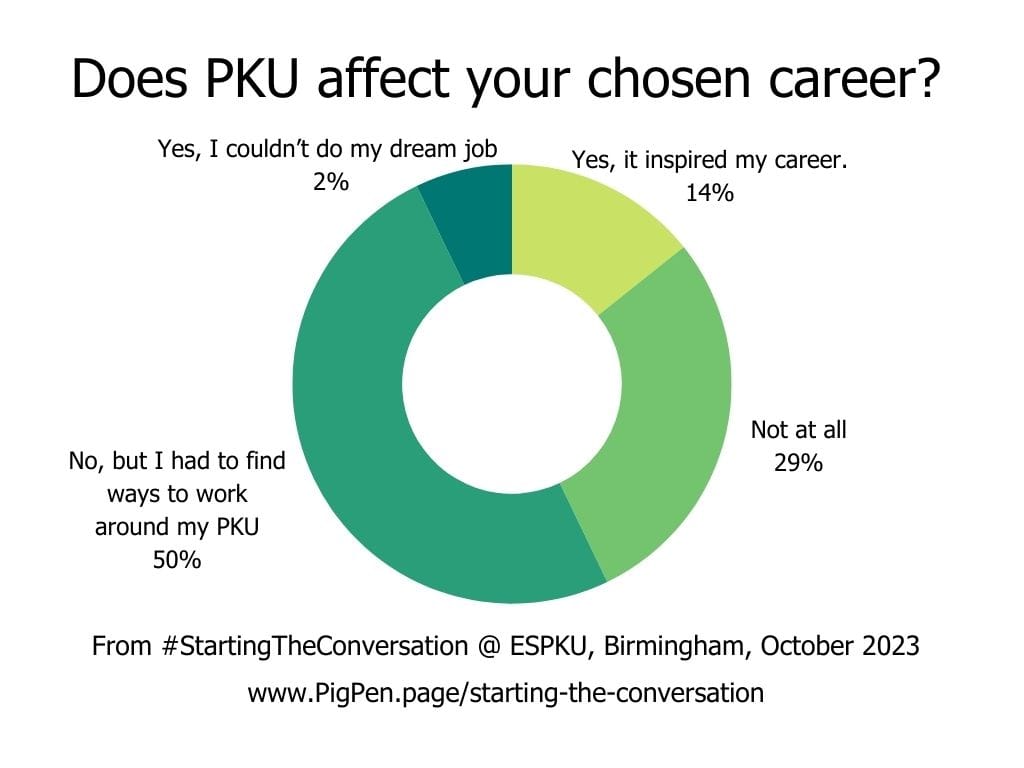
Over half of participants found that PKU impacted their career negatively.
It was heartening to see that PKU inspired some participants in their career, however, over half of participants found that PKU impacted their career negatively.
### Does PKU impact your social life?
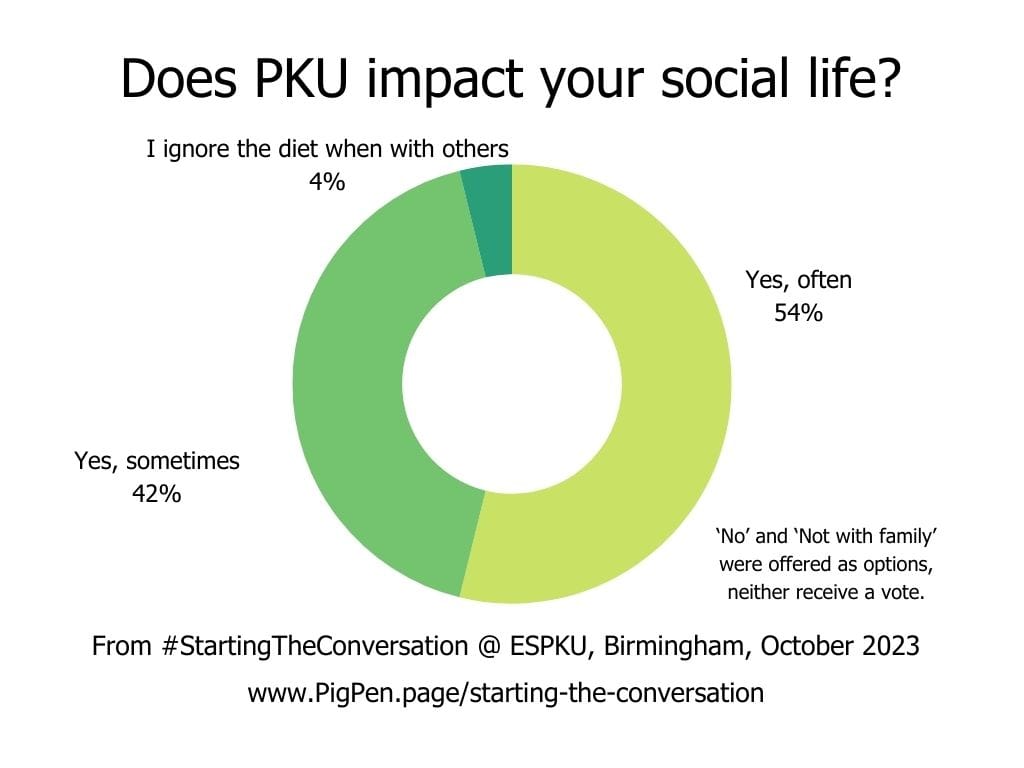
All responses indicated that PKU takes a toll on their social life
All responses indicated that PKU takes a toll on their social life. Given the nature of the treatment and the importance which food plays in social occasions, this is not unexpected. More thought needs to be given to supporting adults in managing PKU as their social lives expand beyond home and school.
> I am not aware of prior data regarding this question before, so this result is significant.
### Are you concerned about aging with PKU?
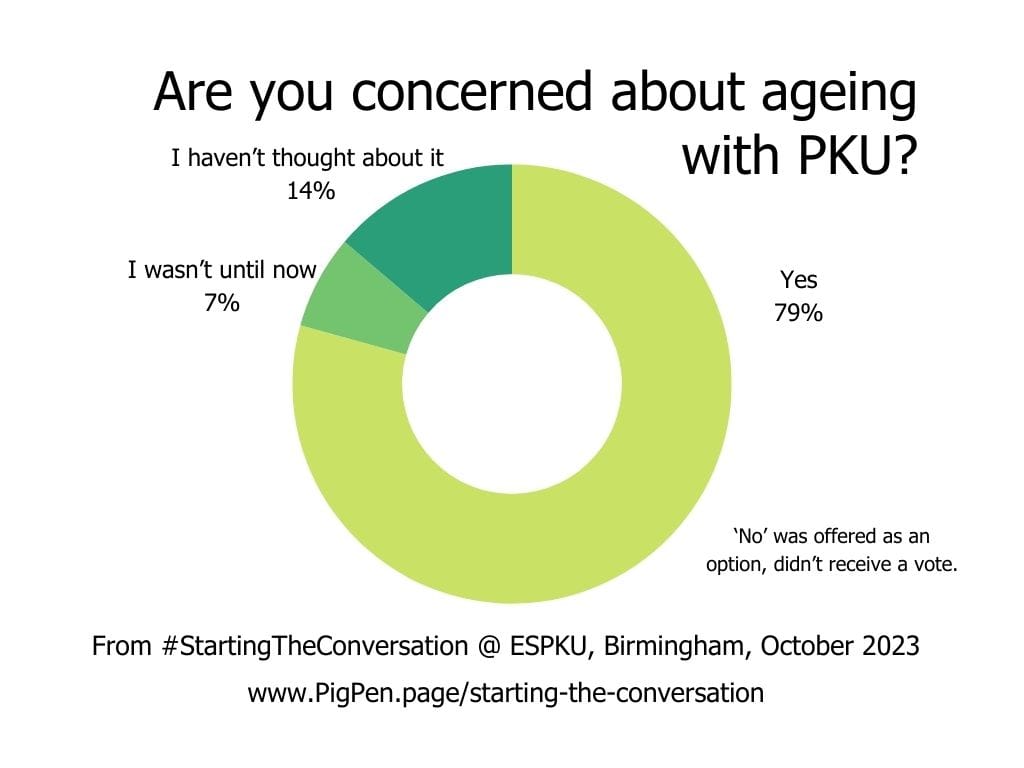
The majority of participants were concerned about aging with PKU.
The majority of participants were concerned about aging with PKU. I am not aware of prior data regarding this question before, so this result is significant. Given that one of the conference presentations earlier in the day noted that nothing is known about ageing with PKU, this fear is critical yet unsurprising.
### How could your national organisation support you more?
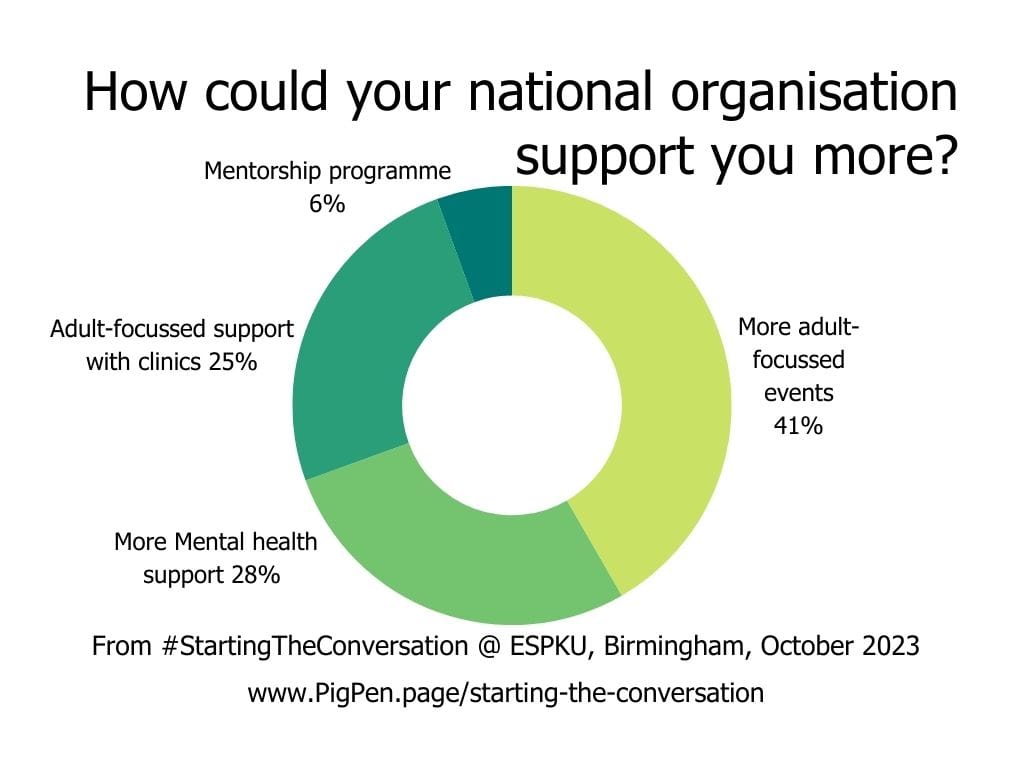
An open-ended question, with 36 responses, which can be roughly grouped as follows:
- 41% More adult focussed events, including online opportunities to mingle as adults
- 28% More mental health support
- 25% Adult focussed help dealing with clinics, and accessing new treatments
- 6% Mentorship programme for younger adults with PKU
The desire for more support from peers was continued in this question, with many wanting their national organisations to facilitate meetings and support networks.
### Can you help with PKU research?
I hope to run, or help others to run, similar workshops at future PKU events & conferences. [**Please do get in touch if you are interested in running a workshop**](https://www.pigpen.page/contact/).
### Emergency travel with PKU
URL: https://www.pigpen.page/emergency-travel-with-pku/
Last updated: 2023-11-03T18:58:26.000Z
A need to fly around the globe at late notice has me thinking about how people with PKU need to prepare for the unexpected, alongside the challenges of leading an ordinary life with a rare disease. Here are a few tips to be ‘emergency ready’ with PKU.
## Supplement:
I strongly urge you to make supplement a priority. An emergency is not the time to be affected by the PKU headache, brain fog, or with PKU shakes and clumsiness. I celebrate the fact that ready-to-drink PKU supplement is popular due to the convenience and ease of taking it .
I have always preferred powdered sachets, despite the need to carry a bottle and a mixer. The main reason for the preference is being able to travel at short notice, and with less anxiety. I write this mid-air on a delayed aircraft which has been rerouted around closed airspace in the Middle East. I don’t know whether we will land in time for me to make my connecting flight. And I am pretty sure my checked bag will not be transferred. This is frustrating. The fact that I have 14 days worth of supplement tucked safely in my carry-on backpack means a missing or delayed bag will not be a disaster for my diet.
## Meals:
I used to panic a great deal about food when travelling. Then I realised that it is possible to get salad & chips almost anywhere. Not an exciting meal, but calories nonetheless. It is also far easier now to find PKU suitable smoothies and fruit on sale in airports. Don’t underestimate how filling a smoothie or soup can be when flying.
## Packing
Thank heavens for conference swag! If anyone manning the stands at PKU events has wondered if the samples they generously dish out are useful, I assure you they absolutely are. Packed away in my checked baggage are many items which I picked up at the conference or which arrived in sample packs soon after.
I have several meal-sized packets of Promin burger and sausage mix, and one of their pastas. Also in there are Mevalia biscuits and fruit bars (perfect for travelling!). I have an airbnb with a bread maker, so a packet of PKU flour has gone in next to my usual breakfast cereal.
## Customs letter
You might wonder how I feel about taking a bag of white powder (flour) through customs? Tucked in with the food in my checked luggage is a letter from my PKU clinic stating that these are foods for a special medical purpose. There is also a copy of this letter with the supplement in my hand luggage, and a third with my insurance and travel documents.
I must shout out to my clinic, who responded within hours to a request for an updated letter. My prescription has changed recently, meaning my current letter was out of date. The speed with which they sent me a new one meant I was able to board the flight with no problems.
## Where I need help:
The meals on board my two flights (one 8 hours long, the other 16) will have pushed my protein allowance beyond its limits. Before flying, I signed up for the ‘Asian Vegetarian’ meals. As someone who loves curry, this seemed sensible.
Dinner was a Saag Daal (spinach and chickpea curry) with a side salad of chickpeas and sprouted grain. Not the best. Most of the meals were chickpea-based, or bulked out with rice. I am considering changing to a different vegetarian option for the way home. If anyone has a better tip for an inflight meal more suited to PKU, [**Please let me know!**](https://www.pigpen.page/contact/)
## What are your tips for travelling with PKU?
### What is LNAA?
URL: https://www.pigpen.page/what-is-lnaa/
Last updated: 2024-01-02T14:03:49.000Z
Visitors to the joint ESPKU & NSPKU conference this year will have noticed the stand from [PREKULAB](https://www.prekulab.com/?ref=pigpen.page), which I hadn’t seen at previous UK conferences. They had samples of [PreKUnil, their PKU LNAA tablets](https://www.prekulab.com/prekunil/?ref=pigpen.page), on site. But what are LNAA tablets?
I wrote about LNAA in my book, [*Living with PKU*](https://www.pigpen.page/books/)*,* and the excerpt on LNAA is published below. **Please note that LNAA tablets are not available on the NHS** in the UK, though the team at PREKULAB are investigating that possibility.
## Superb feedback on my PKU book
Huge thanks to those clinicians, families, and people with PKU who introduced themselves at the conference. Many told me that the explanations in the book were clear and that the helpful format of *Living with PKU* had helped them. It is the reason I wrote the book and am thrilled to hear it is fulfilling that aim!
> Many told me that the explanations in the book were clear and that the helpful format of *Living with PKU* had helped them.
## Excerpt from *Living with PKU*
### Large Neutral Amino Acid (LNAA) treatment for PKU
This is a supplementary therapy for PKU which is in use in some European countries. It is particularly aimed at those with mild PKU. The mechanism in LNAA treatment relies on the competition between molecules for passage from the blood into the brain. This passage is protected by the blood/brain barrier, which acts like a security system. Remember, it is the phe in the brain which causes problems in PKU. We use the phe in the blood to measure those levels, as we can’t yet measure the amount of phe directly in the brain.
Phe is one of nine LNAA’s which pass across the blood/brain barrier. In people with PKU, the high levels of phe in the blood mean that a higher percentage of the LNAA’s crossing into the brain are phe. The idea of LNAA treatment is to change the percentage of phe molecules passing into the brain by increasing the levels of other LNAAs in the blood. This would return the ratio of LNAAs in the blood closer to equilibrium, which removes the advantage which phe molecules have at the blood/brain barrier. A study published in 2020 found that adding in LNAA supplements along with a restricted diet therapy tended to improve both adherence to treatment and the quality of life for those who participated (Burlina, et al., 2020).
LNAA could, in theory, be administered alongside the restricted diet therapy or other treatments for PKU. However, the difficulty lies in proving the effect. For decades, we have measured the severity of someone’s PKU and the possible effect on their brain through blood phe levels. In LNAA treatment, the idea is to remove this relationship so that blood phe levels no longer provide a window on the amount of phe reaching the brain. This removes the main objective scientific measurement relied on over decades of PKU treatment. So, how do we prove that LNAA treatment is safe through objective measures? I have had no experience with LNAA treatment, but it is considered an option for adults in European countries such as Denmark. I suspect that a key hurdle in government commissioning elsewhere will be the need to find a clinical measurement of the treatment benefit, as blood phe measurements may not be considered an effective measure for this LNAA treatment.
## If any PKU patients would like to share their experience with LNAA treatment, [please do get in touch](https://us14.list-manage.com/contact-form?u=f73ac54f6732b3d571c1d2f66&form%5Fid=3475895e7198b5e0191bc1a41c2897ea&ref=pigpen.page)
### Tips for blood spots
URL: https://www.pigpen.page/tips-for-blood-spots/
Last updated: 2023-10-25T10:18:29.000Z
TW: Discusses blood and needles. My recent [sapropterin trial](https://www.pigpen.page/sapropterin-trial-part-1/) meant I was doing daily blood spots. I reviewed different lancets and came up with a few tips.
TLDR: the lancet used makes a difference to pain & healing, as does choosing the site carefully.
My first memories of blood spots are not happy ones. Back in the 1980s, lancets for home use did not exist in rural NZ. One parent would hold my heel or finger still while the other jabbed it with a sanitised sewing needle. Occasionally, they went a little too deep. Often, understandably, the jab was too shallow and needed repeating. No one was happy with this, so we avoided the process.
## PKU blood spots while avoiding needles
The solution was to do a blood spot whenever a scraped knee or a cut finger allowed. Our testing kit was stored with the plasters, and my parents would fill in a blood spot card before patching me up. If we got to the end of the month and I hadn’t hurt myself, then we’d resort to the sewing needle.
However, this was far from ideal. And I do not recommend this approach. Most of my childhood blood spots were not taken first thing in the morning and on an empty stomach. Those are the best conditions for the most accurate blood level reading. Plus, the random nature of injuries meant that some blood spots were only a week apart while others had a 6-week gap.
### The Lancet device solution
We found a solution when lancet devices became commercially available. My parents found a Softclix device that was initially developed for diabetics. This changed our blood spot routine for the better.
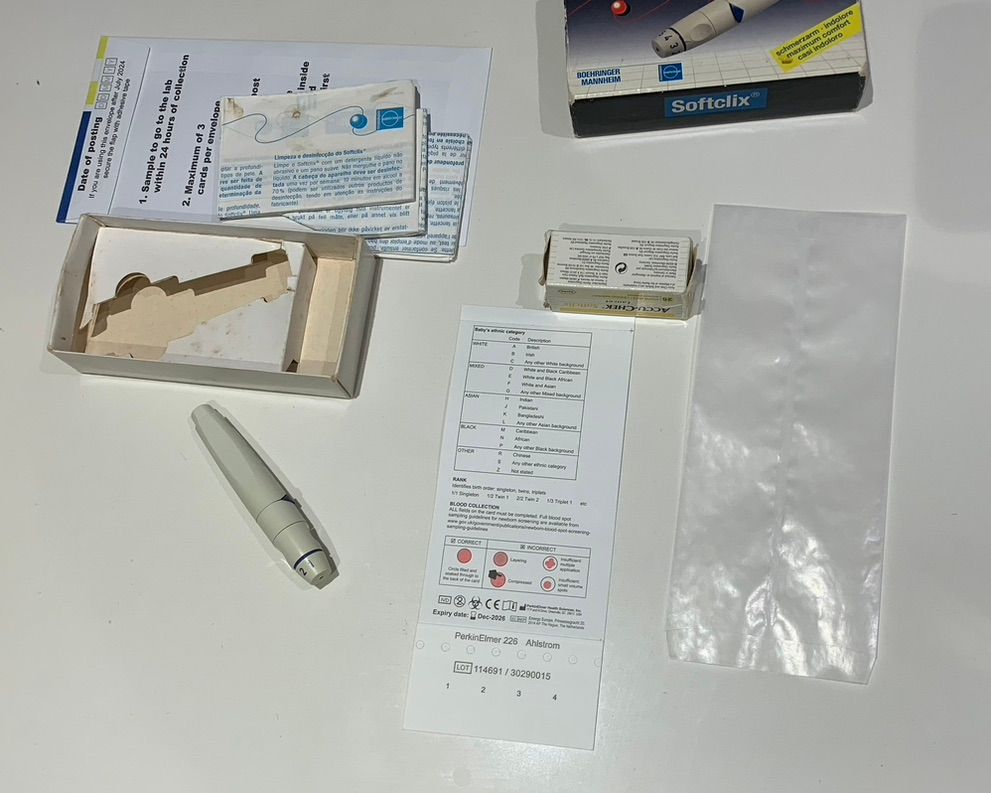
My blood test set up with the decades-old Softclix device
In my teens, I happily started taking blood spots on my own. The Softclix, like other lancet devices which are now common, regulates how deep the needle will go. I still use my decades-old device now, as a replacement lancets are available in most chemists. While such devices are pricier than single use-lancets (£5-£15), mine has lasted nearly 30 years, and many house moves. It is certainly worth the investment for someone doing regular blood spots.
## Lancet Trials
My recent [sapropterin trial](https://www.pigpen.page/sapropterin-trial-part-1/) meant I was doing blood spots every day, so I experimented with the different lancets. Oh my goodness, not all lancets are equal! While no blood collection method is fun or painless, the type of lancet used does have a significant effect on pain and healing. Over the years, I have accumulated several single-use lancets alongside my Softclix device. I trialled them all over the last few months and present them below in order of comfort.
### Lancet device
This was the by far the most comfortable method, though please note that I’m used to it. This is a device shaped like a thick pen, and replaceable lancets are widely available. It is activated by a button, and you can adjust how deep the lancet goes. This is handy for children, and where a new activity might produce a callus. Do note that children should not fill or empty the device, however, as the needle is exposed during this process.
- Pros: the most comfortable, long-lasting device, adjustable.
- Cons: expensive, children shouldn’t use, needs a bit of time to set up.
Examples: [https://www.accu-chek.co.uk/lancing/fastclix](https://www.accu-chek.co.uk/lancing/fastclix?ref=pigpen.page).
Found at Boots: [https://www.boots.com/truedraw-lancing-device-10248015](https://www.boots.com/truedraw-lancing-device-10248015?ref=pigpen.page) and a review site: [https://www.diabeticcorner.com/truedraw-lancing-device/#product-reviews](https://www.diabeticcorner.com/truedraw-lancing-device/?ref=pigpen.page#product-reviews)
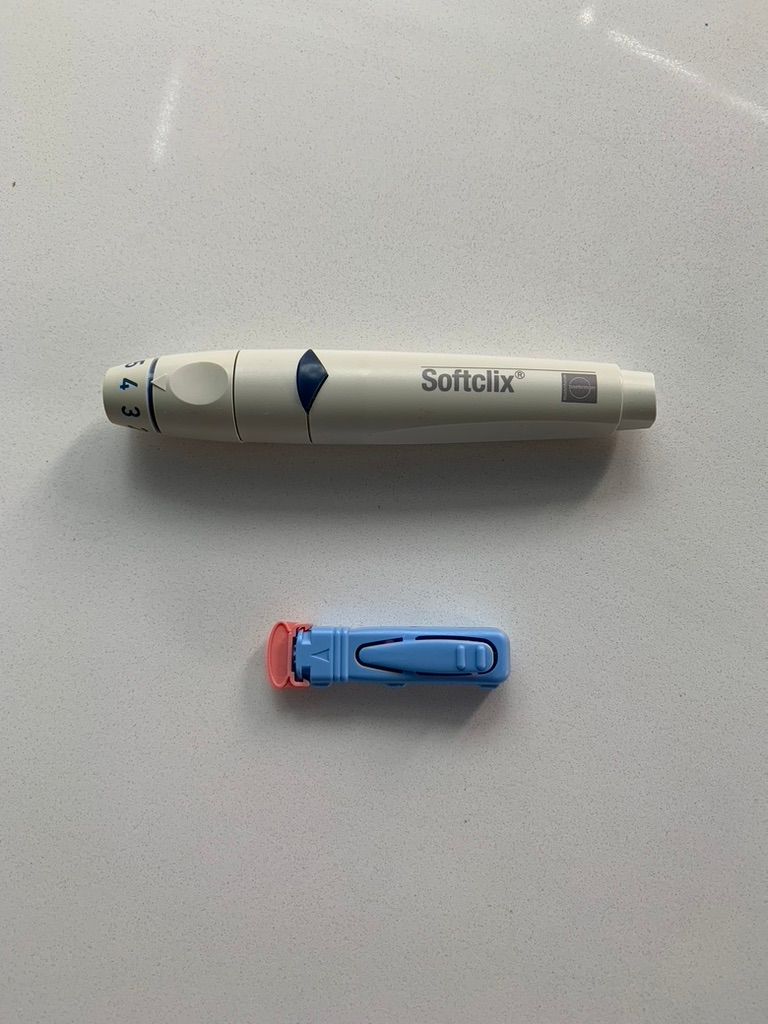
Softclix lancet device (top), and Unistik lancet below.
### Unistik lancet
Next was the blue Unistik, which is the one currently handed out by my NHS clinic. This is simple to use, as you simply twist out the pink cap, place it against the finger, and press the button. The needle is recessed when the device is spent. This was fairly easy to use, but every so often I found that the device had activated in storage, or while I was removing the pink cap. This isn’t too much of a bother provided you have a stock to hand. The needle went a little deeper than my usual lancet device setting, causing slightly more pain. Not enough to put me off, and I started using these on busy mornings to avoid setting up the lancet device.
- Pros: quick, simple to use, needle only exposed when device activated
- Cons: depth is not adjustable, need a supply as may already be activated
Example online: [https://www.wms.co.uk/c/Unistik%26reg-3-Neonatal-and-Laboratory-%281-8mm%29-x100/p/D231](https://www.wms.co.uk/c/Unistik%26reg-3-Neonatal-and-Laboratory-%281-8mm%29-x100/p/D231?ref=pigpen.page)
### Pressing lancet
Third in the line-up was an oval, press activated lancet. This type is operated by pressing the lancet against your finger. There was something unpleasant about having to press it into your finger, rather than keep your hand still and push a button. It is a psychological thing, but unpleasant nonetheless. If done correctly, the needle in this device also tended to go quite deep – and wow, did it hurt! This meant I would press the device into the finger while at the same time trying to pull away to avoid the pain. This lancet was not fun, and the site hurt for a day following.
- Pros: quick, to use, needle only exposed when device activated
- Cons: depth is not adjustable and often hurts, possible psychological barrier.
Example: [https://www.medonthego.com/Push-Button-Lancets-21-Gauge-15mm-Pink-Microtainer-BD-366593-Box200\_p\_132480.html](https://www.medonthego.com/Push-Button-Lancets-21-Gauge-15mm-Pink-Microtainer-BD-366593-Box200%5Fp%5F132480.html?ref=pigpen.page)
Oval pressing device (top), old lancet type below
### Older pressing lancet
Lastly, and least recommended, was the older, square blue lancet at the bottom of the photo. Like the previous lancet, this device is activated by being pressed against the skin. Further, the needle on this is actually a small cutting blade. If you have serious callouses on your fingers, or have trouble getting enough blood for the spots, then this one might be for you. But I’m sure there are better options, such as the adjustable lancet devices! I had to use plasters for the first time in decades after using this, the blood simply wouldn’t stop. The site took a while to heal and hurt for several days.
- Pros: Plenty of blood.
- Cons: everything else.
(No online examples, as I couldn’t find any. I think this is an old one and if you do have any, do yourself a favour and avoid!)
## Universal blood spot advice
The process of taking daily bloodspots for weeks taught me several universal truths. Firstly, even when the same lancet is used, some mornings a bloodspot will hurt more. Maybe the site is closer to the nerve, or the needle point is a little longer… I’m not certain. But doing the blood spots every day meant that I noticed the variation.
### Lasting variations
The pain can also last for varying lengths of time. On good mornings there was the ‘little scratch’ and then that was it. On other days, the site ached for a while. Occasionally, the area still stung when touched in the afternoon, or over the following days. There seemed to be no rhyme or reason to this, though deeper lancets did hurt more, and for longer.
### Healing time
Doing the blood spots daily also caused problems for my fingers. Sometimes the areas healed easily, sometimes they didn’t. I was rotating through both sides of every finger on my left hand, which gave them a week to heal. But by the end of the month I had several healing sites on a single finger.
Again, some blood spot wounds healed quickly and others didn’t. After a month of daily blood spots, my fingertips were a mess. Some sites had calloused over and others had started peeling. When I went back to regular weekly and monthly blood spots, this issue disappeared. I will try using other fingers in future, rather than just my favourite spot.
### Universal tip!
The one universal thing across all blood spot testing is to allow a decent distance between the blood spot and the finger nail. Nothing was more annoying than to get a decent drop accumulated only for it to run into the nail bed. It meant I lost the drop, made a mess, and had to squeeze all over again. So, do take time to ensure that your chosen lancing site is on the side of the finger. The finger pads hurt more as there are more nerve endings there. So avoid the nail and the back if you can—no one said this was easy!
## More help
The [NPSKU has an advice sheet](https://nspku.org/wp-content/uploads/2020/01/Blood-spot-quality-does-count.pdf?ref=pigpen.page) on getting your blood spots correct for labs in the UK. If you have any other advice, or a favourite lancet, then [please tell me](https://www.pigpen.page/contact/)
### Sapropterin trial, part 3: the trial
URL: https://www.pigpen.page/sapropterin-trial-part-3-the-trial/
Last updated: 2023-07-28T10:55:26.000Z
After navigating the genetics testing and establishing a baseline level, I was able to start trialling Sapropterin. I have written about these other processes in previous blogs (see links below). I had a poignant moment when I realised I was about to try my first treatment beyond restricted-diet therapy in over 40 years of living with PKU.
[Sapropterin trial part 1: genetics and patience](https://www.pigpen.page/sapropterin-trial-part-1/)
[Sapropterin trial part 2: baseline testing](https://www.pigpen.page/sapropterin-trial-part-2-baseline-testing/)
## The first dose of Sapropterin
The Sapropterin available on the NHS in England is a generic from a company called Teva. It is a small, white pill which is dissolved before drinking, and the dosage is worked out by a PKU clinic. The NSPKU conference in the autumn had been filled with questions about how to mask the taste. The first dosage showed me why.
Wow, that’s an intense acidity! I didn’t have the advised apple juice to dissolve the pills in. (Parents – take note and be more prepared!) I simply dissolved them in water and gritted my teeth. The dosage was quickly followed with my PKU supplement to remove the taste. How often do you do that?
I was lucky with side effects, and only had a headache the first week when starting the pills, and then at the end when coming off them. The trial took place over 4 weeks, with me taking bloods daily at first, then on alternate days. This was all done under the instruction of the clinic, and your experience may vary.
## A possible response to Sapropterin
The blood spots from my first week on the pills seemed to show a drop. I admit that I began to get excited. That was a mistake, and one I’d encourage others to avoid!
The second week of the trial was awful, as I came down with a stomach bug. I did not know that I was supposed to stop sapropterin testing while I was ill. This was my third mistake. So if you are trialling Sapropterin, or any other medication, make sure you know what you are supposed to do if you become ill. And, unfortunately, the stomach bug left me quite ill.
## Factors that affect Sapropterin & blood phe levels
Anecdotal reports seem to show that sapropterin is mostly negated by any illness. Further, there are three things that can lead to higher blood phe levels even when the PKU restricted diet is carefully followed: illness, sudden weight changes, and the menstrual cycle.
In the second week of the trial, while the stomach bug raged, I lost over a kilo of weight. Things started looking up towards the end of that week. However, my period then started. My blood levels for these two weeks spiked up to and over my initial baseline testing.
This was incredibly disheartening. However, in the fourth week of the trial, all my blood levels went back down below my baseline. Fortunately, my clinic agreed to apply for a second monthly trial for me. This was mainly predicated on the results of my first and final week of the trial.
# A second Sapropterin trial was needed
The disruption of the bank holidays and doctors strikes the arrival of the next prescription of Sapropterin, and of the bloodspot equipment needed for trial number 2\. I was able to start this in early summer, so I undertook one trial in winter and one in summer.
This second trial also held challenges beyond the already onerous tasks of recording all food, supplement, and medication intake. Three of the specially marked envelopes, which were posted into different post boxes on different days in early June, have still not turned up as I write in mid-July. This means that over a week’s worth of effort in a 4-week trial was useless. People with PKU cannot get home phe monitoring kits fast enough.
# Disappointing result.
Sadly, the clinic and I did not need those missing blood results to see that I was not responding to the Sapropterin. Rather than declining, my blood spot levels were actually going up. It has been a long and challenging process, made more difficult by postal problems, strikes, illness, and plenty of emotional highs and lows. But today, I finally got the call confirming that I have completed the Sapropterin pathway as the protocols in England stand currently, and I will not be continuing on the medication.
It took 12 years for Sapropterin to be approved on the NHS, and a further 19 months for me to reach this conclusion. It is disappointing, but at least I know now! After all the effort required, it will be a relief to simply return to diet as normal – who knew I would ever feel that way! I have a new respect for all those families who are also going through this process.
## Thanks to those who fought for Sapropterin
Huge thanks to the clinicians and my PKU friends who supported me, and of course to the NSPKU and those who campaigned for years for this treatment.
Next: read my tips from 6 months of nearly constant blood spots – [not all lancets are equal!](https://www.pigpen.page/tips-for-blood-spots/)
### Sapropterin trial, part 2: Baseline testing
URL: https://www.pigpen.page/sapropterin-trial-part-2-baseline-testing/
Last updated: 2023-11-30T17:08:16.000Z
Baseline testing is a necessary period of control before starting on sapropterin. It ensures that your blood phe levels have stabilised before starting the medication. Importantly, it gives a baseline against which any response can be easily seen. During baseline testing, my blood spots changed from monthly to weekly. And, I needed to show at least 6 results which were:
- between 300umol/L and 600umol/L and,
- within 100umol/L of each other
This would give the baseline figure against which the blood phe levels while I was on sapropterin would be tested.
Part one of the Sapropterin Blog series:
[Sapropterin blood genetics test for PKU PhenylketonuriaA year after I went in for blood tests to determine if my PKU would respond, I finally took my first dose of sapropterin.Pig PenPauline O’Connor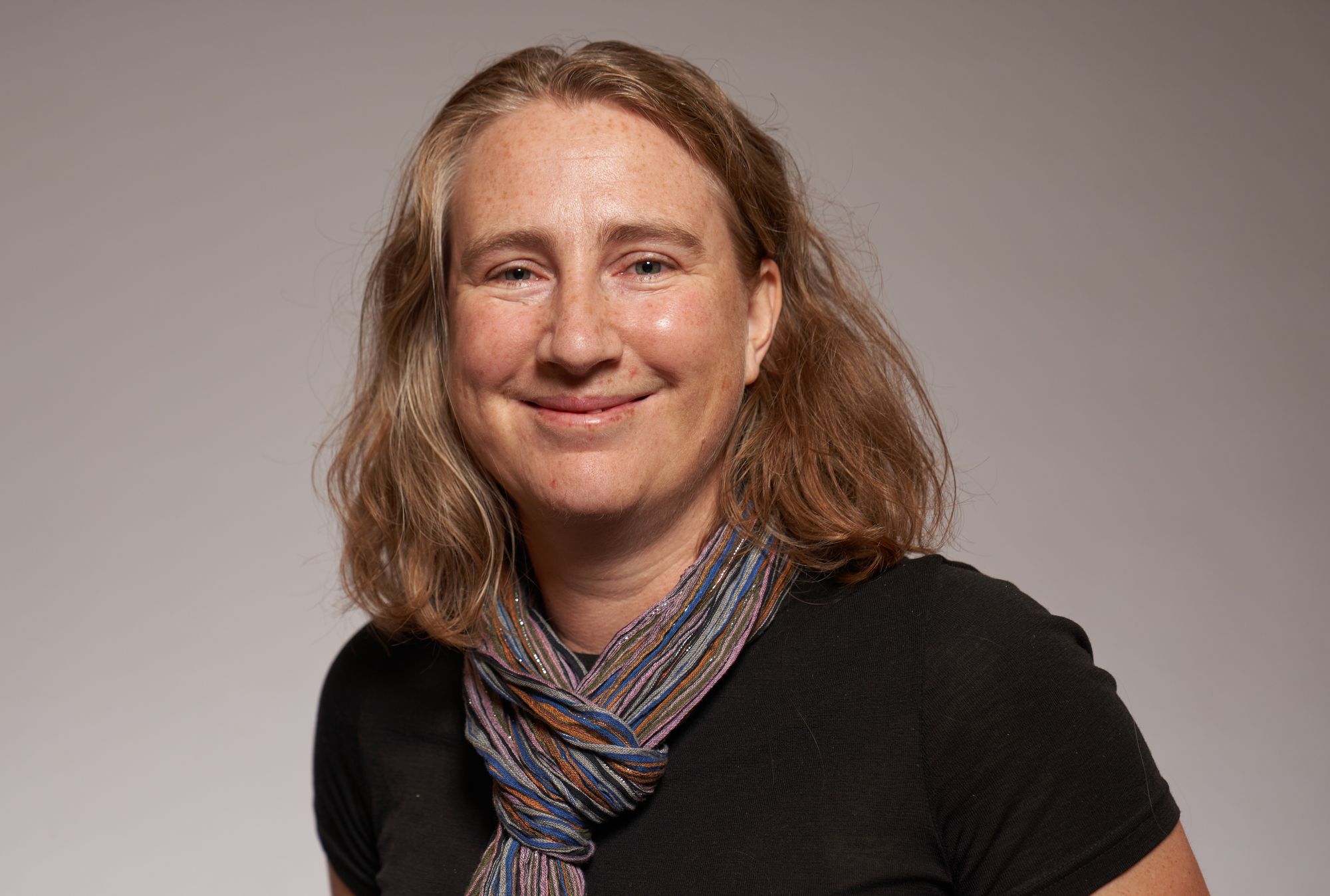](https://www.pigpen.page/sapropterin-trial-part-1/)
Click for part one in the series.
### Lessons from Baseline testing
I was ready to start baseline testing in early December, the month of parties and food. While the testing could be delayed until the new year, I had already waited over 40 years for a treatment beyond restricted diet therapy. The desire to start immediately meant strict control over Christmas. Most years I would stick to the diet, but also have quite a few treats; like more potatoes, or extra sweets.
Not this year! Christmas and New Year’s became a time of searching out protein-free treats; including fruit jellies, PKU baking, and lots of exotic fruit. December and January were not easy, but I did learn more about my diet and attitude to it than I had in the past year. Most importantly, I learned that I had never done something quite like this before.
I knew that the control needed to reach the six blood phe levels required for baseline testing would be difficult. When I checked the list of my bloodspot results from the last 30 odd years, I discovered that I’d come close to managing that once in three decades. I knew that maintaining this level of control would be a tough ask. But what I didn’t know was that when I thought I had been strict on my diet in the past, I really hadn’t.
### Blood phe can be too low
The requirement to weigh all my food and record every exchange & supplement across a month gave me the best control I’d ever had. Usually, when I was being strict, I would not *quite* record every exchange. Instead, I’d convince myself that I would remember it. Or that a little extra at supper wouldn’t change things too much. Or I wouldn’t weigh portions and just eyeball the amount.
In the three years running up to the baseline testing, my average levels were 500umol/L. During testing, two days before Christmas, my level was 104umol/L. My lowest blood result ever.
In the first four weeks of baseline testing, my levels were between 300umol/L and 100umol/L. After an initial burst of planning, the organisation to get these levels was not terribly different from before the control period. The focus on my diet actually felt good, as I was doing it with purpose. Physically, I had more energy and my head felt clearer on these lower levels.
That is interesting, and something I want to explore in the future. However, those levels were too low for the baseline trial. Indeed, after my result of 104, the clinic called to check I was okay. It is possible for blood phe levels to be too low, as well as too high.
### Protein allowance increase without sapropterin
I have heard from others who had to increase exchanges during the baseline testing, and before starting on sapropterin. And, like them, I had wondered why. Now, I was experiencing it myself.
The level of control I was showing to get my levels down below 200 consistently, meant there wasn’t enough leeway to show a response to sapropterin when I eventually started the medication. I needed higher levels, so the clinic increased my exchange limit. My phe allowance increased by two exchanges, from 5g of protein every day to 7g. This was a wonder to me, as other people on low exchanges will know.
I was suddenly allowed more daily protein than I’d ever been on in the past. And I hadn’t even tried sapropterin yet. How did that happen? I think the increase in exchanges happened because, in the past, I hadn’t actually been recording my diet properly. This meant I was having those extra 2 exchanges in snacks and extra helpings, but I wasn’t recording them.
Now I had permission from the clinic, so I could have those two exchanges without guilt. As long as I recorded them carefully! The good news is that, whether I respond to sapropterin or not, I should be able to keep those extra two exchanges. As long as I don’t revert to my unintentional ‘no need to record them, she’ll be right’ attitude.
### Reducing hunger on PKU
I started taking (and recording!) the extra two exchanges and noticed a change in my hunger levels immediately. That was interesting, given I had probably been having those two exchanges in an unplanned manner already. I could now plan my food to incorporate those exchanges across the whole day.
Instead of using those two exchanges on unplanned afternoon snacks, or rationalising them as ‘just a little extra’, I spent a cold January having those two extra exchanges planned across the day. Breakfast, lunch, and dinner were now 2 phe each. And the final exchange was held back in case of an unforeseen office biscuit tin, or an oat milk latte with a friend. If I hadn’t used it by then end of the day, I had a small supper.
It might seem like a small change, but the increase in phe at breakfast meant I could last the entire morning without hunger pangs. The same happened in the afternoon, and I soon found I wasn’t having my elevenses and afternoon snacks. The increase in exchanges alone was worth the months of weekly bloodspots and weighing.
### 11 weeks of control before sapropterin
It took me 11 weeks to get a baseline level of six blood tests which were between 300 and 600umol/L, and which were within 100umol/L of each other. It was not easy. I skipped events, pub lunches, evenings out, visits to friend’s places… Basically, I didn’t go anywhere that I could not be sure of the exact content of protein in my food.
However, I finally reached the baseline requirements almost exactly a year after undergoing blood tests for genetic testing. It had taken patience, perseverance, the encouragement of others in the PKU community. But I could finally start on a sapropterin trial.
**Note:** the three years before baseline testing, I had been on 5 exchanges and I thought I had a strict control. Over those 3 years, my average blood phe level was 500umol/L. During the ‘strictly recorded and measured’ 7 exchange regime, my average blood level was 490umol/L. This, and the fact that I knew I was guilty of being a little loose sometimes, is what leads me to believe that I had been having the extra 2 phe previously, and was simply not recording them carefully.
### [Next: the sapropterin trial.](https://www.pigpen.page/sapropterin-trial-part-3-the-trial/)
### Sapropterin trial, part 1: genetics & patience.
URL: https://www.pigpen.page/sapropterin-trial-part-1/
Last updated: 2023-10-25T10:18:54.000Z

# Sapropterin trial, part 1: genetics & patience
The UK’s decade-long fight for sapropterin required resilience, determination, and patience. Now that the drug has been approved, our patience is being tested again. A year after I went in for blood tests to determine if my PKU would respond, I finally took my first dose of sapropterin. (For a quick explanation of why the testing is needed, see [The genetics of PKU](https://www.pigpen.page/the-genetics-of-pku/).)
## Sapropterin result
After the blood test, I waited as the weeks turned into months. Finally, it was seven months before the phone call. The result was the one which I had expected, but hoped not to receive. My clinic told me that I was unlikely to respond to sapropterin.
This was followed by a letter which confirmed that I would not start trialing sapropterin, and which included the genetics results. One of my two variants was classical, and not responsive to sapropterin. The other was unknown, but deemed unlikely to respond. I did ask my clinic about this, but was told the lab had looked at the unknown variant and determined that it would not respond.
Only 25% of people with PKU are likely to respond to sapropterin, and I had known for years that I was unlikely to be one of them. But, after waiting 42 years for a treatment beyond a restricted diet, it was terribly disappointing. I cried over what would not be, and moved on.
## Sapropterin variants
Until the NSPKU conference, where I learned that some patients who had the same result as me (one unknown variant) were still trialling sapropterin to see if the unknown gene was responsive.
At my next PKU appointment, I asked the question. There was a long discussion, during which I learned that they estimated a 2% probability of responding. That is a depressingly small percentage. But it is not zero. And the clinic offered me a sapropterin trial, despite the very low chance of a response.
You might be surprised to learn that I did not accept this immediately. Given the disappointment which the letter had initially provoked, I did not leap in at the news they would allow me to trial sapropterin if I wished. Instead, I took a few days to decide whether I wanted to do this. I knew from other friends and from social media that the trial was difficult. And could I cope with the disappointment if, once again, I was told it wouldn’t respond?
## Start of the trial
In the end, I took the trial. I had to. It is the only way to know for sure. And so, it was in the inauspicious month of December, that I [started on the baseline testing](https://www.pigpen.page/sapropterin-trial-part-2-baseline-testing/).
[Sapropterin trial, part 2: Baseline testing for Kuvan PKUMaintaining this level of control would be a tough ask. But I discovered that, when I thought I had been strict on my diet in the past, I really hadn’t.Pig PenPauline O’Connor](https://www.pigpen.page/sapropterin-trial-part-2-baseline-testing/)
### Happy Birthday to Living with PKU
URL: https://www.pigpen.page/happy-birthday-to-living-with-pku/
Last updated: 2024-01-02T17:11:38.000Z
[*Living with PKU: a low protein life with Phenylketonuria*](https://www.pigpen.page/books/) launched in paperback and e-book one year ago today! This project would not have come about without the help of some generous people who donated their time and feedback: my writing teacher, the NSPKU dietician, and Soheb (another adult with PKU). Thank you all.
## Hitting Bestseller lists
On the big launch day last year, I got Covid-19\. This meant I was unable to do the planned promotion for the book. But the PKU community stepped up, and *Living with PKU* hit NUMBER 1 in the Genetics hottest releases list. It also made the top 6 bestsellers list, up there with Richard Dawkins and Adam Rutherford.
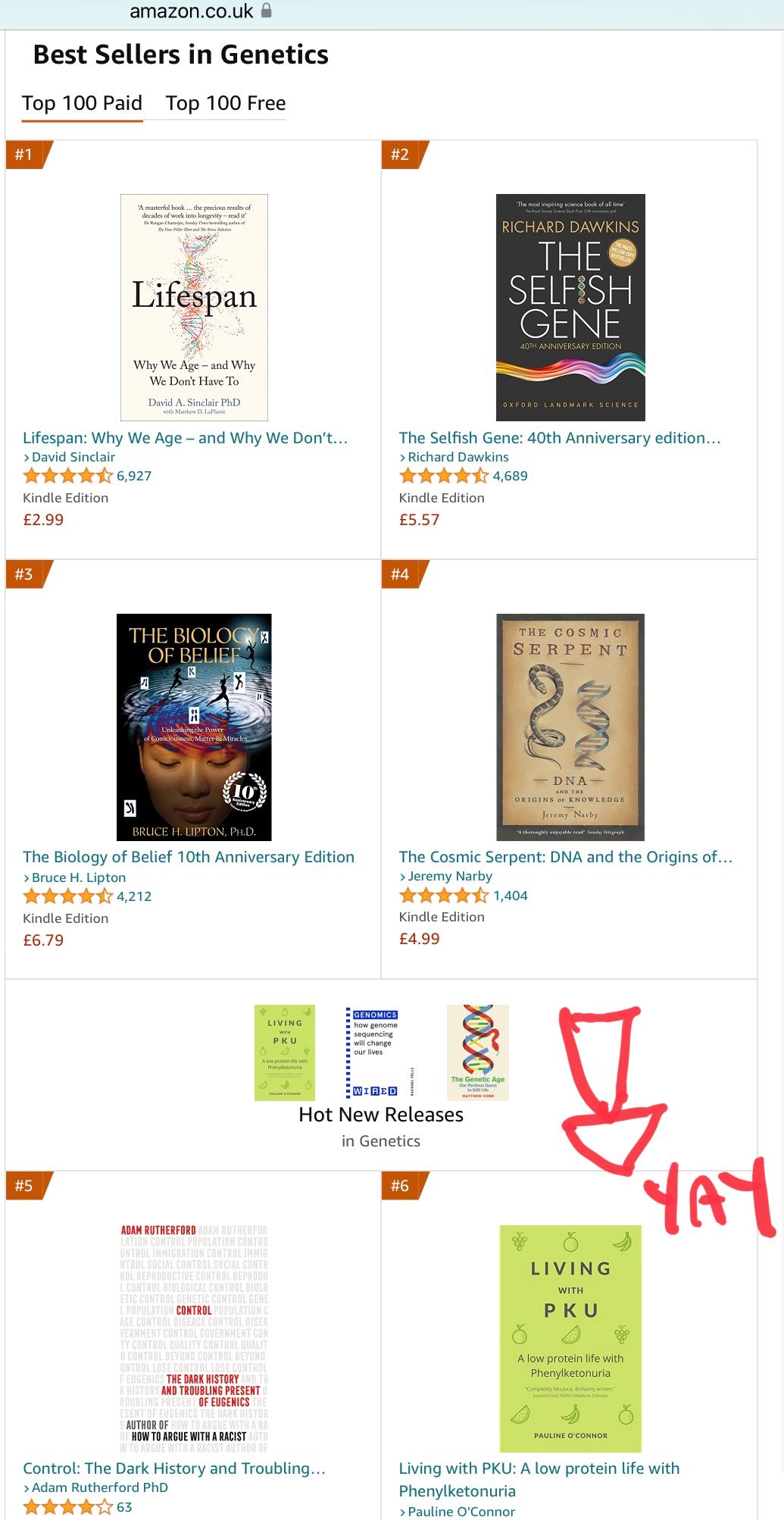
## Amazing reviews
Then the reviews started rolling in, with 5 stars across the board and recommendations, like “This would be an excellent book for anyone with PKU, their friends and family, and importantly, clinicians treating those with PKU. Knowing what the lived experience is of PKU is essential to providing better care and this should be read by GPs, dieticians, and consultants alike. Highly recommend!”
> “This would be an excellent book for anyone with PKU, their friends and family, and importantly, clinicians treating those with PKU. Knowing what the lived experience is of PKU is essential to providing better care and this should be read by GPs, dieticians, and consultants alike. Highly recommend!”
Out of the blue, the book was picked up by a [journalist who writes on issues of food allergy and intolerance.](https://www.allergy-insight.com/on-phenylketonuria-pku/?ref=pigpen.page) He was keen to write about PKU for PKU day, and picked up a copy to help. This gave me a moment of deep satisfaction when a professional journalist and writer described *Living with PKU* as: “Well-written, as well as wise, and never once does it run out of steam or become dull to a non-knowledgeable reader.”
> “Well-written, as well as wise, and never once does it run out of steam or become dull to a non-knowledgeable reader.”
A cheeky gin or two was imbibed to toast that success. But, more important, has been the individual stories from people who have contacted me about the difference the book has made for them. It was the reason I sat down to write in the first place, and am so glad it has helped.
## Global readership
In the year since launch there have been 115 copies sold, more than in the first two years of my first, traditionally published, book on brain injury. The bulk of those sales have been in paperback, rather than by e-book, which is interesting. My guess is that it is easier to share a paperback among the family.
Most copies have sold in the UK, which is expected, but the readership is wonderfully global:
UK: 65
US: 41
Germany: 4
Canada: 2
Australia: 2
Spain: 1
Thank you to everyone who has bought a copy. If you enjoyed it, then please leave a review, so others can find the book. If you didn’t enjoy it, or have feedback, then please tell me.
There are plenty of people with PKU who do not speak English and I hope to work on translations, once finances allow. Meanwhile, there are a few markets which a good number of English speakers where the book hasn’t reached as yet.
If any readers are in Ireland, Sweden, or the Netherlands and might have suggestions for how to get the book into hands and libraries in those countries then please let me know.
Thank you again to the wonderful PKU community!
## 50% of profits from Living with PKU to the NSPKU
The NSPKU is celebrating its Golden Anniversary this year, as the patient organisation formed 50 years ago. They are running a fundraising campaign, which I’m supporting by donating **50% of profits from copies of Living with PKU sold in June & July to the NSPKU**. [Please join in to celebrate and support the work of this valuable charity.](https://www.pigpen.page/books/)
How can you help?
1. If you have been wavering over a buying *Living with PKU,* then now is a great time to [buy a copy and join the fundraising effort](https://www.pigpen.page/books/)!
2. If you already have a copy, please leave a review to help others find the book
3. Please share this news far & wide to anyone who might benefit from this valuable resource for PKU and support the NSPKU.
***Thank you!***
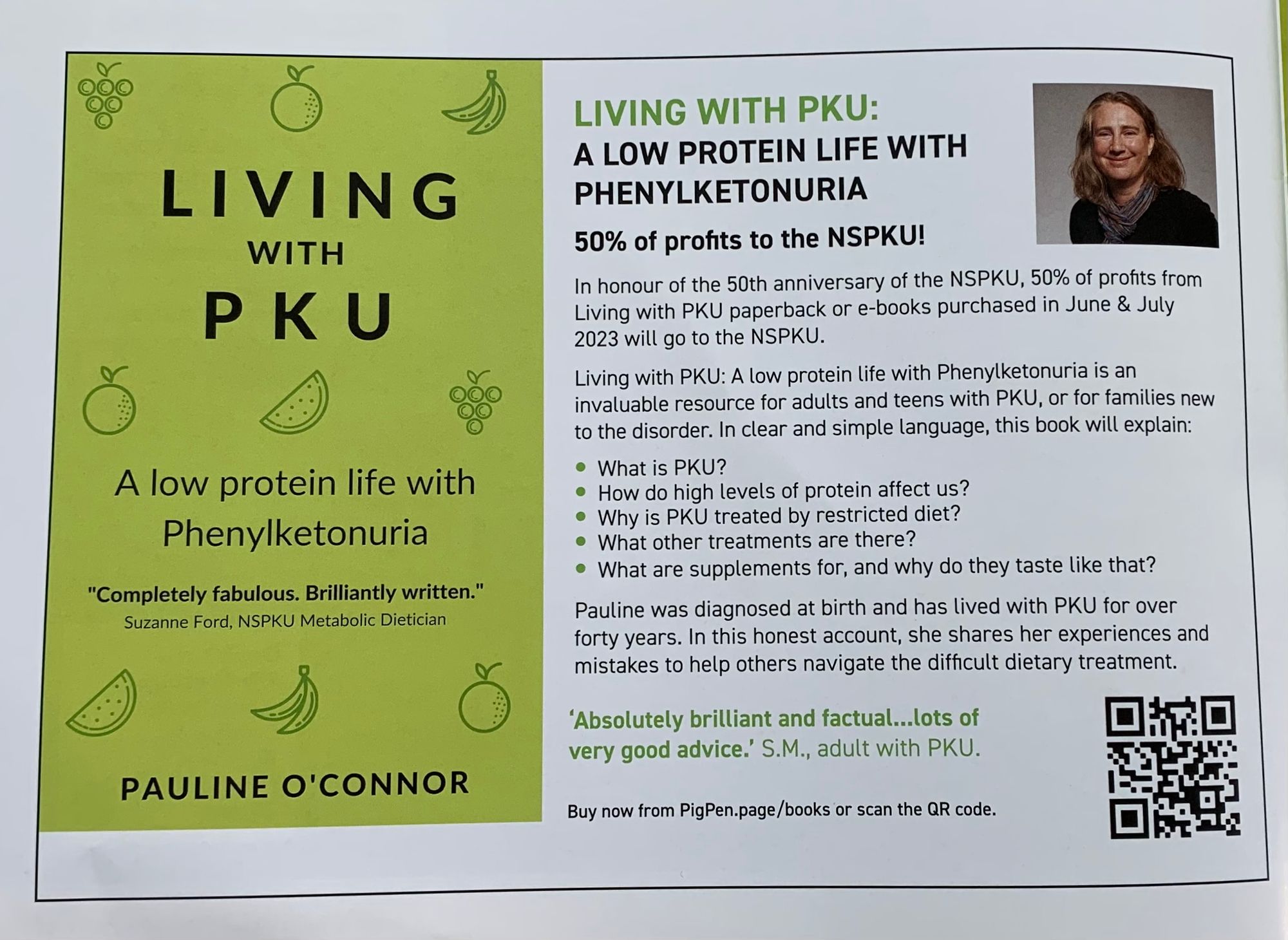
### The genetics of PKU
URL: https://www.pigpen.page/the-genetics-of-pku/
Last updated: 2023-11-30T17:06:15.000Z
A **simple** run down of the genetics of PKU, and how that relates to sapropterin testing. (I’m going for the “Explain like I’m five” version here. There are complete definitions available online.)
PKU is caused by a *recessive and inheritable change* in our *DNA*. Bear with me, I’ll break that down.
Our *DNA* is a series of chemical messages inside us which carry all the information about how we live and look. It is basically the recipe for how we are built.
*Inheritable change* means that there is a change in this ‘recipe’ which is handed down within families.
*Recessive* means that the change is rarely passed down to children.
So, PKU is caused by an uncommon change in a part of the recipe which builds us, and that change can be passed down within families. Someone with PKU has inherited two slightly changed parts of DNA, one from each parent. A person without PKU might have either two standard parts of DNA, or one standard and one changed part. It is only when a person inherits two changed parts of DNA that they have PKU. The chart above might help with this bit!
PKU is quite rare because most people inherit two standard parts of DNA, or one standard part and one changed part. The chance of the child having PKU depends on which part is inherited from the other parent.
Potential parents can be tested to determine whether they are carriers or not. There are several companies which offer this testing commercially. I have not been able to find any free carrier testing. The best source to find this type of testing would be your local PKU clinic, specialist, or support group.
## Sapropterin testing
We know from the above that someone with PKU has inherited two changed parts of DNA, one from each parent. However, not all the changes which give PKU are the same. Or, to put it another way, everyone's recipe is changed in a slightly different way.
At last count, there were more than 950 recorded changes in the DNA which led to someone having PKU. This explains why there are some people with PKU who can tolerate more protein than others, they inherited a different mix of these 950 changes.
It also explains why sapropterin will work well in some people with PKU, and not in others. It comes down to the mix of these 950+ DNA changes which we inherited. This is why the UK has been conducting DNA (genetics) testing for sapropterin responses.
### [Discover my lessons from a sapropterin trial here.](https://www.pigpen.page/sapropterin-trial-part-1/)
### PKU Raisin Scones
URL: https://www.pigpen.page/pku-raisin-scones/
Last updated: 2024-11-14T15:07:07.000Z
I’ve spent years trying to adapt non-PKU recipes to our specialised flour, with varying success. This recipe always works well for me, once I found a few tweaks. It is based on one from Nutricia’s website but is now missing. A reminder, then, to save recipes rather than relying on websites!
## Ingredients
140ml Sno-Pro or alternative PKU-friendly milk substitute
1 tsp Psyllium Husks
200g Loprofin Mix, plus extra for dusting
2 tsp baking powder
1.5 tsp Loprofin Egg Replacer
50g caster sugar
50g butter, cubed
50g raisins or raspberries, chopped
**Note:** Mixing the psyllium husks with only 100ml of Sno-Pro leaves you 40ml, which you can use to adjust the dough if it is too dry when you are kneading it.
Method
## Method
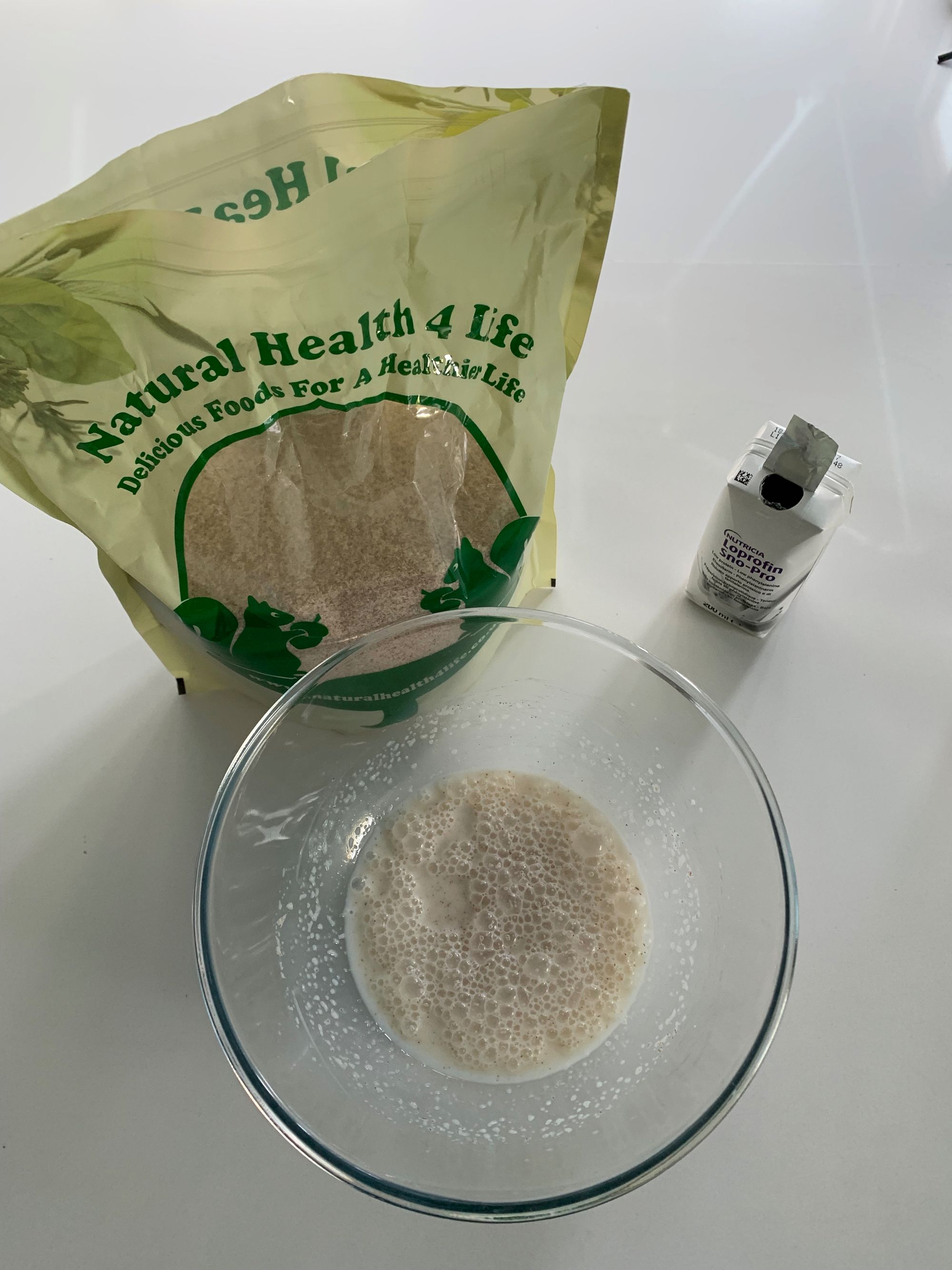
Mix 100ml of the Sno-Pro/Loprofin Drink and Psyllium Husks in a bowl and leave to thicken for 10 minutes.
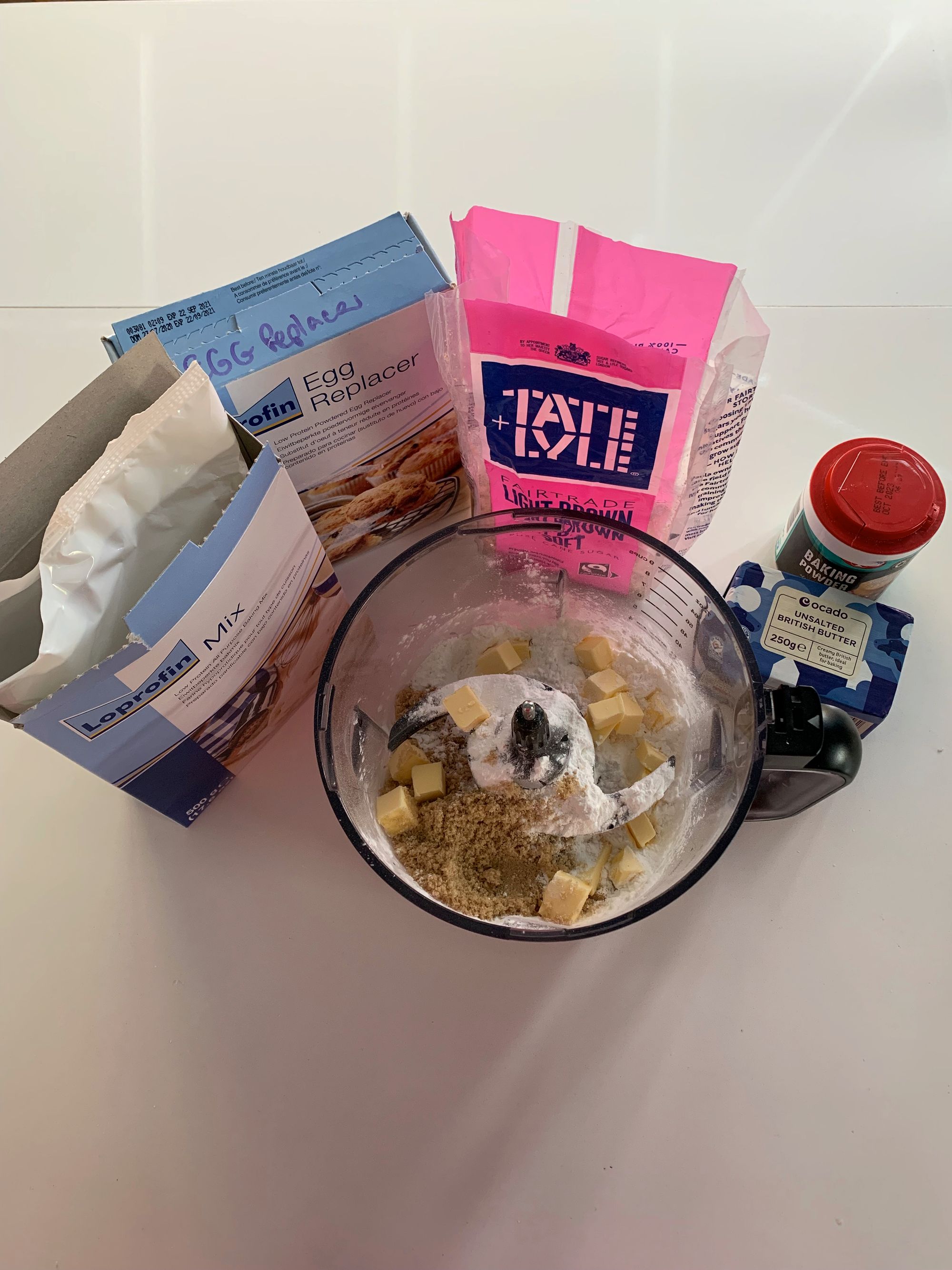
In a separate bowl, add the Loprofin Mix, baking powder, Loprofin Egg Replacer and caster sugar. Rub the butter into the Loprofin Mix until the texture resembles breadcrumbs. Or be lazy like me, and measure this all into your food processor bowl, then blitz the butter in.
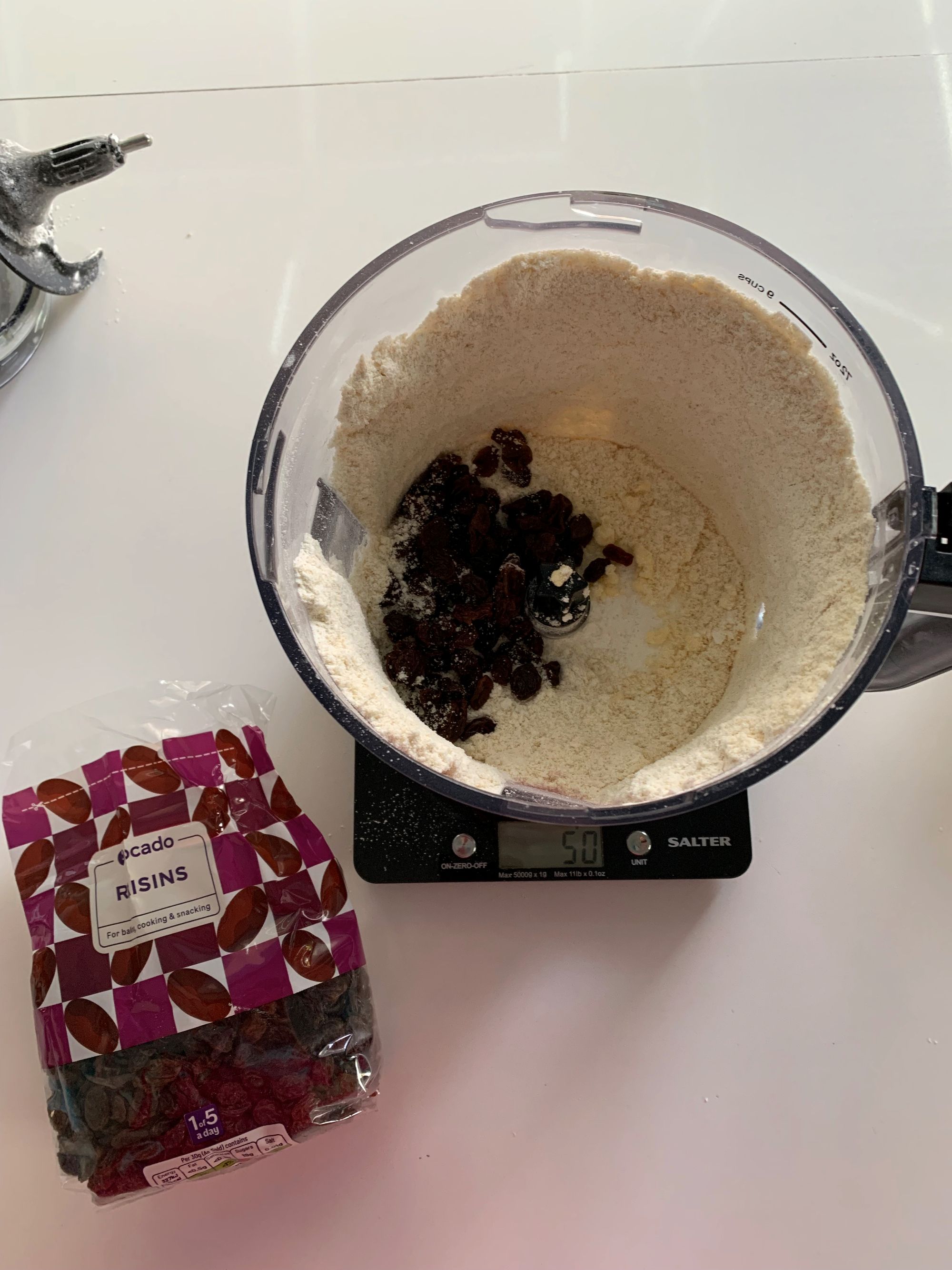
Measure in the raisins and mix them in evenly.
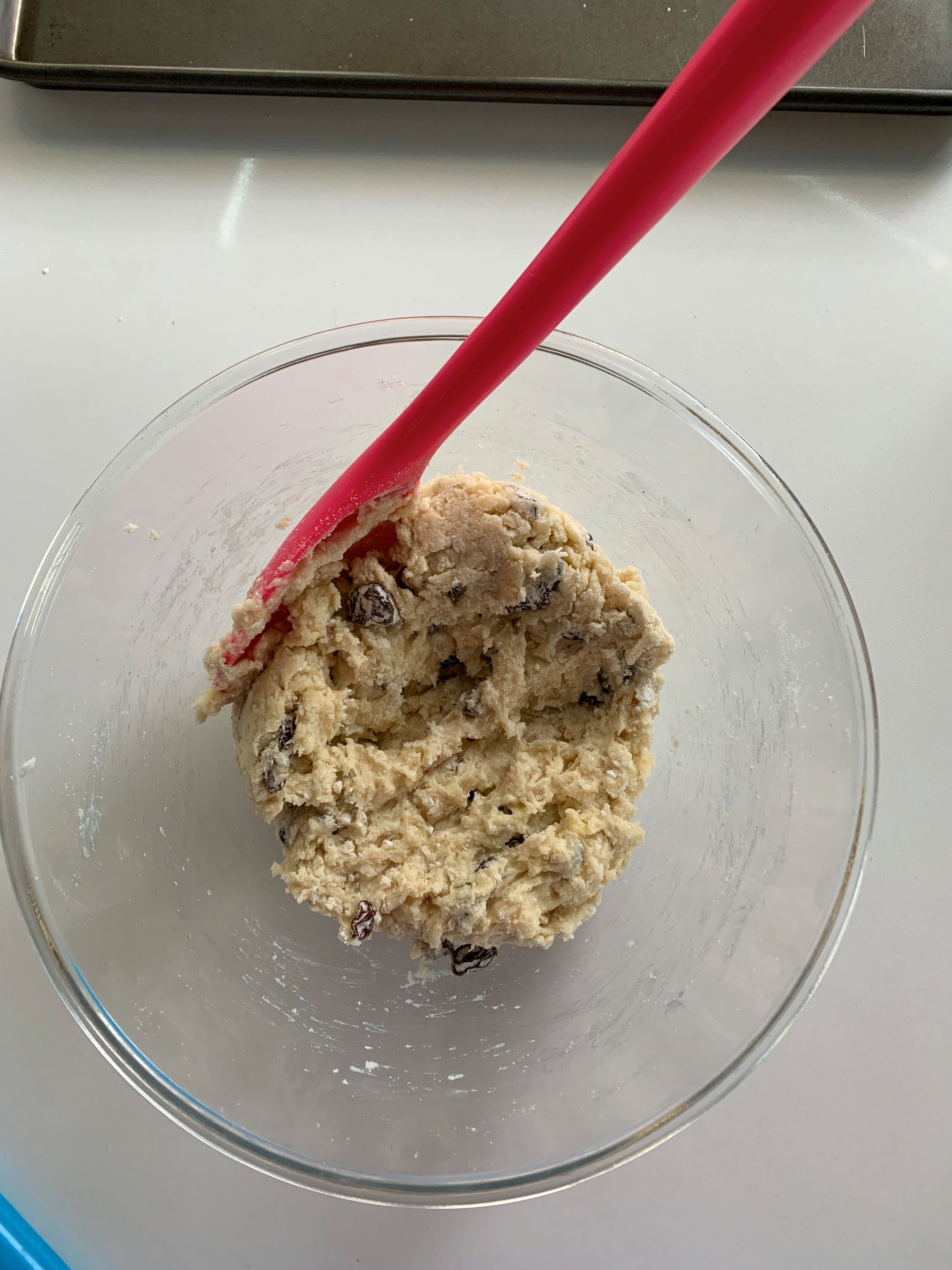
Gradually stir in the Sno-Pro & husks mixture to give a soft, sticky dough. At this point, preheat the oven to 200°C (fan) and make sure you have a greased or lined baking tray handy.
Knead the dough lightly for a few seconds on a surface dusted withLoprofin Mix until smooth. If it is too dry to handle properly, add the extra Sno-Pro a little at a time.
Roll out the dough to approx. 1-inch (2.5 cm) thick. Cut into rounds using a 2-inch (5cm) cutter. Re-knead, roll out, and cut further rounds from the dough trimmings. Brush each scone with a small amount of Sno-Pro or milk substitute and place them on a greased baking tray.
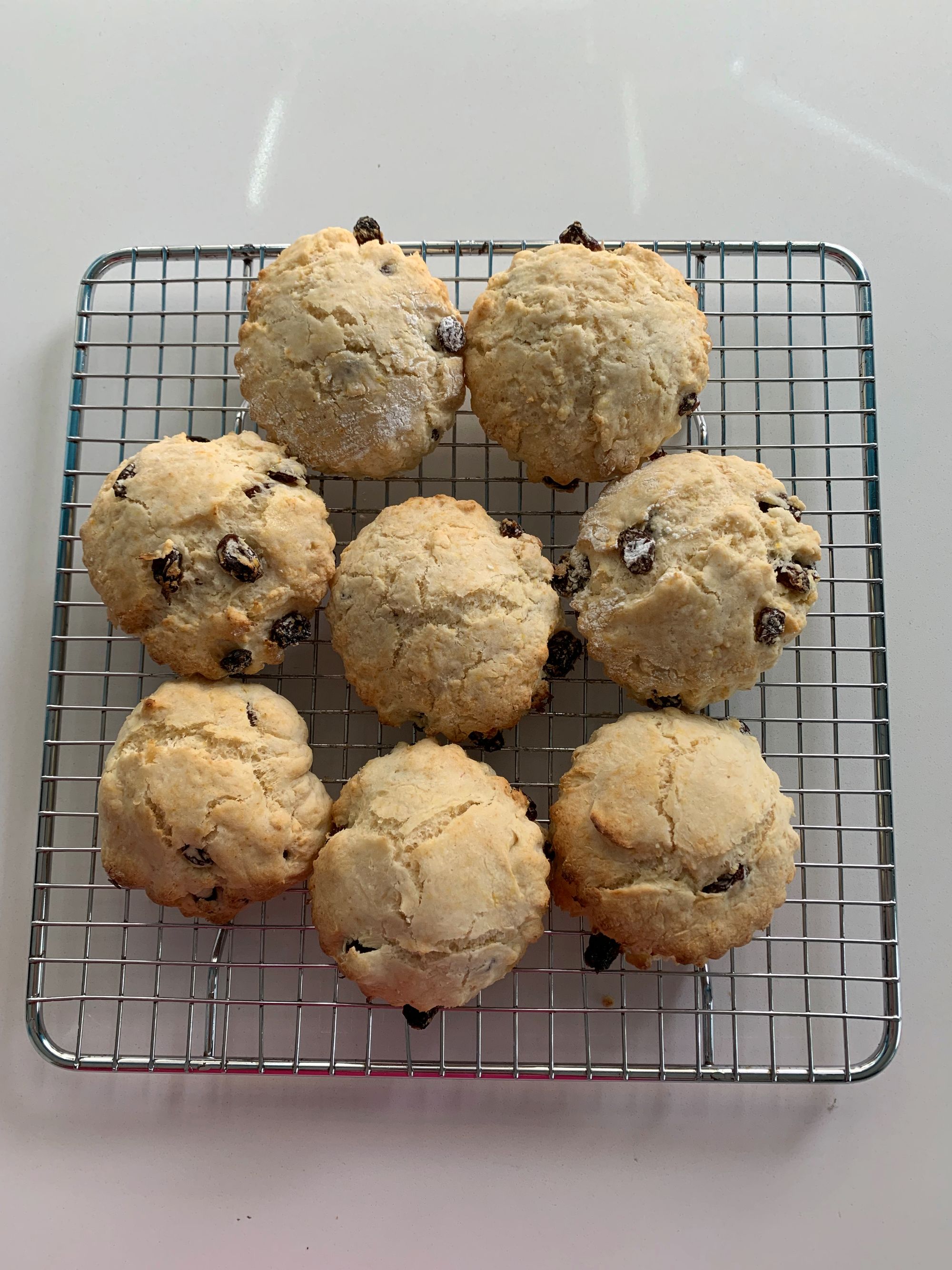
Bake in the pre-heated oven for 10–15 minutes. Cool on the tin for 5 minutes before transferring to a wire rack to cool. Enjoy!
### Did you like this low protein recipe? Please share your suggestions below.
### Cucumber and avocado smoothie
URL: https://www.pigpen.page/cucumber-and-avocado-smoothie/
Last updated: 2023-06-09T13:51:27.000Z
Something a bit different for hot weather and PKU meals. I came across this as a recipe for a ‘no-cook’ soup but in both temperature and texture it is best described as a smoothie.
It will not be phe-free so be sure to check the amount of protein in the sour cream, yoghurt or creme fraiche. I use Oatly creme fraiche (giving roughly 2phe per portion) or Koko plain yoghurt to reduce protein to 0.5 per portion. It will serve 4 as a starter or two as a lunch for those days when it is just too hot to eat.
### Ingredients
1 cucumber, peeled. (You can go further and de-seed it, but I've never bothered.)
1 ripe avocado, pitted, peeled.
2 spring onions (also called green onions), chopped
2 tablespoon freshly squeezed lime juice
1 cup sour cream
1 cup cold water
Sea salt and freshly ground black pepper
2 tablespoons chopped fresh coriander leaves
### Method
1. In a blender or food processor, combine the cucumber, avocados, spring onions, lime juice, sour cream, and water. Process until smooth. Season to taste with salt and pepper. If the soup is too thick for your liking, thin it with water.
2. Stir in the coriander and serve immediately, or cover and let chill.
I hope you enjoy this recipe, please [let me know](https://www.pigpen.page/contact/) what you think.
### Fennel and 'cheese' salad
URL: https://www.pigpen.page/shaved-fennel-and-cheese-salad/
Last updated: 2023-06-09T13:50:38.000Z
Salads come to the fore in hot weather, helped along by the often overlooked fennel. Our favourite salad so far is an easy, phe-free number which I adapted from a blog:
## Shaved fennel and PKU cheese salad
Serves two as a main or four people as a side salad. This is phe-free when made with a phe-free cheese. If you need to use some protein, measure in a cheese with protein or add pine nuts (7g of pine nuts = 1phe).
### Ingredients
1 bulb of fennel
10 or so clean, fresh mushrooms
Small amount of phe-free cheese, either pre-grated or from a block. If you are using a cheese with protein don’t forget to measure the amount so you can calculate the exchanges. I used the Ocado grated cheddar alternative to keep this salad phe-free and easy.
1 tablespoon olive oil
Salt and pepper to taste
Juice of half a freshly squeezed lemon. For those of us without a fresh lemon on standby this is about 1 tablespoon of lemon juice.
### Method
1. Cut off the top stalks and rough bottom of the fennel bulb. Reserve any feathery fronds at the end of the stalks. Wash and dry the bulb. If any of the outside is bruised or browned, gently cut it off without hacking through the bulb.
2. Cut the bulb in half, and shave the fennel with a mandolin or thinly slice with a good knife. Put this fennel into a salad bowl.
3. Shave or thinly slice the clean, dry mushroom caps, and add them to the fennel.
4. Add in the lemon juice, olive oil and add salt and pepper. Add in your cheese, if using a block, grate it or use a vegetable peeler to imitate Parmesan.
5. Mix together and either leave for an hour at room temperature or serve straight away.
Optional: For garnish, sprinkle with the clean, dried feathery fennel fronds, or parsley or with measured pine nuts for extra exchanges. Serve with PKU-friendly bread to soak up the dressing.
I hope you enjoy this recipe, please [let me know](https://www.pigpen.page/contact/) what you think.
### Protein-free Carrot Cake
URL: https://www.pigpen.page/protein-free-carrot-cake/
Last updated: 2025-03-21T20:02:16.000Z
This is a protein-free carrot cake, which is perfect for Easter, celebrations, or the occasional treat. I adapted the recipe from the UK Guardian’s "How to make the perfect carrot cake", and it is a firm favourite.
I use the Nutricia Loprofin Mix and egg replacer, but it should work with the Fate Low Protein All-Purpose Mix, and the Promin Low Protein All Purpose Baking Mix too.
> Please let me know if you have tried the cake with those mixes 😄
### Low-protein carrot cake calculations
I followed the UK PKU guidelines, and used protein-free egg replacer, cream cheese, and flour. By doing this, the only protein which needs counted is in the butter. Butter usually has 0.6g protein per 100g, and the recipe below uses 75g of butter. That is 0.45g of protein in the entire cake, so each slice is allowed freely.
**Recipe tips:**
- I use a food processor with a grating attachment to grate the carrots, and the dough blade to mix the liquids.
- if using unsalted butter, add 1/4 tsp of salt to the flour;
- cake mix can be baked in two equal diameter cake tins, or in one large loaf tin;
- the oil reduces the protein content and helps keep the cake moist, but you could use 150g butter and cut the oil if preferred.
## Ingredients
75g butter, melted
75g oil, plus extra for greasing
150g soft light-brown sugar
3 tsp PKU-friendly egg replacer
6 tsp Luke-warm water
200g PKU flour
1 1/2 tsp baking power
1 tsp baking soda
1 tsp ground cinnamon
½ tsp grated nutmeg
Zest of 1 orange
100g sultanas or raisins. (I have used 60g raisins and 40g crystallised ginger in these photos)
200g carrots, peeled and grated
**For the icing:**
100g Violife creamy spread (or other PKU-friendly cream cheese spread)
150g icing sugar
Zest of ½ lemon and a squeeze of juice (or just the juice if, like me, you were too lazy to clean the zester!)
**Method**
1. Preheat the oven to 180C and grease and line the bases of 2 × 15 cm cake tins, or on large loaf tin.
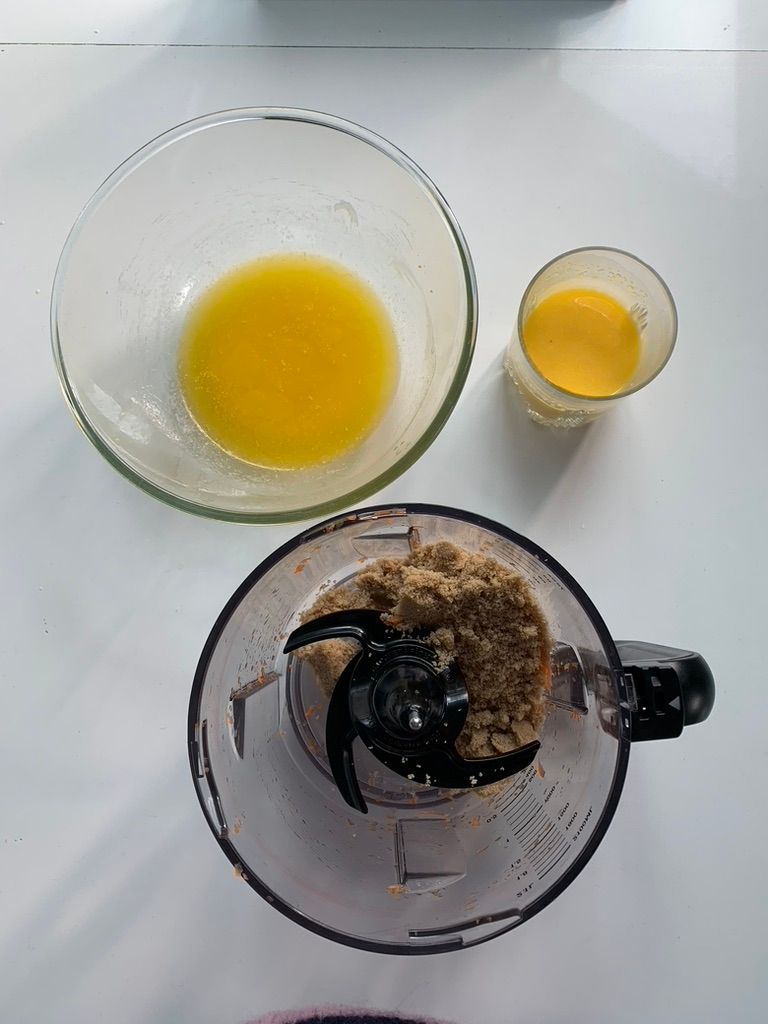
2\. Weigh out the butter and oil in a microwave safe dish. I used the same mixing bowl which I will use later to cut down on washing up. Mix the egg replacer powder and lukewarm water together. Weigh the sugar into the food processor bowl (or mixing bowl), then add the melted butter & oil and mixed egg powder & water mixtures. Whisk well until the ingredients are thoroughly combined and the mixture has almost doubled in volume.
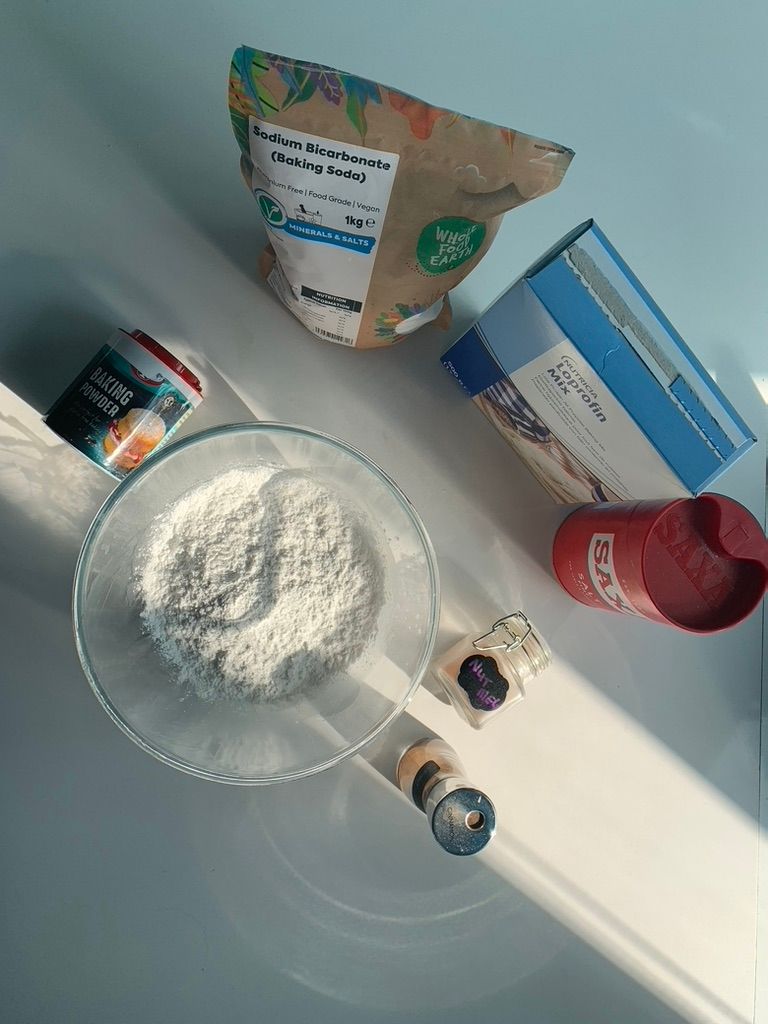
3\. Weigh the flour, baking powder, baking soda, salt (if using, see note on butter in tips above) and spices into a mixing bowl and stir briefly to combine.
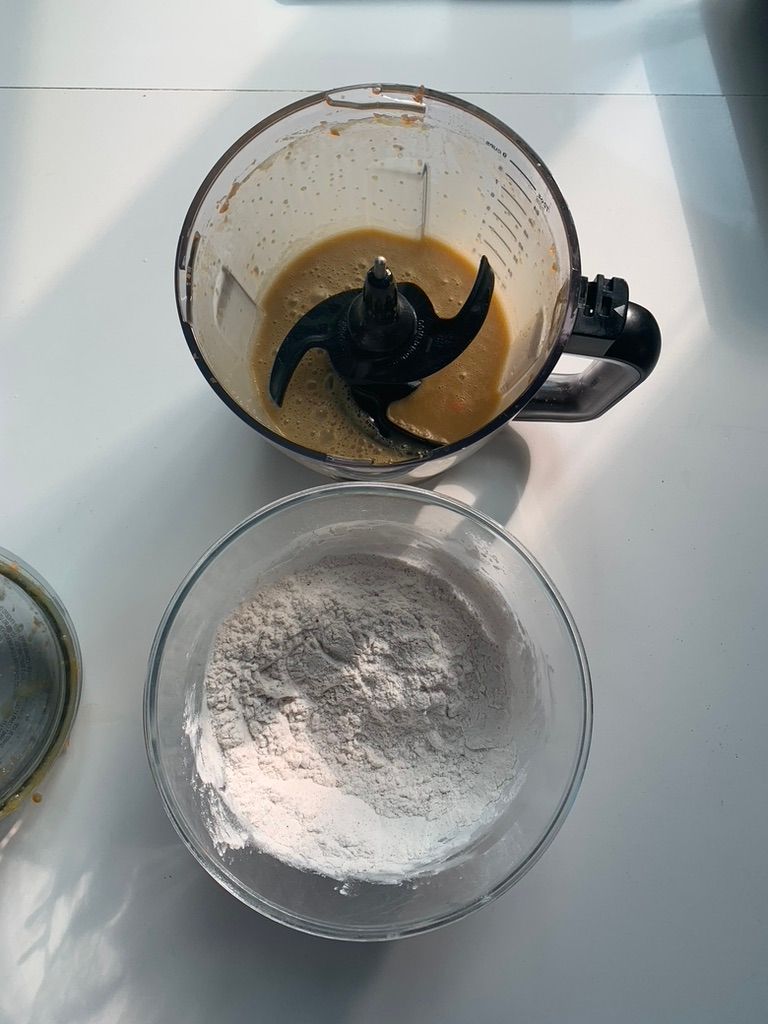
4\. Fold the liquid mixture into your dried ingredients bowl, being careful to knock as little air out as possible.
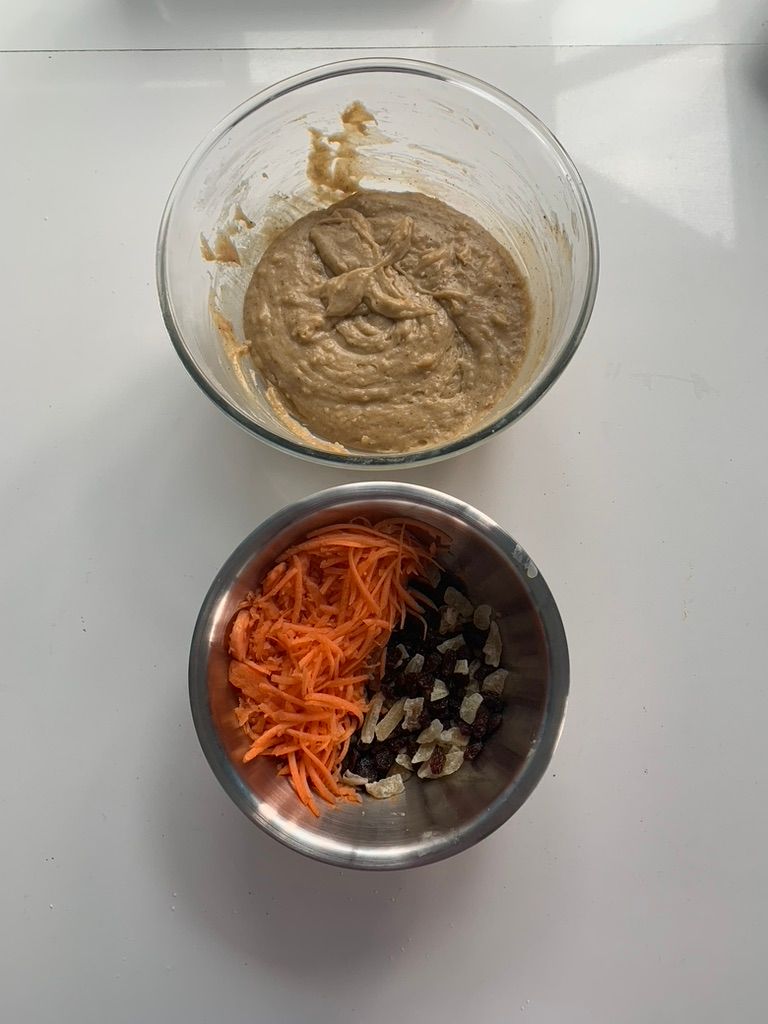
5\. Fold the grated carrots and raisins or sultanas into your mixture until all ingredients are just combined.
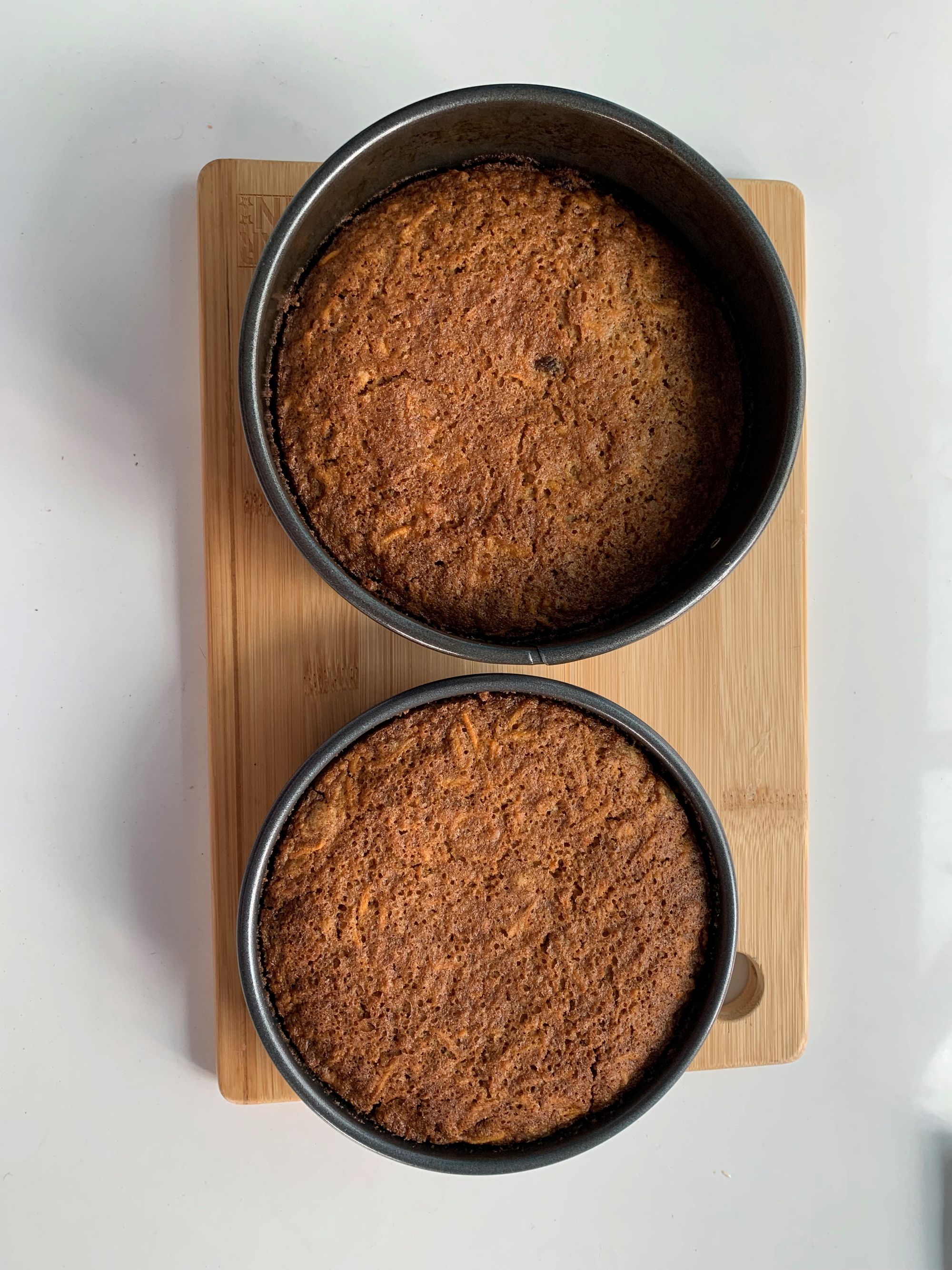
6\. Pour or spoon the mixture evenly between the two tins. Bake for about 30 minutes until a skewer inserted into the middle comes out clean. Cool the cakes in the tins.
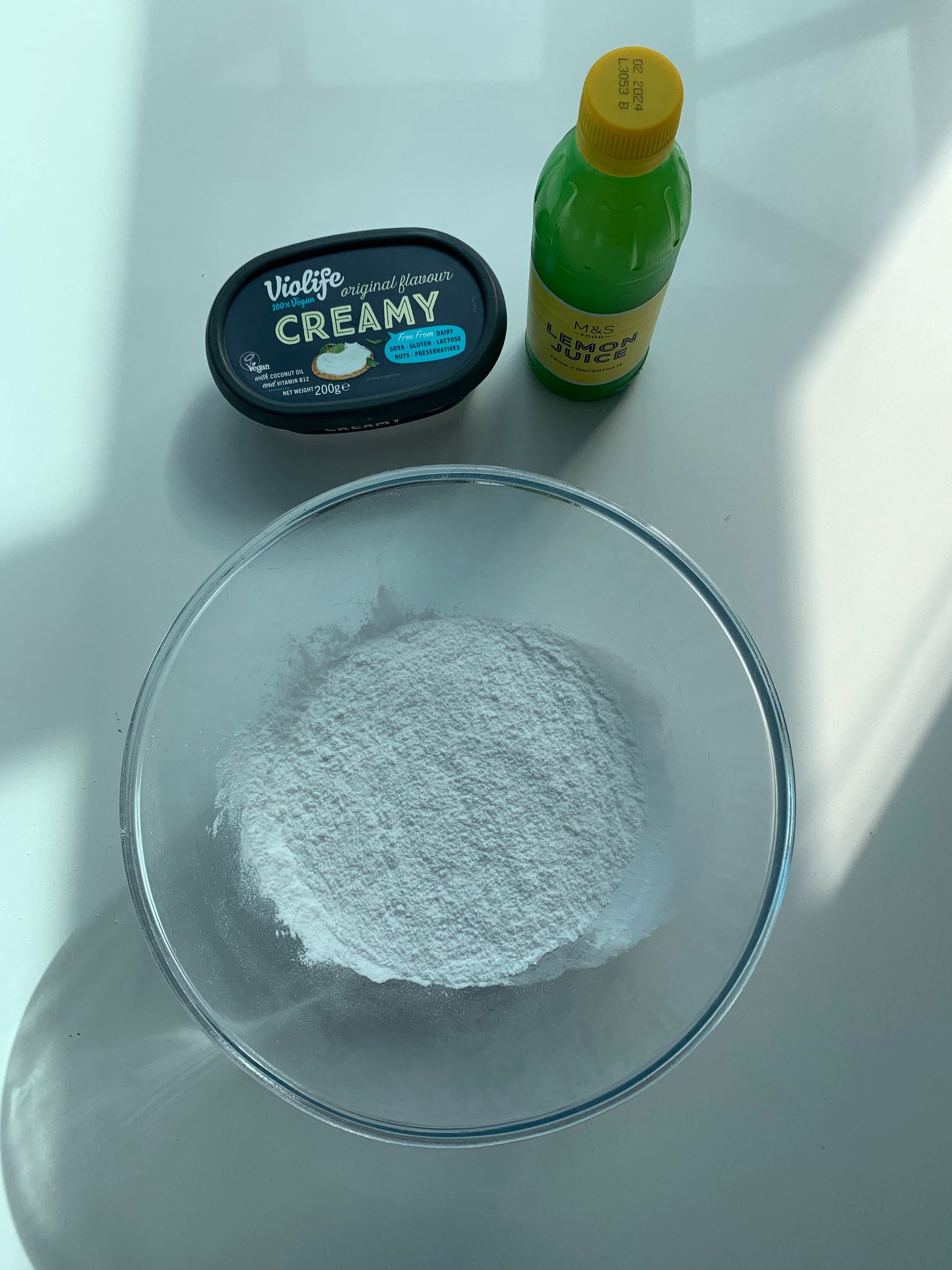
7\. Meanwhile, beat together the icing ingredients and refrigerate. When the cakes are cool enough to ice, remove from the tins, top one with half the icing, and then the other cake. Ice the top, and decorate with the lemon zest, if using.
I hope you enjoyed this recipe, you will [find more ideas here!](https://www.pigpen.page/tag/recipes/)
### Newsletter 8 - January
URL: https://www.pigpen.page/newsletter-8-january/
Last updated: 2024-10-22T16:14:56.000Z
> If you would like to receive future emails, you can [sign up here](https://mailchi.mp/be6eb020b0cf/signup?ref=pigpen.page)
A new year usually means new goals and challenges, the anticipation of exciting changes. Except that this year feels different. There has been a bit too much ‘new’ in the last few years, and I feel the need to just catch up with it all.
I can’t be the only one who is still exhausted by the frenetic pace and turmoil of the last two years. Sadly, that isn’t the way life works. The truth is that there will always be more to do than time to do it in. **The trick is to focus on what we want to do**, easier said than done.
## PKU
It is tempting to simply ‘do what you want to do’ but in life, as in PKU, there is always admin to get on with. Or, in my case, to forget about until the week before Christmas when I realised that my monthly prescription request was stuck in the postal strikes. I called the company and was brightly informed that it was too late, that there was nothing to be done, I would now not receive PKU prescription foods until nearly February, and do have a Merry Christmas. Brilliant.
> Top Tip: have a support group.
Top Tip: have a support group. This is where a PKU community can really help. One, admittedly whiny, social media post later, and I was inundated with advice on how to get an emergency prescription to the GP along with offers of excess stock from kind strangers. A huge thank you again to everyone who stepped in to help!
I now know that I should have enough food, and it will give me a chance to finally try out some PKU sample and trial packs which have been waiting since conference. Plus, I have had a timely reminder that you get out of social media what you put in. Thus, in 2023, I will try to be positive online - and to post more dog photos!
**What small steps can you take each week to build your own support network?**
### News in PKU: Sepiapterin trials
This will not be news to those who are on them, but there are sepiapterin trials now taking place in the UK. The information has now disappeared from the NHS Clinical trials webpages, but there are some families on social media who confirm that they have started the trials.
Sepiapterin is another potential treatment for PKU, which works similarly to sapropterin (aka Kuvan). However, in *some* early trials, sepiapterin has proven more effective at reducing blood phe levels, and appears to work in all patients. This is incredibly exciting for those of us who are deemed unlikely to respond to sapropterin. The news is a much-needed boost for many with PKU who endured a gruelling 2022 in which that sapropterin guidelines were implemented unevenly across the UK.
(NB: the NHS information stated that the sepiapterin trials were for those over the age of 2 years. However, diligent investigations by a group of keen adults found that, in practice, the trials were only at paediatric clinics in the UK. I’m glad the trials are happening, but have to question why adults are, in effect, prevented from accessing potential treatments.)
### PKU trials recruiting now
As the information on the sepiapterin trials is no longer available on the NHS Be Part of Research page, I have to assume that entry is no longer possible. (Please let me know if you discover otherwise!) However, there are some PKU trials still recruiting.
Why not start off 2023 with a spirit of giving back and helping to improve the future for everyone with PKU and [Be Part of Research](https://bepartofresearch.nihr.ac.uk/results/search-results?query=PKU&location=&ref=pigpen.page).
## Brain Injury
Plans for the new year can seem overwhelming: How will I fit in everything on my bucket list when I’m already exhausted at the end of the day (or even the start of the day?) This concern is amplified for those who suffer from pathological fatigue, which is common after a brain injury. A critical part of my brain injury recovery was learning my **Four P’s of Fatigue Management**, and I still find these helpful 9 years on.
### Polly’s Four P’s of Fatigue Management
When we are exhausted, dissatisfied with life, or simply making plans for a new year, it can be helpful to establish our **Priorities**, to **Plan** out what needs to be done, and to **Pace** our time too. But, how can you work out what your priorities are if you don’t have any **Perspective**? You need to know what is most important to you before you can prioritise them in your day.
**Thus, Polly’s Four P’s of Fatigue Management are:**
**1 Perspective**
**2 Priorities**
**3 Planning**
**4 Pacing**
This might seem daunting and ‘just another thing to get done’. Actually, it is spending time to make time as, once you have a clear idea on what really matters (Perspective), everything else becomes easier. You know instinctively what your Priorities are, which makes it simpler to say ‘No’. If something doesn’t fit with your Perspective or your Priority, you can say no with a clear conscience. This makes planning your time in, and learning to pace yourself, easier.
There is more on this in [my memoir of the recovery](https://www.routledge.com/Living-with-Mild-Brain-Injury-The-Difficulties-of-Diagnosis-and-Recovery/OConnor/p/book/9780367524081?utm%5C%5Fsource=individuals&utm%5C%5Fmedium=shared%5C%5Flink&utm%5C%5Fcampaign=B011121%5C%5Fdm1%5C%5F1au%5C%5F1aj%5C%5Fd741,&ref=pigpen.page), but you just need 5 minutes of spare time to think about what matters to you in life. Get your **Perspective** right, and everything else follows.
## Recipe
It is hard to avoid recipes at this time of year – everyone seems to have that one key recipe which will change your life in only 3 simple steps. I do have salad recipes and easy lunch ideas on my blog, but my big food tip this month is to look again at something you may have dismissed.
My Christmas has been revolutionised this year but finally buying from an online [PKU shop at Promin Metabolics](https://prominpku.com/shop?ref=pigpen.page). Despite knowing about this shop for PKU foods for years, I hadn’t bought anything. This year, I stocked up on protein-free mince pies, gingerbread, fruit loaf and other goodies which have made my festive season more enjoyable. And, given my troubles with PKU foods in January, I will be visiting their fresh bread shop again soon.
**What have you overlooked in the past which might make your life a little easier in the next year?**
## Final thought
We are all aware that it is good to be kind. New research has found that, as well as benefiting the person you are being kind to, offering an act of kindness has benefits for you too. Here are five ways you can offer kindness and boost your wellbeing in 2023.
> Here are five ways you can offer kindness and boost your wellbeing in 2023.
### [Five ways to wellbeing](https://www.pigpen.page/everyday-acts-of-kindness/)
**Connect** — connect with those around you, at home, at work, and with your local community.
**Be active** — go for a walk or run, step outside, cycle. Discover a physical exercise which you enjoy.
**Take notice** — be curious, remark on the unusual, and savour the moment. Reflecting on your experience will help you appreciate what matters to you.
**Keep learning** — try something new, or rediscover an old interest. Learning new things can make you more confident, and may be fun.
**Give** — do something nice for a friend or a stranger. Thank someone. Linking yourself to the wider community can be rewarding!
### Like what you’ve read? [Sign up for more great content](https://mailchi.mp/be6eb020b0cf/signup?ref=pigpen.page)
### Campaign update at NSPKU2022.
URL: https://www.pigpen.page/campaign-update-at-nspku2022/
Last updated: 2023-11-30T17:05:19.000Z
Kate Learoyd, Caroline Graham, and special guest Liz Twist MP.
Liz Twist MP spoke to the conference in her role as Chair of the All Party Parliamentary Group (APPG) for PKU. She began by extolling the difference which Sapropterin makes for some, but she also acknowledged the need to work for those who it will not help.
### Discover the [genetics of PKU and how sapropterin works here](https://www.pigpen.page/the-genetics-of-pku/)
### or find my [lessons from a sapropterin trial here](https://www.pigpen.page/sapropterin-trial-part-1/).
Liz Twist began campaigning for access to sapropterin on behalf of one of her constituents, but she said: “No one story would ever have made this happen. It was everyone’s effort.”
> “No one story would ever have made this happen. It was everyone’s effort.”
NSPKU took individual stories and the results of their surveys to parliament, where they had real impact. The real-life stories are the ones which make a difference to the MPs, and the “penny drops when they see the exchange amounts”. The NSPKU display showing the amount of different foods allowed as one exchange had a notable impact and garnered support for the campaign.
The conference session did segue into a discussion on the protocol for defining responsiveness to sapropterin. (I will post on this soon.) Speaking as Chair of the APPG for PKU, Liz said that the group and the NSPKU need to work out how to move into the next phase of campaigning.
Looking forward to a continued campaign for new treatments, Liz Twist noted a key lesson which the APPG had learned was don't give up.
> **Don’t give up!**
Kate Learoyd acknowledged that MPs may be bored with hearing about PKU now, but that they are stuck with the NSPKU and the ongoing campaign for better treatment for those with PKU. A positive and ongoing effect from the sapropterin campaign is that relationships have been made. There was an emphasis among all speakers, that the networks will be maintained, as these will aid the fight for future treatments.
Professor Anita MacDonald, speaking from the audience, added that another big lesson from the sapropterin campaign was that any future treatment should be trialled in patients to inform response protocols, rather than the other way around. This was well received in the room.
Prof. MacDonald went on to say that health professionals must take a scientific approach to assessing any evidence for new treatment. But they must also remember that patients must be given a chance to access the treatments which they deserve.
This session was a little fraught at times, with much discussion on sapropterin protocols. It was reassuring that those who do not respond to sapropterin have not been forgotten. The lessons of persistence and collaboration learnt in the campaign for treatment will strengthen the continuing fight for better PKU treatments in the UK.
### Review: five Sphere flavours
URL: https://www.pigpen.page/review-five-sphere-flavours/
Last updated: 2023-03-21T15:11:08.000Z
[Vitaflo Sphere](https://www.vitafriendspku.co.uk/pku/product/pku-sphere?ref=pigpen.page) have two new, and frankly delicious, flavours in their supplement range. I tried all five flavours in one day and took notes for you. It is worth noting that I found Sphere to be more filling than other, non-GMP, supplements; so I did reduce my meals and snacks by the end of the day.
## What is GMP
Sphere was one of the first GMP products for PKU. You can find out [more about GMP products here,](https://www.pigpen.page/what-is-gmp/) or check out my earlier [trial of Sphere vs my phe levels here](https://www.pigpen.page/new-chocolate-sphere/).
## Red berry Sphere
Straight out of the packet, it smells like Eton Mess (an English dessert of raspberry, meringue, and cream). Once this supplement is mixed with water, it smells and tastes like raspberry milkshake powder. So if you are mixing your supplement with one to mask the flavour, perhaps this might work for you. I had this flavour with breakfast.
## Lemon Sphere (new)
I swear it smelt like sherbet lemon with a hint of vanilla immediately upon opening the packet. Definitely an uplifting citrus smell and flavour once mixed. Almost juicy and very nice change from overly sweet flavours. Would switch to this myself. Delicious. I had this flavour at lunch, and wanted more.
## Banana Sphere (new)
Smells like those retro banana foam sweets which haunted pick’n’mix sweet aisles when I was a kid. I made the mistake of mixing this with slightly warm water, which is often a killer for PKU supplements. But it was still delicious, with a flavour like banana milk. I had a slight problem with the mixing this one fully, but that could have been the impatience of not having much time for my mid-afternoon snack.
## Vanilla Sphere
Basically, what it says on the tin, this was an innocuous vanilla-flavoured drink. The slight chalky undertone, which is a feature of all GMP drinks, is fairly noticeable here. That being said, this is a fairly unexciting and inoffensive, neutral drink. As those with PKU know, that is high praise for a supplement. Taken after a spicy dinner.
## Chocolate Sphere
I took this at bedtime but, don’t be fooled, this isn’t a rich dark chocolate drink. Rather, it tastes like a vanilla milk drink with a hint of chocolate. Some people think this flavour is more vanilla than chocolate. Either way, it has been my staple Sphere drink for a few years. Trying it against the other flavours today was useful. I find it hard to provide an accurate description as it is now so familiar. However, it is no longer my favourite Sphere. Time for a Change.
## Try new things, even if you don’t switch
And this is another reason to try new things. Flavours change over the years, as do our tastebuds. Make a point to ask for new trial packs, or seek out the tasting stands at a PKU presentation day or conference. Whether your supplements are working for you or not, there is usually something new to explore which might just surprise you.
## See you at conference
I hope this was useful for you, and please say hullo if you are at the [2022 NSPKU conference](https://www.nspku.org/nspku-conference/?ref=pigpen.page). It would be great to meet some readers and find out more about what you would like to see on here.
Plus, if you bring your copy of [Living with PKU,](https://www.pigpen.page/books/) I’d be thrilled to sign it.
### New book: Living with PKU
URL: https://www.pigpen.page/new-book-living-with-pku/
Last updated: 2023-12-13T21:39:17.000Z
***Living with PKU: A low protein life with Phenylketonuria*** is a new and valuable resource for adults and teens with Phenylketonuria (PKU), or for families new to the disorder..
Available now in [e-book and paperback from Amazon](https://www.amazon.co.uk/Living-PKU-protein-life-Phenylketonuria-ebook/dp/B0B4FB651S/ref=sr%5F1%5F1?crid=U4AZ65NSB1HS&keywords=living+with+PKU&qid=1655632207&sprefix=living+with+pku%2Caps%2C70&sr=8-1&ref=pigpen.page), and you can read the first few chapters for free. Available with other retailers soon. [Subscribe for publication updates](https://mailchi.mp/be6eb020b0cf/signup?ref=pigpen.page).
## Outstanding Reviews for this PKU book
> ‘**Completely** **fabulous**. **Brilliantly** **written**.’
> Suzanne Ford, Metabolic Dietician & advisor to NSPKU.
> ‘**Absolutely** **brilliant** **&** **factual…lots** **of** **very** **good** **advice**.’
> S.M., adult with PKU.
> ‘**Skilfully** **compiled**…**readable** **for** **anyone** **new** **to** **PKU**.’
> C.H., new to PKU.
## Clear explanations and practical advice on PKU
In clear and simple language, this book explains:
\- What is PKU?
\- How do high levels of protein affect us?
\- Why is PKU treated by restricted diet?
\- What other treatments are there?
\- What are supplements? And why do they taste like that?
## PKU book by an author with PKU
Pauline has lived with PKU for over forty years. In this honest account, she shares her experience and mistakes to help others navigating the difficult dietary treatment.
**This book is packed with practical advice on:**
\- PKU and mental health
\- Managing PKU clinics
\- Travel & emigrating
\- Women & PKU
\- Healthy eating and exercise.
## Available now: read for free
Get the [e-book and paperback from Amazon](https://www.amazon.co.uk/Living-PKU-protein-life-Phenylketonuria-ebook/dp/B0B4FB651S/ref=sr%5F1%5F1?crid=U4AZ65NSB1HS&keywords=living+with+PKU&qid=1655632207&sprefix=living+with+pku%2Caps%2C70&sr=8-1&ref=pigpen.page), and you can read the first few chapters for free. Available with other retailers soon. [Subscribe for publication updates](https://mailchi.mp/be6eb020b0cf/signup?ref=pigpen.page).
[](https://www.pigpen.page/books/)
### PKU recipe for breadmakers
URL: https://www.pigpen.page/pku-recipe-for-breadmakers/
Last updated: 2022-06-19T10:37:31.000Z
There has been a lot of social media chatter about bread in the last few weeks. I have made my own PKU bread in a breadmaker for decades, and use this reliable recipe. I’m not going to make you read my life story first, so here is the recipe with discussion below.
## Recipe for PKU loaf in breadmaker
9g psyllium husks
3g sugar
8g yeast (or one Loprofin yeast packet)
490ml warm water (or 200ml SnoPro and 290ml water, but this didn’t work for me)
3tbsp olive opil
500g Loprofin mix
1/2g salt (optional)
Take the bread pan out of the bread maker (you want to avoid spilling ingredients in there). Ensure the mixing paddle is in place, then measure in the first three ingredients.
Add the water, or the water and SnoPro. Use a non-stick safe whisk or spoon to mix well, then set a timer for 10 minutes. The mix will thicken in this time.
After 10 minutes, add the oil, then the flour. Add the salt last, so it is on the flour not in the liquid yeast mix. Note that salt is optional, I prefer my bread without the salt.
Set the cycle to gluten-free. If you have the choice, set the crust option to dark.
This recipe came from a Nutricia PKU recipe book years ago. The closest I can find on their website presently is the ‘[Homemade bread loaf’](https://www.nutricia.co.uk/patients-carers/recipes/homemade-bread-loaf.html?ref=pigpen.page), but that is not for a machine.
## Notes on PKU loaf in breadmaker
### Do you get a ring of hard, unmixed flour on the final loaf?
This happens to me, and I found a way round it—though I do not think it manufacturers would recommend it! After the first few minutes of the cycle, I lift the lid and can see that this ring of unmixed flour has formed out of the reach of the rest of the dough. Using a small silicone spatula, I carefully scrape this flour back into the dough where it is incorporated into the dough.
### Psyllium husks and PKU
These are a phe-free husk which help PKU baking in two ways. First, it improves the texture. When I started using them, my loaves suddenly became soft like supermarket white bread. They also help to add fibre and bulk, which helps us to feel full. Before using these, I would happily eat four slices. Now, two is the most I can manage in a sitting. These are available in most health food shops, larger and speciality supermarkets, or online stores.
I hope this helps, please [let me know](https://www.pigpen.page/contact/) how you get on
### Everyday acts of kindness
URL: https://www.pigpen.page/everyday-acts-of-kindness/
Last updated: 2023-01-01T16:27:25.000Z
**How can we fit small acts of kindness into our day?**
2021 became a year of volunteering as I donated my time and skills to several charities. Just before Christmas that year, one of my articles appeared in the NSPKU [News & Views magazine](https://www.nspku.org/download/rainbow-edition-of-news-views-free-to-download/?ref=pigpen.page). The NSPKU, or the [National Society for Phenylketonuria](www.nspku.org), advocate for those affected by Phenylketonuria; an inherited metabolic disease (*see [‘What is PKU?’](https://www.pigpen.page/what-is-pku/)*).
The article, **The power of kindness**, was well-received. Here is a small excerpt:
## The benefits of wellbeing
The New Economics Foundation (NEF) is a charity which works toward an economy that benefits people and our environment. You might think that this is an odd place to go to for research on wellbeing, but that is precisely why it is worth paying attention. The evidence for the benefits of wellbeing are so strong that even economists looking at them. And they have been doing so for some time.
In 2010, the NEF published a document entitled ‘Five ways to wellbeing’. It was modelled on the NHS ‘Five-a-day’ campaign, which encouraged us to eat 5 portions of fruit or veg every day. In this case, the NEF wanted us to do five things a day for our mental health.
Why would our wellbeing be important to a charity focussed on improving the economy? As their document noted:
> ‘Evidence suggests that a small improvement in wellbeing can help to decrease some mental health problems and also help people to flourish’.
This document is now 11 years old. In that time, the amount of evidence showing the economic burden of poor mental health has grown.
In 2018, the OECD (Organisation for Economic Co-operation and Development, an international policy development organisation) stated that mental ill-heath cost the UK £94 billion every year. To put that into perspective, that is £1,424 for every adult and child in the UK at the time. This was also before the pandemic caused a decline in mental health and wellbeing for many people.
## Five ways to wellbeing
Figures like this show why economists are looking at improving the wellbeing of the public. The ‘Five ways’ in the NEF’s wellbeing plan are:
1. Connect — connect with those around you, at home, at work, and with your local community.
2. Be active — go for a walk or run, step outside, cycle. Discover a physical exercise which you enjoy.
3. Take notice — be curious, remark on the unusual, and savour the moment. Reflecting on your experience will help you appreciate what matters to you.
4. Keep learning — try something new, or rediscover an old interest. Learning new things can make you more confident, and may be fun.
5. Give — do something nice for a friend or a stranger. Thank someone. Linking yourself to the wider community can be incredibly rewarding.
I didn’t believe that I had time to fit all five activities into a single day, so focused on just one; giving. It turned out that actively searching for ways to give meant that I inadvertently achieved the other activities too. Through the act of giving, I connected with my new community and saw more of it as I walked or rode further afield. I learned about the history of my city and neighbours, and I gained new experiences to savour.
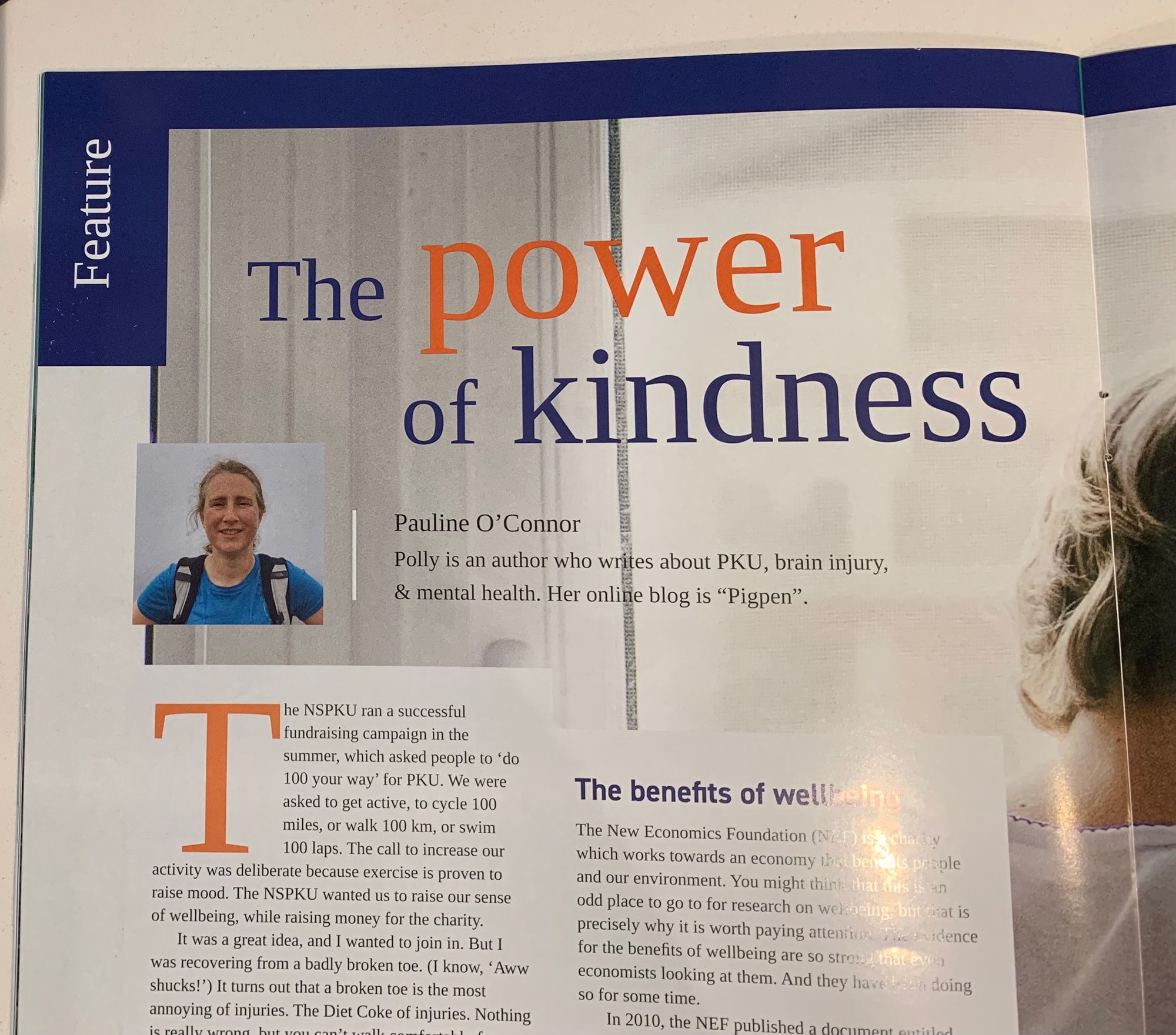
Article in News & Views Issue 168\. © Pauline O’Connor 2021
## The science of kindness
> We are all aware that it is good to be kind. New research has found that, as well as benefiting the person you are being kind to, offering kindness has benefits for you too.
As with everything in science, ‘more research is needed.’ Researchers at the Sussex Kindness Research network have partnered with BBC Radio 4 to ask people about their everyday experiences of kindness. The survey closed at the end of last year, and [the results will be released later in 2022.](https://universityofsussex.eu.qualtrics.com/jfe/form/SV%5F1RYvaR5UA1czYvs?ref=pigpen.page)
## Which way to wellbeing will you choose?
Until then, try to fit in a few of the ideas into your days. You don’t have to do all five, perhaps you just want to move more, or connect with those around you. Published research suggests that will feel better, and we all need that on these dark winter days.
### The dogs of change
URL: https://www.pigpen.page/the-dogs-of-change/
Last updated: 2023-12-13T21:48:35.000Z
A few weeks ago I completed [#100KindThingsForPKU](https://www.pigpen.page/100-in-june-2021/). As part of the [NSPKU’s ‘100 in June’ ](https://www.pigpen.page/100-for-pku/)campaign, I did 100 acts of kindness during the month. The habit must have remained, and led directly into this month’s challenge.
Our neighbours were days away from their long-anticipated holiday when they learned of a problem with their dog sitter. Their dog is a rescue and gets on well with us. Plus, we are on the list for a rescue ourselves. This seemed the perfect opportunity for a trial run of dog owning.
## Too much change
Our pooch-for-a-fortnight was delivered at 7am one sleepy, heatwave morning. Suddenly the pace of change here, well, changed. For weeks my inner voice had been nagging that ‘getting out of bed earlier was the best way to get more exercise’. And I had spent weeks ignoring it. Now, procrastination wasn’t an option. If I wanted to save the carpets, I had to grab the poo bags and head out the door.
Alongside the nagging voice had been another one. This said that heading out for a walk first thing was a step too far. That I needed to get my PKU diet sorted because exercise on an empty stomach didn’t mix with PKU. Yes, this was blithely ignoring the fact that a 30-minute walk around the park is not a 2-hour gym & weights session. But it just felt a step too far, and something which my will power simply wasn’t up to after a stressful year.
## Or not enough change
At the same time, I had convinced myself that this simple step was also not enough. That a quick walk around the park each morning was not going to make a dramatic difference to my current injuries, weight problems, and general feeling of malaise. That there was no point doing this one small thing because I needed a greater intervention.
Thus, a quick walk in the park was both far too big a change, and not enough of a change simultaneously. The idea of a walk became emotionally charged, to the point that it was easier just not to try.
## Just right
In the end, it was easy, and pleasant to get out for a stroll. I didn’t collapse due to disastrously low blood sugar, if anything I felt more awake. The limbs and blood were already energised, so it didn’t as much effort to get up from the breakfast bowl and start on the next task.
I told myself that fear of making a mistake with my PKU stopped me from early morning exercise. But, if I am completely honest, I was using PKU as an excuse for my laziness. A simple change which I had avoided and lingered over for months took place overnight. The real test will be, can I keep up the change when the dog owners return from their holiday?
## The pace of change
Dog sitting has helped me realised how quickly we adapt. Change can happen so fast that we aren’t ready for it: an animal arriving overnight who needs your care; a novel virus leading to a global pandemic within months of detection.
At the other end, change happens with a creeping slowness which feels like static: the incremental recovery from a brain injury; a twelve-year wait for a new PKU treatment.
## Slow changes.
My first encounter with the feeling of unending 'sameness' was during my recovery from brain injury recovery. My days, weeks, and months seemed to become one and the same. This is how I described it in the prologue to my book on the recovery:
> Events tend to bleed into each other, just as blood seeps into delicate brain tissue. Large tracts of time were lost, like rain on a window pane eventually soaking up all the individual drops into one long trickle.
If that is how things feel for you, or you are having trouble ‘restarting’ after our numerous lockdowns, then perhaps focus on one thing. One small thing which can be an easy change in the day. This could be as simple as setting a timer when on social media, having a cup of tea with no distractions, or doing one small task rather than a bigger project.
## One small thing each morning
Achieving one small thing at the start of the day, can help to tee you up for more success. Or, if the day is just not going to be a good one, can help comfort you when you accept that it is going to be a bad day. I find it can be easier to be kind to myself, to give myself a break and have a duvet day, if I’ve managed to do something, anything, beforehand.
If, like me, any change has morphed into an emotional drain; and a change into something which is both far too large and far too small. Try it once. Just once might be all you need to find out if it is manageable. If it doesn’t work, then at least you know and will stop worrying about it.
Give it a go, you might surprise yourself!
### 100 in June 2021
URL: https://www.pigpen.page/100-in-june-2021/
Last updated: 2022-03-09T16:03:14.000Z
Since the 28th was a Monday this year, the NSPKU celebrated one day early on the on Sunday the 27th with an exciting programme of events. The day kicked off with an energetic workout and finished with a good ol’ pub quiz in the evening.
- All of the events are available on the [NSPKU YouTube channel](https://www.youtube.com/channel/UC6qDV2%5FS9gYNWMZwVNEZWGA/videos?ref=pigpen.page):
[https://www.youtube.com/channel/UC6qDV2\_S9gYNWMZwVNEZWGA/videos](https://www.youtube.com/channel/UC6qDV2%5FS9gYNWMZwVNEZWGA/videos?ref=pigpen.page)
## 100 your way for PKU
As mentioned before, NSPKU campaign aimed to get people active by setting a target of 100 in June. 100 miles, 100 km, 100 lengths of the pool... This was widely intepreted by the people to got to work!
- The very [impressive Boyd](https://twitter.com/mrs%5Fmartin%5F2012?ref=pigpen.page) managed 100 situps for PKU. Well done Boyd!
- [Duncan Noble-Nesbitt](https://twitter.com/DNobleNesbitt?ref=pigpen.page), [Jen Dewey](https://twitter.com/JenDewey1?ref=pigpen.page), and [Dani Bee](https://twitter.com/Danii04391761?ref=pigpen.page) all walked or ran 100 miles for PKU in June. Congratulations to you all!
- [Clair](https://twitter.com/ClairBear42?ref=pigpen.page) has been doing squats and pushups to raise awareness and fund for NSPKU. [Soheb](https://twitter.com/sohebsoheb?ref=pigpen.page) managed 100 planks!
My apologies to those whom I have missed!
I’ve not been able to get active this month, so have been doing [100 Kind things for PKU](https://twitter.com/search?q=%23100kindthingsforpku&src=recent%5Fsearch%5Fclick&ref=pigpen.page). This has turned out to be a mix of volunteering, trying new things to reduce waste, and looking after myself too! You can find the list below or on the Twitter #100KindThingsForPKU.
How can you be kind today?
## 100 Kind Things for PKU
**Tues 1 June**
1. Exercise! A lovely bike ride through the fields in bright sunshine.
2. Afternoon tea in the sun to celebrate writing actual words on the new book, because charity begins at home.
**Wed 2 June**
3. Helped an older friend who was struggling with the joys & massive problems of social media.
4. Volunteered proofing skills to assist with a charitable publication.
5. Volunteered proofing skills and feedback for PKU research study.
6. Completed a different research study for PKU - please join in if you haven’t already!
**Thurs 3 June**
7. Contacted local brain injury charity to volunteer time in future.
8. Enjoyed and revelled in an afternoon of sunny banter with a friend without worrying about what might happen next. #BeKindToYourself too
**Fri 4 June**
9. Shared a laugh with a stranger over missing shop radio during #Lockdown.
10. Offered to help neighbour with their gardening waste. (Hey, it’s the thought that counts!)
11. Feedback on documents for another PKU research study.
**Sat June 5**
12. Day out in London and schlepped around with my huge water bottle to avoid buying water for #PKU supplements. Trying to be kind to the planet.
13. Ice cream for the brother on a hot day.
14. Bought delicious chocolate coated cherries for the husband, & didn’t snaffle any as know I feel better when I stick to the #PKU diet so counts as being kind to me. That’s my reasoning anyway.
15. Helped a lady who seemed to be choking. She was ok, just needed water.
**Sunday 6 June**
Umm, Does listening to the #EngvsNZ cricket match right to the bitter end count as an act of kindness?
**Mon 7 June**
16. Helped friend with another IT problem
17. My usual 2hrs volunteering in a local shop.
18. Found a use for old plastic pots in the garden, another thing kept out of recycling. #BeKindToThePlanet
19. Awesome yoga session! #BeKindToYourself.
**Tues 8 June** was a long day watching the NICE meeting so did not have time to focus on #100KingThingsForPKU, nevertheless:
20. Out on the bike to enjoy a glorious summer evening. #BeKindToYourself
21. Gave the bored nettles on the overgrown pathway something to do!

**Wed 9 June**
22\. Tried out out local refill shop where you refill food containers with staples like dried fruit to save on packaging.
23\. Found out I’m still in the running as a volunteer for another community committee. Best slow down or I’ll have no time left to work!
24\. Spread the word about some #PKU research you can do right now, huge thanks to everyone who helped!
25\. Gorgeous Evening enjoying the mystery rose which has just flowered in the new garden. #BeKindToYourself
**Thur 10 June**
26\. Didn't mention today's cricket to any English fans
**Fri 11 June**
27\. Out for a ride in the morning - #BeKindToYourself
28\. Volunteered for proof-reading work.
29\. Lovely chat with a friend to cheer us both up!
30\. Still not mentioning the cricket! #ENGvsNZ
**Sat 12 June**
31\. Met up with friends to get us all out of the house :)
32\. Dinner was a salad entirely from the garden, huzzah #BeKindToYourself
33\. Biting my tongue to avoid mentioning the cricket #ENGvsNZ
**Sun 13 June**
Too hot… too hot!
**Mon 14 June**
34\. More discussions with local group about volunteering.
35\. The usual volunteer spot in a local business
36\. Spent time online cheering up folk who are having to self isolate in this fine weather.
**Tue 15 June**
37\. Gorgeous bike ride round the bridle paths for exercise.
38\. Finally put pen to paper, or fingers to keyboard, & made progress on the next book.
(Given anxiety over not doing either, have decided both of these count as #BeKindToYourself )
39\. Spent time talking to new neighbour even though I really had to go!
40\. Helped out friend with IT questions
Whelp! June is halfway through & I’m falling behind. Need to be more kind
**Wed 16 June**
41\. Another catchup about volunteering, things taking longer as folks are having to isolate.
42\. Another good stretch on writing and research for book no. 2 #AmWriting
43\. Read up on 3D printers so I don’t have to keep pestering the other half with questions (trust me, he’d see this as a kindness!)
44\. Took the evening off to sit in the garden. #BeKindToYourself
Running behind on #100KindThingsForPKU, wish I’d done planks!
**Thurs 17 June**
45\. Managed not to beat myself up over falling down a YouTube hole while I was supposed to be writing! #AmNotWriting
46\. A few song recommendations to help a friend out with their challenge. (Go @sohebsoheb!)
47\. Met a Kiwi at the vaccine centre and neither of us mentioned the English weather?!
48\. Helped out a friend who had anxiety over a forthcoming public speaking gig.
**Fri 18 June**
49\. Registered with @GiveBloodNHS as blood donor for the first time in 25 years! (Had a bad reaction first time in another country which put me off.)
50\. Booked my first blood donation appointment online. It isn’t for a while but I think that still counts as is a big step for me.
@GiveBloodNHS make it easy to book and thanks to @NSPKU
for the encouragement.

From the Give Blood website resources at https://www.blood.co.uk/
##
halfway through #100KindThingForPKU!
**Friday 18 June cont.**
51\. Treated my friend and her daughter to lunch, it was so lovely to see them again!
52\. Back to not mentioning the English weather at the Cricket.
**Sat 19 June**
53\. Awesome day hosting friends who we hadn’t seen for a year. Joyous fun, teasing, and kindness all round!
54\. Not sure if I have any followers who are Indian fans but best not mention the NZ cricket team, come on Black Caps!
**Sun 20 June**
55\. Leftover bbq aubergine with melted cheese and tomato sauce on a homemade PKU burger bun. #BeKindToYourself
56\. Gave someone a lift to avoid the rain, then
57\. Gave myself the day off. It was lovely but definitely behind on this now!
**Mon 21 June**
58\. My usual volunteering session.
59\. Managed to wrangle a big table down a tight stairwell so the exhausted mum didn’t have to.
60\. Upsold a customer from a card to a painting - all profits go to cancer research so win!
61\. Ran round for a customer who had forgotten their mask and managed a long distance transaction.
62\. Only danced when no one was watching, a true kindness for everyone.
**Tue 22 June**
First post #BrainInjury migraine for a long time. Managed to sort out the gas service men and then to bed. Little time for kindness except for:
63\. A lovely evening walk in fresh air #BeKindToYourself
64\. A chin wag with the neighbour to hear all about Dave’s excessive sharp sand problems. Ooooh #Gossip
**Wed 23 June**
65\. Meeting to discuss volunteer spots with another local charity.
66\. Supported two new local businesses on the high street.
67\. Back to the refill shop to #BeKindToThePlanet.
68\. Shuffled round the diary to help out with volunteer shifts.
69\. Not mentioning the #NZvsIND match.Except to say a huge thank you to both India and @BLACKCAPS for such an amazing test match.
**Thur 24 June**
70\. Helped out an older friend with annoying IT problem. Why is word count so hard to find!?
71\. Met up with chair of local heath volunteer team to learn how I might help there.
73\. Spent time with new neighbour who clearly needed a bit of a chat.
74\. Actually stopped to pet a cat, this is a biggie for a dog person.
75\. Agreed to do a favour for another neighbour while they are away.
76\. Was apparently so nice to the delivery driver that he made a note to thank us in feedback!
77\. Bought an ocean saver antibacterial pod to try out in the kitchen. Hoping it will mean less plastic round here!
78\. Managed to reach the daily word target woohoo.
79\. Listened to and cheered up a couple more friends who are struggling with the need to self isolate.
80\. Big walk as the sun went down to listen to the birds settling in for the night. Lovely & relaxing #BeKindToYourself
**Friday 25 June**
81\. Lovely bike ride out into the fields at last! #BeKindToYourself
82\. Waved to the horse, I’m sure he appreciated it :-)
83\. Wrote actual words on the next book (PKU this time!)
84\. Nice walk & catch up with a neighbour.
85\. Hurray, agreed to write another article for @NSPKU, I do enjoy coming up with those!
**Sat 26 June**
Got off to a poor start on the #100KindThingsForPKU as the alarm on our new car went off in the middle of the night. And we couldn’t turn it off. Standing in the street in your dressing gown helplessly clicking key fobs at 2am does not inspire kindness! However…
86\. Round of apologies to all the neighbours in the morning, fortunately most hadn’t heard a thing.
87\. Met up with friends for a day out of the house and a big walk in the countryside.
88\. Weeded a bit of the neighbours front garden so their gorgeous cocker spaniel doesn’t drag grass burrs into the house.
89\. Helped out a neighbour who had received an excessive delivery of builder materials.
**Sun 27 June**
90\. Rescued Vege box delivery from @OddboxLDN They work with growers to prevent waste so we get a weekly box of restaurant/supermarket quality fruit & vege every Sunday morning. Importantly, you can specify three ‘don’t delivers’ to avoid high phe vegetables
91\. Kicked off Sunday morning with @LouLamaris and her great workout. Thank you Louise, it was great to get moving #BeKindToYourself
Spent move of the day enjoying others kindly giving up their time for #PKU. Thank you to all involved in #IPKUDday
**Mon 28 June**
92\. Undertook my usual local volunteering spot in town.
93\. Helped someone find their way, I’m new to town so took a bit of effort!
94\. Lovely yoga class to end the day #BeKindToYourself
**Tue 29 June**
95\. Muddy walk on the local heath to start the morning. #BeKindToYourself
96\. Got started on the article for @NSPKU, hopefully it is what they are after.
97\. Proofed a bit more work for a friend.
98\. Helped out a neighbour.
**Wed 30 June**
99\. One of the big lessons has been that I’ve fallen back into checking social media a lot. So planning to take a bit of time offline to #BeKindToYourself
100\. Last and certainly not least. Donated some of the (meagre) profits from my book sales to date to the @NSPKU.

Photo by [Kelli McClintock](https://unsplash.com/@kelli%5Fmcclintock?utm%5Fsource=unsplash&utm%5Fmedium=referral&utm%5Fcontent=creditCopyText) on [Unsplash](https://unsplash.com/s/photos/kind?utm%5Fsource=unsplash&utm%5Fmedium=referral&utm%5Fcontent=creditCopyText)
### Dizziness after brain injury
URL: https://www.pigpen.page/dizziness-after-brain-injury/
Last updated: 2023-12-13T21:49:14.000Z
After my concussion and brain injury, I was dizzy for a year. Not just light-headed, or feeling faint. The world was spinning in front of my eyes. Objects seemed to whirl in space. My brain was busy trying to repair itself, but had to retrain to cope with this new problem at the same time.
## Dizziness is a serious problem
As reported in the NRTimes, dizziness can be hidden behind other injuries at first and can even interfere with treatments. When you are finally up and moving around, dizziness can be very isolating. Gail Archer is a clinical lead occupational therapist at Neural Pathways and is quoted in the article:
“One client couldn’t go to the local shopping centre because the patterned floor made her feel uneasy, and there was lots of movement around her. All the noises and feedback going into her visual field made her feel unsteady, like she was going to fall. She’d grab onto shelves in supermarkets.”
## Trapped and alone
My dizziness left me feeling trapped and alone. For months, I avoided busy areas wherever I could, but even familiar spaces can cause problems. I once became trapped in a bathroom. It was a place I’d been many times and I could simply turn the lock to free myself.
But, in my vision, the door was sliding to the side before springing back and then sliding again. The handle seemed to be moving in space and ‘catching’ it was difficult. Eventually, I had to knell on the floor and move my hands up the door to find the lock. I didn’t feel safe in there after that.
## Dizziness isn’t normal
At my first A&E visit, I was told that this dizziness was a normal symptom of concussion which would fade over time. It didn’t. Dizziness was my constant companion and I feared I would be struggling to live in a spinning world for the rest of my life.
It took a full year before I had a diagnosis of ‘vestibular migraine’. My relief was immense. Finally, I had a name for this. The diagnosis also meant a referral to a new clinic, and a reassurance that there were treatments which could help. I had a lot to learn about how the body perceives dizziness and maintains a normal balance.
## Vestibular system
'The vestibular system…is a sensory system that provides the leading contribution to the sense of balance and spatial orientation for the purpose of coordinating movement with balance.’[1](#fn1)
As most people would assume, the inner ear is part of the vestibular system. But it is not the whole vestibular system. The brain processes the information from your limbs and eyes as well as your inner ear to maintain your balance. All these organs and sensations combined are your vestibular system. Interference with any of these parts of the vestibular system may cause balance, dizziness or vertigo, or a combination of all three.
## Difficulties diagnosing vestibular injury
During my recovery, I was a member of the [Headway North London group.](http://www.headwaynorthlondon.org/news--notices.html?ref=pigpen.page) One evening, the group hosted Dr Seemungal, a neurologist at Imperial College London. His presentation formed the basis of my understanding of the vestibular system, and was [reproduced in my book](www.pigpen.page/books) with his kind permission.
Dr Seemungal also donated his time to another presentation in April 2021\. This time it was to the [Headway West London group](https://www.headwaywestlondon.org.uk/?ref=pigpen.page), and was held over Zoom thanks to Covid-19\. I have tried to use lay person terms in my notes and hope they haven’t altered the meaning.
Dr Seemungal explained that there are four ‘types’ of vestibular injury which can arise from a brain injury. These can be broken down into roughly anatomical sections:
- Injuries to the nerves & ear labyrinths
- Injuries which cause problems with gait (walking)
- Injuries which cause cognitive problems
- Injuries which affect function of the body, e.g., : visual symptoms.
A patient with a brain injury may have any combination, or all of these. Usually, a health professional will look for one diagnosis to explain all the symptoms, rather than considering multiple causes. That is changing, as both health professionals and patients become aware that someone with a TBI may have more than one diagnosis. Moreover, treating one problem may leave the patient with unresolved problems. At one stage of my recovery, I was in four separate brain injury clinics and undertaking several courses of treatment at once. This was difficult and exhausting, but it did work!
## Vestibular migraines
One of the effects of problems with the vestibular system is vestibular migraines. Vestibular migraines are sometimes referred to as migrainous vertigo and are a type of migraine which mainly causes extreme dizziness. To my lay persons ears the explanation was ‘your migraines make you dizzy, and your dizziness gives you migraines.
Such was the cycle I was on for over a year. I started a process of completing a migraine diary to find triggers, and I started on a treatment for migraines prophylactics. I was also referred to a Vestibular physiotherapy clinic which greatly improved my recovery. But, as I explained above, it took a great deal of time to get to that diagnosis.
Dr Seemungal, and his colleagues, continue in their efforts for improved diagnostic techniques to improve the lives of those with brain injury. You can [find out more about those techniques](https://www.nrtimes.co.uk/breakthrough-in-diagnosing-imbalance-in-tbi-patients/?ref=pigpen.page) here or [learn more about my book here](www.PigPen.page/Books).
1. [https://en.wikipedia.org/wiki/Vestibular\_system](https://en.wikipedia.org/wiki/Vestibular%5Fsystem?ref=pigpen.page) [↩︎](#ffn1)
### 100 for PKU
URL: https://www.pigpen.page/100-for-pku/
Last updated: 2022-03-09T16:02:35.000Z
There is a campaign to raise awareness, and money(!!!), for PKU. If you can spare any amount of change, large or small, to support the NSPKU in their campaigns for better treatment and in supporting us then [please donate and enjoy the warm fuzzy it gives you](https://donate.justgiving.com/donation-amount?uri=aHR0cHM6Ly9kb25hdGUtYXBpLmp1c3RnaXZpbmcuY29tL2FwaS9kb25hdGlvbnMvNjcyMDNkMTA1NjE1NDc1MjlkNWI2NGEzMDQxYzc0YTM=&ref=pigpen.page).
## Get active in June for PKU day 2021
This campaign has been headed by the NSPKU and the indefatigable & semi-retired Anita MacDonald. (Side note: Many suspect Anita is actually a Terminator, a cyborg sent from the future to campaign for PKU. And she absolutely will not stop, ever)
The campaign aims to get people active by setting a target to hit this month. Your target is 100\.
100 km cycling or running, 100 minutes exercising, 100 push-ups, 100 lengths of the pool, 100 hula hoops-a-hooping... The possibilities are endless. This is a great idea which both improves your mental health and keeps PKU in the public eye following the Call the Midwife episode which screened in May.
## 100 possibilities
This challenge has been taken up in fine style. A brief perusal of the UK PKU twitter scene offers up:
- Jen Dewey, a mum of two with PKU who is walking 100 miles in June. She has made a strong start, and you can support her efforts [here.](https://www.justgiving.com/fundraising/jenwalks100milesinjune?utm%5Fsource=Twitter&utm%5Fmedium=fundraising&utm%5Fcontent=jenwalks100milesinjune&utm%5Fcampaign=pfp-tweet&utm%5Fterm=2fcc433afbb94e1fa05308f337a0db84)
- Danii Bee is going to run or walk 100 miles in June. Help her along [here.](https://www.justgiving.com/fundraising/danielle-barrett6?utm%5Fsource=Twitter&utm%5Fmedium=fundraising&utm%5Fcontent=danielle-barrett6&utm%5Fcampaign=pfp-tweet&utm%5Fterm=71aabfa5df1949aba8ab2cb2b8e6efba)
- Clair (@[ClairBear42](https://twitter.com/ClairBear42?ref=pigpen.page)) got a head start on all of us by doing 5 pushups a day for the last 28 days. Impressed with the 15 per day you’ve been doing Clair!
Those are great ideas and I'd like to join in, but I’m recovering from a broken toe. The most annoying of injuries. The Diet Coke of injuries. Nothing is really wrong, but you can’t walk comfortably for long, or run, or do HIIT. I tried push-ups, squats, star jumps, mountain climbers, planks… all bend the broken digit in painful ways.
## Emotional energy drain
Maintaining my usual level of exercise hasn’t been easy, so I can’t commit to doing more. But another thing I have been struggling a little with lately is noticing the little things. As life has opened up a bit more, I've lost track of the little things in all my worry about the big things.
Maintaining a balance between seeing the people I love and the needs to stay safe & avoid another wave of infections is taking a lot of my emotional energy. I’m struggling to replace that energy. And to get out of my lockdown habits of doom scrolling or spending hours reading clothing reviews without buying anything. A change of mindset is needed. So I’ve decided to do:
## 100 kind things for PKU in June
These might be:
- kind things for myself, cause you gotta take care of you.
- kind things for others, cause supporting others gives us a little warm fuzzy feeling inside. (Go on! Makes someones day with a compliment or a fresh cuppa, or perhaps a [donation](https://www.nspku.org/support-us/?ref=pigpen.page)…)
- kind things for the planet
I’m hoping that these small acts of kindness mean I will focus less on the negative things which seem to be overwhelming at times. And that by actively looking for positive changes which I can make, I might overcome the feeling of helplessness which became ingrained as the pandemic unfurled.
## 4 a day
Well, actually 100 kind things in June is 3.33 recurring kind things per day. But I’m a little behind and aiming for four things gives me a little leeway. I’ll post them on [Twitter](https://twitter.com/poconnor?ref=pigpen.page) with the #100KindThingsForPKU hashtag and hope you can keep me accountable or join in!
1. If anyone has a photo of Anita in aviator glasses and a leather jacket, then that is all the proof we need. [↩︎](#ffn1)
### PKU awareness month 2021
URL: https://www.pigpen.page/pku-awareness-month-2021/
Last updated: 2024-05-01T14:25:09.000Z
May was PKU awareness month, and this year we have had a considerable boost from the story line on the [BBC programme Call The Midwife](https://www.bbc.co.uk/iplayer/episode/m000w732/call-the-midwife-series-10-episode-5?seriesId=m000vbzf&ref=pigpen.page). It was a sobering reminder of how far we’ve come. And how far we have to go.
The development of a restrictive diet therapy at Birmingham Children’s hospital in the 1950s allowed thousands of people around the world to avoid serious cognitive degradation and lead nearly normal lives.
However, seventy years later, PKU is still treated predominantly by diet therapy in the UK. Given the rarity of the disease, PKU was neglected for years. New therapies have been developed, and some are available now. But not on the NHS.
> The NSPKU are continuing to fight for access to treatments. The next NICE consultation is on, and you can sign up to watch it on the [NSPKU website](https://www.nspku.org/register-to-watch-the-next-nice-committee-meeting-for-kuvan/?ref=pigpen.page).
## PKU reality
PKU Awareness month has been difficult for me. My adherence to diet has not been great. It is odd to admit that I’m over 40 and still find myself sneaking food. As a teenager, cheese was my vice. I would sneak it from the fridge thinking it was the perfect crime. I still sneak cheese, though more of a danger recently has been the dark chocolate buttons I bought for baking. No baking has happened and yet: ‘Umm, the level of the chocolate buttons is dropping?’
Guilt and shame flood in.
‘Yes, I have been eating the chocolate buttons… and also your cheese.’
‘There is PKU cheese in the fridge.’
‘I know, but I wanted your cheese.’
## Breaking the habit
How did I get into this habit in the first place? I need to know why I sneak food so I can break the cycle. Working from home over the last fifteen months has been a problem as the kitchen is right there! The fridge and cupboards filled with tasty little treats. When I got peckish in the office, I had PKU cereal and biscuits in my desk drawer and nothing else. Now all I have to do is walk downstairs and there is normal cheese, cereal, nuts, chocolate… So will power is definitely needed. And I need to remind myself:
## Don’t be a dolphin
Dolphins do not drink, they get all of their liquid requirements from their food. In some cases, a dolphin in captivity will drink from a fresh water hose. But will then not eat for days because they cannot distinguish between hunger and thirst.
After I submitted a food diary, one dietician pointed out that I tend to eat within an hour of a meal. At that time, I am probably thirsty rather than hungry. This is because you do need to take water after most PKU supplements, and liquids are required in the digestion of food.
So, I started drinking more during and after meals. Sure enough, I was making fewer trips to the cookie jar within an hour or two of eating. Now, when I start feeling peckish, I’ll remind myself not to be a dolphin and try a drink first. If I’m still hungry after that, then I will snack.
## Cold comfort
My other snack tigger is temperature. If I’m cold, I’ll head to the kitchen for hot toast & a cuppa. If that isn’t enough, then I start looking elsewhere for the quicker snacks, regardless of their Phe level.
This is amplified by the menstrual cycle. I know that my non-PKU friends have trouble regulating their body temperature and get the munchies just as their period arrives. It is true for me, but the comfort food is forbidden. Unless I bake it. This month I decided to make cookies, and then ate half the dough before it even saw an oven.
How do you work out the protein for a dozen spoonfuls of raw cookie dough? Add in a couple of salted cashews, some of the husbands far tastier cereal…It adds up over the days and the end of the month has been a bit harder. I have more brain fog, headaches and general grumps.
## It’s just one thing after another
The thing about the PKU diet therapy is that you just have to keep doing it. There is no respite. I’ve had a bad month. But I just have to keep going. Until we get other treatments for PKU, there is no choice.
We just have to dust ourselves off and try again. And it is punishing and relentless. But it is that or suffer more.
Dragging yourself out of a downward spiral or back onto the diet therapy is not easy. But for me, and everyone I have talked to, it is worth the effort to discover who you can be.
> It is also why PKU needs a treatment which isn’t 70 years old.
## Get more treatments on the NHS
This is why the NSPKU and many others are campaigning to get Kuvan and other treatments through the NHS. The next meeting is on the 8th of June and you can register as an observer through the [NSPKU website](https://www.nspku.org/register-to-watch-the-next-nice-committee-meeting-for-kuvan/?ref=pigpen.page). Please join us!
### Fatigue after ABI: boom and bust
URL: https://www.pigpen.page/fatigue-after-abi-boom-and-bust/
Last updated: 2023-12-13T21:49:42.000Z
Almost every brain injury survivor will need to deal with fatigue following their Acquired Brain Injury (ABI). Headway UK states that ‘it is the most commonly cited effect of brain injury reported by the 11,000 callers to our helpline each year’[1](#fn1).
Fatigue caused by an illness or injury is known as pathological fatigue. This isn’t the same as simply being tired. The pathological fatigue which sets in after ABI is nothing like that which happens after a long work shift or a poor night’s sleep. Nor is pathological fatigue resolved with a night or two of good sleep.
## Pathological fatigue is always there.
My apologies to anyone dealing with fatigue who just read that, but I’m afraid that it is true. Fatigue will change, and may lessen as you become stronger after your injury, but life after an ABI means managing your fatigue.
> There are things which you can do to help improve your stamina and hence lessen your fatigue.
When I could finally get into an Adult ABI clinic 15 months after my injury, one of the first things the clinician signed me up for was Vocational Rehabilitation. Basically, a clinic which aimed to get me back to work. While they did liaise with my employer and make recommendations over the work environment, their main focus was training me in managing fatigue and building stamina.
## Boom & bust cycle
This term is as relevant to fatigue management as it is to economics, where I first heard it. In pathological fatigue it describes how ‘the temptation to push ourselves when (we) have more energy means that we can burn ourselves out. [2](#fn2) This leads to a period of low energy where we need to recover and rest before being able to resume our activities.
This cycle can stretch across a single day, where we wear ourselves out in the morning and are unable to do anything in the afternoon. Or it can last across a month. I have build my stamina to the point where I now have a week or two of feeling well enough to get in more exercise or tick off more tasks. But if I am not careful, I crash into a few days of rest and recovery.
> Fatigue still needs to be managed seven years after the initial brain injury.
## Fatigue and mood
This cycle can have a detrimental effect on a someone's overall mood. It is really hard to be chipper and upbeat when simply showering is exhausting. But beyond that, the mood lifts with the increase in activity as being able to exercise, achieve things, or see people all tend to be enjoyable.
When the bust happens, not only does the lift from enjoyable activities go, but there is an added depression from the feeling of being ill again. Add in the guilt over having mis-managed the fatigue, and the ‘low’ can be very low indeed.
## Everyone needs a duvet day
My counsellor said this to me one session when I had been angry with myself over the failure to balance out my activities. A day of fun and seeing people had plunged me into a time of low energy and mood. This was a simple thing, but helped me to realise that I am not alone.
Yes, it is true that I do need more duvet days that those around me. But to get the best effect from those days, I needed to stop being myself up and rest. Wherever you are on the Boom & Bust cycle, it is important to still be kind to yourself.
Want to know more about my journey with Fatigue after brain injury? Please take a look at [my debut memoir out now!](https://www.pigpen.page/book-available-now/)
1. [https://www.headway.org.uk/news-and-campaigns/campaigns/brain-drain-wake-up-to-fatigue/](https://www.headway.org.uk/news-and-campaigns/campaigns/brain-drain-wake-up-to-fatigue/?ref=pigpen.page) [↩︎](#ffn1)
2. From ‘The Boom-Bust Cycle’ PDF by Northern Lincolnshire and Goole NHS Foundation Trust. [↩︎](#ffn2)
### PKU ‘Fish’ fingers
URL: https://www.pigpen.page/pku-fish-fingers/
Last updated: 2026-04-09T11:44:08.000Z
My thanks to the [NSPKU ](https://www.nspku.org/documents/?wpdmc=dietary-info&ref=pigpen.page)for putting me onto this new product: [Quorn Vegan Fishless Fingers](https://www.quorn.co.uk/products/vegan-fishless-fingers?ref=pigpen.page). Do note that, while they are under the Quorn (TM) brand, this is a new formulation which is friendlier to those on a PKU restricted diet.
## Exception to the Quorn rule.
NSPKU advise that Quorn products are on the ‘Red, Forbidden list.’ These are a sole exception due to their new formulation based on rice rather than the usual high protein mycoprotein formula.
**Do not assume that you can start to have all Quorn products**, most are still too high in protein for PKU.
## First ever ‘fish’ finger supper.
When I asked my friends for their recommendations for my first ‘fish’ finger supper, the reply was ‘I haven’t had those since I was 10.’
> There is no reason for fish fingers to be a child only meal, we face too many food restrictions for that nonsense.
The ‘fish’ fingers cook from frozen and take 10 minutes under the grill or 15 minutes the oven. I found the oven was ideal as it meant I could make chips at the same time to go with them.
At 2.6g protein for 3 fish-fingers, it does take half of my daily protein. This meant I needed something Phe-free and slightly more ‘adult’ to serve with them. If you have a fennel in the fridge which needs to be used then there is a recipe for a Phe-free coleslaw below. Alternately, as above, you could serve with salad leaves drizzled with a bit of oil & seasoning.
Sweet potato wedges were an obvious substitution for fries. I follow the Guardian recipe for [Fenugreek-roasted Sweet Potato](https://www.theguardian.com/lifeandstyle/2014/sep/20/sweet-potato-recipes-10-best?ref=pigpen.page) wedges though I don’t always use the spice. It is replicated below with the fenugreek as optional. Or you can substitute paprika for smokier fries.
## Sweet potato wedges & ‘fish’ fingers
1 large or 2 small sweet potatoes, cut into wedges
1/2 tsp ground fenugreek (Optional. Leave out or switch with another spice.)
1 tbsp olive oil
Salt & pepper to taste.
1. Pop the wedges in a bowl, add the spice (if using), oil, salt & pepper. Mix then spread out in a roasting tin lined with baking parchment.
2. Place in an oven preheated to 180C/350F/gas mark 4 and roast for 10 minutes.
3. Make the fennel coleslaw, below, so flavours can meld before serving.
4. After 10 minute in the oven, mix the wedges round. If you have room to create a space in the middle for the ‘fish’ fingers, do that and then put them back into the oven for 8 minutes. If you don’t have room, put the fingers on a second tray.
5. After 8 minutes, turn the fish fingers over and return to the oven for another 7 minutes. The wedges and ‘fish’ fingers should be soft and golden. Serve immediately with the salad or coleslaw.
## Fennel coleslaw
Adapted from [a previously posted recipe](https://www.pigpen.page/pku-and-heatwave-friendly-recipes/), without the mushrooms. Makes 2-4 portions depending on the size of fennel bulb. This ended up making quite a lot, but it was even better as a leftover the next day.
1 bulb of fennel
PKU friendly Parmesan, grated. I use \[Violife Prosociano Wedge\] available in most supermarkets.
1-2 tbsp Olive oil, extra virgin is ideal but use what you have.
Salt and pepper to taste
Juice of half a freshly squeezed lemon, or 1tbsp from a bottle.
1. Cut off the top stalks and rough bottom of the fennel bulb. Wash and dry the bulb. (If any of the outside is bruised or browned, gently cut it off without hacking through the bulb.) Cut the bulb in half, then shave or thinly slice the fennel.
2. Put the fennel in a bowl and dribble with the olive oil. Sprinkle with salt and pepper. Add the grated cheese and lemon juice then mix well. Ideally let it sit before serving.
## Result!
This meal was easy & delicious and the fishless fingers are a good addition to the PKU food cupboard. Hope you can enjoy them too.
(Please note, I didn’t have sweet potatoes for this photo so swapped out 1 ‘fish’ finger’ to leave Phe for the potato wedges.)
### Research & changes in sport related ABI
URL: https://www.pigpen.page/research-changes-in-sport-related-abi/
Last updated: 2023-12-13T21:50:17.000Z
I’ve written previously about [UKABIF](https://www.pigpen.page/ukabif-at-parliament/) and their London group, [ABIL](https://www.pigpen.page/abil-march-2019/). Their presentations over the last year have helped to keep me in touch with developments in acquired brain injury (ABI) while stuck at home. I missed their online summit in November 2020 so am grateful that the presentations are now available on [YouTube](https://www.youtube.com/channel/UCzypYbv0m1Zr7zJlTe2FvOA?ref=pigpen.page).
## Concussion vs subconcussive
As my ABI was caused by football, I jumped straight to ‘[Sport-related Acquired Brain Injury - what has changed?](https://www.youtube.com/watch?v=d9Fa5stniE0&ref=pigpen.page)’ by Dr Michael Grey, Reader in Rehabilitation Neuroscience, University of East Anglia. Within the first two minutes we were presented with vital research updates.
Dr Grey noted that, rather than talking about sport related concussion, we should be using the phrase ‘sport related ABI’.
> This is because ‘particularly for neurodegeneration, it is not really about concussions, it is about knocks to the head.’
He called these **subconcussive injuries**, those knocks and blows which don’t develop into full concussion but which still cause damage. This was expanded further, in the Q&A section of his presentation, when he was asked:
## What is the single best thing we can do to reduce brain injury in football?
His answer was to reduce risk. Given that there is now good evidence that subconcussive injuries over time is causing damage, we need to reduce the exposure of all players to such incidents. This might mean a reduction in heading the ball, especially for children. Five years ago, the US has banned heading in children under ten in football (soccer).
Dr Grey stressed that, while we certainly want children and adults to return to sports following COVID-19, we must understand the risks and reduce them as much as possible.
## What has recent research found?
The rate and severity of concussion in sport has certainly grown in public awareness in the last few years. This appears to have piggybacked on the back of research into sport related ABI which has grown exponentially in the last decade. As Dr Grey noted, the last five years has seen a doubling in the number of sport related neurodegeneration publications.
However, when looking at the treatment of concussion in the East of England, Dr Grey’s team found a postcode lottery in information given out from A&E’s on discharge following ABI. This is particularly true for those who do not have a ‘red flag,’ or symptom highlighted to medical professionals as a problem. This variety in information and symptom recognition results in very little follow up, especially for those suffering with post-concussion syndrome.
## Scores project: women needed!
During his presentation, Dr Grey linked to a paper which came out in 2020 and provided [‘New findings on footballers and head injuries’.](https://www.nrtimes.co.uk/new-findings-on-footballers-and-head-injuries/?ref=pigpen.page) When I [wrote about this paper](https://www.pigpen.page/brain-injuries-in-women/), my main gripe was that women appeared to be missing from the research. I was thrilled to hear that Dr Grey’s new project had an intended emphasis on recruiting females for the study:
The [SCORES project](https://scoresproject.org/?ref=pigpen.page) is seeking to recruit males and females who are over 40, live in the UK and do not have a diagnosis of dementia. Adults who have played football, other sports, or who have engaged in an active lifestyle are eligible and:
> We are especially looking to recruit more former female professional and amateur footballers to our study.
## Sign up!
The study is conducted online via computer and tablet and only takes 30 minutes every three months. The registration and initial research steps took less than half an hour. Please do sign up to this valuable study and find out more at [https://scoresproject.org/](https://scoresproject.org/?ref=pigpen.page).
### First income as an author
URL: https://www.pigpen.page/first-income-as-an-author/
Last updated: 2023-12-13T21:39:46.000Z
**Get paid for what you do.** In March 2021, I received my first royalties as a published author. Woo-hoo! It didn't pay all of the bills, but it was the first income from my career change. As such, it was a much-needed affirmation.
This income wasn’t from directly from book sales, nor from my publisher. Rather, the royalties came from secondary uses of my work.
> Authors are due a payment when their work is borrowed from, or photocopied in, a public library, universities, and other institutions.
## ALCS
Fortunately, authors do not have to do the leg work in contacting each university or library themselves. The [Authors’ Licensing and Collecting Society](https://www.alcs.co.uk/?ref=pigpen.page) set up in 1977 as a non-profit organisation to collect such payments on behalf of their membership. They collect payments for books as well as for articles or scripts and disburse them in yearly payments.
My debut book came out in late December 2020 and I registered it with ALCS in immediately. I was not expecting anything in their March distribution, as my sole registered work had been out less than three full months. However, I did receive a distribution payment for photocopying & audiovisual use! A small one, but incredibly welcome.
## Join the ALCS
If you are writing, editing or translating any combination of:
- books
- articles
- scripts for TV
- scripts for radio
Then get in touch with ALCS: [https://www.alcs.co.uk/join-alcs](https://www.alcs.co.uk/join-alcs?ref=pigpen.page)
Lifetime membership of ALCS costs just £36, and I made that back easily in this first payment. Alternately, **membership is free if you are already a member of the:**
- Society of Authors
- Writers’ Guild of Great Britain
- National Union of Journalists
- British Association of Journalists
- Chartered Institute of Journalists
## Public Lending Rights
When a book is borrowed from a public library, the book’s contributors may be eligible for a payment. These are known as **Public Lending Rights (PLR)** and there is a scheme which can collect such payments on the author’s behalf. And, like the ALCS, it is worth joining.
The PLR scheme for the UK is administered by the British Library and payments are made in January. I missed the distribution this year so will have to wait patiently until 2022.
> Eligible works include printed books, e-books, and audiobooks. Payments can be made to illustrators, authors, editors, translators, or audiobook narrators.
**Find out more** about eligibility here or join the scheme at [https://www.bl.uk/plr](https://www.bl.uk/plr?ref=pigpen.page)
## Society of Authors
I mentioned the Society above and, while they do not arrange direct payments to authors, membership has been essential in my early years on this new career path. The Society of Authors is the UK trade union for authors, translators, and illustrators. I joined the Society as soon as a contract offer from a publisher meant I was eligible.
One of the key services which the Society offer is scrutiny of contracts. Even while my membership application was underway, staff at the Society were scrutinising the contract. This was a boon for a novice author, and their service broke down many of the terms and complications. I have also found their tax advisory service, run by [HW Fisher](https://www.hwfisher.co.uk/specialisms/authors-journalists/?ref=pigpen.page), to be invaluable!
Over the pandemic lockdowns, the Society of Authors provided emergency funds to struggling members and held online events to help with training, creativity and even simple socialising. If you are not yet a member, please have a look at their eligibility and services:
[https://www2.societyofauthors.org/](https://www2.societyofauthors.org/?ref=pigpen.page)
## Don't leave money on the table.
[**Make sure you are subscribed for secondary rights, or update your account with new books, today!**](https://www.bl.uk/plr?ref=pigpen.page)
### Change and neuroplasticity
URL: https://www.pigpen.page/change-and-neuroplasticity/
Last updated: 2025-07-01T11:37:21.000Z
In 2020, as the world adjusted to a pandemic, there were numerous articles on how lockdowns had changed us. The following year, many tried to draw a line under the pandemic and move on.
> Neuroplasticity is [the concept that the brain can rewire itself](https://nrtimes.co.uk/how-new-tech-and-an-old-concept-are-shaping-stroke-care/?ref=pigpen.page).
## Change is inevitable
Often, when things are uncertain, we have a strong desire to get back to the way things used to be. Uncertainty is , well, uncertain. Life is often about becoming comfortable with knowing that we don't know what will happen.
This is familiar to anyone with a brain injury. Too much has happened to a brain injury survivor for them to be exactly who they were before. Instead, there is a pre-injury self and a post-injury self. The difference between these versions of ourselves is known as [self-discrepancy](https://nrtimes.co.uk/why-redefining-who-you-are-after-a-brain-injury-could-be-the-most-important-aspect-of-recovery/?ref=pigpen.page).
I suspect that many will experience self-discrepancy in the months and years around life events. The desire to return to 'normal', to our pre-injury or pre-event self, is strong. But, in some cases, a return will be impossible.
> Life is often about becoming comfortable with knowing that we don't know what will happen
## Neuroplasticity
Just as a brain injury survivor can find hope in neuroplasticity, so can someone rebuilding during and after other trauma. Neuroplasticity is "[the concept that the brain can rewire itself](https://nrtimes.co.uk/how-new-tech-and-an-old-concept-are-shaping-stroke-care/?ref=pigpen.page)". Or, as Dr Seemungal puts it in my brain injury memoir, "[the brain can change in response to training](https://www.routledge.com/Living-with-Mild-Brain-Injury-The-Difficulties-of-Diagnosis-and-Recovery/OConnor/p/book/9780367524081?utm%5Fsource=individuals&utm%5Fmedium=shared%5Flink&utm%5Fcampaign=B011121%5Fdm1%5F1au%5F1aj%5Fd741)."
This makes sense, as change is not new. Change happens all the time. Usually, it causes a little ruckus and then we become used to it. Our brain becomes used to it. This happens on small time scales, for instance the first week after school holidays is a struggle and then a routine sets in. Or it can happen over a longer time, as we become more fluent in a language or adept at a musical instrument.
## Hope for the future
I like the concept of neuroplasticity as it is proof that we can change. Whether we need to adapt to a small thing such as a new exercise routine or something larger like adjusting to a new society, our brains can do it.
Scientists have discovered why [our brains are large.](https://www.theguardian.com/science/2021/mar/24/scientists-discover-why-the-human-brain-is-so-big?ref=pigpen.page) We learn more about how brains work, [age](https://www.nrtimes.co.uk/breakthrough-in-understanding-brain-ageing/?ref=pigpen.page), and react to training and injury every day. There is an exciting future in brain research out there.
For now, as we face a rapidly changing world, I’m glad to know that neuroplasticity will help me to adjust.
### PKU and non-PKU lasagne in the same dish.
URL: https://www.pigpen.page/pku-and-non-pku-lasagne-in-the-same-dish/
Last updated: 2026-01-16T10:04:14.000Z
PKU lasagne sheets have returned to my cupboard after a long absence. I hadn’t used them for many years because making a lasagne is a bit of a faff! Plus, we’d have to make two; a PKU lasagne and a non-PKU lasagne. This need to double up on meals is a common problem for people with PKU.
A bit of experimentation in our kitchen led to a 2-in-1 lasagne. A single dish with one half PKU lasagne and the other non-PKU lasagne. The key is to not mix up your pastas. The PKU side is phe-free.
*Cautionary note: I checked this recipe with the NSPKU who do not recommend it for children or pregnant woman because of the risk of possible overlap or should you forget which end has the PKU lasagne.*
There are two options for the sauces in this recipe. You can either make your white and tomato sauces from scratch or you can go with ready-made PKU friendly options from the supermarket. The [NSPKU Branded Exchange Free Foods](https://www.nspku.org/download/branded-exchange-free-foods-list/?ref=pigpen.page) is a great help with this, and with all PKU supermarket shopping.
## 2-in-1 PKU & non-PKU lasagne
The quantities given in this recipe fit an oven dish which is 20cm x 30cm. Makes four generous adult sized servings, 2 PKU and 2 non-PKU.
### Ingredients
6 sheets of PKU lasagne, *I use Nutricia Loprofin sheets*
6 sheets of non-PKU lasagne
1 Tbsp oil
1/2 an onion
2 x 400g cans of jackfruit, *make sure they are in brine not syrup*
1 tsp paprika
1/4 cup PKU friendly bbq sauce
**for the tomato sauce**
1 Tbsp oil
250g Soffritto mix, *a mix of PKU friendly vegetables. If you have never used soffritto mix, I recommend adding it to soups, stews and tomato sauces for extra flavour.*
2 x 400g cans of chopped tomatoes
**for the white sauce**
25g butter
20g PKU flour Mix
125ml PKU milk
Buy me a cuppa ☕ — your support helps keep this blog free, and helps to me write about PKU, brain injury & mental health.
[Buy Pauline a cuppa ](https://donate.stripe.com/14keYi5dp9E26Oc9AA?ref=pigpen.page)
### Method
1. Boil the PKU pasta sheets for seven minutes or few minutes less than their full cooking time. Then drain and lay out individually to avoid them sticking together while you make the rest of the dish. You may need to pre-boil the non-PKU lasagne sheets but some brands to not require this. Check out [this post](https://www.pigpen.page/tips-for-pku-and-non-pku-pasta/) for more tips on cooking PKU pasta.
2. Either heat up the off the shelf tomato sauce or make it from scratch by heating the oil in a saucepan then adding the soffritto mix to defrost. Once the mix has defrosted it will start to fry gently and the celery and onions will become transparent. At this point, add in the canned tomatoes and bring to a simmer.
3. Start to heat another tablespoon of oil in a second saucepan. Dice the onion and add that to the saucepan to fry gently. Drain the jackfruit and roughly chop the fruit into smaller pieces. Add this it to the onion along with the paprika. Turn the heat up and fry the onion and jackfruit over a medium heat for 5 minutes and then add the bbq sauce. Mix well and cook for another 5 minutes or until the jackfruit becomes soft and starts to fall apart. You may need to add a little water if the sauce starts sticking to the pan while it cooks.
4. In a third saucepan (I did say this was a faff but it is worth it!), either heat the off-the shelf white sauce or make it from scratch. If making from scratch, melt the butter over a low heat then gradually add the Loprofin Mix, stirring constantly to make a smooth paste. Remove from the heat and gradually add the Sno-Pro. Bring to the boil and cook for a further 2-3 minutes. Keep a close eye and stir frequently as this will thicken suddenly.
5. With your pasts sheet and jackfruit cooked, and your sauces heated, it is time to preheat your oven to 180°C fan. Now for the assembly. Place a thin layer of tomato sauce in the bottom of an oven dish. Then fit a single layer of PKU lasagne on one side, and non-PKU lasagne on the other. You may wish to mark which side is which by putting a dollop of sauce on the side of the dish. See photo below for reference.
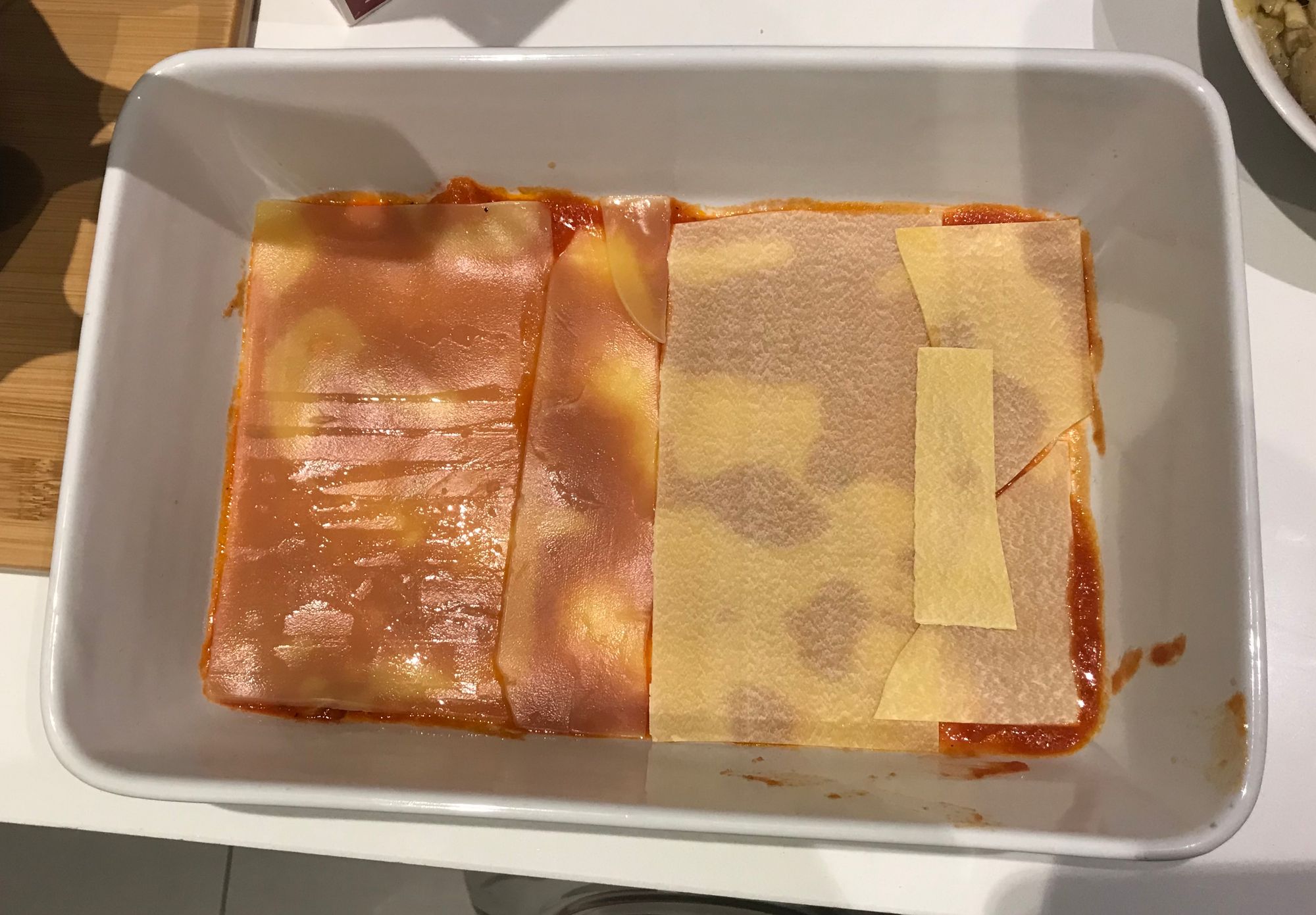
Cooked PKU lasagne on the left, non-PKU pasta on the right.
6\. Next, spread half of the cooked jackfruit carefully on to the pasta followed by a third of the tomato sauce and then a third of the white sauce. It will look something like this:
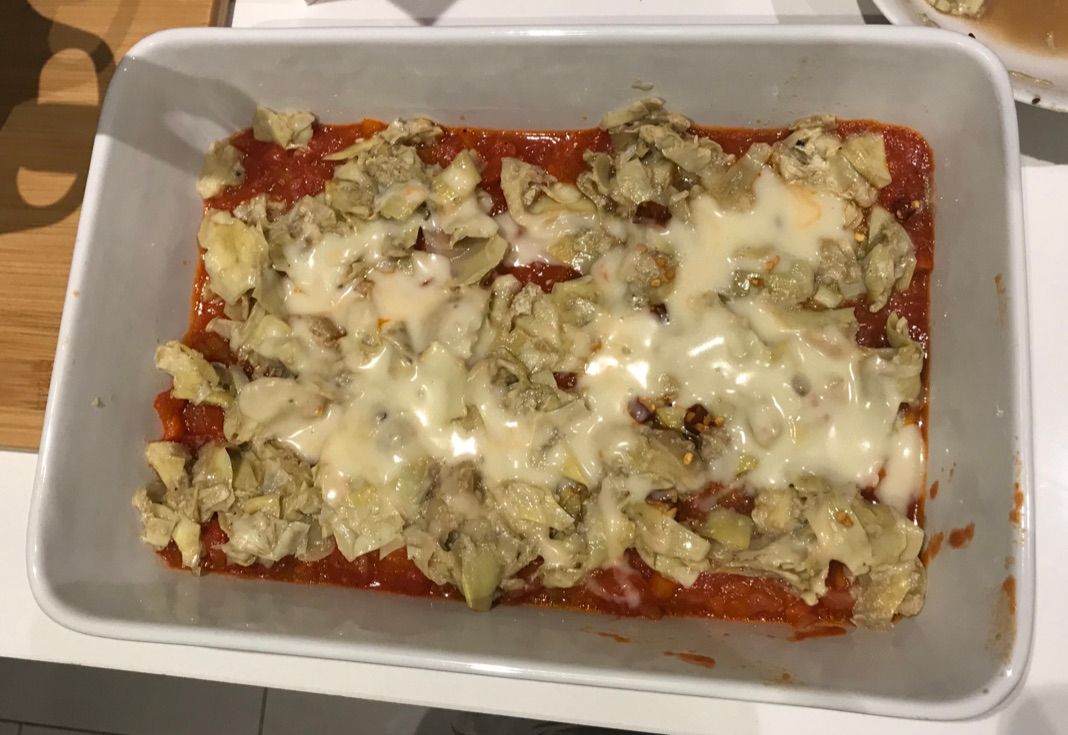
First layer of lasagne complete
7\. Cover with another layer of lasagne sheets, taking care to keep a separation down the middle and the different pastas on their correct side. Spread the rest of the jackfruit onto this lasagne and cover with another third of the tomato and white sauces. Add your final layer of lasagne, followed by the last of the tomato and white sauces. At this point, I mark the PKU side with excess pasta.
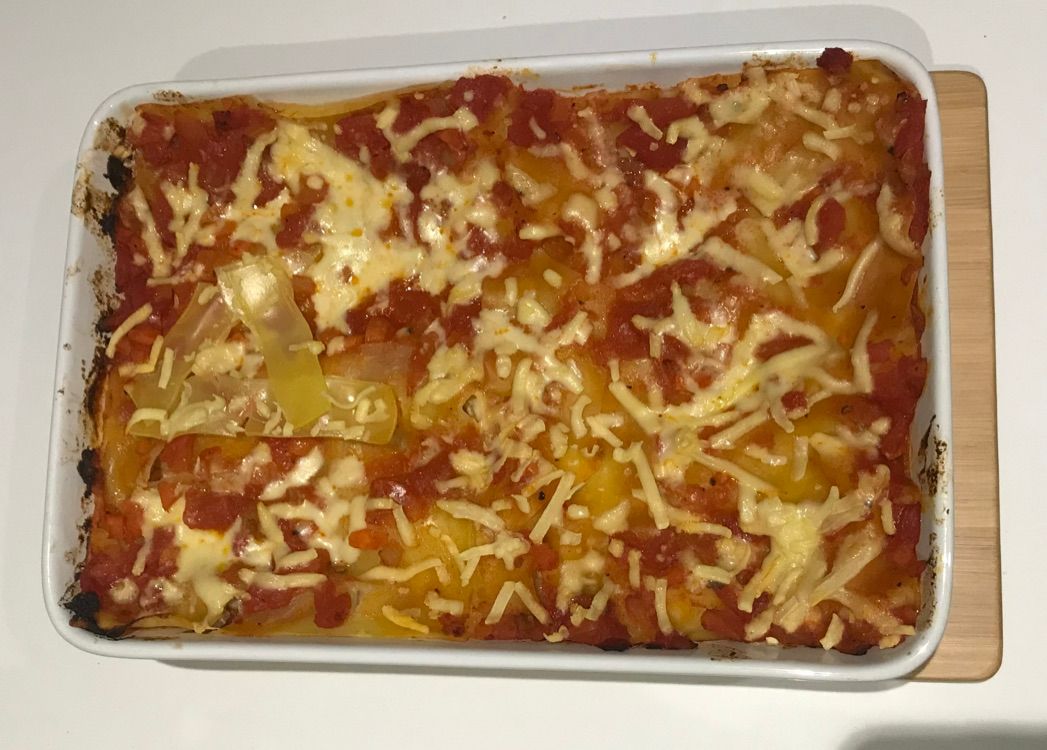
The cooked lasagne with a ‘P’ marking the PKU pasta side
8\. Finally, sprinkle with PKU friendly cheese and bake for 40-45 minutes. Bon appetit! Any leftovers will sit happily in the fridge for a day in a sealed container.
### Want ideas like this direct to your inbox?
## Join the community
Get early updates, recipes and your free gift.
Join us
Email sent! Check your inbox to complete your signup.
No spam. Unsubscribe anytime.
### Dear New Zealand,
URL: https://www.pigpen.page/dear-new-zealand/
Last updated: 2022-03-09T15:06:20.000Z
I write this as Kiwi in the UK who has been living under ever-changing restrictions for nearly a year. I am truly grateful that my family and friends in NZ have been spared this.
Now that NZ is facing more variants and further restrictions, I see some down under are making the same mistakes which happened here. Mistakes like pouring over headlines and social media to find the culprit. Or dealing with uncertainty and fear by assigning blame on 'them', 'the others'.
I want to tell you what we have learned so far:
- It will get worse before it gets better.
- Protect what you have.
- Learn to live with uncertainty.
> We are all afraid, but fear is not an excuse to cast blame, or to label people as ‘them’ or ‘other’.
I have heard it said that people in the UK are ignoring what is going on. ‘Why aren’t you angry about the lives you have lost?’ ‘Why are you ignoring the trauma which your front-line workers face every day?’
Believe me, we see it. We feel the losses.
I’m into double digits of the number of family members who have died, and of friends who have lost family in the last year. That is easily triple a normal year, but none had COVID-19\. None of those loved ones are included in the statistics which grace our newspapers, websites and social media feeds. Yet, many of those deaths were still due to COVID-19\. Across the country, how many were lost due to late diagnosis? Or from an exhausted health service trying to cope? Or because our usual safety nets are stretched beyond breaking point?
We feel all these losses. And yet, we are disconnected from them because we are unable to comfort our friends and family. We simply cannot be with our loved ones when a hug would do so much. All these losses and hidden grief and lack of recourse turn us numb.
We read with horror and despair of the trials which our frontline workers face. Of junior doctors crying in cupboards because the career which they embarked on with so much hope and out of a desire to help is now an unrelenting nightmare. And they have nowhere to go and no-one to turn to. Only a cupboard to cry in before returning to a ward full of yet more death and suffering.
We see this and we stay in. It is all we can do. It is the only tool we have while we wait for the wave to break and for the vaccines to arrive.
Meanwhile, we endure the smaller losses. The missed hugs, the uncelebrated births and birthdays. The lost weddings and Friday night beers. We haven’t seen our friends or family in person for months. For permitted daily exercise we walk down the middle of the road to avoid our neighbours, and they thank us for doing so. We try to ignore niggles in the joints which have weakened with a year away from the gym.
Then we come home, to more loss. Our horror and despair cools to anger. Then we hear another horror, another loss. And we face yet more despair, which turns to anger. Over and over again. Until we turn numb.
My point is not to wail and beat my chest, to cry ‘we have it much worse than you!’ But to point out what you do have. A chance to learn from the mistakes of others.
There is an impression that so many people have died in the UK because the population has been lax about COVID-19\. This has even been fed by the UK Prime Minister who stated that the UK is a ‘freedom-loving country’[1](#fn1) and suggested the infection rate is the fault of a rebellious population which simply can’t live with restrictions on their liberty. (If ‘freedom-loving’ sounds a bit ‘Trumpian’ you are right, but that is a whole other can of worms.)
Before you factor this ‘freedom-loving’ statement into your reasoning for the UK’s huge death toll, bear in mind that this is the same PM who told parents it was safe to send their kids back to school. Only to close them the next day, after the children had mingled for hours. [2](#fn2)
The UK population is not, in general, so rebellious or ‘freedom-loving’ as to ignore a death toll as scandalous as this one. That U-turn, one of many in the past year [3](#fn3), came about because scores of parents and teachers refused to believe the PM. Many schools remained closed, their children staying home, despite his reassurances. Faced with two awful choices, most in the UK preferred a lockdown to a higher death toll.
Yes, there are always those who break the safeguards in place. And there will always be people who believe that the rules don’t apply to them. And there will always be a temptation to say ‘if they are doing it, then why can’t I?’ And there will always be people who seize your uncertainty and fear for their own gain, or to mask their failings.
> But just because someone is being a dick, it doesn’t mean you should be a dick too.
And when someone is assigning blame, and labelling people as ‘them’ or ‘other’, ask what that person gains from division.
Now is the time to hold yourself to a higher standard. And to remember that most people around you are simply trying to do the same.
1. [https://www.theguardian.com/world/2020/sep/22/johnson-refuses-to-rule-out-second-covid-19-lockdown-amid-new-restrictions](https://www.theguardian.com/world/2020/sep/22/johnson-refuses-to-rule-out-second-covid-19-lockdown-amid-new-restrictions?ref=pigpen.page) [↩︎](#ffn1)
2. [https://www.theguardian.com/commentisfree/2021/jan/05/school-boris-johnson-national-lockdown-prime-minister-mistakes](https://www.theguardian.com/commentisfree/2021/jan/05/school-boris-johnson-national-lockdown-prime-minister-mistakes?ref=pigpen.page) [↩︎](#ffn2)
3. [https://www.independent.co.uk/news/uk/politics/boris-johnson-school-meals-prime-minister-u-turns-brexit-a9568956.html](https://www.independent.co.uk/news/uk/politics/boris-johnson-school-meals-prime-minister-u-turns-brexit-a9568956.html?ref=pigpen.page) [↩︎](#ffn3)
### Follow a plan, not a feeling: Finding a way out of low mood
URL: https://www.pigpen.page/follow-a-plan-not-a-feeling-finding-a-way-out-of-low-mood/
Last updated: 2026-08-07T09:20:59.000Z
Participating in brain injury research can improve our daily lives. Not just in the longterm, but here and now. This was my experience after struggling with a low mood.
Brain injury survivors commonly struggle with depression and a sense of loss. It is understandable to feel low during periods of isolation or disruption, but what can we do to keep ourselves going?
## Participation brings a sense of purpose
There is no shortage of advice out there on maintaining good mental health. One tip is to find something which gives you a sense of purpose. That can be difficult when options feel limited, but there are always avenues worth exploring. I came across a study into low mood following ABI: the MAPLES study.
> **M**ood. **A**ctivity. **P**articipation. **L**eisure. **E**ngagement. **S**atisfaction.
The study was run by the MRC Cognition and Brain Sciences Unit at Cambridge University. A key goal in the study was to give participants ‘tools to help increase engagement in activities you find meaningful or enjoyable’. At the same time, the team were looking at the difference between meeting as a group to plan individual activities versus meeting to participate in a group activity.
The study was adapted so that sessions could be held remotely via video link. I was asked to commit to a 90-minute meeting conducted via video link once a week for two months.
Buy me a cuppa ☕ — your support helps keep this blog free, and helps to me write about PKU, brain injury & mental health.
[Buy Pauline a cuppa ](https://donate.stripe.com/14keYi5dp9E26Oc9AA?ref=pigpen.page)
## How activity affects mood
In the first week, Introduction and Mood Monitoring, we learned about the links between activity and mood in the behavioural activation cycle. This demonstrates that social isolation can lead to a low mood, which can reduce energy levels meaning we avoid enjoyable activities, which results in further social isolation.
**The vicious cycle**
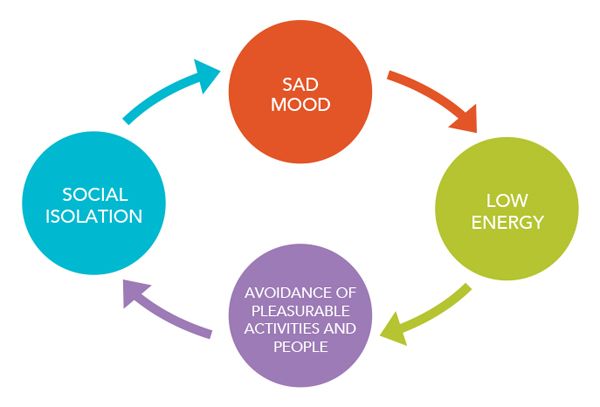
From the website of American Academy of Family Physicians
It is easy to feel trapped in an ongoing cycle of low mood. But the good news is that a break in one part of the cycle can lead to improvements elsewhere in the chain.
This is known as **behavioural activation** and means that planning for or doing an enjoyable activity, such as arranging to call a friend for a chat, can help us to feel less alone. This improvement in mood which gives us more energy which helps us to plan the next enjoyable activity. I’ve noticed this myself after a walk, or workout, I feel lighter and ready to tackle new activities.
> The motivation has come after an activity.
However, even with the promise of a better feeling ahead, it can be difficult to drag yourself into an activity when in a low mood. This is where the research meetings helped me.
## Helping researchers helps you
There were several activity and behavioural tools introduced and practised across the eight-week study. Each tool worked in a slightly different way, and each of the participants in my group had their favourites. The main message for me was:
**‘Follow a plan, not a feeling.’** This mantra works in several ways:
1. **Do something.** Sitting around and waiting for your mood to improve rarely works. You need to do something about it. In difficult cases that may mean talking to a counsellor or your GP.
2. **A plan makes the decision for you.** You have talked yourself into doing something, what should that be? If you have a plan, this decision is already sorted for you. It might be time to call a friend, or go for your walk, or settle into the next episode. If you don’t have a plan, then it is time to make one!
3. **The next step is easier.** Once you have done something, you will usually have a bit more energy to try doing something else. As noted above, the motivation can come after the activity.
> [**This research study has now been published**](https://link.springer.com/article/10.1186/s12916-023-03128-7?ref=pigpen.page)**.**
## Looking forward
My participation in the research project left me with a lifted mood, and with tools to help me look after my mental health. This research study has now been published, and I feel a warm sense of having helped contribute to it.
[You can read the final paper here](https://link.springer.com/article/10.1186/s12916-023-03128-7?ref=pigpen.page).
## Join the community
Get early updates, recipes and your free gift.
Join us
Email sent! Check your inbox to complete your signup.
No spam. Unsubscribe anytime.

### PKU and being ‘Hangry’.
URL: https://www.pigpen.page/pku-and-being-hangry/
Last updated: 2025-04-11T10:10:19.000Z
## Hanger: being irritable or angry because of hunger.
Everyone gets hangry from time to time, but it seems to happen more frequently to me than to my friends or family. As a child, when my siblings and I were delegated to clean the table and kitchen after dinner, I would always eat the remnants of the family sized salad. No matter how much I’d eaten, I could always empty the bowl.
While my stomach was full, I didn’t feel satisfied. The phrase ‘full stomach’ never seemed to mean the same to me as it did to others. Perhaps a stomach full of salad isn’t as satisfying as one full of protein? I’ll probably never know.
## Spotting ‘Hangry’ in the wild
I can usually see when others are hangry, but it can be difficult to spot in myself. At least, difficult to spot before I say something I regret. I dealt with this lack of insight through diligent application of snacks. This became clear a few years ago, when my PKU dietician asked for a food diary. Three days in the office went like this:
- 7am Fruit smoothie & PKU supplement before cycle commute.
- 9.am Bowl of PKU cereal. Yep, an actual second breakfast.
- 11.am PKU crackers with jam or honey for elevenses.
- 1.pm Lunch with PKU supplement.
- 3.pm Prowl office for treats which might go well with a PKU supplement.
- 7pm Dinner with PKU supplement.
- 9pm Honey sandwich.
I’m impressed the dietician didn’t ask if I was part Hobbit. I was snacking at regular two hour intervals until 3 in the afternoon before a longer break until dinner.
It was in the early evening, ironically while making dinner, that I was usually hangry. I’ve heard from a few PKU people at conferences and online discuss the need to eat regularly to maintain good levels of physical and mental energy. But this was a bit much.
> “Hunger and anger, I learned, are one and the same.”
> Rebecca Camu, ‘A Splinter of Glass,’ *The London Magazine, December//January 1992*
## Eat better, not more
The dietician suggested I eat foods which would help me to feel full for longer. She explained that if I could eat larger meals less often, i.e. cut down on snacks, I might find my blood sugar remained stable, and I could avoid becoming ‘hangry’.
We are supposed to have an exchange of normal protein along with our PKU supplement. Since I had 5 exchanges and took 4 supplements, the new plan was to eat only four times a day. Breakfast, lunch, dinner and an afternoon snack to avoid hunger in the evening.
## The tricks which worked for me
- Psyllium husks
The addition of psyllium husks to my baking had the most beneficial effect on my satiety, and my snacking. I have always made my bread and the bread maker recipe with psylliums husks meant I was now full after two slices of toast, rather than four.
- Rolled oats
I added more fruit and an exchange of rolled oats the morning smoothie. 10g of rolled oats is 1 exchange/phe. On mornings when I wasn’t running out the door, I would eat the fruit and oats on PKU cereal rather than blitz into a smoothie as this filled me up for longer.
- Hydration
My dietician pointed out that I tended to eat when I may have been cold or thirsty rather than hungry. The bowl of cereal at work became a big cup of tea to warm me up after chilly morning rides and I had herbal tea rather than honey in the evening.
- Timing
Instead of the elevenses, I moved lunch an hour earlier and ate more. My afternoon supplement stayed at the same time I ate yoghurt and fruit rather than rely on random kitchen treats.
## What didn’t work
There were plenty of times when I wasn’t organised. Days when I had a hangover, or too many meetings to have a proper lunch. My most memorable working lunch was a coffee & chocolate brownie snatched from the closest café. Not great for a low protein diet.
Life gets the way, there were many reasons I didn’t always follow my planned meals. But, time and time again, what really didn’t work was beating myself up over my mistakes. Or hiding from them.
> Be kind to yourself. Sometimes that involves a little honesty.
If I had too much protein, or missed too many meals, I would often become sad or angry. At those times I’d have to suck it up and admit ‘that was not a good meal choice & now you don’t feel well, so do better next time.’
## Remember, eating well may not mean eating often!
I’m always on the look out for meal ideas. If you have a savoury low protein lunch idea, please do share in the comments below or [let me know! ](https://www.pigpen.page/contact/)
### Resolution redux
URL: https://www.pigpen.page/resolution-redux/
Last updated: 2022-03-09T14:57:48.000Z
Whether you have given up on your resolution are doggedly hanging in there, please remember to be kind to yourself and to celebrate the little wins.
## Resolution, what resolution?
My fitness tracker popped up at midday on New Year’s Day to remind me to get in 30 minutes of exercise at some point. I decided then and there:
“half an hour isn’t so hard. I’ll aim for 30 minutes of exercise every day in 2021.”
In an ever-changing world, this was something under my control. I dragged myself off the sofa and out the door. Fast-forward 24 hours, and it was freezing, drizzly and frankly horrid out there. Plus I had a good book and isn’t that what holidays are for? My resolution lasted less than two days.
## Be kind
The key thing is, I didn’t beat myself up. I didn’t label myself a failure who now couldn’t do any exercise until 2022\. In the weeks since, I’ve run, cycled, walked and yoga’d for 30 minutes for at least half of the days. It would be more but apparently a 50-minute walk only counts as 16 minutes of exercise, not that I’m bitter.
> The point is, a few setbacks don’t mean you have failed.
I may not have managed 30 minutes of exercise everyday according to a device on my wrist. But I have still moved more than I managed in December. That is a little win to celebrate.
## Celebrate the little wins
On Wednesday, I managed my second 5 km run this year. Win!
Yesterday, I didn’t leave the house but cleared some nagging tasks off the to-do list. Win!
Today… well, I got a blog post up. Win!
Whatever you decided to change this year, please remember to celebrate the little wins.
If you are PKU-er who resolved to do a little better on the PKU Diet therapy, great! It isn’t easy, good lord it isn’t. But setting that intention is a big win. Celebrate it. Celebrate each recorded exchange and every change to your eating habits and a little present to your future self.
And if you have struggled with the changes, remember that by simply paying attention to what you are eating you are already making a difference. The habits and effects will come.
## PKU and January diets
This is a time of year when so many people are trying out new diets, and we are bombarded with new eating plans and advice, none of which applied to the strict PKU regime.
[I’ve written about this before](https://www.pigpen.page/fad-diets-pku/) so please have a read, be kind and remember:
Celebrate the little wins.
### New Year, New Book
URL: https://www.pigpen.page/new-year-new-book/
Last updated: 2023-12-13T21:40:12.000Z
## Or ‘How not to do a book launch’
Is doom scrolling a waste of time when the rallying cry is to pay attention, to see what our leaders are doing, or not doing, in our name? Against such a backdrop, how can we possibly demand a slice of precious attention, put up our hands and say ‘Look guys, I did a thing’?
I was supposed to write this days ago but have spent hours switching between the events on Capitol Hill and the crisis in the UK hospitals. Those parts of social media feeds and newspapers which aren’t full of ‘unprecedented events’ are filled new book lists. Or perhaps I live in a strange corner of the Twitter-verse. But I do take that as a sign to say:
## Look guys, I did a thing
My [debut book](https://www.routledge.com/Living-with-Mild-Brain-Injury-The-Difficulties-of-Diagnosis-and-Recovery/OConnor/p/book/9780367524081?ref=pigpen.page) came out on the 30th December!
Woo hoo!
Sadly, I wasn’t able to put in a six-week pre-release marketing blitz for reasons such as
- I don’t know how to do a six-week pre-release marketing blitz
- I was too busy buying, selling and moving home in the middle of London Lockdowns to learn how.

Let’s call this a ‘soft launch’, made even softer by delays in the post which mean I am yet to hold a copy myself. It is a weird feeling when others have hold of my creation before I do. Perhaps today a delivery will arrive which will change that?
It is unnerving to send a story out into the world, but I'm grateful to see that is has been well received:
> “Incredibly vivid... this book will be of great benefit to professionals, survivors and their families alike.”
*Dr Neil Parrett, MA(hons), DClinPsy, PgDip, CPsychol. Consultant Clinical Psychologist (Neurorehabilitation)*
> I've got to chapter 11 with [#LivingWithMildBrainInjury](https://twitter.com/hashtag/LivingWithMildBrainInjury?src=hash&ref%5Fsrc=twsrc%5Etfw&ref=pigpen.page) by [@poconnor](https://twitter.com/poconnor?ref%5Fsrc=twsrc%5Etfw&ref=pigpen.page) about her experiences with [#braininjury](https://twitter.com/hashtag/braininjury?src=hash&ref%5Fsrc=twsrc%5Etfw&ref=pigpen.page), and I'm totally gripped with the book. Thoughts so far, thread down below 👇
>
> Book link: [https://t.co/Cn5SHtUV8R](https://t.co/Cn5SHtUV8R?ref=pigpen.page)
>
> — Soheb 💙 (@sohebsoheb) [January 7, 2021](https://twitter.com/sohebsoheb/status/1347305522635091971?ref%5Fsrc=twsrc%5Etfw&ref=pigpen.page)
## Find the Book!
If that sounds like a book you’d like to read, grab it from one of the below. It is available in e-book, paperback and hardback.
\-[Routledge](https://www.routledge.com/Living-with-Mild-Brain-Injury-The-Difficulties-of-Diagnosis-and-Recovery/OConnor/p/book/9780367524081?ref=pigpen.page), buy direct from the publishers. **20% discount! Enter the code BSE20 at checkout, only on Routledge website.**
\-[Hive](https://www.hive.co.uk/Product/Pauline-OConnor/Living-with-Mild-Brain-Injury--The-Difficulties-of-Diagno/25656640?ref=pigpen.page), support your local high street.
\-[Bookshop.org](https://uk.bookshop.org/books/living-with-mild-brain-injury-the-difficulties-of-diagnosis-and-recovery-from-post-concussion-syndrome/9780367524081?ref=pigpen.page), supporting local book shops.
\-[Amazon](https://www.amazon.co.uk/Living-Mild-Brain-Injury-Post-Concussion/dp/0367524082/ref=sr%5F1%5F2?dchild=1&keywords=living+with+mild+brain+injury&qid=1610119852&sr=8-2&ref=pigpen.page)
### Art and Music Therapy in a Pandemic
URL: https://www.pigpen.page/abil-seminar-lead-in/
Last updated: 2022-03-09T14:46:14.000Z
In this new age of Covid-19, [ABIL’s](https://www.abil.co.uk/?ref=pigpen.page) quarterly forums have been launched online. I signed up, eager for the sense of normality which came with them. The seminars, now webinars, also help with my perspective. Sometimes, and especially this year, I find that I have retreated mentally to a place where my thoughts and concerns are always about me. While this is useful from time to time, it is not a good mental state long term. The ABIL and other brain injury webinars have always provided a range of perspectives which illuminate and challenge me. For more background, I’ve written before about [ABIL and their conferences](https://www.pigpen.page/who-are-abil-acquired-brain-injury-forum-for-london/).
In October, ABIL’s seminar tackled the difficult question of ‘How to look after yourself and enjoy life whilst caring.’ For their last seminar in a difficult year, ABIL presented us with ‘Art and Music therapy in a Pandemic’. The use of music in reabilitation or as a tool alongside other therapies had never occurred to me. Elizabeth Nightingale, the Neurological Services lead at [Chiltern Neuro and Medical services](https://www.chilternmusictherapy.co.uk/?ref=pigpen.page) provided an introduction to this fascinating field.
Elizabeth spoke about the use of Musical Mnemonics Training help to lay down memories in people after a TBI. To a layperson, this seemed to turn irritating ear worms into useful reminders for repetitive tasks. One of her clients is an adult left with memory problems after a brain injury whose occupational therapist had referred for help with everyday tasks. Elizabeth worked with the client on a lyrical mnemonic to remember a recipe and to purchase ingredients in the supermarket. It worked, and her client was able to make themselves a hearty macaroni & cheese.
Music therapy proves useful for physical activities and the team at Chiltern Music Therapy also work with clients on their physiotherapy goals. Music encourages engagement and makes repetitive, and often painful, exercises more appealing. Elizabeth used video examples to demonstrate the use of song to encourage a specific movement in time with the beat.
In her example, Elizabeth was using video call software to interact with a client in conjunction with onsite care team. The video also demonstrated that the pandemic has led to therapists and their clients discovering previously hidden digital abilities. Initially, the team at Chiltern Music were worried about clients who might have problem with focussing on a screen. However, as the weeks went on, many clients including older adults were engaging with the remote services.
There were challenges in the switch to online services, including the ever present dodgy connections. Furlough meant that staff and clients needed to adjust to new people as well as new technology. The changes had a more personal toll as the team found that the amount of personal energy needed to run an online therapy session proved to be exceptionally challenging. As Elizabeth memorably put it
> 'I’ve never spent so much time with my own face.'
Elizabeth and her team persisted and found they were able to provide services beyond one-to-one work. Chiltern Music were able to run group sessions, with a structured format of turn taking. Though there were challenges around muting participants in order to prevent feedback.
Alongside live events, the team also provided recorded videos to provide stimulus and therapy in the home. Where there have still been troubles, pre-recorded work to allow more flexibility or for an onsite therapist or loved one to engage with the client in a planned session.
Looking to the future, Elizabeth conjectured that services could be adapted to include digital musical therapy as part of a discharge service. In the more immediate future, and an exciting development, Chiltern Music Therapy will be working with Homerton Hospital. They will be integrating their ideas from 2020 into a six month programme in 2021 working alongside Shaun Caton, the Art Curator and Programme Manager at Homerton Hospital.
As I said, this was a fascinating introduction to an area of brain injury rehabilitation which I hadn’t come across before. The video is available as a [Microsoft Teams Presentation here](http://url9932.events.irwinmitchell.com/ls/click?upn=d8iwMPbvXocCj9B0EwvxQrdgCQYfIHMGSRfw-2BdCdfdk39qck0ohgdaOhRvlq4-2BLcKmglTKx9rB6NuiF9KQO6gOaiBN7qyXuhqFgHkMN3HR5FRCMlD6-2BruRZGGrfeyM0sZrzPjGVQ7AOwFRuwT8j5fQG2AYLFbwMdIrjSKNPwt20DJZWqvrYCZni8qXip3LDFcBJXirOhZWFFPzbctSjXXNDBoNE3jE28lDKG2lpJ1ebWkIj5ROGvoaRHdgxhaiS2Fff2YumlpjTc4hrrX9MAqDWOaN-2FCzM9cwk52FQ8U2e9xWfHdadrh10Zz4O-2FTMDHIOlaO5zwRUL44GJvMj2leECMqXGji3nrBZj92NuT33ZF7S6k3ujEOkA57olCJWsM0HbGo%5Fz7Cgr0iJNcKFhJ7ZeLjBM-2BQeX2jueFNBB0wkX8CS8eH-2FOnpWKm6JlUuZN2q8fHurVwmQzAZTLPzYMy1btqjpjO1XYjJeKbF8CA9o3wbCCVM7L63cfY4R4ENka2-2FI-2Btv9PTYRs8tvIpq7hbLZmVy-2FfPY17rEipcjpclrYEqK7pRfHCDJ-2B0I9lSKR8ca68b-2Bltxal44fvH7oNa4LIDxA5rzT-2Fs6fl6px7Q3xjqjhk90gSGTShC36kE3w-2BhP-2BPk3UM7nuFG2L65XTI4ZYbvBqnX84DBXo2KW6cZ3kHJ0drBKA0mJlbiem5pyTRQoP0SmsIBLgAAOOBRy5eIYggulcCEedQZlupRvoDnhQ2C6-2FXhhtCQ7p8wFO49miHS5bB6MNE-2B&ref=pigpen.page) and is well worth your time - especially for the 2020 Christmas number one ‘Mingle all the way’!
### Rugby concussions and Cricket rigour
URL: https://www.pigpen.page/rugby-concussions-and-cricket-rigour/
Last updated: 2022-03-09T14:35:46.000Z
Rugby is starting up again after the Covid-19 hiatus. The final weekend of the Six Nations is usually a big one for my friends, we book a table in the pub and meet for a marathon of rugby and revels. Of course, with the new lockdown in the UK that didn’t happen. But we welcomed the resumption of matches all the same.
I enjoyed many contact sports until a football match led to a mild brain injury. Now, I no longer play and sometimes struggle over whether I can still enjoy them as a spectator. [A rule change to tackle height in 2018 was intended to reduce the incidence of concussion in the game](https://www.pigpen.page/rugby-rules-football-failures-and-concussions-in-sport/). One of the things that reassured me was that these changes were based on research using the approved scientific method.
## Research trials
It seems there are now questions over the conduct of a trial which looked into the effects of a lower limit to legal rugby tackles. In 2018, World Rugby stopped a trial into a lower tackle line after there was evidence of increased concussion in players. So far, so good. However, in August this year [an article in the NRTimes ](https://www.nrtimes.co.uk/rugby-decision-misleading-researchers-claim/?ref=pigpen.page)reported there may be safety and ethical issues over the running of the trial.
The NRTimes article quotes a series of tweets by [Dr. Adam White](https://adamjohnwhite.co.uk/?ref=pigpen.page), a lecturer and researcher in the field of Sport Education and Health. There were questions over informed consent of the participants and in the framing of the trial at the ethics stage. Sadly, I do not have subscription access to the paper on the trial which is at [BMJ Journals.](https://bjsm.bmj.com/content/early/2020/07/24/bjsports-2019-101557?ref=pigpen.page)
[Dr White’s twitter thread](https://twitter.com/adamjohnwhite/status/1289142598909779968?ref=pigpen.page) does share screenshots from the paper and explains the reasons behind his concerns. Both Dr White and NRTimes note that World Rugby have been contacted for comment, but I haven’t seen a response in the last three months, do let me know if I have missed it.
## Ducking the controversy
I admit it, I’m reluctant to go any further in explaining the trial and queries over it. Partly that is because I would just be covering the same ground as both the article and Twitter feed. But also because I’m reluctant to draw a conclusion without access to the paper. It does give me pause over whether I can still enjoy the Autumn Internationals this year.
I think the best quote to leave the story on is from Dr White:
> “All efforts to make our game safer must be taken. But research, particularly intervention/trials, must be conducted ethically ensuring participants give full, informed consent and can withdraw without prejudice or penalty.”
This was not the only headline regarding the safety of rugby players this autumn. The news that rugby players had risked their health, and the health of others, by [ducking Covid-19 rules before a match](https://www.theguardian.com/sport/2020/oct/23/england-match-with-barbarians-called-off-following-covid-19-breach-rugby-union?ref=pigpen.page) filled many pages, virtual and paper, in October. This was easy to decide on, and I’m sure that many fans were deeply disappointed by the behaviour.
## Speaking of ducks
When you compare that behaviour to the efforts which went into ensuring that two series of international cricket could be played in England this year, then rugby’s attitude to safety is easily questioned.
[Players, officials, commentators, media, ground and hotel staff spent weeks in ‘Covid-19 bubbles’](https://www.independent.co.uk/sport/cricket/england-cricket-test-match-summer-schedule-old-trafford-ageas-bowl-a9539961.html?ref=pigpen.page)to ensure that cricket would be played at a time when fans really needed the distraction and normality. The Pakistan and West Indies cricket teams and officials travelled at a very uncertain time and spent weeks in quarantine to ensure the matches could be played in a safe environment. Despite the challenges, it was a [fantastic summer of cricket](https://www.theguardian.com/sport/2020/aug/26/in-praise-of-a-fantastic-summer-of-test-cricket-despite-all-the-handicaps?ref=pigpen.page) which was [hugely appreciated](https://twitter.com/mrchrisaddison/status/1298308508400721922?ref=pigpen.page).
Another example of cricket’s attitude to player safety can be seen in the reaction to the death of Phillip Hughes, an international cricketer. He died as a result of an incredibly rare incident, a fast ball striking his neck. Helmets fitted with neck guards were common place at all levels of cricket within weeks.
However, [the wearing of a helmet is still not a legal requirement](https://www.icc-cricket.com/about/cricket/rules-and-regulations/helmets?ref=pigpen.page) in cricket matches. That decision is left with the player. This means we must continue to raise awareness of brain injury so that participants in all sports can make an informed decision about their safety.
[Click here find out more about support available](https://www.pigpen.page/support-for-brain-injury-during-the-pandemic/) for brain injury survivors during the pandemic. To see what you can do to raise awareness of brain injury, take a look at [Headway UK’s campaign page](https://www.headway.org.uk/news-and-campaigns/campaigns/?ref=pigpen.page).
### Gyms and PKU
URL: https://www.pigpen.page/gyms-and-pku/
Last updated: 2026-02-26T13:00:43.000Z
They were so good, we made it a hat trick! Welcome to the third of [Soheb's](https://pkutalk.com/@soheb?ref=pigpen.page) blog posts. You can check out his first posts, on moving with PKU, [here.](https://www.pigpen.page/inaugural-guest-post-moving-with-pku/)
Soheb also has PKU and is an active member of the online community. He has combined his IT skills and PKU knowledge in several ways to help himself and others manage their PKU.
These include the [PKU calculator](https://pkucalculator.com/?ref=pigpen.page) to help manage exchanges and supplements through out the day, and the associated [PKUtalk forum](https://pkutalk.com/about?ref=pigpen.page).
In his first [two blogs](https://www.pigpen.page/guest-post-moving-with-pku/), Soheb discussed the challenges of moving out of home with PKU and offers his top tips & encouragement. Here, Soheb talks about gyms, exercise and PKU.
## The truth is…
I mentioned in a previous blog post that I go to the gym. As of now, I pretty much use the cross-trainer, but I used to heavily utilise the dumbbells to do some weight lifting. That might sound really weird given how I have PKU and yet I'm building muscle and losing weight, so that's the perfect topic to talk about.
The idea of being fit/muscular, and being a "gym rat", was so thoroughly unappealing to me that I detested the slightest mention of it from anyone. I used to ask myself: “How could anyone just torture themselves continuously for hours on end every day, just to look a little slimmer?”
I really put off going to the gym as much as possible. Even when I did have a gym membership, I initially went once every month or so because the thought of exercising myself to the point of exhaustion was maddening.
> So here's the truth - exercising yourself to the point of exhaustion ***is*** maddening and you shouldn't do it.
## Getting started
... OK, blog over, time to go home and never attempt to go to the gym, right? Not quite.
Like with everything, going to the gym should be fun and rewarding, not an exercise in torture. Not only that, but improvements don't happen overnight. If you've never been before, it will take a bit of time for you to go on the treadmill/cross-trainer for more than 1 or 2 minutes without collapsing to being able to stay on for half an hour or even an hour if you are really dedicated.
The trick is to treat the gym or exercise time as a great way to spend some quality time to yourself doing things on your own terms. And **do exercises on your own terms**. Take your time to do your exercises. Start off as easy as possible, and then gradually move up levels. It can take days, weeks, months, or even years. Doesn't matter - do the exercises on your own terms.
Whatever you do though, **never compare yourself to others**. They have probably spent years at the gym getting to their fitness level, so don't bog yourself down by comparing yourself to others.
Instead, compare the time you spent exercising with time spent not exercising. The fact that you are doing exercises may be time where you'd otherwise be lounging around the house being unproductive.
## Weight training
Before I start this segment on weight training, I want to clarify that I am not an expert in weight training nor am I a dietitian, so:
**Please seek out advice from experts** before you go ahead and do anything in this segment if you feel even the slightest bit unsure. **Do not put your health at risk over something you've read on the internet.** This segment is here to help you become motivated with the idea of weight training as well as report on what worked for me.
The process of weight training involves lifting weights. The act itself leaves little tears in your muscles which get repaired by protein in your body. The body does its best use the protein to make the muscle even more resilient to tears, so you get a stronger layer of muscle.
*Pauline’s note: This isn’t painful provided you don’t overdo it. The little tears give your muscles a buzz, or warm feeling. You may have already felt this after a workout and wondered what it was. The key, as Soheb says, is to take it slowly and don’t lift the heaviest weights just because you can.*
So, how on earth does someone with PKU gain big muscles? Well, you kind of do and don't. The truth is that your body isn't going to be as muscular as other people's bodies - mine certainly isn't.
Admittedly, I'm not a biology expert, but your body does produce *some* protein - it's the reason why you have to keep clipping your nails and trimming your hair. It's why, y'know, you keep growing and changing and aging etc. It's the body's basic building block. Hopefully, you will feel more encouraged to tackle weight training, but may be disappointed with the results initially.
> Bear in mind my previous point of **never compare yourself to others**.
- First of all, weight training is the one area where you may find people abusing substances to unnaturally increase their muscle mass.
- Secondly, don't worry about others - think about how much progress you've made from before to now. That thought will keep you in a positive, healthier mindset for weight lifting and will avoid you taking silly health risks just for supposedly big weight gains.
If you are struggling, speak to your dietitian for advice for gaining muscle mass. The two easiest fixes that can be done is taking your PKU supplements **after** you've done your workout, and if recommended by your dietitian, taking an extra supplement.
*Pauline;s note: Please do not take a commercial protein drink to build muscle! Even if your gym recommends it. The likelihood is that they have no idea what the extra protein will do to someone with PKU. Please follow Soheb’s advice and speak to your dietician.*
In terms of weight training, I would say take it slow and gradual. Don't jump to the highest weights you think you can lift, as tempting as that is. Instead, start with small weights. I'd recommend somewhere between 8kg and 12kg, and aim for a goal to do 3 sets of 8/10 repetitions.
Once you can easily weight lift at your starting weight, increase the weights by 2kg and repeat. Lots of repetitions with smaller weights will leave your body looking more toned while smaller repetitions with higher weights will help you bulk your mass.
Most importantly, enjoy the process itself. It sounds maddening, but a lot of the fun is doing weight training, being sore the next few days after, and then once you're all healed up you can just feel the difference, making the process worth it. Be sure to give your muscles plenty of days to recover too, otherwise that will just undo all the work you put in!
## More reading
*Final note from Pauline: I used to think that having PKU meant I couldn't build muscle at all. But it just takes a bit of time and care - like anything with PKU! If you are interested, here are some more links to check out:*
- From the PigPen blog: [Fitness, BMI & PKU](https://www.pigpen.page/fitness-bmi-pku/)
“BMI is not a personalised reminder of your chocolate and/or beer binges. It lets you know roughly how you are doing.”
- From a PT with PKU writing for Nutricia: [PKU & Fitness - The Challenge of Weight Loss](https://www.lowproteinconnect.com/Your-World/PKU---Fitness---The-Challenge-of-Weight-Loss/?ref=pigpen.page)
“Last year doing bodyweight High Intensity Interval Training I lost almost 3 dress sizes, 8% body fat and... 1.5kg. People kept commenting how much weight I'd lost, but I hadn't lost weight. I had lost fat and gained muscle, which is awesome!”
[Share your PKU Story and find your Low Protein communityEvery story adds to our shared understanding of PKU. The post can be anonymous, we don’t have to share your name. Join our community and share your story todayPigPen | Pauline O'ConnorPauline](https://www.pigpen.page/share-your-story/)
### Brain Injuries and Lack of Insight
URL: https://www.pigpen.page/brain-injuries-and-lack-of-insight-2/
Last updated: 2026-07-23T12:31:50.000Z
### I thought I was fine. I thought I was coping. I thought I was back to normal.
If you've had a brain injury, there's a good chance you've said some version of those words. And there's an even better chance they weren't quite true.
This is the problem of ***lack of insight***, and it's one of the most frustrating, isolating parts of living with a brain injury. Not just for survivors, but for the people around us who can see what we can't.
## Why this matters for insight
Here's the cruel part: **the things you're worst at after a brain injury are often the things you've done ten thousand times before.** They're the things that feel the easiest, which means they're the things you least expect to fail at.
So when someone asks "Do you need help with that?" your brain thinks: "*I've always known how to do this".* And you believe that. Because the feeling of competence is still there, even when the ability to perform the task might not be.
> That is where **lack of insight affects you**. Not because you're in denial, or being stubborn. Because your brain is telling you a story that isn't true anymore, and you have no way to check that from the inside.
## How that works in daily life
Think about the things you do, or used to do, without thinking: tying your shoes, or pouring a glass of water at home.
When you pour a glass of water, you aren't used to thinking about it. Your hand knows how heavy the jug is, and how far to tilt it so the water comes out gently. The effort to do this feels like nothing, because to your conscious mind, it *is* nothing.
Now imagine that, after a brain injury, you pour the water and miss the glass. Or you forget halfway through, or you can't remember why you walked into the kitchen.
> The task hasn't changed. **Your brain's ability to run it on autopilot has*.*
## My own journey with this
As I wrote at the start: I thought I was fine, and coping, and back to normal. Then I started to notice that my routine was lagging. I would plan all my events into designated time slots. And then... go and do something else.
It was ridiculous and demoralising. I would often admonish myself with *'look at everything you haven't done! You aren’t managing anything, what a failure.'*
This pattern of ignoring tasks continued across digital calendars, printed diaries, and deliberate alerts. I was an equal opportunity ignorer. It was clear that the problem wasn’t how I was recording my tasks.
Nor could I blame memory either as I’d start my day looking at my tasks then...drift off into other things. Even while I was doing something, at the back of my mind would be the little niggle of tasks waiting for me. So the problem wasn’t memory, what was it?
Now we begin to see the effect of a lack of insight. I knew there was a problem, and had even managed to work out what the problem **wasn’t.** How could I find out what the problem was?

Photo by Zach Lucero on Unsplash
## Answers from others
Often, those around us help us to find an answer. I found mine in a presentation by[ Sara Challice](https://www.whocares4carers.com/about-me/?ref=pigpen.page) on attention and concentration after brain injury. She said **“Memory problems may actually be a problem with concentration and attention.”**
> The problem was that my ability to concentrate had been decimated after brain injury.
My attention barely has time to settle on one item when it is pulled away by something elsewhere.
Effectively, I have retrained my brain to have a minimal attention span. Even when I finally focus on one thing, I am usually pulled away within minutes. I can look at a hundred different things but never actually get anything done!
## Reset to a FARCE
I have come up with a little mantra which helps me to:
- **Focus** **on what I can control.** I can’t control what someone else does, or what has already happened. I can control how I react and what I choose to do next.
- **Acknowledge my thoughts and feelings.** Ignoring stress or anxiety is only going to make things worse. Giving myself time to notice how I'm feeling can help to manage my emotions.
- **Connect with my body.** Noticing what I'm doing and slowing down to pay attention has been helping me to train my attention and concentration.
- **Remembering this is a marathon, not a sprint.** In the depth of my recovery I found it hard to avoid the fear that my future was set. But change is a constant. I am not the same person I was a year ago, and will be different again in another year.
- **Every little helps.** This ties into number four, and may not be necessary for everyone. But it makes me smile to remember that 1% better today is still an achievement.
Now when I find myself training my brain the wrong way, I’ll think **FARCE**, have a quick smile and return to my planned tasks. And this post is proof that my concentration and attention spans have improved!
**Takeaways:**
- **F**ocus on what you can control
- **A**cknowledge your thoughts and feelings
- **C**onnect with your body and note what you are doing and engage with that
- **R**emember that this is a marathon not a sprint
- **E**very little helps

## Join the community
Get early updates, recipes and your free gift.
Join us
Email sent! Check your inbox to complete your signup.
No spam. Unsubscribe anytime.
### Moving with PKU: Get moving!
URL: https://www.pigpen.page/guest-post-moving-with-pku/
Last updated: 2026-02-26T12:58:36.000Z
Welcome to the second of [Soheb's](https://pkutalk.com/@soheb?ref=pigpen.page) blog posts. Soheb also has PKU and is an active member of the online community. He has combined his IT skills and PKU knowledge in several ways to help himself and others manage their PKU.
These include the [PKU calculator](https://pkucalculator.com/?ref=pigpen.page) to help manage exchanges and supplements through out the day, and the associated [PKUtalk forum](https://pkutalk.com/about?ref=pigpen.page).
In his [first blog for PigPen.Page](https://www.pigpen.page/inaugural-guest-post-moving-with-pku/), Soheb discussed the benefits and potential pitfalls facing a PKU-er moving out of home for the first time. Here in part two, he looks at practicalities of moving and how to prepare:
## Get your Exchanges (or Phe allowances) sorted
It sounds really obvious, but if you are where I was before I moved out, I really had no clue about exchanges and measuring protein levels etc. If you can, really try to get to grips with counting exchanges and gauging if you are meeting or exceeding your exchanges and your supplements every day. This is important because our body makes phenylalanine by itself if it hasn’t got enough, and it will do so by breaking our bodies down.
At that time, in 2015, I didn’t really have a good idea on my exchanges. Due to the way I was managing my diet (low/free protein on the weekdays, bingeing on high protein on the weekends), the dieticians assumed I was on 20 exchanges. After a bit of a reset and recalculating exchanges, I’ve found out I’m actually on 6-7 exchanges.
If you are unsure about your exchanges and don’t really know where to start, try speaking to your dietitian about your exchanges. They are there to guide you on the right track. Bear in mind that it is in their best interest to see you managing the diet well, so the both of you have a vested interest in getting your diet back on track. If, for some reason, you feel like you can’t speak to your dietitian, try speaking to a charity that specialises in Phenylketonuria. The one in the UK is called the [NSPKU](https://www.nspku.org/dietary-information/?ref=pigpen.page) and they are absolutely wonderful, helpful, and judgement-free.
## How to get your Exchanges sorted
Either way, try your best to get to grips with exchanges and measuring out your food, etc. If you don’t measure out your food, once you’ve worked out your exchanges (if you haven’t already or you aren’t confident that it is correct), start by introducing some food with phe in your diet that you feel like you can easily measure. Cereal is a great starter for this and can really help you get in the routine of measuring your exchanges and slowly taking control of your diet.
> I’m not asking for total control of your diet, all I’m saying is have **some** control on your diet.
And don’t worry if you don’t. I didn’t really have control, at the time and my phenylalanine levels in my blood test when I lived out were some of the lowest phe results I had in my entire life, just due to being extra cautious. It just helps to prepare as much as possible before you move out as it can make your PKU, and your life, a lot easier to manage. One way or another, you’ll get to the point of having things under control.
## What you need in a new home
So, you are looking around for a new place, what should you look for? For me, I would say the following is a must:
- Adequately sized kitchen
- Plenty of storage space for prescription food
- Adequate fridge/freezer space
When I moved out, to save on the cost of rent, I moved into a shared house, so the above was really important to me. I think if you rented out a flat or a house on your own or with family, you wouldn’t have to worry about the above so much as you don’t have to worry about anyone else taking up space.
If you do decide to go with a shared house or flat like I did, be warned that some housemates, new and old, can just gobble fridge, freezer, and storage space. Normally just having a kind word about asking for a bit more space should do the trick. My experience has been as it is a shared house, nobody really wants to start drama, everyone wants to get along, so people will be happy unless it seems you’re making other people’s lives more difficult.
## Think about your options in new places
Something to think about and consider when having any shared space is do you want a bigger room to keep your food & supplements in, or do you want to take advantage of the available shared space? Luckily while I lived in a shared accommodation, nobody dared to drink my supplements (it only happened once, behind my back, and the person deeply regretted it after getting a load of the bitter acidic taste). My food was also safe, especially when I explained PKU to them. In fact, a lot of people were incredibly sympathetic to my plight, even though there was little that could be done by them.
My room was a 6x6 box, lovingly called “my cupboard with a bed”. The single bed fitted from end-to-end, it was that small. The kitchen was somewhat long, but not very wide. Two people would struggle to get past each other. There was lots of fridge/freezer space. But the oven didn’t work. It would short circuit the bottom of the house when someone used the oven and turned on the TV downstairs.
## Option: The GP and Pharmacy
So, you’ve found a great place to move into and are seriously going for this place. Excellent! The first thing to do when you get there is to note down the nearest GP and pharmacy. If you are planning to essentially live there long term, then I suggest you register to your closest GP and try to find the best pharmacy around you that caters to your needs. Things to think about include:
- Home delivery options
- Location and parking
- Customer service, will the staff be easy to contact and communicate with.
My original plan was to stay in my shared flat for no longer than 2 years. Since I wasn’t planning on sticking around for too long, I decided to stick with the GP at my parents’ house. However, I ended up in that flat for three years. Eventually, my the GP near my parents house found that I was living somewhere else and advised me to sign up with the GP near my flat. This was because I was using services further from my home and affecting their ability to support more local patients.
That meant I had to move to a new GP. Which meant asking my dietitian to call them and explain my condition and how I have to go to London to see a specialist because my condition is just that rare and that I was a bit unique. I was allowed to get my new GP to send prescriptions to the pharmacy at my parent’s place. This may seem incredibly long winded and stupid, especially as I’m going to take the food and supplements back to my place, but I was already spending every weekend at my parents and there wasn’t much storage in “my cupboard with a bed”.
It worked well for a while, but when I moved back to my parents changing back to the old GP was a pain. Several months were spent ensuring pharmacies got prescriptions from the correct GP. If I had to do it all over again, I would probably try to register to the new GP as soon as possible, as that was a hassle I’d rather get over and done with as quickly as possible.
## Option: PKU Prescription food has changed
Food choices for people with PKU used to be incredibly scarce but now we have an ever-growing amount of options to choose from, and it doesn’t seem to be slowing down. We have more options on prescription and companies to chose from than ever before so you can be as fussy as you like.
> **Help is readily available, more than ever before.**
And if you have any prescription problems, you can always (as a last resort) go to the manufacturer’s website and order food directly from them. This will cost you money as opposed to getting food on prescription, so be wary of that if you are trying to manage your finances.
Before doing that though, don’t forget to get your dietitian or your local PKU charity ([NSPKU in the UK](https://www.nspku.org/contact-us/?ref=pigpen.page)) involved. There is no reason why you should have to fight the battle alone. A lot of the time if the pharmacist gets extra heat from specialists, you best believe they will take the issue seriously. Just check that you have paid for the prescription or that your prepayment certificate is up to date.
Even dieticians are more accessible which means you can quickly fire off a random question to your local group and get an answer within a matter of minutes, rather than days or even weeks like back in ye olden days of yore.
## Option: Vegan food in supermarkets
One of the things I used to freak out over before I moved out is where I would go and get food. Now I know people would say “the supermarket, duh!” But with PKU that’s an... uh... very restrictive place. Of course, I had to go there to get the basics and whatnot, but it didn’t really have much in terms of low protein food back in 2015\. Back then, veganism was a quirky thing that only a small amount of people would bother with.
Nowadays in 2020, veganism is all the rage and supermarkets are all about options. Seriously, how much variety in cheeses do we have??? (Pauline’s note: There will never be enough cheese!)
There are plenty of places (both physical and online) that sell more variety of “alternative” food like cheeses that are vegan friendly and super useful for us PKU folks!. Even supermarkets have some vegan options which may not be phe-free, but are low enough that you can use as exchanges. Not only that, but in the UK we have online stores such as [Alternative Stores](https://alternativestores.com/collections/low-protein-pku?ref=pigpen.page) that have a section just for PKU people! That honestly blows my mind to even think about!
Hopefully this blog has given you a few things to think about and options to investigate as you look to move. I’ll finish by echoing what I said in my last post. Mistakes will happen, but …
## The greatest teacher, failure is. *Yoda*

Thanks to D A V I D S O N L U N A for sharing their work on Unsplash
[Share your PKU Story and find your Low Protein communityEvery story adds to our shared understanding of PKU. The post can be anonymous, we don’t have to share your name. Join our community and share your story todayPigPen | Pauline O'ConnorPauline](https://www.pigpen.page/share-your-story/)
### Moving with PKU: Get ready
URL: https://www.pigpen.page/inaugural-guest-post-moving-with-pku/
Last updated: 2026-02-27T13:04:48.000Z
Welcome to the first of [Soheb's](https://pkutalk.com/@soheb?ref=pigpen.page) blog posts. Soheb also has PKU and is an active member of the online community. He has combined his IT skills and PKU knowledge in several ways to help himself and others manage their PKU.
These include the [PKU calculator](https://pkucalculator.com/?ref=pigpen.page) to help manage exchanges and supplements through out the day, and the associated [PKUtalk forum](https://pkutalk.com/about?ref=pigpen.page).
In these [two blogs](https://www.pigpen.page/guest-post-moving-with-pku/), Soheb discusses the challenges of moving out of home with PKU and offers his top tips & encouragement:
## Part one: Get ready
Take a deep breath.
Moving out can be pretty intimidating in itself, but when you have PKU, it can feel incredibly intimidating. Especially if, like myself, you have rarely cooked and had often relied on the help of others to help you manage your PKU (by the way, there is no shame in admitting that).
If you are considering moving out into a new place, there are a few things you will need to think about carefully. Hopefully as I go through all of this, you will feel more prepared and more relaxed about the possibility of moving. I want to say, however, if you haven’t done all of these things or even any of these things, don’t worry about it. A part of moving out is finding your own groove and re-finding yourself in the process of it all. Take what I’m about to write as guidelines and an encouragement to help you consider other possibilities in moving out rather than as strict ‘do or do not’ rules.
## Relax and enjoy yourself!
The thing with PKU that I’ve noticed is that nearly everyone who has PKU tends to overthink things to the point of almost being paralysed by decisions at times. I know I’ve been stung hard by this and it was one of the reasons why I really avoided moving out in the first place. Here’s what will happen as you live out.
> You will make mistakes. This is inevitable, but it won’t ruin you and it doesn’t define who you are.
**You will make mistakes. This is inevitable, but it won’t ruin you and it doesn’t define who you are.**
You might go past the crisp aisle and see the bag of Doritos Lightly Salted crisps with the salsa and think “hmm, I haven’t had that in a while, but I’ll be sensible and only have a bit at a time.” So you buy the massive sharing bag of Doritos and dip only to get home, watch a movie or play a video game or something whilst absolutely demolishing the contents of that bag of crisps and dip.
You might go to the cinema and think “hmm, I haven’t had popcorn in a while, I’ll get the small bag.” You pick up the small bag only to get convinced to buy the large bag as it’s like 1p more expensive (thanks, cinemas). Then you go into the theatre only to wolf down the whole bag of popcorn before the film is started and you are dying of thirst from the salty popcorn.
You might find a restaurant that is all about doing hamburgers, but you end up going every other day to this place buying chips and onion rings, completely baffling the waiter and the chefs in the process.
You might even find a local Chinese restaurant and stuff your face with lots of vegetable spring rolls and the greasiest chips known to mankind.
Dear reader, I have done all of these things. Furthermore, I have done these things for days, weeks, and even months to the point where it affected my concentration, my mood, my focus -all of that jazz. None of that matters because...
## You will grow from being independent.
You live, you learn, you laugh. All of these things taught me something down the road that had I not ever moved out, I never would’ve grown as a person. Like how I learned to do blood tests by myself. How I managed to fit in cooking my low protein lunch every day while working in dinner. How I became a gym addict and became stupendously fit in the process from struggling to climb one floor to easily traversing 3 floors of stairs with ease. Moving out helped me to learn all these things. And learning helped me to managed my diet with my lifestyle.
> **Moving out meant I was ready when life had to change.**
My daily life moved on from the cosy normal to travelling to London for 3 days for a learning/networking event, meeting clients, and even going on dates. Even if you don’t take these things as far as other people, there’s always that little taste of experience you’ve had so that you become wiser to the next time you are faced with the situation. Which brings me onto...
## Things will always get better
I know, it almost sounds laughable given the state of the world right now, but it is true. When I was 10, the only supplements available were Maxamaid and Maxamum. I used to have this in a thermal flask which
1) made it horrendously warm and disgusting and
2) made me look like the Hunchback of Notre Dame carrying that around in secondary school.
Eventually I was introduced to PKU Express which came with a tiny little green cup with a lid. That was a game-changer. Now I had this little discrete thing I can easily take and actually live a normal life. It has been such a pivotal moment for me that I sometimes refer to my current supplement, [PKU Sphere](https://www.pigpen.page/new-chocolate-sphere/), as PKU Express out of sheer memory muscle.
Blood tests used to be this awful, agonising thing where I’d prick myself repeatedly with this stupid pen lancet thing. But now I have these individual lancet things which I use once and seems to draw enough blood to convince people I’m turning water into wine.
## Give moving out a trial run
If you don’t feel comfortable living out, give spending a day or two out a shot - the [NSPKU annual conference](https://www.nspku.org/nspku-conference/?ref=pigpen.page) is a great first step towards that kind of independence. If you have a similar conference in your country, I suggest you should take it and meet up with some PKU people! It will be great, and you’ll learn so much from the process!
I hope you get something out of this, but if there is any one thing I can hope you get out of this, it is to:
## **Think less and do more!**
Normally, I wouldn’t offer this advice to anyone, but like I said before, the PKU community (myself included) tends to overthink to the point of paralysis.
It can be tempting to place all these feelings of frustration, conflict, and fears of the unknown at the feet of PKU. And quite honestly, I completely get that. I suspect if I didn’t have PKU, I would probably be a radically different person taking all sorts of crazy risks and whatnot.
That’s not to say I didn’t take any crazy risks. I clearly wasn’t managing my PKU very well beforehand when I jumped head-first into a small box room on my own. At the time, it didn’t feel like such a monumental leap, and in a way, it still doesn’t feel like that. It’s only when I think about the person who I am now that I can trace it down to taking those steps in moving out on my own terms. The key thing to remember is that we can’t let what we eat define who we are and control our future.
Mistakes will happen. You will have high phe. You will have brain fog. You might be a little clumsy and bump into things that are blindingly obvious. You may even have mood swings. But here’s the thing, you will have these things even if you sat at home all day and did nothing.
If you want to move out, go for it. If you don’t want to move out, that’s fine too. But whatever your choice is, **don’t let PKU the reason why you do or do not do something**.
[The second part of Soheb’s blog](https://www.pigpen.page/guest-post-moving-with-pku/) has helpful advice on getting ready to move, whether that means leaving home for the first time or for a family with a PKU-er moving to a new place.
[Share your PKU Story and find your Low Protein communityEvery story adds to our shared understanding of PKU. The post can be anonymous, we don’t have to share your name. Join our community and share your story todayPigPen | Pauline O'ConnorPauline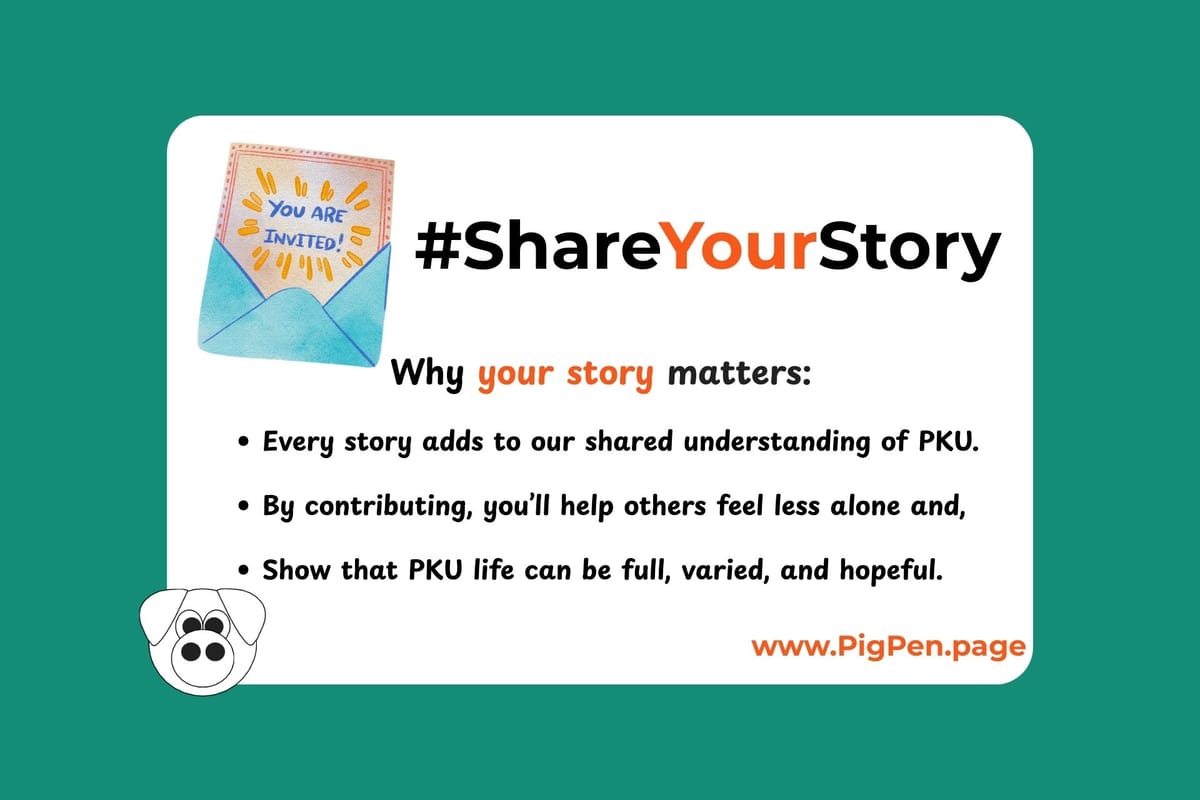](https://www.pigpen.page/share-your-story/)
### Support for Brain Injury during the pandemic
URL: https://www.pigpen.page/support-for-brain-injury-during-the-pandemic/
Last updated: 2022-03-09T14:32:08.000Z
The post last week highlighted some of the challenges facing UK Brain Injury Survivors and those caring for them during this pandemic. There are positive changes out there which offer support in new ways.
## National and local charities providing on-going support
[Headway - the brain injury association](https://www.headway.org.uk/?ref=pigpen.page) is a UK charity which aims to “promote understanding of all aspects of brain injury and provide information, support and services to survivors, their families and carers.”[1](#fn1) The charity have a network of local Headway groups, many of whom have moved their support online.
[Headway East London](http://headwayeastlondon.org/?ref=pigpen.page) is one of the larger members and offered a range of services pre-Covid including a day service for survivors with a fully interactive kitchen and art studio. They have fundraised impressively to continue these services in a safe manner in the last few months and have been delivering supplies to their members homes.[2](#fn2) [Headway North London](http://www.headwaynorthlondon.org/contact-us.html?ref=pigpen.page) and [Headway West London](http://www.headwaywestlondon.org.uk/?ref=pigpen.page) are both significantly smaller with limited finding, but they are continuing their regular meetings online. Headway groups around the country have changed their services to help survivors, find out more about [your local service here.](https://www.headway.org.uk/supporting-you/coronavirus/continued-care-in-your-community/?ref=pigpen.page)
The Stroke Association have worked with NHS England to produce an information page on ‘[Coronavirus for stroke survivors](https://www.stroke.org.uk/finding-support/information-coronavirus-stroke-survivors?ref=pigpen.page#I%E2%80%99m%20a%20stroke%20survivor.%20What%20does%20coronavirus%20%28COVID-19%29%20mean%20for%20me?)’. The page includes details on help available if you can’t leave home and on ‘[Managing loneliness and isolation](https://www.stroke.org.uk/finding-support/managing-loneliness-and-isolation?ref=pigpen.page)’. There are Easy-Read resources available to download. The Association have also launched a [12-week exercise programme](https://mystrokeguide.com/news/12-week-stroke-specific-exercise-video-programme?ref=pigpen.page) to help meet the need for recovery now that many specialised therapies and exercise venues are closed. The videos are arrange into three separate groups to match the differing levels of mobility following a stroke.
## Continuing to raise awareness
The business of raising awareness of Brain Injury is continuing in the shadow of the public health crisis. I have [written elsewhere](https://www.pigpen.page/who-are-abil-acquired-brain-injury-forum-for-london/) about the work done by [Acquired Brain Injury Forum for London (or ABIL)](https://www.abil.co.uk/category/news/?ref=pigpen.page). Over the initial UK Lockdown from March to June, ABIL hosted two webinars on ‘Living with Brain Injury During Covid-19’ and ‘It’s okay to not feel okay – implications and ideas for supporting staff working with people living with brain injury during the Coronovirus pandemic’ [3](#fn3). Though the second was not directly aimed at someone in my circumstances, I found the webinar useful. And I enjoyed a bit of human contact, even if it was just listening online. ABIL are no longer able to run their quarterly forums in central London, but they will be running more webinars, the next one on [Thursday 15th October.](https://www.abil.co.uk/abil-webinar-thursday-15-october-1100-1230-focusing-on-carers-needs/?ref=pigpen.page)
ABIL is the London node on a network of regional groups connected by the [United Kingdom Acquired Brain Injury Forum (or UKABIF)](https://ukabif.org.uk/?ref=pigpen.page). Again UKABIF is a charity which aims to ‘promote better understanding of all aspects of acquired brain injury’ [4](#fn4). One of their main functions is to act as a staging post for information, directing Brain Injury Survivors and their families towards sources of advice and help. They also specialise in events and seminars designed to raise awareness of brain injuries, rehabilitation and research. While many of these events are run by regional groups, they are increasingly available online. Forthcoming events are [available here](https://ukabif.org.uk/events/event%5Flist.asp?ref=pigpen.page).
## Looking on the bright side
The pandemic is far from over, but already there are positives, not least in understanding and treating ABI. The heading for this section mirrors the title of an NRTimes [5](#fn5) article by Boda Gallon [6](#fn6) which discusses this idea and some outcomes more fully:
“Providers and their people need to respond to this opportunity and reposition from fighting fires and coping around how things have always been, to repositioning ahead of the curve and innovating services towards what will be a new normal.”
The full article is worth a read - [https://www.nrtimes.co.uk/looking-on-the-bright-side/](https://www.nrtimes.co.uk/looking-on-the-bright-side/?ref=pigpen.page)
Though we are still less than a year into this pandemic, some of these positive changes are already having an effect at a local level. The Oxfordshire Stroke Rehabilitation Unit has set up a virtual community service to help support patients when other therapies were no longer available due to COVID-19\. The programme has bridged the gap for patients over the last few months and may well continue:
“Being optimistic, I’d like to think this is longer term than the virus, as it’s meeting a patient need. A lot of research shows us that, when patients leave in-patient services they feel ‘abandoned’ and like they ‘drop off a cliff’.” [7](#fn7)
## Soldiering on
[Chris Bryant](https://www.chrisbryant.org.uk/?ref=pigpen.page) is the MP for Rhondda and chair of the All-Party Parliamentary Group (APPG) for Acquired Brain Injury. He has been raising the issue of Brain Injury in Parliament for years and co-hosted the [UKABIF at Parliament](https://www.pigpen.page/ukabif-at-parliament/) event last summer. He spoke recently about the many steps which government still needs to take to help improvements of care after Brain Injury and voiced concern over the “impact the coronavirus has had on research that is needed to help advance the work of the APPG.”[8](#fn8)
I have been involved in brain injury research projects over the last few years and the ABI community on Twitter recently alerted me to another opportunity to engage with new research. The [Cognition and Brain Sciences Unit at the University of Cambridge ](https://www.mrc-cbu.cam.ac.uk/?ref=pigpen.page)are conducting a study into the effects of different sorts of group therapies which may have benefits for people with a brain injury. While the study started before the pandemic, it has been adjusted to run safely online. I saw an opportunity to help further research into brain injury rehabilitation, and to provide me with some much needed social contact over the lonely winter months ahead. If you have, or care for someone with, a brain injury then please consider helping too: [https://www.mrc-cbu.cam.ac.uk/take-part/](https://www.mrc-cbu.cam.ac.uk/take-part/?ref=pigpen.page)
1. Headway UK website. “Aims and objectives.” [https://www.headway.org.uk/about-headway/aims-and-objectives/](https://www.headway.org.uk/about-headway/aims-and-objectives/?ref=pigpen.page) Accessed September 2020\. [↩](#ffn1)
2. Headway East London website. “Headway (B)East mode! Keeping connected through Covid-19”. [http://headwayeastlondon.org/blog/headway-beast-mode-covid-19/](http://headwayeastlondon.org/blog/headway-beast-mode-covid-19/?ref=pigpen.page)Accessed September 2020\. [↩︎](#ffn2)
3. ABIL website “ABIL webinars – on 1st and 8th June”. [https://www.abil.co.uk/abil-webinars-on-1st-and-8th-june-presentations-and-related-information-links/](https://www.abil.co.uk/abil-webinars-on-1st-and-8th-june-presentations-and-related-information-links/?ref=pigpen.page) Accessed September 2020\. [↩︎](#ffn3)
4. UKABIF website home page. [https://ukabif.org.uk/](https://ukabif.org.uk/?ref=pigpen.page) Accessed September 2020\. [↩︎](#ffn4)
5. NRTimes website [https://www.nrtimes.co.uk/](https://www.nrtimes.co.uk/?ref=pigpen.page) [↩︎](#ffn5)
6. Boda Gallon website [https://www.bodagallon.com/](https://www.bodagallon.com/?ref=pigpen.page) Accessed September 2020\. [↩︎](#ffn6)
7. NRTimes website. ‘Stroke unit that sets up its own virtual community service’. [https://www.nrtimes.co.uk/stroke-unit-that-sets-up-its-own-virtual-community-service/](https://www.nrtimes.co.uk/stroke-unit-that-sets-up-its-own-virtual-community-service/?ref=pigpen.page). Accessed September 2020 [↩︎](#ffn7)
8. NRTimes website. “MP reflects on the aims of the APPG for acquired brain injury.“ [https://www.nrtimes.co.uk/mp-reflects-on-the-aims-of-the-appg-for-acquired-brain-injury/](https://www.nrtimes.co.uk/mp-reflects-on-the-aims-of-the-appg-for-acquired-brain-injury/?ref=pigpen.page)Accessed September 2020 [↩︎](#ffn8)
### Coronavirus, rule changes and ABI
URL: https://www.pigpen.page/coronavirus-rule-changes-and-abi/
Last updated: 2022-03-09T14:28:55.000Z
I started writing this article five times because I’m confused by what we now are, or aren’t, supposed to be doing. And I am lucky to have decent memory and ability to recall information despite my brain injury.
On Monday the 21st of September, the Joint Biosecurity Centre (JBC) put the UK Coronavirus Alert Level back up to Level 4 [1](#fn1). This is the first time that the JBC have raised the UK Coronavirus Alert Level and is the highest level they have ever announced. But, the UK isn’t back in Lockdown because that is Level 5 of the Coronavirus Alert Level. The JBC have never ordered a full UK Lockdown because they didn’t exist before May.
## So we are in Level Four again, but not Lockdown. Confused yet?
The next day, Tuesday 22nd September, the PM [told the UK parliament that people should](https://www.theguardian.com/politics/live/2020/sep/22/uk-coronavirus-live-news-covid-19-latest-updates-politics?CMP=share%5Fbtn%5Ftw&page=with:block-5f69e6fa8f08f9ea3f784e52&ref=pigpen.page#block-5f69e6fa8f08f9ea3f784e52):
1. Work from home if possible, but construction firms, schools and retailers will remain open.
2. Follow the [‘Rule of Six’](https://www.bbc.co.uk/news/uk-54139262?ref=pigpen.page) but with exceptions. e.g. up to 30 mourners are allowed at a funeral but only 15 people at a wedding ceremony or reception.
3. Book ahead to go to pubs, bars and restaurants or order a takeaway. But do this before 10pm when all these venues must close.
4. Wear face coverings in indoor public spaces, and in hire vehicles & taxis, except where you are seated to eat & drink.
5. Be assured that Covid-secure guidelines will become law in retail, leisure and tourism and other sectors.
I confess I thought these last two were already law. And I’m not sure why singing a hymn in a church is twice as safe at a funeral as doing so at a wedding. But I’ll carry on reducing my risk and the risk to others as much as I possibly can.
These rule changes make fairly little difference to my life at the moment. Thankfully, I have been discharged from all rehabilitation clinics and do not need care at home. Over the summer I have continued working from home, ordering food online, and exercising in the parks. The big change on previous summers has been not seeing friends and only spending two evenings at a pub.
## How do you follow rules if you don’t remember them?
But, as I said at the top, I still retain a decent memory and ability to recall information following my brain injury. [The NRTimes](https://www.nrtimes.co.uk/the-headway-manager-translating-government-covid-19-advice/?ref=pigpen.page) has reported on how confusing these rules can be for people with a brain injury. The article quotes Glenys Marriott, chair of Headway South Cumbria:
“If I can’t get my head around it, how are people with brain injuries supposed to take it in? Much of the advice doesn’t make sense and it changes by the week.”
“Some brain-injured people are disinhibited; they love a cuddle. They meet people and want a hug – they’re very affectionate. But they can’t do that anymore, we’re having to retrain them all the time to say they’ve got to wear mask if they go out, and they can’t shake hands; it’s so different for them.”[2](#fn2)
I also experienced this, I hugged more or grabbed items from other’s hands without thinking. It was embarrassing and confusing enough without the additional fear of infection.
The fear of standing out in public is already prominent in some people with brain injury. Anxiety levels raise when you follow what you think are the guidelines but notice that others aren’t. I wrote about my experience of that particular anxiety, which I attributed to ‘Fear Of Missing Out’ in a [previous blog](https://www.pigpen.page/2020-halfway-through/).
## Loss of support and professional therapy
The Fear Of Missing Out is magnified by a fear of not getting better. Nearly half of all respondents to The Patients Association survey on health care during the first months of UK lockdown had put off accessing services and support. More than two thirds had had appointments cancelled. [3](#fn3)
To be clear, this is not a dig at health or social care workers who continue to help others in a role which was demanding even before the pandemic. It is an acknowledgement of the fact that the pivot to a Covid response has caused considerable disruption to an already strained service. There have been reports that the NHS will not fully recover for four years. [4](#fn4)
This has effect has rippled across society in ways which are only just being recognised. An important section of The Patients Association report quantified the impact of the UK pivoting to a ‘Covid response’ footing:
- “60% of disabled people had struggled to access food, medicine and other necessities,
- 35% reported increased levels of psychological distress, and almost half described inaccessible information, confusing guidance and a lack of advice.
- Disabled people reported facing cuts to care packages, delays to assessments and difficulty securing PPE for their care workers.” [5](#fn5)
Glenys noted the effect of this on members of Headway South Cumbria and on the Cumbrian Neurological Alliance:
“Some members have had a really difficult time because anyone who had a care package that included social care were likely to have that care package suspended.”
> “People were furloughed by care agencies…all those people with professional approaches to neurological conditions, who would have given good advice on what to do and what we’re missing, had dropped away, and many were moved to Covid teams.”
## The impact of being vulnerable
One of my family members received a letter informing her that she was vulnerable and set out the new rules and regulations for her sudden ‘shielding’ status. Her fear and anxiety levels rocketed and stayed high for weeks. The report by The Patients Association found a similar impact in their survey and noted that:
“Terms such as ‘vulnerable’, assigned without any choice, entrenched existing stigma and prejudice against disabled people, and employers, retailers and government services have failed to provide reasonable adjustments or accessible information, according to respondents.”[6](#fn6)
## What can we do?
I have resolved to being more positive at the end of my blogs, and admit that the above will make for bleak reading given the prospect of a lonely winter for many. But we do need to be the change we want to bring about.
The report from The Patient Association had several positive things to say about local community groups providing aid to family or strangers. I’ve been volunteering from my local mutual aid over the summer and hope to continue doing so. It only takes a couple of hours out of my week to deliver food parcels from the local food back to someone shielding and means they have something to eat. We also give to the foodbank through our online grocery delivery.
### If you have a spare hour in the week, please consider spending it helping [your local mutual aid group ](https://covidmutualaid.org/?ref=pigpen.page)too. Or let me know about other ways to help over on [Twitter](https://twitter.com/poconnor?ref=pigpen.page).
1. BBC website. “Coronavirus: How does the Covid-19 alert level system work?“. [https://www.bbc.co.uk/news/explainers-52634739](https://www.bbc.co.uk/news/explainers-52634739?ref=pigpen.page) Accessed September 2020\. [↩︎](#ffn1)
2. NR Times website. “The Headway manager translating government Covid-19 advice’ by Jessica Brown. [https://www.nrtimes.co.uk/the-headway-manager-translating-government-covid-19-advice/](https://www.nrtimes.co.uk/the-headway-manager-translating-government-covid-19-advice/?ref=pigpen.page). Accessed September 2020\. [↩︎](#ffn2)
3. The Patients Association. ‘Pandemic Patient Experience; September 2020.” Page 3 [https://www.patients-association.org.uk/Handlers/Download.ashx?IDMF=2fdaa424-8248-4743-a4d5-fe1d3f403d20](https://www.patients-association.org.uk/Handlers/Download.ashx?IDMF=2fdaa424-8248-4743-a4d5-fe1d3f403d20&ref=pigpen.page). Accessed September 2020\. [↩︎](#ffn3)
4. Guardian website. “It'll take four years for NHS to recover from Covid-19, health chiefs warn.” [https://www.theguardian.com/society/2020/jun/27/itll-take-four-years-for-nhs-to-recover-from-covid-19-health-chiefs-warn](https://www.theguardian.com/society/2020/jun/27/itll-take-four-years-for-nhs-to-recover-from-covid-19-health-chiefs-warn?ref=pigpen.page). Accessed September 2020\. [↩︎](#ffn4)
5. The Patients Association. ‘Pandemic Patient Experience; September 2020.” Page 9 [https://www.patients-association.org.uk/Handlers/Download.ashx?IDMF=2fdaa424-8248-4743-a4d5-fe1d3f403d20](https://www.patients-association.org.uk/Handlers/Download.ashx?IDMF=2fdaa424-8248-4743-a4d5-fe1d3f403d20&ref=pigpen.page). Accessed September 2020\. [↩︎](#ffn5)
6. The Patients Association. ‘Pandemic Patient Experience; September 2020.” Page 9 [https://www.patients-association.org.uk/Handlers/Download.ashx?IDMF=2fdaa424-8248-4743-a4d5-fe1d3f403d20](https://www.patients-association.org.uk/Handlers/Download.ashx?IDMF=2fdaa424-8248-4743-a4d5-fe1d3f403d20&ref=pigpen.page). Accessed September 2020\. [↩︎](#ffn6)
### A day in the life of PKU
URL: https://www.pigpen.page/a-day-in-the-life-of-pku/
Last updated: 2026-02-26T13:53:40.000Z
I have been with my PKU clinic since emigrating to the UK over a decade ago and have a good relationship with them. I know from speaking to others that I’m fortunate in that. I didn’t know my dieticians followed this blog though - Hullo team! Recent emails from the clinic started a rumination on perspectives of PKU, particularly the view from the other side of the consulting desk.
I know that PKU is one of many Inherited Metabolic Disorders (IMD) and IMD’s are only a small corner of the vast range of diet therapies which dieticians interact with. A dietician’s focus on PKU may be a purely objective one focused on brain damage, amino acid and nutrition inputs. They only see us once every few months so how do you show them the daily perspective? How do you explain living with PKU to someone who approaches it from a medical or academic perspective?
## Diet trials!
Oh yes! How often has someone with PKU wanted to say: “If my diet is so simple then you try it!” In the past few years, several people have stepped up to the challenge and done just that. In 2018, the NSPKU set out a ‘Diet for a Day’ challenge and managed to convince several MPs to try it out. [Liz Twist MP](https://twitter.com/LizTwistMP/status/1012467140513984512?ref=pigpen.page) was already campaigning for PKU in parliament and the experience brought home to her the challenges which people with PKU face every day. You can see the video on her [twitter feed.](https://twitter.com/LizTwistMP/status/1012467140513984512?ref=pigpen.page)
Before that, in 2015, I was glued to the blogs when registered dieticians Louse and Sarah undertook their [‘7 day 7 Exchange Dietitian Challenge’](https://www.dietitianslife.com/special-diets/7-day-7-exchange-pku-challenge-the-preparation/?ref=pigpen.page). Qualified dieticians with years of experience in the NHS between them having to deal with the intricacies of a daily PKU diet?

Yes please! There was a bit of schadenfreude. But I am grateful for their explanation of the difficulties encountered and for the tips uncovered.
## PKU from the inside
Those are both perspectives of PKU from the outside, but how do you explain the challenge of PKU as someone living with it? This was an interesting question and I also realised that I am only one perspective on PKU. I needed to get a wider point of view to do this properly. The PKU Twitter community is a great resource and in this instance their posts showed that planning is key when it comes to the PKU diet. So my challenge became:
> **How do you explain to a medical professional the effort which goes into planning every meal?**
This is a blog post, not a novel, so I decided to set out how much effort goes into breakfast.
## The most important meal of the day
I still remember the day, nearly a quarter of a century ago, when the new PKU list told me I couldn't have cornflakes anymore. New analysis showed that a 30g portion of cornflakes is 2.5 Phe exchange. A small bowl, even with PKU friendly milk, would cost half of my 5 exchanges a day. I simply couldn't do that anymore. The news was devastating.
That may sound like hyperbole but think about how often cornflakes are used as a metaphor for normality. TV shows, movies, and even adverts portray pouring a bowl of cornflakes as the ultimate symbol of an ordinary start to the day. Families round the table eating together before heading off on their separate ways. The stressed cop, trying to get just one moment to himself before the phone rings with the latest horrible murder. Even Uma Thurman in Kill Bill is seduced by the soothing normality of a cereal box and nearly killed by the hidden gun.[1](#fn1)
## A PKU breakfast which works…
But to return to my point, one day a letter turned up telling me that I could no longer partake in that small daily ritual of normality. As a teenager who just wanted to fit in, that was pretty hard to take. This was before bread makers could cope with gluten free flour. My mum and I would diligently spend every Sunday baking for the week ahead. We did our best but, let's just say it wasn't until my first gluten free bread maker that I discovered toast shouldn't be chewy.
In rural NZ in the 90’s, we didn't know that PKU specific cereals existed. That was probably just as well as there was little chance of convincing the government to ship them halfway around the world for the 120 of us Kiwis with PKU. [2](#fn2) For a few years my answer was sweet corn fritters. While my brother & sister groggily dragged themselves out of bed, I was at the stove whipping up a double batch of sweet corn fritters, hot ones for breakfast, cold ones for lunch. We were having a particularly difficult time with bread making and sandwiches were not a lunch box option.
In my early 20’s, I home-stayed with a family in the US while doing work experience and it was there that I found the answer to my breakfast problems - a berry smoothie! Yes they are everywhere now, but back then... Well, now I feel old :-). The recipe has changed a little over the years but I still take some time in the evening to prepare a cup of frozen berries, 10g (1Phe) rolled oats and PKU friendly milk or apple juice. This defrosts overnight and I blitz in a banana in the morning.
## Except when it doesn’t
Some nights I forget to sort out breakfast. I’m too tired, too busy, too hungover - real life gets in the way. On those occasions, the mornings are a bit more difficult. Sure I could just defrost the berries in the microwave, but have you ever tried to drink a warm smoothie? Let’s just say, it’s not great.
At this point a dietician might be thinking, “you have oats, just make porridge!” I’m only allowed 5g of Phe for the whole day and you are supposed to have your Phe with your amino acid supplement. In turn, you are supposed to take your amino acid supplement at even intervals through-out that day. I have four supplements which leaves 1g of Phe for each supplement, and one spare for treats or mistakes. All of that means I have 1Phe available for breakfast. That means I can have 10g of oats. Even with sliced banana and raisins on top that is not enough for breakfast. And no, I’m not allowed cream.
So, if I forget to do the smoothie prep eight hours in advance then it's usually toast for breakfast. Assuming I've remembered to make it. I’ve had a bread maker since university, and think I am still the only student in my halls who had a formal dispensation for a bread maker in their dorm room.
Fast forward to now and my current model is a 10yr old Panasonic with a gluten free cycle. Another lifetime highlight, eating my first slice of bread baked on a gluten free cycle.
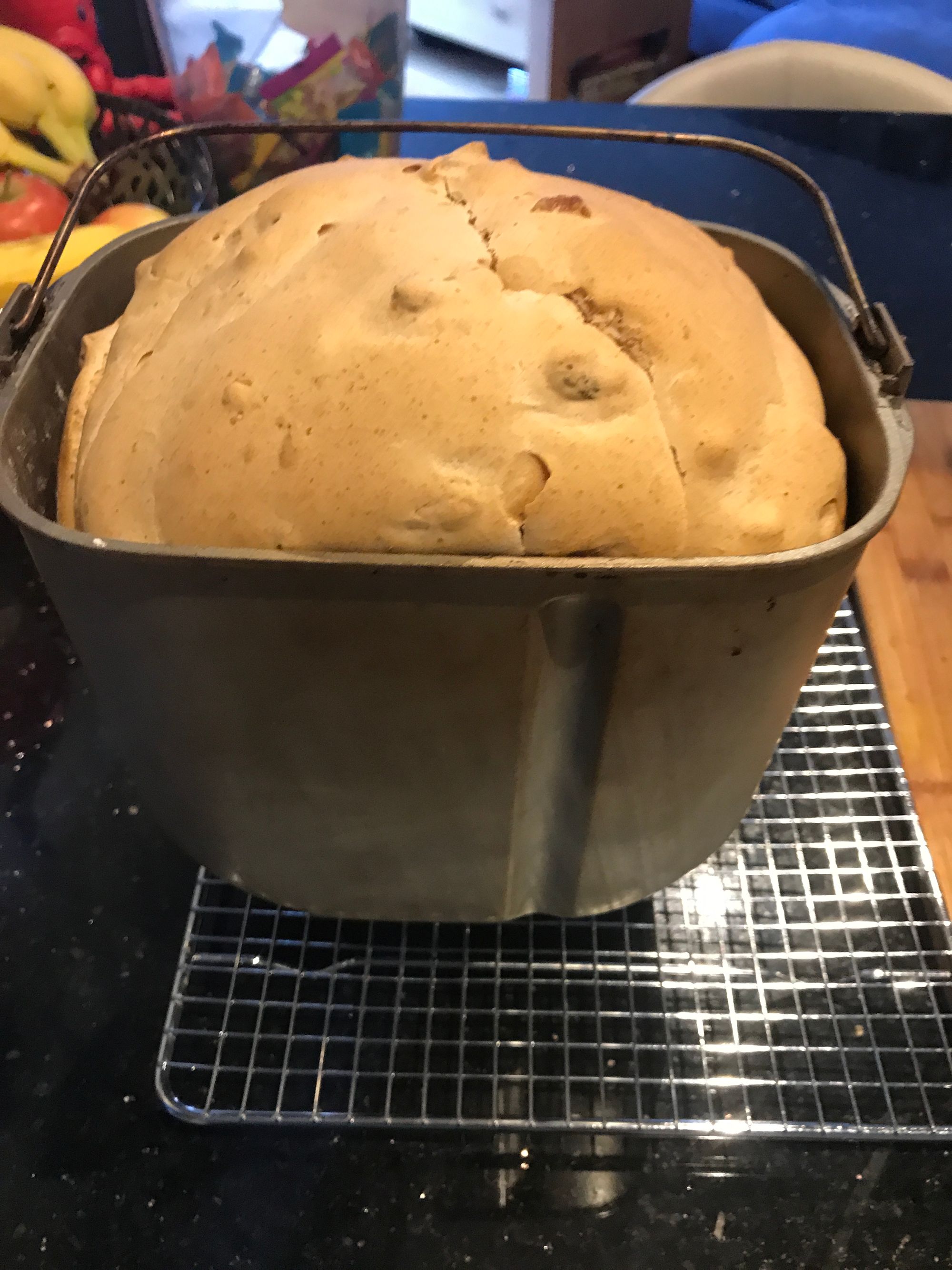
Sheer awesomeness. The fast gluten free cycle takes 3 hours to prep, bake and cool before you can eat. A long time to wait for breakfast if you have run out. The early morning shuffle in pjs to the local store to grab a new loaf or pint of milk is not an option for someone on the stricter PKU diets.
## Back to cereal
What about PKU cereal! As someone who grew up without it, I still find pouring a bowl of completely Phe-free breakfast cereal is a novelty. There are several PKU cereal options available on prescription now. And the fact that there are now protein-free plant milks to go with them is just amazing.
Only, the flakes & loops that I’ve tried are hard straight out of box. I mean hazardous to your fillings hard. I've found they all need to soak for about 30 minutes in order to soften up a bit. If you skip this step or can't wait that long, some bits have been tough enough to cut the inside of my cheeks. Still not an instant breakfast.
There is one brand of coconut yoghurt in the UK which works out at 160g for 1Phe. Yay, cereal and yoghurt for breakfast! Except when that yoghurt isn’t available. There are so many coconut yoghurts now that supermarkets don’t feel the need to carry all the lines. Early in the UK lockdown, I couldn’t get my hands on that particular yoghurt for love nor money.
So even now, the blissful normality of just sitting down and having breakfast is still not an option for most people with PKU. But we cope, we get there. We record our exchanges and gulp down our amino acid supplements in any way we possibly can. Then we don't have to think about food again till lunch time.
### PKU breakfast ideas from Louise and Sarah
As if by magic, Louise posted some new ideas for a PKU breakfast while I was writing this post - check it out. [https://www.dietitianslife.com/special-diets/pku/low-protein-breakfast-ideas/](https://www.dietitianslife.com/special-diets/pku/low-protein-breakfast-ideas/?ref=pigpen.page)
1. Does anyone else wish a dietician would weigh in on the nutritional effects of concealing weapons in the larder? [↩︎](#ffn1)
2. I like to ensure all facts used on PigPen.page are backed up with proven studies and linked sites for people to explore. But in this case, the figure of 120 people in NZ with PKU comes from a PKU camp in North Canterbury in 1999\. I did not keep the paperwork, my apologies. [↩︎](#ffn2)
[Share your PKU Story and find your Low Protein communityEvery story adds to our shared understanding of PKU. The post can be anonymous, we don’t have to share your name. Join our community and share your story todayPigPen | Pauline O'ConnorPauline](https://www.pigpen.page/share-your-story/)
### NaNoWriMo and daily habits
URL: https://www.pigpen.page/nanowrimo-and-daily-habits/
Last updated: 2026-04-09T11:34:36.000Z
One of the reasons I started this blog was to give my writing a bit of oxygen. But it also gave me something to write for, a blank page which would need to be filled regularly. The hope was that it would force me to create that writing holy grail:
## A Daily Writing Habit
Almost any piece of advice on being a writer will emphasise the need to develop a daily writing habit. This is an allocated time of day when you sit down and write for a set word count or a certain length of time. Famous authors credit a large part of their success to this habit.
> “Habit has written far more books than inspiration has. If you want the Muse to visit you, she needs to know where you are: so stay at your desk.” Phillip Pullman [1](#fn1)
In his memoir [‘On Writing’,](https://www.hive.co.uk/Product/Stephen-King/On-Writing--A-Memoir-of-the-Craft-Twentieth-Anniversary-E/10734898?ref=pigpen.page) Stephen King notes that he writes 2,000 words every day. Sometimes that word count is reached easily, other days it is a toil that stretches on hour after hour. Frankly it is nice to know that even he has a problem doing that too. But the point is to write every day. Get into the habit!
## [NaNoWriMo](https://nanowrimo.org/?ref=pigpen.page)
It was with this aim mind that I took up a friend’s challenge to do NaNoWriMo last year. [2](#fn2) National Novel Writing Month (NaNoWriMo) is:
> “a daunting but straightforward challenge: to write 50,000 words of a novel during the thirty days of November.” [3](#fn3)
It really is that simple, you have 30 days to write 50K worth of words on a new novel. That is 1,600 words per day for a month. It sounded manageable when broken down like that. In the last week of October I signed up and filled a large sheet of paper with a plot structure. I felt ready.
## NaNoWri… No
On Day One I sat down and started writing. For the first five days of the challenge I managed to hit the target. Then I had a day off. It wasn’t intentional, just a long day with errands and demands on my time getting in the way. I put in a couple of longer sessions over the next few days and got back up to target. But it was tough. I was doing very little beyond sitting at the desk struggling against the word count.
Even when I told myself to get up and walk away from the computer, I was still thinking about the writing I hadn’t done. Not any helpful stuff, like plot points or how to develop the character. No, I was simply castigating myself for not writing. After the obligatory walk, I’d make a cup of tea, sit back at the desk and…. Yeah, nothing.
## Write-In sessions
My friend, who has half a dozen or so ’NaNoWriMo’s’ under her belt, came to the rescue. I spent a few Saturdays at her place (this was pre-pandemic) for ‘write-in’ sessions. We wrote in bursts of 25 minutes, the limit of my attention span post-brain injury. In the breaks, we would discuss our current works, any sticking points and could bounce ideas off each other.
I was familiar with writing to a timer, but doing it with another person in the room made it more fun. The chance to talk and stretch the mental muscles after writing sprint was an effective, way to get the word count up. I didn’t complete the challenge, but don’t feel failed either. I wrote 35k words in 30 days, 70% of the target. Crucially, that was more than I had written for some time.
## Next steps
In the past few months, especially during lockdown, my friend and I have repeated the experience. Every fortnight or so, we’d book time together for an online chat. Then the timers were set and we’d write feverishly before the timer went off and we would report in with each other for updates.
There are several companies who provide similar retreats. [4](#fn4) These write-ins used to be IRL. Where a group of writers would meet at a set location and write on separate projects, all fuelled by writerly snacks provided. These retreats have continued in an online format and I’m considering doing one.
For now though, I’m taking part in [Writers’ HQ’s ****free**](https://writershq.co.uk/free-writing-courses/?ref=pigpen.page) ’14 days to a daily writing habit’ course. This has proven to be a mixture of videos, exercises and prescribed writing sessions delivered in one neat little email every morning. You also get access to, and are encouraged to use, the Writers’ HQ online forums. We are only five days in, but again I have managed more writing in that time than has happened for many a week. I have also been surprised, comforted and inspired by the writing community on the forums.
I signed up to the course with one eye on NaNoWriMo again. If I can get into a daily habit over September and October then I’ll be in a great position for the November sprint. Meanwhile, I think it might be time to call my friend to set up another virtual writing retreat.
### Have you found success with a writing retreat? Or is there another technique you would recommend? Please let me know over on [Twitter](https://twitter.com/poconnor?ref=pigpen.page)
1. [https://twitter.com/PhilipPullman/status/1087269789930790912?ref\_src=twsrc%5Etfw%7Ctwcamp%5Etweetembed%7Ctwterm%5E1087269789930790912&ref\_url=https%3A%2F%2Fmashable.com%2Farticle%2Fphilip-pullman-writing-advice-twitter%2F](https://twitter.com/PhilipPullman/status/1087269789930790912?ref%5Fsrc=twsrc%5Etfw%7Ctwcamp%5Etweetembed%7Ctwterm%5E1087269789930790912&ref%5Furl=https%3A%2F%2Fmashable.com%2Farticle%2Fphilip-pullman-writing-advice-twitter%2F&ref=pigpen.page) [↩︎](#ffn1)
2. When writing a blog on procrastination, it is good form to show just how long you have been procrastinating before posting. [↩︎](#ffn2)
3. [https://nanowrimo.org/what-is-nanowrimo](https://nanowrimo.org/what-is-nanowrimo?ref=pigpen.page) [↩︎](#ffn3)
4. [https://londonwriterssalon.com/ ](https://londonwriterssalon.com/?ref=pigpen.page)& [https://writershq.co.uk/](https://writershq.co.uk/?ref=pigpen.page) **language warning* [↩︎](#ffn4)
### 2020 - halfway through.
URL: https://www.pigpen.page/2020-halfway-through/
Last updated: 2022-03-09T14:26:47.000Z
Yes, I know it is September. But in my defence I refer to court to [2020](https://en.wikipedia.org/wiki/2020?ref=pigpen.page). The events of this year have distorted our usual sense of time. 2020 has changed our world entirely, but has also been a sodding grind.
## On the 23rd of March the UK went into lockdown…
…and I posted a [blog](https://www.pigpen.page/pku-in-a-time-of-covid/). I realise one of these events had a greater effect on most people’s lives than the other. When the PM asked the nation to stay at home, the husband and I had already been self isolating for 10 days. As a result, the blog progressed from gasping at the sight of an empty London to hints and tips to help one through a few of weeks of social distancing.
Ah, how naive I was! But it was a different time. Anxiety at what lay before us mixed with the determination to make the best of it. My initial post set out the ‘Four rules’ I’d come up with to maintain a healthy mental state.
1. Get outside once a day
2. Get exercise once a day
3. Video call someone once a day
4. Cut yourself some slack!
There have been many more rules made, flouted, discarded and denied in the weeks since.
## Twenty three weeks later…
… and none of my rules made it through intact. The plan to call someone once a day went first. Frankly, it was a relief to scrub that one off the list. I’ve gone back to the usual pre-Covid group chats and messages. Now that I don’t see folks in person there are some people I text more often and others who have gone to the bottom of the list. That’s ok, we all have those re-prioritised chat feeds now.
One thing which I hope will continue is the weekly online gaming session. A few hours of online company is something which I know has got me through those weeks when I don’t really speak to anyone other than the husband.
As for rules one and two, getting outside proved difficult when the parks were full, hay fever covered everything in an orange dust and the roads melted in the heat. I tried online exercise courses but a one bedroom flat doesn’t provide much room for an excitable video when the other occupant is in a company wide meeting.
All of this meant there were several times when the final rule, of cutting myself some slack, was missed because I was too distraught at failing in all my other rules.
## Five things I managed to do
Our usual pace of life has gone which means I often brood on how little I managed to do this year. To help drag myself out of these moods, I drew up a list of five things I’ve achieved. It provides solid evidence and reassurance that I have progressed, despite the chaos.
1. Signed a publishing contract and wrote the book (whoop!).
2. Participated in health research studies for the NHS and private companies.
3. Volunteered in my community with our Mutual Aid group.
4. [Invented the PKU friendly Dark Chocolate & Ginger Hot Cross Bun loaf for the bread maker.](https://www.pigpen.page/dark-chocolate-ginger-hot-cross-bun-loaf/)
5. Knocked 5 minutes off my 5km run time.


## What were the good memories of lockdown?
Most Londoners would say something about meandering deserted streets, waking to bird song or enjoying the clear air. The photo above is the view south from Parliament Hill in July. IRL, you could see the North Downs 20 miles away.
Afraid I’m fairly typical. My favourite memories are of running on quiet roads in bright sunshine while children took over the pavements with hopscotch games. At home, running and gardening tips were swapped with the neighbours as we all had fewer people to speak to.
As soon as we were allowed to, a friend and I would meet regularly for long evening walks. Less frequent were our HIIT sessions, where would shout at each other through a minute of pushups to the bemusement of other park users. As the weather warmed, we turned to swimming sessions as exercise and catch-ups in the heat.
I avoided the supermarket for months as our household were lucky to get regular delivery bookings. Though the husband would say that waking in the night to book deliveries while the website was quiet is an odd definition of ‘luck’. The variability of food available meant that we branched out into a few different recipes. [PKU “Fish and Chips”](https://www.vitafriendspku.com/en/recipes/fish-and-chips/?ref=pigpen.page) were a staple in the cooler spring evenings which then gave way to vegetable sushi in the summer. (NB even vegetable sushi is fairly high in protein so has been restricted to a treat now and then).
## The bad: Social media and FOMO1
There were hours spent scrolling through news feeds in an attempt to understand the multitude of daily events. I countered these by rushing to the other extreme of social media and news detoxes. Entire weekends were spent in achieving a momentary reduction in my reading list.
The weeks in early May, when lockdown was lifted but we were all told to stay at home anyway, were the worst. I was caught in a loop of FOMO at it’s most aggressive. “I should be out there, but it isn’t safe. But I’m missing out, but I don’t want to see anyone incase one of us is infected…”
On those days I would watch more TV than I thought possible. As a side effect, I have finally caught up on the Marvel and Star Wars movie franchises. When I felt I’d wallowed enough, a run, cycle, or just a walk around the block would usually reduce that FOMO back to a manageable level.
## And the regrets.
I wish I had made more of an effort to manage my daily structure . While I did finish my writing project before the publishers deadline, it would have been completed earlier if I’d spent fewer mornings in the dressing gown scrolling news feeds. Nor did I settle into a routine for my exercise, partly due to commitments outside my control.
In hindsight, I think I was waiting for a routine to materialise so I could slot in exercise and work times. This may have been easier with a regular nine-to-five job. But I’d bet I’m not the only one who didn’t do much because there wasn’t a routine to fit those events into.
Those uncompleted tasks or missed events would play on my mind and my mood would spiral downwards. I’d often write the day off and sink onto the sofa pledging to do better tomorrow, only to repeat the cycle. Having a structure wouldn’t have avoided those anxious days entirely - this is a pandemic after all. But I think I would have had fewer depressed moments.
## Seize the day
Just as the pandemic isn’t over, nor is the chance at doing things a bit differently. That goes for society as well as ourselves. But since we aren’t all stateswomen at the top of our game, we need to be the change we want to see in the world. And often that means starting small.
This week I’ve planned in my exercise and have been shocked to discover it doesn’t actually take as long as I thought. This means I’ve started a few other chores which I finished sooner than anticipated. Can I keep it up? There will be difficult days, when the headaches or the cold rain mean getting out the door is just too damned hard. But I will still have the next day to work on an addition to my little list of ‘Five Things’.
I’d be interested to hear what got you through, please let me know on [Twitter.](https://twitter.com/poconnor?ref=pigpen.page)
1. Fear Of Missing Out [↩︎](#ffn1)
### Dark Chocolate & Ginger Hot Cross Bun loaf
URL: https://www.pigpen.page/dark-chocolate-ginger-hot-cross-bun-loaf/
Last updated: 2022-03-09T14:14:32.000Z
Back at Easter, I wanted Hot Cross Buns. But I didn’t have enough Phe exchanges to have a ‘normal’ bun. There was an excellent recipe for Fate Hot Cross Buns circling on Twitter. But I didn’t want to bake. I just wanted a PKU friendly Hot Cross Bun, toasted, buttered and in my hand right now!
Of course that didn’t happen. Plus I have a bit of a reputation for setting fire to buns when they are in the toaster.
That last bit got me thinking. What I really wanted was a Hot Cross Bun loaf which I could slice and toast like normal bread. And I have a bread maker…
## Behold! My Lockdown 2020 Invention.
### Method
1. Mix the psyllium husks, sugar and yeast into the bread pan. Add the water and sno-pro then leave to sit for 10mins.
2. While that is thickening, mix the next five ingredients together in a separate bowl.
3. Once the 10 minutes are up, add the oil to the bread pan then add the dried ingredients. Set gluten free cycle and crust to ‘dark’, then start.
### Ingredients
9g psyllium husks
40g brown sugar
1 packet (8g) PKU yeast
100ml Sno-Pro
390ml warm water
1 1/2 tsp mixed spice
100g dark chocolate chips. (Or keep it Phe free by
substituting more dried fruit.)
150g dried fruit (I have used a mix of crystallised ginger, raisins and glazed cherries. Would advise against using mixed peel as I found it quite chewy.)
500g PKU flour
pinch salt
3tbsp oil
### Change, ambiguous loss, and spoons
URL: https://www.pigpen.page/change-ambiguous-loss-and-spoons/
Last updated: 2026-03-13T13:03:29.000Z
### Navigating Life's Challenges
Change is a constant in life. Whether it’s a global event, a personal health journey, or an unexpected disruption, we are often forced to adapt to new realities, sometimes at a moment’s notice. For many, this process is exhausting, especially when the change is unwelcome or feels beyond our control.
After my brain injury, I struggled to accept that my life had changed. I resisted it, fighting to return to the way things were. It was draining. If this sounds familiar, you’re not alone. Many of us face moments where life shifts abruptly, leaving us feeling overwhelmed and depleted.
### Spoon theory: Understanding Energy and Willpower
Years ago, I discovered [spoon theory](https://en.wikipedia.org/wiki/Spoon%5Ftheory?ref=pigpen.page), a metaphor used to explain the limited energy people with disabilities, chronic illnesses, or brain injuries have each day. Imagine your energy as a set number of spoons. Every task: getting out of bed, attending a meeting, or even making a decision; uses up a spoon. Once your spoons are gone, they’re gone.
This theory isn’t just for those with health challenges. Psychologist Roy Baumeister describes willpower as a finite resource, something we all must manage wisely. When life throws constant changes at us, we spend our spoons just trying to keep up. For those managing chronic conditions like [PKU](https://www.pigpen.page/what-is-pku/) or recovering from a [brain injury](https://www.pigpen.page/pollys-brain-injury/), the daily cost of spoons is even higher.
### **Ambiguous Loss: The Weight of What’s Missing**
Change often brings loss, not just the loss of a person, but the loss of normalcy, routine, or the life we envisioned. This is called [ambiguous loss](https://en.wikipedia.org/wiki/Ambiguous%5Floss?ref=pigpen.page), a feeling of grief for something intangible yet deeply felt. It might be the loss of small freedoms, like gathering with friends without worry, or the cumulative weight of tiny disappointments.
These losses add up. A single straw doesn’t break the camel’s back, but a pile of them can. Recognising ambiguous loss helps us validate our feelings and understand why we might feel drained, even when it seems like “nothing much” has happened.
### **Embracing the New Normal—Whatever It May Be**
Adapting to change doesn’t mean giving up on the past. It means finding ways to move forward while acknowledging the challenges. Here’s how you can start:
1. **Acknowledge Your Spoons:** Track your energy levels and prioritize tasks that truly matter.
2. **Name the Loss:** Give yourself permission to grieve what’s changed, even if it’s not tangible.
3. **Create Small Wins:** Celebrate tiny victories—they add up to big progress over time.
4. **Ask for Help:** You don’t have to navigate this alone. Reach out to friends, family, or support groups.
### **Your Story Matters**
Change is universal, but how we experience it is deeply personal. If spoon theory or ambiguous loss resonates with you, I’d love to hear your story.
How do you manage your spoons? What losses have you navigated? Share in the comments or [get in touch](https://www.pigpen.page/contact/).
[Share your PKU Story and find your Low Protein communityEvery story adds to our shared understanding of PKU. The post can be anonymous, we don’t have to share your name. Join our community and share your story todayPigPen | Pauline O'ConnorPauline](https://www.pigpen.page/share-your-story/)
## Join the community
Get early updates, recipes and your free gift.
Join us
Email sent! Check your inbox to complete your signup.
No spam. Unsubscribe anytime.
### Now it’s summer
URL: https://www.pigpen.page/now-its-summer/
Last updated: 2022-03-09T14:16:17.000Z
I saw a friend on Tuesday.
I hadn’t seen her since January.
We judged the breeze.
Where to sit so one doesn’t breathe on the other?
“How about this spot?”
“Too close to that group. This one?”
“Is it far enough from the path?”
Finally, we sank to the grass.
The scent of hand sanitiser wafted in the air.
Our conversation mirrored months of video calls.
“Not much, You?”
“Every day is the same, but now it’s summer.”
We didn’t look at each other,
eyes scanned the park instead.
Others were monitored for their proximity.
Were they too close to each other, to us?
All these people out, being too close.
Were they in a bubble together?
Do they think it is all over?
Do they believe they are somehow immune?
Or were they having the same longed for contact marred by anxiety?
After an hour or so, we parted.
Without the usual hugs.
“We could try this again, as long as the rules don’t change.”
“I mean, even the government breaks their own rules.”
“I guess now, it’s about how safe we feel.”
“Yeah, and that changes daily.”
I saw a friend on Tuesday
I hope to see her before January.
### PKU in a time of Covid
URL: https://www.pigpen.page/pku-in-a-time-of-covid/
Last updated: 2022-03-09T14:12:37.000Z
This is a worrying time so I will start by highlighting the NSPKU Video on Coronavirus and the statement on their website. These both contain important advice for anyone with PKU or for those who care for someone with PKU. If you haven’t seen them, please take a look:
## NSPKU video on Coronavirus / Covid-19
[https://twitter.com/NSPKU/status/1241050317074161664](https://twitter.com/NSPKU/status/1241050317074161664?ref=pigpen.page)
## NSPKU statement on Coronavirus / Covid-19
[](http://www.nspku.org/news/story/coronavirus-covid-19-0?ref=pigpen.page)[http://www.nspku.org/news/story/coronavirus-covid-19-](https://www.nspku.org/nspku-guidance-re-coronavirus-covid-19/?ref=pigpen.page)
Now more than ever people with PKU will be needing each other for tips on how to use unfamiliar foods or for help with the strain of maintaining a specialised diet. It is also a good time to establish or strengthen your PKU support network. This support network was one of the key outcomes of a panel discussion given at NSPKU 2020 back in February. You can read more about the conference and that discussion [here.](https://www.pigpen.page/nspku-2020/)
Everything just feels a bit rough at the moment and there is plenty to worry about in the news. Here in London, the last few days have felt:
- part ’28 Days Later’ as the busy work and tourist areas have emptied of all but bemused pigeons,
- part Survival Prep hub, as stores have filled with people and emptied of goods, and
- Part stoic ‘Keep Calm and Carry On’ as usually aloof neighbours now smile as we pass each other 2m apart on quiet suburban pavements.
## Physical Distancing vs Social Distancing
The term ‘Social distancing’ has been trending everywhere in the last few weeks. Most people have heard of it, fewer people are doing it. It refers the need to reduce the chances of infection by limiting the number of times we interact with people or with surfaces that might have the virus. This will help to reduce the time it takes for this virus to circulate round the population, and give the NHS a better chance of caring for those affected.
I have no problem with the science behind this term. It is sensible advice for anyone with an infection and is as true for the new coronavirus as it is for the more familiar common colds and flus. However, I really dislike the name. It implies the need to cut oneself off from the world. It rings with connotations of loneliness and abandonment.
There have been calls for the name to change to ‘Physical Distancing’ which I prefer. The aim of reducing transmission of infections involves reducing physical contact so the name is more accurate. But it looks like the need to change our lifestyles to radically reduce the infection rate will last for weeks, or even months. Humans are social animals, we will need to maintain our social contacts which may become more important now than ever. That is why I will be trying to use the term Physical Distancing wherever I can (well, wherever I remember too!)
## Reducing Physical contact.
On the 12th of March, the UK government released the advice that anyone with a persistent cough or a fever should self-isolate for 14 days. I was with a friend for 12 hours that day who developed a cough that afternoon. None of us have been officially ordered to self-isolate, mostly because it is impossible to get a test. However, my husband and I have chosen to act as though we have been exposed to the virus, though I know there are those who have chosen to act otherwise.
So I post this missive from day eleven of drastically reducing our physical contact with other people. The two of us have spent this time in a small London flat which has three rooms: one bedroom, one bathroom and a kitchen/living area. When he takes a video conference call for work, my desk is in the background so there is no escape. Yes, it has taken some adjustment and is a matter of finding a balance between minimising any risk to others and minimising the risk to ourselves.
The sudden change of lifestyle has meant getting some rules in place. I know from past experience that my mental health suffers without fresh air and exercise. My first two rules have been reflected this:
1. Get outside once a day
2. Get exercise once a day
We have a small courtyard and is has been possible to sit out there, in ski gear, and work in the sun for a while. Exercise has proven a little more difficult. Obviously the gym and other exercise classes are not an option. But it has been possible to get a decent walk around the quiet backstreets of suburbia while maintaining a 2m distance from everyone (and wearing gloves). So every day I’ve gone out for a quick march around the deserted back streets. On Friday I managed my first run in seven months, it wasn’t pretty but it happened.
This has helped to set structure in the day, and give us both a little time away from each other. As awareness of the need for physical distancing has spread it has been easier to walk or run while keeping away from others, but again not everyone is doing it.
## You can still be social
My third rule ties directly into my discomfort over the term ‘Social Distancing.’ I have friends and family members who live alone and are faced with the prospect of spending weeks on their own. They will be working from home so will be getting emails and phone calls, but that isn’t friendly contact. Which brings me to the next rule:
3\. Video call someone once a day.
This has proven fairly easy given the wide range of services out there. I have used
- [Skype](https://www.skype.com/en/?ref=pigpen.page) to speak to a friend under “Shelter at Home” orders in California,
- [FaceTime](https://apps.apple.com/us/app/facetime/id1110145091?ref=pigpen.page) to speak to parents who are hunkering down in NZ,
- [Discord](https://discordapp.com/?ref=pigpen.page) to share a virtual Friday night beer with London friends now that the pubs have been ordered to close and
- [Roll20](https://roll20.net/?ref=pigpen.page) to play an online board game with folks scattered around the South East.
Friends have used [Zoom](https://zoom.us/?ref=pigpen.page) to link up seven households for a game of Trivial Persuit, one camera was dedicated to the board. If you haven’t used these services before, most of them are free and easy to use. Seeing a friendly face can make a big difference to a phone call.
## Or chose not to be social
This post was supposed to go up yesterday, but I realised in the morning that I was just fed up with anything and everything. Day 10 of self isolation proved to be a day of truly shutting the world out. Phone off, internet ignored and books read. I really needed it as ten days of being cooped up had mixed with general anxiety about the state of the pandemic to leave me feeling wrung out.
Handily, this brought another rule.
4\. Cut yourself some slack!
If it is all a bit much, then give yourself some time to stop and ignore stuff. This could be a morning or a full day, ideally a day when you aren’t having to work. Or maybe you turn work and the phone off at 5 and ignore the world for an evening. If ever there was a time to look after your mental health, and that of those around you, this is it. Remember, sometimes it is ok to not be ok and just take a break.
I have no doubt more rules will come along as the weeks stretch out. I’m thinking about setting myself a project - perhaps now is the time to remember how to play my unloved musical instrument in the corner? I will be trying out more recipes and hope to get them up here. In the meantime, I look forward to seeing you all and hearing your tips on Twitter.
Stay safe, and remember that if you need help just ask. The NSPKU and PKU twitter folks are there for you.
### NSPKU 2020
URL: https://www.pigpen.page/nspku-2020/
Last updated: 2022-03-09T14:12:07.000Z
This year Rare Disease Day fell on that rarest of calendar days, the 29th of February. The NSPKU now hold their annual conference on the weekend closest to that special day and this happy combination meant that it was well beyond time for me to attend again. I had last attended a pre-Christmas conference as a child, and remember little beyond the Santa Claus. Sadly, I could only attend on the Saturday this year, but the line up was worth the early start.
This report covers the Saturday morning session which includes the latest research and legal wrangling on PKU. I hope to cover some of what was going on at the food stands and in the afternoon workshops soon.
## Pioneers of the First PKU Diet
### Professor Anne Green, Birmingham Children’s Hospital
Professor Anne Green opened proceedings by taking us back to Birmingham in 1948 when three pioneering doctors synthesised the first dietary treatment. It wasn’t known if a treatment was even possible and embarking on a low protein diet in the midst of post-war rationing was an epic challenge. As Professor Green noted, many things had to come together for the development of a treatment:
- Mary Jones had to spot that there was a problem with her daughter Sheila.
- Mary’s GP listened to her concerns and referred her on to…
- The three doctors at Birmingham Children’s who were determined to find a solution.
- Mary and her family had to trust in a new diet and find a way to stick to it in a time when food in England was a precious commodity.
This was a sobering tale, but also a hopeful one. If the diet had improved so much from it’s early days, there is surely hope that the treatments will get easier. This section segued neatly into our next speaker.
## Medical Update & Treatment Options
### Dr Radha Ramachandran, Consultant in Inherited Metabolic Disease, Guys & St Thomas’ NHS Foundation Trust
Dr Radha reported on new research into PKU treatments. As I noted above, this is hopeful but all treatments are in their early stages and little is know about if they will work or what the long term effects might be.
#### Gut absorption therapy in PKU
There are a few options being investigated which might absorb Phe (Phenylalanine) in the gut before it goes into to bloodstream. One option is using a safe version of Lactobacillus to carry PAH (Phenylalanine Hydroxylase, the enzyme which people with PKU are lacking) into the digestive tract. Another option being looked at is using a medical resin instead of bacteria. It is very early days for both methods and we just don't know if either approach is safe or if it will be effective.
#### Enzyme replacement therapy for PKU- Beyond Palynziq
This branch of research looks at using a substitute enzyme to help someone with PKU to metabolise Phe. I’ve written more about the background of why and how this works [here](https://www.pigpen.page/what-is-pal/). Currently there is an enzyme replacement therapy on the market in the US and EU called Palynziq which needs to be injected into the skin at least daily. Dr Radha spoke about the possibility of introducing engineered cells to the liver to deliver the replacement enzyme directly to the digestive system. Again this is very new, and one of the key questions is working out how long such liver cells might live and thus how effective any treatment might be.
#### PKU and gene therapy
The news that there is work on setting up a gene therapy trial in the UK caused quite a stir during Dr Radha’s talk. In very layman’s terms, this therapy would involve:
1. Isolating a bit of a gene which corrects the production of PAH in someone with PKU
2. Finding a (good!) virus to carry the gene safely and without changing it
3. Finding a way to inject the virus carrier and gene into someone with PKU
4. Directing the virus carrier to the correct place in the body for it to work
5. Once there the gene segment starts to work, producing PAH and treating the PKU.
You can see why there was excitement about this therapy and potential trial. But, as always in science and research, there are many ****But’s**. Ensuring that steps one to four can happen safely and reliably many times over is no easy task. I don’t pretend to know the in’s and out’s but reproducibility and safety are big assumptions here.
If the technology does reach the stage where these steps are sorted out, there are still many unknowns like:
- Will it work?
- What is the correct dose and does that dose differ between patients?
- Does virus affect other organs?
The researchers do know that the immune system will react to the virus. So each patient can only receive this treatment once. It is key to remember that, while the expectation is of a life time cure, we currently have no idea if that will actually happen. So if this is injected into someone and it doesn’t work then their immune system will probably mean that trying again is not an option.
## Side step - Kuvan.
Kuvan, or sapropterin, was the talk of the conference thanks to the launch of a Daily Express campaign to get funding for the drug on the NHS. This was an exciting development which has progressed quickly in the last week. There is now a petition to parliament for Kuvan to be funded on the NHS. At time of writing enough people have signed to ensure that the government will respond, though no response had yet been received. ****[To sign the petition, click here](https://petition.parliament.uk/petitions/300034?ref=pigpen.page)**
## PKU and the Law
### Peter Todd, Partner, Hodge Jones & Allen, Solicitors, London
“Peter Todd is a solicitor and partner of Hodge Jones & Allen Solicitors, London. He practises in the field of medical and public law, including cases about refusal by the NHS of funding for expensive medical treatments.” [1](file:///var/folders/m9/k49cx8jx6qvgr7lz6r1glb800000gp/T/com.ulyssesapp.mac/6dcdd70151624d15884a67aea68374f8/NSPKU%202020/index.html#fn1)
Peter became involved in medical funding several years ago and the success for his client drew the eye of a PKU parent who enlisted his help for Kuvan funding. This conference segment was an illuminating walk through the legal wrangle about the commissioning of Kuvan on the NHS.
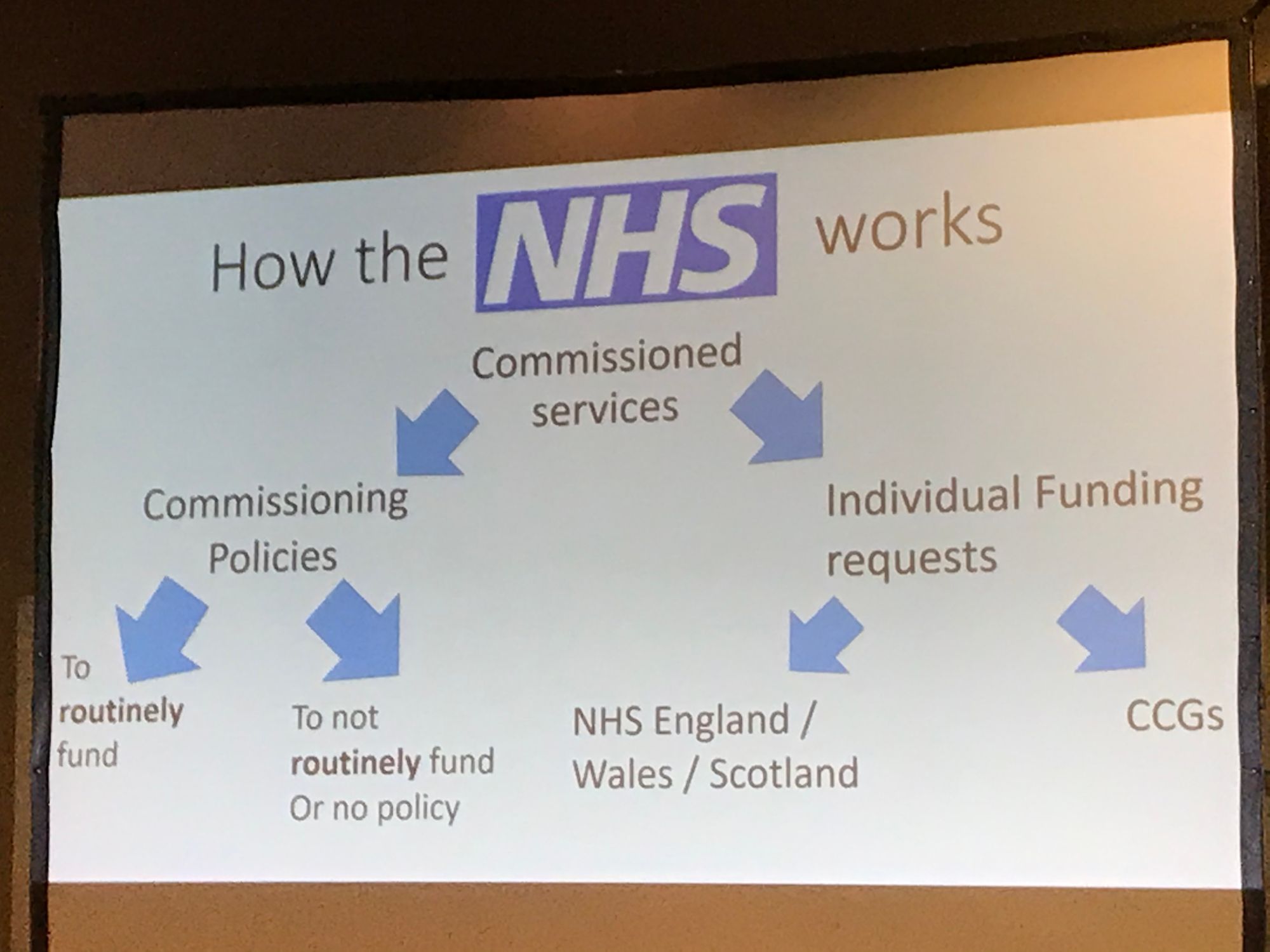
Slide from Peter Todd's presentation
From the slide above, Kuvan currently sits in the ‘Not routinely funded’ box. Peter has led the charge in challenging this through the court. This work has been laborious but there has been some success in challenging the method used for reaching the ‘Not routinely funded’ decision. Peter noted that Kuvan is effectively now in a battle for funding against other rare diseases. I couldn’t help thinking that we are competing in the hunger games
In good news, those with PKU who cannot maintain levels below 600 µmol/L may have a route to Kuvan through an Individual Funding Request. I hesitate to discuss that process here as it is involved. Possibly the best place for a query is Kate Leaoryd ([https://twitter.com/PKUFamily](https://twitter.com/PKUFamily?ref=pigpen.page)) of the NSPKU.
I did ask Peter if there is any scope to question the 'levels above 600’ only access to treatment. However, that is the limit for brain damage which is currently widely accepted by the medical community so that is the level at which access to the new treatment is set. As was pointed out during the extensive Q&A session, this is a frustrating and slow process which can seem unfair. But, thanks to the efforts of people like Peter, progress is being made.
## PKU and the Family
### Angela Matthews (NSPKU Support Group Lead for Kent) and Friends
Angela had gathered together a panel which included adults with PKU, the parent of an adult with PKU and the parent of a newly diagnosed PKU child. Their discussion was a frank one which ranged from memories of growing up through frustration of daily life with PKU to the fears of a parent. Discussions such as these hinge on the participants and all who took part were candid in their experiences. The nature of the section means that it is not easy to discuss here, but one outcome was agreed on by all:
****Having a community around you really helps with PKU.**
Whether it be a network ‘in real life’ (IRL) or online, having people who know what it is like to grow up with or along side someone with PKU is important. The fact that this is such a rare diesase means that finding people ‘IRL’ can be difficult. So if you are looking for a PKU community the best place to start may be online at:
or following [@NSPKU](https://twitter.com/NSPKU?ref=pigpen.page) and others with PKU on Twitter - [like me!](https://twitter.com/poconnor?ref=pigpen.page)
I must finish by saying that being a part of the PKU community on social media has proven invaluable. Sometimes just having someone say ‘I get that too!’ is so encouraging. It was great to meet some of the online pals at the conference and I’m already looking forward to next year.
1. NSPKU Conference 2020 - Programme Abstracts. [http://www.nspku.org/publications/publication/47th-annual-conference-2020-programme-abstracts](http://www.nspku.org/publications/publication/47th-annual-conference-2020-programme-abstracts?ref=pigpen.page). Accessed March 2020\. [↩︎](file:///var/folders/m9/k49cx8jx6qvgr7lz6r1glb800000gp/T/com.ulyssesapp.mac/6dcdd70151624d15884a67aea68374f8/NSPKU%202020/index.html#ffn1)
### Fad Diets & PKU
URL: https://www.pigpen.page/fad-diets-pku/
Last updated: 2026-01-02T15:31:37.000Z
As the prime month for dieting begins, please spare a thought for those of us who have no choice but to avoid over 80% of foods every day, every year.
> **Why do I feel bad when my PKU embarasses others managing lifestyle diets?...I remind them of their privilege**.
## The privilege of choice
A few of my friends have been trying various diets, and all power to them. I genuinely hope that they are happy with their food. The conversations this month tend to revolve around how cutting out or adding foods has helped people. This can be difficult for someone with PKU, or the many other rare dieases which are managed by a restricted diet therapy.
Often these conversations become stilted or end in embarassing silences when those involved remember that am managing a far more restricted diet, & cannot make simple changes to my food.
## Why do I feel bad when my PKU embarasses others discusing their lifestyle diets?
Because, whether I speak or not, **I remind them of their privilege**. Being able to chose what you eat, or what you avoid, is not an option for anyone on a medically restricted diet. This is the downside of the fad diet phenomenon. For of us sitting through these conversations, it’s going to take a pretty big upside to balance that out.
## PKU-friendly products
The trend towards plant-based and vegan diets has improved the wide availability of PKU-friendly products. I wasn’t allowed cheese for the first 30 years of my life. But then coconut based cheeses came out and suddenly I was rolling in cheesy experiments.
There are many other new products of course. For the first time in our relationship the hubby and I can have the same milk in our tea. This may not seem huge, but it’s the small things that matter - and the knowledge that if you mix the cups up you don’t have to worry. The PKU social media community are an excellent resource to find PKU friendly products.
## PKU-friendly recipes
Finding PKU-friendly recipes for all of these new products is exciting. I often have a go at making these inventive dishes at home. Weekends are a good time for experimenting and filling up the freezer with handy low-Phe or Phe-free meals.
If these work a few times, then I'll pop the recipes up at [https://pigpen.page/tag/recipes/](https://www.pigpen.page/tag/recipes/). Or these can be searched by main ingredient (e.g., carrot or fennel) using the search box on the home page. Alternately, check out the websites for the specialist food providers.
> **The PKU social media community are an excellent resource to find PKU friendly products**
## Eating out
Eating out has also become much easier in the last few years. In pubs, the standard meal was salad & chips and the restaurant dish was some a version of vegetarian risotto or pasta. “Hold the parmesan please.”
The trend towards catering for other diets has helped. Obviously, just because a dish is plant based or vegan doesn’t mean that it is suitable for the PKU diet. But there is more choice now. The number of tweakable dishes per menu has only increased slightly but the variety has exploded. Some of my meals out have included both teriyaki and tempura cauliflower, ratatouille tartine with vegan cheese, wild mushroom parmentier and beetroot tartare.
## Remember, be kind
Whether you are the one with PKU, sitting through a friend's list of 'good and bad' foods, or a friend who just wants to share their experiements, uncomfortable feelings can be avoided with kindness. Perhaps you could tell your friend that, you are happy for them in their lifestyle and move the subject away from diets. Or ask your PKU friend if they have any tips for managing a diet in the long-term which they might share.
I hope many will enjoy the experiments with food this month and are able to making lasting changes for the better. Please remember to leave some of the low-protein vegan items for the rest of us! .
### Blogging Anxiety
URL: https://www.pigpen.page/blogging-anxiety/
Last updated: 2025-12-26T12:34:15.000Z
Suddenly we are several weeks into 2020 and the blog has been neglected. I have avoided another post as, just after the last update, the PKU social media community discussed the need to focus on how difficult it is to stick to the PKU diet.
There was talk of the need to ensure that one person talking about doing well on the diet doesn’t discourage others who might be struggling with their treatment. Yes, this is a valid concern and one I have been reflecting on for the last month or so. It is the reason I hadn't updated the blog.
## PKU ain't a walk in the park!
I have pretty much always been on diet so cannot write about the struggles of returning to it and the need to wean myself off ‘forbidden foods.’ The clinics tell me that I'm one of the few who have managed to keep my Phe levels within target range (bar a few holidays) for decades now. So, as an outlier, should I be writing about PKU at all?
I have never said that the PKU diet is easy but I do try to avoid negative thinking. It is not easy to be positive about having an inherited metabolic disorder, but I do try. Of course I don't leap out of bed in the morning and shout “Hurray! I have PKU!” Like many of us trying to stay on diet, I have spent hours trying to arrange a holiday or stomped angrily from supermarket to supermarket just trying to find a decent lunch.
## Campaign for new treatments
We all deserve access to better foods, medicines and treatments. And we need to be aware that just as the diet therapy doesn't work for everyone, Kuvan, Peg-PAL and other new PKU treatments will not work for everyone. Also, the long term consequences of these therapies are unknown. This means there needs to be more scientific trials, both of treatments currently on the market and of those in development.
Sadly, as someone who has worked to maintain Phe levels below the EU guidelines for years[1](file:///var/folders/m9/k49cx8jx6qvgr7lz6r1glb800000gp/T/com.ulyssesapp.mac/64ef6cf378e04d5492cbb53655ef8f90/Suddenly%20we%20are%20several%20weeks%20into%202020%20and%20the%20blog%20has%20been%20neglected!%20I/index.html#fn1), I have not been eligible for any of these trials. Even if I lived in the EU, I would not be eligible for Peg-PAL[2](file:///var/folders/m9/k49cx8jx6qvgr7lz6r1glb800000gp/T/com.ulyssesapp.mac/64ef6cf378e04d5492cbb53655ef8f90/Suddenly%20we%20are%20several%20weeks%20into%202020%20and%20the%20blog%20has%20been%20neglected!%20I/index.html#fn2) unless I allowed my Phe levels to rise and kept them there for a long period of time.
Essentially, I need to risk brain damage in order to be considered for one of the non-diet therapy trials. I have to admit that this annoys me, it just seems unfair. And I do play the game in restaurants sometimes, ‘What would I order right now if I was on one of the new therapies?!’
Two years ago, I wrote about this struggle for the NSPKU as part of their ‘My Story’ requests [3](file:///var/folders/m9/k49cx8jx6qvgr7lz6r1glb800000gp/T/com.ulyssesapp.mac/64ef6cf378e04d5492cbb53655ef8f90/Suddenly%20we%20are%20several%20weeks%20into%202020%20and%20the%20blog%20has%20been%20neglected!%20I/index.html#fn3). I don’t believe this has been published yet, and do let me know if I missed it, but it is relevant so I have shared an extract below:
## Diet Anxiety
“PKU means managing your food all day, every day. Always working out how to get in your supplements while finding the ‘Goldilocks Protein Zone’ - not too much Phe, not too little. When you add in the need to order PKU food monthly and manage your stocks it’s not surprising that food can become a huge preoccupation.
As if things weren’t bad enough, we live in a society where food is seen alternately as a weapon or a medicine, a panacea or the cause of all illness. You need only glance at newspaper headlines to see how much judgement is cast on ordinary diets. Food can be classed as ‘healthy’, ‘un-healthy’, ‘processed’, ‘non-processed’, ‘natural’, ‘junk’, ‘superfood’, ‘full of empty calories’…
Anything can trigger it, but Diet Anxiety usually shows up when I go outside my usual routine. New events need a plan and I won’t be relaxed about them until I’ve found a few safe meals and mentally packed my supplement. I’m guessing I’m not alone in being a grown PKU adult who still worries about where their next meal is coming from.
Diet Anxiety used to come more often and affect me deeply. I would be in a flood of tears and rage about how damned unfair it was that no-one else needs to check out local menus before clicking ‘buy-now’ on a train ticket. In the midst of one of these episodes I realised they were the same feelings I’d had a year before, triggered by similar ‘holiday-shopping’. At that point it seemed useless to keep raging. Ultimately the wailing didn’t change anything and just wore me out.”
## When life gives you lemons...
That is when I decided to be as positive as possible about PKU. The blog grew out of that, somewhere to share useful recipes or meal tips.
I realise that not everything I write will help everyone, that would be impossible. But I will offer encouragement and share what I’ve learned. At the same time, I can join the NSPKU campaigns for new treatments in the hope that they might become available.
I hope our online community has room for sharing both raw struggle and well meant positivity.
## Write to your MP
P.s. please consider writing to your MP about the fight for new treatments. The NSPKU offer a template letter and guidance on their website: [http://www.nspku.org/news/story/write-your-mp](http://www.nspku.org/news/story/write-your-mp?ref=pigpen.page)
1. [https://www.thelancet.com/journals/landia/article/PIIS2213-8587(16)30320-5/fulltext](https://www.thelancet.com/journals/landia/article/PIIS2213-8587%2816%2930320-5/fulltext?ref=pigpen.page) [↩︎](file:///var/folders/m9/k49cx8jx6qvgr7lz6r1glb800000gp/T/com.ulyssesapp.mac/64ef6cf378e04d5492cbb53655ef8f90/Suddenly%20we%20are%20several%20weeks%20into%202020%20and%20the%20blog%20has%20been%20neglected!%20I/index.html#ffn1)
2. [https://pigpen.page/what-is-pal/](https://www.pigpen.page/what-is-pal/) [↩︎](file:///var/folders/m9/k49cx8jx6qvgr7lz6r1glb800000gp/T/com.ulyssesapp.mac/64ef6cf378e04d5492cbb53655ef8f90/Suddenly%20we%20are%20several%20weeks%20into%202020%20and%20the%20blog%20has%20been%20neglected!%20I/index.html#ffn2)
3. [http://www.nspku.org/publications/publication/my-pku-story](http://www.nspku.org/publications/publication/my-pku-story?ref=pigpen.page) [↩︎](file:///var/folders/m9/k49cx8jx6qvgr7lz6r1glb800000gp/T/com.ulyssesapp.mac/64ef6cf378e04d5492cbb53655ef8f90/Suddenly%20we%20are%20several%20weeks%20into%202020%20and%20the%20blog%20has%20been%20neglected!%20I/index.html#ffn3)
### Rugby rules, football failures and concussions in sport.
URL: https://www.pigpen.page/rugby-rules-football-failures-and-concussions-in-sport/
Last updated: 2022-08-23T14:00:40.000Z
That old chestnut, but it really won’t go away. The sporting season picked up in autumn with the Euro qualifiers in football and the Rugby World cup in Japan. Both tournaments have gathered more controversy this year over the prevalence of concussion; and over the steps taken by governing bodies to prevent dangerous contact. A simple, independent test for concussion would be a massive boon for all sports. I reported on a possible detection method before; however, we are still a lot of research away from a [pitch-side diagnostic test](https://www.pigpen.page/concussion-substitutes-now-allowed-in-international-cricket/).
The last few years have seen numerous studies showing the damage which contact sports can cause to the brain. This has moved the argument on from whether brain injury can happen to how to make the sports safer. Several codes have introduced new rules to improve player safety, with new tackle rules in rugby and equipment updates in cricket. But as fast as these rules are introduced, loopholes are found.
## Football and cynical rule dodging
The UEFA concussion protocol was dodged in a blatantly unsafe fashion recently. A player appeared to be knocked out by a dangerous tackle and was removed from the field, only to return four minutes later. After the match, the [manager defended the swift return ](https://www.headway.org.uk/news-and-campaigns/news/2019/headway-shocked-by-giggs-concussion-comments/?ref=pigpen.page)by claiming the player had not been concussed but was merely acting.
[Headway UK](https://www.headway.org.uk/news-and-campaigns/news/2019/headway-shocked-by-giggs-concussion-comments/?ref=pigpen.page) noted that this meant either the concussion protocols were ignored, or a professional team used those protocols to seek tactical advantage. Either way, the incident sets a dangerous precedent for grass-root competitions, where younger player seek to emulate their heroes without expert medical assessment on hand.
The incident noted above was covered by inews this week. Their [article](https://inews.co.uk/sport/football/concussion-football-daniel-james-injury-wales-croatia-ryan-giggs-816372?ref=pigpen.page) is worth reading for the arguments that ‘on the issue of impact head injuries, football can and must make improvements quickly and there are no easy excuses.’
## Hope for Rugby?
As a kiwi I am torn between enjoying the current Rugby World Cup and cringing at the thought of possible brain damage to players. Fellow fans will know that the rules governing safe and dangerous rugby tackles have been changed in the run up to the cup. [This has been causing controversy](https://www.sport24.co.za/Rugby/RugbyWorldCup2019/hall-of-shame-2019-world-cup-on-track-for-red-card-record-20191005%20.?ref=pigpen.page) as the players, referees and coaching staff have been adjusting to the new rules and more warnings and cards have been imposed as a response. 4
Steve Hansen, the All Blacks coach, was asked about the prevalence of red and yellow cards in the tournament this week. [He said there was](https://www.theguardian.com/sport/2019/oct/07/steve-hansen-fears-tackle-red-cards-could-swing-rugby-world-cup-knockout-games?ref=pigpen.page) “no point moaning about it, it’s about accepting and getting on with it… A couple of people have been very seriously injured in tackles and in some cases actually passed away. Have we got it 100% right? No. But.. we’ve got a responsibility to try to respond to that and do it the best we can". 5
It was heartening to read an article in which a leading figure in the game was arguing that the rules are there for a reason, and that the coaches and players need to adjust to those rules. It isn’t perfect, but it is getting there.
### ABI & Gardening
URL: https://www.pigpen.page/abi-gardening/
Last updated: 2026-02-05T11:19:35.000Z
*“When you plant something, you invest in a beautiful future…”* Monty Don.
This simple hope can mean a lot during difficult times.
In the long grey time between my injury and managing to get treatment, I spent many hours laying as still as possible and looking out the window. We live in inner London but are lucky enough to have some outside space. It is just a small courtyard but not many people have that round here.
I have always loved gardening so had a few pots and flowers to cheer me up. My constant dizziness and fatigue meant even that small hobby was nearly abandoned. Friends came over to help me plant sweet peas, a fast growing plant which needed little care and gave me plenty of small beauty in those quiet hours.
Once the treatment started to kick in I started to emerge from the zombie like effects of the injury. It felt like rejuvenation, sap rising in the body, a personal Spring after a long dark winter. It seemed obvious to turn to the natural world and reflect this in the garden. Out went the mis-matched pots, in came two gigantic planters. Six hundred litres of soil and compost were delivered down a central London driveway by bemused delivery drivers. I sank a square bucket in one planter and made a small wildlife pond. The first tulips were an affirmation of my recovery, the first damsel fly taking wing from the reeds was simply a joy.
## Gardening on the NHS
The [NHS is now using Social Prescribing](https://www.england.nhs.uk/personalisedcare/social-prescribing/green-social-prescribing/?ref=pigpen.page), where a GP can refer a patient to local, non-clinical services. This could be volunteering in the community, taking part in an arts or social group or joining a sports club. This includes gardening and a GP clinic in Manchester is already prescribing gardening to some of their patients.
There is growing evidence which shows the benefits gardening has on our mental health. The Royal Horticultural Society were arguing that gardening should be available on the NHS as far back as 2014\. Beyond the NHS, gardening has been used at HMP Parc to help prisoners with their mental health and study for a career after release.
Buy me a cuppa ☕ — your support helps keep this blog free, and helps to me write about PKU, brain injury & mental health.
[Buy Pauline a cuppa ](https://donate.stripe.com/14keYi5dp9E26Oc9AA?ref=pigpen.page)
## Gardening after a brain injury
Headway UK offer “gardening projects that help to reduce depression, improve self-esteem and provide brain injury survivors with vital peer support and companionship.” The Cambridge branch highlighted in the weblink run a gardening training course for those who have had a brain injury or have other mental health issues. As the participants learn about horticulture, they are also learning skills to help their recovery. The example of animals to come in and rid plants of pests is used to demonstrate that: “we don’t always need to solve problems”.
There are several Headway schemes to help those with a brain injury to become involved in gardening. The charity also offer advice for managing some of the effects of brain injury in the garden. You can access more help at their [website.](https://www.headway.org.uk/supporting-you/?ref=pigpen.page)
## Most important thing about gardening - enjoyment.
Basically, take joy in what you do.
## Join the community
Get early updates, recipes and your free gift.
Join us
Email sent! Check your inbox to complete your signup.
No spam. Unsubscribe anytime.
### Fitness, BMI, & PKU
URL: https://www.pigpen.page/fitness-bmi-pku/
Last updated: 2025-12-26T12:17:29.000Z
Many of us with PKU, or other chronic conditions, will have our body measurements are taken at regular clinic appointments. Body weight is one aspect which is considered when setting personal treatment regimes for PKU and other metabolic disorders. This means I have a fairly extensive record of my weight for over three decades.
I try not to obsess, but living with PKU means my weight is regularly discussed. Throw in the messages, conscious and unconscious, about weight from society in general, and you quickly see that we deal carry a greater burden of weight issues than many.
> I try not to obsess, but living with PKU means my weight is regularly discussed.
## Losing weight vs losing fat.
One memorable occasion, I was quietly confident before stepping on the scales. I’d joined a gym and been fairly active since then. My clothes were loose and I felt stronger. I was sure I had lost weight. The only question was how much I had lost.
Nothing. The scales said both my weight and BMI had gone up slightly. But how!
Another PKU patient, [Kate Buckland, reported a similar experience](https://www.nutricia.co.uk/patients-carers/articles-stories/pku-fitness-the-challenge-of-weight-loss.html?ref=pigpen.page) in her piece for the Nutricia website: “Last year doing bodyweight High Intensity Interval Training I lost almost 3 dress sizes, 8% body fat and… 1.5 kg. People kept commenting on how much weight I'd lost, but I hadn't lost weight. I had lost fat and gained muscle, which is awesome!”
## Beyond BMI
Many health experts believe BMI has [significant limitations](https://www.ncbi.nlm.nih.gov/books/NBK594362/?ref=pigpen.page). The NHS states that "The BMI calculation is just one measure of health. It cannot tell the difference between muscle and fat."
Essentially, BMI measures if you are carrying too much weight for your height, but it can’t tell you if that weight is excess fat or excess muscle. This is why athletes and gym bunnies are sometimes classed as obese under the BMI system even though they don’t have too much fat.
[Suggestions for new measurements](https://theconversation.com/should-we-ditch-bmi-and-use-the-body-roundness-index-instead-232342?ref=pigpen.page) include the waist to height ratio. This is also known as the body roundness indicator, or BRI. This is a factor of your height, weight, and waist measurement. Fortunately, there is a [body roundness calculator](https://bri-calculator.com/?ref=pigpen.page#calculator) to help us.
> Remember that many of us with metabolic disorders are already on a restrictive diet.
## Safe weight loss and PKU diets
It is widely agreed that losing weight quickly is not a good idea. ‘Yoyo dieting’ is sadly common, when we work hard to lose weight only to gain it all back. Slow and steady changes in habit and lifestyle are the best way to lose weight. The NHS says we should be aiming for a safe rate of weight loss "[between 0.5 and 1kg](https://www.nhs.uk/conditions/obesity/treatment/?ref=pigpen.page) per week".
Wait! Remember that many of us with metabolic are already on a restrictive diet. We already pay attention to what we eat, and generally don’t have the quick gain of cutting out weekly visits to the kebab shop.
We also need to remember that losing weight is a slow process, just as putting it on can be. My health records tell me that the last time I was in the healthy BMI range, the first iPhone had just been released. I do plan to get back to that weight range, but need to recognise that it will take time!
## Getting started on getting fit.
I don't just want to lose weight, in fact, that isn't my main goal. My joints are creaking a bit, and my muscles are a little weaker. I simply want to feel healthier, and that means moving more, too.
The [NSPKU race to £10K](https://nspku.org/nspku-race-to-10k/?ref=pigpen.page) inspired me to pick up the running shoes again. And I have a personal goal for a sponsored walk in memory of a friend planned for the autumn. All this means I would like to feel fitter. 😄
### Pausing the anxiety cycle
URL: https://www.pigpen.page/pausing-the-anxiety-cycle/
Last updated: 2026-03-02T16:54:46.000Z
Many of us recognise the feeling of being “back on the anxiety treadmill”. One week things feel manageable, even good. The next, something knocks us off-balance, and we’re exhausted, foggy, tense, or overwhelmed. It might be physical symptoms, emotional overload, or a sense that you’ve “gone backwards” again.
- What went wrong?
- Why am I feeling like this again?
- When will I get on top of this properly?
- What did I do wrong?
These thoughts can start to circle, faster and faster, until they become the problem themselves. The trap of trying to “solve” anxiety.
## Trying to “solve” anxiety doesn’t work
**If there ever was a time to be kind to yourself, this is it.** When we feel unwell or emotionally unsettled, it’s natural to look for a cause. We scan recent events, conversations, habits, or decisions, trying to pinpoint the moment we “messed up”.
Occasionally, this search is helpful. A clear trigger might emerge — lack of sleep, stress, overstimulation, missed meals, too much pressure without enough rest. Noticing patterns can support self-care and future planning. But often, the answer isn’t clear.
Life is busy and complex. We don’t always get neat explanations for how we feel. When the cause stays hidden, the search itself can become obsessive. The need to find the reason grows stronger, feeding more anxiety, guilt, and frustration — which only deepens the cycle.
## Self-compassion as a practical skill (not a fluffy idea)
This is where kindness to yourself matters most. **We are usually far more understanding towards other people than we are towards ourselves.** If a friend felt overwhelmed or anxious, we wouldn’t accuse them of failure or tell them they’ll “always be like this”. Yet, many of us use exactly that language internally.
It might be helpful to ask yourself: “What would I say to a friend who was in this situation?”
That question alone can interrupt the harsh inner commentary and soften the emotional intensity for a moment. Creating space, a small relief instead of fighting.
For many people, learning to notice and name what’s happening creates a small but meaningful shift. This idea sits at the heart of many mindfulness-based approaches. One widely used framework is the RAIN technique, which offers a structured way to pause without trying to “fix” everything at once.
Buy me a cuppa ☕ — your support helps keep this blog free, and helps to me write about PKU, brain injury & mental health.
[Buy Pauline a cuppa ](https://donate.stripe.com/14keYi5dp9E26Oc9AA?ref=pigpen.page)
## The RAIN technique
**R – Recognise:** Notice what is happening right now. Name the experience as it is: anxiety, frustration, sadness, fear, exhaustion.
**A – Allow:** Let the feeling be there without judging it or pushing it away. Emotions are part of being human; having them doesn’t mean you’re failing.
**I – Investigate:** Gently explore what might be contributing. Be curious, what sensations are you noticing in your body? What thoughts are present?
**N – Non-identification:** Remember that feelings are part of your experience, not your entire identity. You are not your anxiety. What you feel now is real, but it is also temporary.
## Pausing, not stopping, the anxiety cycle
It’s important to be realistic: this is not about eliminating anxiety altogether. There is no single technique that works for everyone, all the time. The aim is simpler — to create a little space.
A pause. A breath. A moment where the cycle slows enough for you to choose your next step, rather than being swept along by it.
For some people, mindfulness practices help. For others, it might be a walk, a grounding exercise, a conversation, or a quiet cup of tea in the garden. The “right” tool is the one that supports you, not the one that sounds most impressive.
## Finding what works for you
If you’re curious about mindfulness or structured approaches like RAIN, there are many accessible ways to explore them — apps, short guided practices, books, videos, or local classes. You don’t need hours of free-time or perfect conditions.
Even a minute of intentional pause can be enough to step off the cycle just long enough to catch your breath.
## Further reading and support
- [Mind](file:///Users/pollyoconnor/Library/Containers/com.ulyssesapp.mac/Data/tmp/50b09712edbf449ba9cea633d90966af/Pausing%20the%20anxiety%20cycle%E2%80%94redux/:%20https://www.mind.org.uk) (UK mental health charity)
- [NHS](https://www.nhs.uk/mental-health/self-help/?ref=pigpen.page) – Anxiety & Mindfulness
- [Greater Good Science Center](https://greatergood.berkeley.edu/?ref=pigpen.page)
- [Mental Health Foundation (UK)](https://www.mentalhealth.org.uk/explore-mental-health?ref=pigpen.page).
[Pauline O’Connor (PigPen) articles on mental healthArticles on mental health with long-term conditions; PKU, Phenylketonuria, rare disease, brain injury, concussion, post concussion, anxiety, TBI, ABI.PigPen | Pauline O'Connor](https://www.pigpen.page/tag/mental-health/)
## Join the community
Get early updates, recipes and your free gift.
Join us
Email sent! Check your inbox to complete your signup.
No spam. Unsubscribe anytime.
### Brain Injury and exercise
URL: https://www.pigpen.page/brain-injury-and-exercise/
Last updated: 2025-12-04T12:49:45.000Z
### Why exercise at all?
It has been said that if exercise was a pill it would sell in the billions. The [NHS would like everyone to move more](https://www.nhs.uk/live-well/exercise/exercise-health-benefits/?ref=pigpen.page), as exercise can:
- "reduce your risk of major illnesses, such as heart disease, stroke, type 2 diabetes and cancer by up to 50%
- and lower your risk of early death by up to 30%."
### Brain injury, fatigue, and exercise
Exercise can be helpful and encouraging for those recovering from a brain injury. Headway UK reports that daily exercise can have an “energising effect, and...have a positive effect on mood. [Exercise can also help you to sleep more deeply](https://www.headway.org.uk/about-brain-injury/individuals/brain-injury-and-me/drained-by-fatigue-try-these-8-ways-to-cope-after-brain-injury/?ref=pigpen.page).”
When every day is a struggle through the fog of fatigue, the thought of fitting in exercise can be overwhelming. But it turns out that exercise has a positive effect on fatigue levels. It increases your stamina and helps you to do more overtime.
### Resuming exercise after a brain injury
I have always been an active person, the bleed in my brain happened during a football match. At the time, I was playing several weekly football matches, and cycling 40 miles a week on my commute. It was a shock to become nearly immobile overnight.
My symptoms of balance problems, vertigo, nausea, dizziness, and fatigue meant there were months when I couldn’t move far from the sofa. On the few occasions I did make it outside, audio and visual hallucinations added to the above, making the world a dangerous place.
The road to a proper diagnosis and the correct treatment took over a year. In that time, my fitness collapsed, my weight ballooned, and my mental health was in tatters. Even before I could get into a brain injury clinic, the GP was urging me to get back to a bit of exercise. It seemed a distant prospect as the fear was all encompassing. I was terrified of another blow to the head.
### Where to start?
I needed to overcome my fear of another injury as well as the dizziness, vertigo, imbalance and hallucinations. This meant finding exercises which would:
- minimise the risk of another head injury,
- would push my much reduced fitness levels without being over taxing,
- and was entertaining enough to distract from the anxiety of simply moving at all.
My starting point was Tai Chi, a series of slow, repeated movements of the arms and legs which had no physical contact with anyone else. My GP had recommended it to help with the dizziness, but the biggest initial effect was on my spatial awareness.
I stopped walking into things and no longer banged into door frames or cupboards. It seemed that the repetitive exercises ‘taught’ my brain where the arms and legs were so I could unconsciously account for them while walking around. This is supported by evidence that [practising Tai Chi reduces the number of falls](https://www.nhs.uk/conditions/falls/?ref=pigpen.page).
Buy me a cuppa ☕ — your support helps keep this blog free, and helps to me write about PKU, brain injury & mental health.
[Buy Pauline a cuppa ](https://donate.stripe.com/14keYi5dp9E26Oc9AA?ref=pigpen.page)
### Small steps add up
After six months of daily practice, I was ready for a bigger challenge. The local community centre has held yoga classes for years. And for years I would walk past thinking, ‘must get there one day’. So one day, I did. The relevant principles are similar to Tai Chi. The body is guided through a series of repetitive movements, only at a more challenging level.
In the first class, I could barely keep up. Everything was new, the instructions, the poses, the protests from muscles which hadn’t been used in months. But I left exhausted and exhilarated. It was fun! I signed up for a beginners class that week and slowly but surely worked to become stronger and more flexible. I still remember the joy of my first side-arm plank.
## Exercise and brain injury rehabilitation
It is more than a decade since my brain injury, and I still avoid football & other contact sports. My exercise is much more varied. I still cycle and do yoga regularly, along with lots of walking. To mis things up and keep it fun, I’ve also joined gyms and tried aerobics, archery, aqua aerobics, Pilates, trapeze, and climbing. I still have difficult days, but even they are much improved with a gentle walk around the neighbourhood.
It is noticeable that if I go a few days without exercise of some type, I will experience disrupted sleep and a reversion to the dizziness & migraines. For this reason, daily exercise is a priority. In fact, I am fitter now than I was before the brain injury.
## Ideas for exercising with a brain injury.
Every injury is different, and the above suggestions will not work for everyone. Headway UK can help, with more suggestions on their website to help inspire you to become a little more active. It doesn’t have to be much, and we can’t expect to do everything at once. Take it easy and remember that just a few minutes strolling around the block can lead to bigger and better things.
Good luck!
(updated December 2025)
## Join the community
Get early updates, recipes and your free gift.
Join us
Email sent! Check your inbox to complete your signup.
No spam. Unsubscribe anytime.
### Concussion substitutes now allowed in international cricket.
URL: https://www.pigpen.page/concussion-substitutes-now-allowed-in-international-cricket/
Last updated: 2025-07-01T13:18:37.000Z
In a landmark rule change, cricket teams will be able to replace concussed players during international games. [1](#fn1) This is exciting news for brain injury awareness, brain injury prevention and for sports fans.
In any team sport, players can feel they must continue when injured to avoid letting their team mates down. A growing recognition of this problem has led to changes in substitution rules across sporting codes in the last few years. Rugby has allowed players to be substituted to allow a Head Injury Assessment and substitute since 2015\. [2](#fn2) Cricket teams competition in the famous Ashes series in England this summer will now be able to follow a similar assessment and substitution practice. The new rules were trialled in Australian cricket before this international debut.
Cricket has been making rule changes in an attempt to prevent head injury for several years now. In 2014 player was killed when a cricket ball struck an area on his neck which was not covered by his helmet. It was a freak occurrence but since that incident helmets have been re-designed to offer more protection to the neck[3](#fn3). Crucially, rule changes have enforced the wearing of helmets during the game. [4](#fn4) [5](#fn5)
There are also efforts to prevent brain injury in rugby, using new training techniques and detection equipment. There is some research showing that training and warm up routines which focus on balance, agility and strength can reduce the indecently of concussion. This research has been used in the development of a new programme which was rolled out by England Rugby in 2017\. [6](#fn6)
A student who suffered concussion during a rugby match has been developed a skull cap which can help detect concussion in players. Oliver Beard has designed his ‘Concussion Guardian’ to both “reduce the likelihood of sustaining concussion”[7](#fn7) and to track impacts on the head. It is an interesting invention and I hope it will be developed for use in rugby and other contact sports soon.
Despite these changes, there have still been several concerning incidents in the recent men’s cricket World Cup and the 2019 rugby Six Nations tournament. This does not mean the rule changes are a failure. The only way to ensure that player is not injured or struck by the ball would be be remove any contact with other people or the ball - something that would spell the end for many sports. While few people would advocate such a drastic step, it is pleasing to see that concussion awareness is leading to rule changes aimed at both prevention and treatment of Acquired Brain Injury.
1. Ashes series to include concussion substitutes for first time, but concerns remain over 'loopholes’. ABC Australia. Accessed July 2019.[https://www.abc.net.au/news/2019-07-30/ashes-series-to-see-concussion-substitutes-come-into-effect/11364940](https://www.abc.net.au/news/2019-07-30/ashes-series-to-see-concussion-substitutes-come-into-effect/11364940?ref=pigpen.page) [↩](#ffn1)
2. Head injury assessment adopted into law, World Rugby. Accessed July 2019\. [https://www.world.rugby/news/70796?lang=en](https://www.world.rugby/news/70796?lang=en&ref=pigpen.page) [↩︎](#ffn2)
3. Phillip Hughes: Cricket helmets redesigned after batsman's death. BBC website. Accessed July 2015.[https://www.bbc.co.uk/sport/cricket/31421607](https://www.bbc.co.uk/sport/cricket/31421607?ref=pigpen.page) [↩](#ffn3)
4. Australia leads the way on helmet safety, but not all cricket nations have followed, Guardian Newspaper UK. Acessed July 2019.[https://www.theguardian.com/sport/blog/2015/nov/26/australia-leads-the-way-on-helmet-safety-but-not-all-cricket-nations-have-followed](https://www.theguardian.com/sport/blog/2015/nov/26/australia-leads-the-way-on-helmet-safety-but-not-all-cricket-nations-have-followed?ref=pigpen.page) [↩](#ffn4)
5. Helmets must be worn by professional cricketers in England next season, Guardian Newspaper UK. Accessed July 2019[https://www.theguardian.com/sport/2015/nov/27/helmets-professional-cricketers-england-wales](https://www.theguardian.com/sport/2015/nov/27/helmets-professional-cricketers-england-wales?ref=pigpen.page) [↩](#ffn5)
6. New rugby warm-up regime can halve number of injuries, Guardian Newspaper UK. Accessed July 2019.[https://www.theguardian.com/sport/2017/oct/21/rugby-warm-up-exercise-study-tackles-rise-in-concussion-injury](https://www.theguardian.com/sport/2017/oct/21/rugby-warm-up-exercise-study-tackles-rise-in-concussion-injury?ref=pigpen.page) [↩](#ffn6)
7. Rugby accident led to Northampton university student designing high-tech concussion-detecting sports skull cap, Northampton Chronicle & Echo. Accessed July 2019.[https://www.northamptonchron.co.uk/news/people/rugby-accident-led-to-northampton-university-student-designing-high-tech-concussion-detecting-sports-skull-cap-1-8991486](https://www.northamptonchron.co.uk/news/people/rugby-accident-led-to-northampton-university-student-designing-high-tech-concussion-detecting-sports-skull-cap-1-8991486?ref=pigpen.page) [↩](#ffn7)
### Cheese Scones and tips
URL: https://www.pigpen.page/cheese-scones-and-tips/
Last updated: 2025-07-01T13:16:17.000Z
British summers are full of scones and tea. My lack of baking prowess is legendary, as is my love for a freshly baked treat. So a few months back I decided to knuckle down and master at least one simple recipe. Every Saturday for a month the kitchen rang to the sound of muttered curses softened by a dusting of flour. But I got there!
Turns out that all you need is:
1. A recipe that works
2. A reminder to stick to said recipe
3. Patience.
I can’t really help you with the last one, but I assure you that patience is a skill which can be learned. In the interest of good scones it is worth it. Quite often I would get to the rolling out stage and think ‘that’ll do, can’t be bothered’. Rest assured that if you can take a deep breath before picking up the rolling pin again the scones will be better for it
Another baking time is touse a food processor to mix the butter into the flour. I have a simple, bench top processor and found that blending the butter into the dry ingredients gave pretty much the same result as rubbing it in slowly - but with far less mess and time.
Where PKU baking can come undone is in finding a good recipe in the first place. I’ve spent years trying to adapt non-PKU recipes to our specialist flour with varying success. This includes adapting [“Recipe: 'Best' cheese scones from Olde Beach Bakery”](https://www.stuff.co.nz/life-style/food-wine/recipes/91778951/recipe-best-cheese-scones-from-olde-beach-bakery?ref=pigpen.page). The recipe needed a few adaptations for PKU, but is now a firm favourite.
**“Best cheese scones recipe” as adapted for PKU**.
Gives 8 - 10 scones with a 2 inch cutter. The recipe is Phe free, assuming you use Phe free cheese & milk substitute.
**Ingredients**
- 1 cup of Phe free milk substitute
- 1 & 1/2 tsp psyllium husks
- 2 cups flour
- 3 teaspoons baking powder
- 1/2 teaspoon salt (optional)
- 50gm soft butter
- 1½ cups grated Phe free cheese substitute
1. Mix 3/4 of the milk with the psyllium husks, leave to sit for 10 minutes while you get on with steps 2 - 4\. Reserve the final 1/4 cup of milk for later. The recipe tends to be wet so you might not use all of the milk.
2. Prepare a baking tray with baking paper or grease with butter/oil. Pre-heat oven to 165 fan. You may want to wait to turn the oven on until after step 4, depending on how quickly your oven heats up.
3. Put the flour, baking powder and salt (optional) into a food processor. Add in the butter and blend until the mixture resembles bread crumbs.
4. Move these ingredients into a bowl and rub in any last big lumps. You can either stir in all the of the cheese or reserve some to sprinkle on top later.
5. Make a well in the centre and add the milk & psyllium mixture. Mix to form a soft dough, adding more of the reserved milk as needed to soften the dough. (Make sure your oven is on before you get flour everywhere in the next step.)
6. Lightly flour a rolling pin, a board and your hands before tipping the dough on to the board. Shape it into a ball then roll into a disc about 2cm thick. Cut into rounds using a 2-inch cutter. Re-knead, roll out and cut further rounds from the dough trimmings.
7. Brush the top of each scone with a little milk. You can sprinkle a little grated cheese on each one if you like. Bake in the pre-heated oven for 10-15 mins. If you want more colour on top, you can grill quickly.
8. Let them cool but be sure to eat one while it is still warm!
### Webinar - Healthy eating on a low protein diet
URL: https://www.pigpen.page/webinar-healthy-eating-on-a-low-protein-diet/
Last updated: 2025-07-01T13:15:30.000Z
One of my favourite dieticians gave a webinar on PKU, but I’ve been off my game in the last few weeks and missed it! Fortunately the inter webs has come to the rescue and Nutricia have made a recording available on their [Low Protein Connect](https://www.lowproteinconnect.com/Events/Webinar---Healthy-eating-on-a-low-protein-diet/?ref=pigpen.page) website. The video is 35mins long.
Louise Robertson is a registered dietician with a special interest in Inherited Metabolic disorders. She is one half of the team behind [Dieticianslife.com](http://www.dietitianslife.com/?ref=pigpen.page) which promises: “Nutrition, diet and the life of a dietitian. No fad diets, potions or pills, promoting evidence-based dietary advice.”
In 2015 the Dieticians Life team undertook the 7 days / 7 exchanges challenge. This caught my eye and I found Louise on Twitter [@louisedietitian.](https://twitter.com/louisedietitian?ref=pigpen.page) (In the interests of full disclosure I admit that the hook was their healthy banana and sultana flapjack recipe.) These are a few of my notes on Louise's webinar, though I recommend taking half an hour to watch it yourself.
Louise kicks things off by saying that “in theory a Low Protein (LP) diet sounds very healthy as it should include a lot of vegetables and fruit.” But her research has found that it can be difficult to eat healthily and watch your weight on a LP diet. Fortunately, she has a few answers.
Louise brought up the need to count the calories in exchange free foods. We must remember that these foods have calories too. She used an example straight out of my playbook: “So if you munch your way through a whole packet of biscuits, LP biscuits, because they are free then you will also be eating lots and lots of calories as well.” Oh yes, mid afternoon office munchies anyone?! After showing us there was a need to watch ourselves here, Louise was reassuring in relation to the proportion of carbohydrate in a LP vs a normal diet.
A big eyeopener was the difference that our exchange foods could have on our calorie and fat intake. Louise admitted to choosing examples from opposite spectrums, but she showed that we could easily affect our fat and calorie intakes by selecting healthier options. Thankfully Louise then went on to list a few for us: popcorn, baked beans, coconut yoghurt etc.
The presentation also tackled the current health scares around sugar and the equally prevalent miracle cure labels attached to butter and coconut oil. (Spoiler: all are wrong). She finished with discussing the new trend towards vegan foods along with tips on eating out. I was pleased to see that her suggestions allied closely with mine - and allows me to shamelessly plug my [article on eating out](https://www.lowproteinconnect.com/Your-World/Polly---Travelling-and-Eating-Out-on-a-Low-Protein-Diet/?ref=pigpen.page), also on Nutricia’s website.
It would have been helpful to have the questions asked by web-attendees included in the uploaded recording, but I appreciate that will have been difficult to ensure privacy requirements are followed. Really it was my mistake for not watching it live.
Thank you for taking the time to present this Louise and I look forward to the next one.
### UKABIF at Parliament
URL: https://www.pigpen.page/ukabif-at-parliament/
Last updated: 2022-03-09T14:02:52.000Z
Two weeks after Chris Bryant MP led a [debate in Parliament on Acquired Brain Injury (ABI)](https://www.pigpen.page/all-party-parliamentary-group-appg-for-acquired-brain-injury/) he co-hosted a Lobbying Reception in Speakers House. The aim of the event was to raise awareness of ABI and of the need to improve neuro-rehabilitation facilities. It was also a chance to talk to MPs and discuss the recommendations contained in “Time for Change”, a report by the All Party Parliamentary Group (APPG) on ABI.
The event was co-hosted by the [United Kingdom Acquired Brain Injury forum - UKABIF.](https://www.ukabif.org.uk/?ref=pigpen.page) UKABIF is a registered charity run by it’s members who include people with ABI, their carers and professionals who research or treat ABI. The Parliament lobbying reception was a highlight of UKABIF’s campaigning at policy level and a natural succession from the [“Time for Change” report](https://www.ukabif.org.uk/campaigns/appg-report/?ref=pigpen.page).
Chris Bryant began proceedings with an update on how the various government departments had responded to the recommendations contained in the APPG report. While the overall responses were less than ideal, it was heartening to note that the issue is being raised at the highest policy level in the UK. Change must be fought for but it can happen.
UKABIF aims to “promote better understanding of all aspects of ABI; to educate, inform and provide networking opportunities for professionals, service providers, planners and policy makers and to campaign for better services in the UK.’ [1](#fn1) UKABIF also supports a network of local groups which meet regularly to discuss regional services. It was through their [London group, ABIL](https://www.pigpen.page/who-are-abil-acquired-brain-injury-forum-for-london/), that I discovered this advocacy group and was able to attend the event. If you would like to discover your [local regional group, this link should help](https://www.ukabif.org.uk/regional-groups/?ref=pigpen.page).
Membership of the group is free for brain injury survivors and their carers while professional memberships are available for individuals or companies working in ABI. It has proven to be an informative introduction to the world of brain injury advocacy to which I hope to contribute. I was not aware of the treatment resources it offers during my recovery, but there is plenty of [information and support for Brain Injury Survivors and their carers available.](https://www.ukabif.org.uk/head-and-brain-injury-information-signpost/?ref=pigpen.page)
Sadly my MP did not turn up to the event, but the invitations to other events will keep flowing. In the meantime, it was encouraging to know that the fight for better awareness and treatment of ABI will continue in Westminster.
1. [https://www.ukabif.org.uk](https://www.ukabif.org.uk/?ref=pigpen.page) [↩︎](#ffn1)
### All Party Parliamentary Group (APPG) for Acquired Brain Injury
URL: https://www.pigpen.page/all-party-parliamentary-group-appg-for-acquired-brain-injury/
Last updated: 2025-11-21T12:29:14.000Z
Acquired Brain Injury is in focus at Westminster today as Chris Bryant, MP for the Rhondda, introduces a Debate on a Motion on Acquired Brain Injury. Bryant is the Chair of the APPG on Acquired Brain Injury which launched in November 2018.
Chris, [@RhonddaBryant](https://twitter.com/RhonddaBryant?ref=pigpen.page), is gaining a reputation on health matters following his melanoma scare earlier this year. His campaign for ABI awareness stretches back further and I was inspired by his talk at an [ABIL](https://www.pigpen.page/abil-march-2019/) forum in 2018\. Elsewhere he has noted that:
"Acquired Brain Injury is an invisible epidemic, and we need to ensure that the neurorehabilitation services required following a brain injury are ‘fit for purpose’ throughout the UK” [1](#fn1)
The APPG has already released it’s first report entitled [‘Time for Change’](https://www.ukabif.org.uk/wp-content/uploads/2018/10/1533%5F40pp%5FAPPG-on-ABI%5FReport%5FTime-for-Change%5F2018%5FAW%5FSINGLES%5FWEB.pdf?ref=pigpen.page) with key recommendations on
- Neurorehabilitation
- Education
- Criminal Justice and
- Sport-related Concussion.
Regular readers will know this last item is of keen interest as [my ABI came from football](https://www.pigpen.page/pollys-brain-injury/). This concern is gaining a wider profile of late following high-profile injuries which have laid bare the inadequacies of current governing bodies and medical data.
The debate is likely to take place at 1pm - hope you will tune in to [BBC Parliament too!](https://www.bbc.co.uk/tv/bbcparliament?ref=pigpen.page)
1. From [https://www.in-pa.org.uk/2018/10/all-party-parliamentary-group-for-acquired-brain-injury-launch-report-on-on-acquired-brain-injury-and-neurorehabilitation/ ](https://www.in-pa.org.uk/2018/10/all-party-parliamentary-group-for-acquired-brain-injury-launch-report-on-on-acquired-brain-injury-and-neurorehabilitation/?ref=pigpen.page)Accessed May 018 [↩︎](#ffn1)
## Join the community
Get early updates, recipes and your free gift.
Join us
Email sent! Check your inbox to complete your signup.
No spam. Unsubscribe anytime.
### PKU Awareness Month Challenge
URL: https://www.pigpen.page/pku-awareness-month-challenge/
Last updated: 2025-05-29T14:49:03.000Z
May is PKU Awareness month in the US. The NPKUA are running a fundraising exercise challenge called "Move Your Pheet", so expect to see that on your socials in the next week or so. For those of us elsewhere, I've come up with a challenge:
## Choose to tell someone about PKU.
Telling someone that you have PKU, or about the condition, really can make it easier to stick to the diet. I’ve become more comfortable about describing my diet over the years, it is a part of me just like the blonde(ish) hair and blue eyes it bestows. However, when I was younger it wasn’t fun to have to explain it all the time.
No one wants to be different. Over time, I leaned that life is easier if the people you hang round with know you were born with a medical condition that means you have to be very careful about what you eat and take daily medical supplements.
That may be as much as you want to tell them, or you might want to explain more. It is **entirely up to you and how comfortable you are** with them. But telling someone close to you that you have PKU can really help you to stick with the diet.
> I don’t apologise for my PKU
## Tell who you want only what you want.
One thing I will say is that I don’t apologise for my PKU. Do you expect a diabetic to apologise for needing insulin, or asking for low sugar alternatives? But equally, I don’t expect people to understand PKU instantly, we are the experts remember.
When you chose to speak about the diet, it can be easier to have a few answers ready for their **FAQs**:
## Sign up for PigPen: Pauline O'Connor, author & advocate.
Pauline O'Connor. Author & advocate for PKU, brain injury, & mental health.
Subscribe
Email sent! Check your inbox to complete your signup.
No spam. Unsubscribe anytime.
## PKU FAQ's
### Can people with PKU eat out?
Of course we can eat out but we might need to be a bit more careful about where. A steak restaurant is not ideal, but salad and fries in a pub can be found anywhere. Yes that’s a boring lunch but the rush into plant based diets is helping a long with the PKU diet.
Often I’ll order several sides instead of a main as everyone does veggies sides like spring greens & lots of places do sweet potato fries/ wedges now which are protein free.
### Can I make PKU foods for you?
People will want to host for you, I'm working on making this easier for those around me. It helps if your friends know about your PKU, but it is not necessary. Many people are vegetarian or vegan, meaning hosting a bbq without a few veggies & salad is odd. Ask if you can take something along for your main, like marinated eggplant steaks, Violife halloumi or one of the new supermarket jackfruit offerings.
If you don’t feel comfortable with that, ask what is in the vegetables & salads. Take your supplement to fill you up, and consider taking a smoothie as your drink - these can be very filling.
### What about PKU snacks?
Fruit is always a good call, and bananas & mandarins are amazing. Protein-free & healthy, they even come in their own packaging so don’t need washed.
Alternatively, lots of breakfast bars are around 1g of protein. This is where we get to ignore the ‘healthy’ or ‘ancient grain’ labels and go for the chocolate ones. Often the double chocolate chip rice bars have less protein than dry rock-hard nutty bars.
### PKU brunch ideas?
If your friends or family are tucking into a fry up, join them with tomatoes, mushrooms, onion rings, and an exchange of beans or hash browns. Or go healthy and have a smoothie, so many places offer different recipes based on protein-free fruit, vegetables, juice or coconut milk.
(Side note: I’ve been known to have apple crumble for brunch as it was the most attractive low protein option on the menu. Low protein is my priority, so I bend the other ‘meal time’ rules to fit that in.)
## Do you have any PKU tips to share?
Hopefully you find that more people knowing that you need to take extra care over what you eat will help you to feel less stressed and happier in the long run. Do you have tips for raising awareness or your own tips to share? Did it work for you? Reply to this email, or let me know in the comments.

## Tip Pauline
This blog runs on your support.
[Buy Pauline a cuppa ☕](https://donate.stripe.com/14keYi5dp9E26Oc9AA?ref=pigpen.page)
### New Waitrose Vegan Range
URL: https://www.pigpen.page/waitroseveganrange/
Last updated: 2022-03-09T14:00:12.000Z
I’m a rare visitor to our local Waitrose but serendipity was on my side yesterday as I spotted a new ‘cheese’ and ‘yoghurt’ which seem suitable for the PKU diet. It seems there is a new Vegan range at Waitrose and I picked up two items for a weekend taste-a-thon.
First up the ‘Original Block’ cheese substitute at 0.5g protein per 100g, meaning if you snaffle the whole block in a day you need to count it as an exchange. On first tasting this is a danger as it just tastes cheesier than my usual Violife. It also tends to have the appearance and consistency of a softer cheddar than the Violife range which can seem a little ‘plastic’ at times. In fact we’ve had a little trouble telling this apart from the husbands normal cheddar in the fridge.
The melting test - AKA A Toasted Sarnie for Science. A lot of the previous ‘cheese’ I’ve tried has tended to hold its shape and just get a little like warm plastic in the oven. This new Waitrose alternative performed well as the thick slices melted well with a few bubbles and tempting aroma.
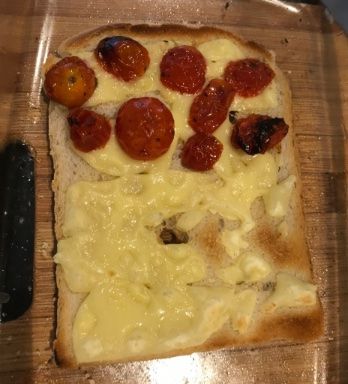
Top with sundried tomatoes, bottom just good ol' melted 'cheese'.
At £2.35 for 200g the price is comparable with the Violife and Sheese ranges, but for an own brand I might have expected a bit more of a discount. Definitely worth a try though and I will try it against a Koko Dairy free cheddar asap.
[https://www.waitrose.com/ecom/products/waitrose-vegan-original-block/480840-692515-692516](https://www.waitrose.com/ecom/products/waitrose-vegan-original-block/480840-692515-692516?ref=pigpen.page)
My other find was a ‘yoghurt’ though it is branded simply as ‘Waitrose Vegan Coconut.’ The smaller text on the back explains that this is a ‘Sweetened coconut cream dessert fermented with bacterial cultures.’ Mmmmm way to sell it, but the key USP for PKU folk is that it has less than 0.5g protein per hundred grams. So again, unless you go nuts and eat half of the 400g pot in one go you shouldn’t need to count it as an exchange.
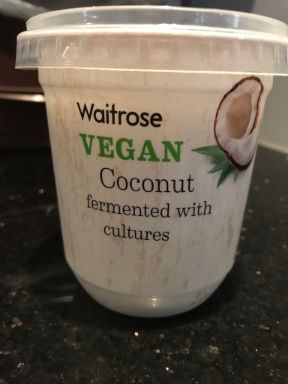
'Sweetened coconut cream dessert fermented with bacterial cultures'...Mmmmm
This appealed to me as I tend to have the Koko plain yoghurt (160g/exchange) and I would like to eat it without getting the scales out. You know, eating it out of the carton with a spoon while tucked up on the sofa bingeing on Netflix like normal folk….
This 'dessert' has the appearance and consistency of normal yoghurt which is a good plus, it is slightly thicker than the Koko brand. I would say that the sweetness is noticeable if you are used to plain yoghurt flavours - it is a little like greek yoghurt with the honey already mixed it. Half of the carton has gone while I’ve written this so it will certainly be sought out again - £1.99 for 400g.
[https://www.waitrose.com/ecom/products/waitrose-vegan-coconut/759234-683951-683952](https://www.waitrose.com/ecom/products/waitrose-vegan-coconut/759234-683951-683952?ref=pigpen.page)
The range also has a soft cream cheese spread alternative which I missed in store so will look out for in the next supermarket trip.
### What is GMP?
URL: https://www.pigpen.page/what-is-gmp/
Last updated: 2025-11-21T12:22:47.000Z
Type ‘What is GMP?” into a search engine and you’ll probably get reams of information on ‘Good Manufacturing Practice’ or ‘Good Medical Practice.’ Both important, but not what we’re thinking about in relation to PKU.
## GMP is GlycoMacroPeptide
That is quite a mouthful, so I’ll use the acronym. GMP is a protein which occurs naturally in cheese whey. “Great” you say, “but we can’t have cheese.” Stick with me here because when GMP is extracted from cheese whey, [“it is the only known dietary protein that is naturally free of Phe.”](https://www.ncbi.nlm.nih.gov/pmc/articles/PMC3633220/?ref=pigpen.page)
Sounds great, except that same paper points out that GMP has a minimal amount of Phe - 5mg per gram of protein. Or 0.5g Phe in 100g of GMP. This is border-line free for people on the PKU diet. But can have big implications for those with low phe allowances and multiple daily supplements.
This worried me enough to prevent me from trying GMP, however, my clinic were reassuring. [I ran a trial, with their blessing](https://www.pigpen.page/chocolate-sphere-trial-results/), and that extra level of daily phe didn't seem to affect me. Please always check with a clinic or health professional before making any changes.
Buy me a cuppa ☕ — your support helps keep this blog free, and helps to me write about PKU, brain injury & mental health.
[Buy Pauline a cuppa ](https://donate.stripe.com/14keYi5dp9E26Oc9AA?ref=pigpen.page)
## Benefits of GMP: taste!
All of us on the PKU diet know how hard it can be to force down an unpleasant supplement after a tasty meal. Spare a thought for those making the supplement. To be useful in any way, our medicine must contain some pretty foul tasting components.
On a PKU study day in London in 2018, the Nutricia product development team demonstrated this by asking delegates to mix their own ‘Amino acid supplements’ (pictured). The results were enough to make everyone present a little more grateful for the efforts put in by flavour developers.
All the scientific trials which I read for this article reported that the (human) participants found the improved flavour of GMP easier to consume. This is critical as the [“Lifelong adherence to the PKU diet is very difficult, often resulting in poor compliance and the neuropsychological consequences”](https://academic.oup.com/ajcn/article/89/4/1068/4596723?ref=pigpen.page) of high phe levels. If a medicine is palatable, it is far more likely that the patient will stick to the treatment.
## GMP: Hunger and heartburn
I’ve been fairly lucky with my supplements in the past, but one of my current treatments does give me gastrointestinal problems fairly frequently. This can matter just as much as flavour. When a medicine makes you feel works, one is much less inclined to keep taking it regardless of the taste.
Trials to date suggest that GMP can lead to [“improved gastrointestinal symptoms and less hunger.”](https://academic.oup.com/ajcn/article/104/2/334/4668552?ref=pigpen.page) Anecdotal evidence from both my home testing, and from my PKU community on twitter agrees with both of these claims.
## Can GMP also mimic LNAA treatment and reduce brain & blood Phe?
All of the above is sounding pretty good, for most people it’s enough that a new supplement tastes better. But it looks like there might be even more benefits to using GMP over a synthesised amino acid supplement. Of most interest is a possibility of an effect similar to that attempted in LNAA (Large Neutral Amino Acid) treatments.
The mechanism of LNAA treatment is essentially that of competition. Phe is one of nine LNAA’s which all use the same ‘transporter’ to cross the blood-brain barrier. As Phe causes problems when it crosses this barrier, the theory goes that flooding these ‘transporters’ with other LNAA’s reduces the amount of Phe which crosses the barrier. This in turn dilutes the concentration of Phe in the brain and reduces the adverse effects.
Obviously, this is a very basic outline, you can read more about LNAA [here](https://www.ncbi.nlm.nih.gov/pmc/articles/PMC2992655/?ref=pigpen.page), or in my book [Living with PKU](https://www.pigpen.page/books/). It looks like GMP supplements might also have this competition effect, another plus to these exciting new treatments, though studies are on-going.
### Other benefits of GMP
Finally, but just as important, one of the studies reported that the lower cost of making GMP means that the treatment might become a more [viable option in poorer countries](https://www.hindawi.com/journals/jnme/2016/2453027/?ref=pigpen.page).
It seems appropriate to end on the call of scientists across the ages – More Data Required! Meanwhile, many companies who make PKU food and supplements offer a GMP-based option. In the UK, dieticians can set up trial packs. Elsewhere, contacting the companies directly, or attending PKU events are good places to find new products.
## Join the community
Get early updates, recipes and your free gift.
Join us
Email sent! Check your inbox to complete your signup.
No spam. Unsubscribe anytime.
(Updated Nov 2025)
### Chocolate Sphere trial: results!
URL: https://www.pigpen.page/chocolate-sphere-trial-results/
Last updated: 2024-01-03T13:05:31.000Z
When the new chocolate Sphere flavour out from Vitaflo (in 2019) I decided to see if I could fit this into my diet - [see here for the first installment.](https://www.pigpen.page/new-chocolate-sphere/) How did I do it and what happened?
### Food report
I kept a food report over the week logging all food & drink so I could calculate up the amount of phenylalanine (phe) from both diet and supplement. The intake varied between 6 exchanges and 12 exchanges, all over my 5 exchange limit. This variation indicated days when either I didn’t eat all of the food exchanges or when I had an unintentional run in with some Easter chocolate!
### PKU Symptoms
Most of us will be familiar with the symptoms of high phe but it is good to remind ourselves from time to time. Remember; familiarity breeds contempt. So we might just be putting up with something not realising we can fix it!
- poor concentration
- frequent migraine headaches tiredness
- anxiety
- skin dryness
- lethargy
- mood swings
- staggering
- joint pains
- difficulty dealing with day to day tasks; such as working out money in a shop
I did notice a headache on day two which hung around for a while but left when I completed the trial. Full disclosure - I actually finished the trial a day early because of the headache. I also felt a bit more clumsy than usual during the trial, but as I was on the look out for symptoms was I being oversensitive? It is the season for colds and bugs and the rest of the household felt unwell too.
How do we control for outside factors this winter bugs or hay fever? Well there is one completely objective measure, the good ol’…
### PKU Blood test
The morning after I finished my Sphere trial I took the usual blood spots and sent them off for testing. I was expecting a high result and was already thinking that, while Sphere is the tastiest supplement I've come across, it is sadly not for me. However, as a scientist would say “never speculate ahead of results.”
*Woah* my blood results were good! 439 μg /L which is well with in the EU guidelines and also within my own personal max where I feel best. So it would appear that the headache wasn’t from too much protein...
### Sphere trial conclusion
Inconclusive! :-) Ah Science, there is always more to learn!
I liked Sphere and my bloods didn’t spike despite a bit of trouble I had during the trial. While my mini trial was inconclusive, I agreed with my dieticians to switch half of my supplement needs to Sphere. This means I can trial it over a longer period of time with more blood tests and see how things go.Thanks to the delivery services, switching has proved very easy.
Please [let me know](https://www.pigpen.page/contact/) how you get on with switching supplements, or delivery services.
### ABIL Conference March 2019 - Brain Injury and Mental Health
URL: https://www.pigpen.page/abil-march-2019/
Last updated: 2025-10-24T14:32:57.000Z
The conference programme promised a varied group of speakers who presented to a packed house at Irwin Mitchell in Holborn, central London.
## Why is integrated care important after brain injury?
Dr Mike Dilley is a Consultant Neuropsychiatrist in Neurorehabilitation and his introduction lay out the difficulties he has encountered while trying to access the right care for someone with an ABI. The account of his tribulations set many heads nodding amongst professionals in the room. I confess that it was perversely reassuring to find that a practising Neurophsychiatrist had also found the process frustrating and laborious. I had tried to access mental health services both privately and through the NHS when struggling with my injury, only to retreat baffled and exhausted.
Dr Dilley noted that the recent increase in awareness and discussions of mental health in wider society is certainly a good thing and that increasing access to care is also very possible. But he noted that not everyone needs the specialised services which are already under strain. The question he identified was how to manage this access. As I understood it there is not currently an integrated ‘triage’ system which determines the best care for someone’s needs and nor which case has priority.
While the early part of Dr Dilley’s talk described the problems for those trying to access desperately needed services, the second part offered. His team have been piloting a system which has focused on integrating care across departments in his hospital. The pilot is still underway but early evidence has shown dramatic improvements in both the access to and a reduction in cost of caring for patients with an ABI.
Buy me a cuppa ☕ — your support helps keep this blog free, and helps to me write about PKU, brain injury & mental health.
[Buy Pauline a cuppa ](https://donate.stripe.com/14keYi5dp9E26Oc9AA?ref=pigpen.page)
## Rehab without Walls
Our next two speakers were both Directors of Rehab Without Walls, a team of specialists in Brain injury case management -[http://www.rehabwithoutwalls.co.uk](http://www.rehabwithoutwalls.co.uk/?ref=pigpen.page)
Ms Cathy Johnson called on her 20+ years of experience when speaking about the links between Brain Injury Case management and Mental health. She noted that early in her career ABIs were considered to be ‘a young man problem’ as a result of over exuberance in drinking, sport and fighting. However, Ms Johnson reported that the rate of ABI among young woman has nearly caught up now.
Throughout Ms Johnson’s talk it was clear that the consequences of ABI on mental health are evident but also, she suspects, underreported. 40-60% of people with ABI report depression in the months after their injury. The reasons are varied but are likely to be a combination of lifestyle changes as a result of the injury e.g. loss of job or relationships. The person could also be grieving for the loss of self and of future plans.
Ms Johnson finished with a request for all of us present to be aware of the prevalence of ABI in the criminal justice system. There have been several papers recently, such as ‘Time for Change’ a report by the All Party Parliamentary Group on ABI, which show that the prevalence of ABI among those in custody is far higher than in the wider population. This segued neatly into the next presentation given by her fellow director at Rehab Without Walls, Dr Neil Brooks.
Dr Brooks is a consultant neuropsychologist who chose to speak on ABI, frontal Lobe damage and mental capacity. We delved into the realm of case law with heavy references to the Mental Health and Mental Capacity Acts. I confess that this was all new to me and provided a fascinating window into the life of police, lawyers and social care workers. How do you decide if a brain injury has rendered someone incapable, especially as it may have affected one area of their brain and/or abilities more than any other? The answer is clearly ‘get a professional opinion’.
## Mental health - a personal perspective
Noushin Pasgar was our final speaker and she gave an inspired talk about living with her ABI which was acquired at birth. One point that hit home with me was:
*“The world is still uneducated in employing someone with mental or physical disabilities.”*
Noushin related experiences with employers which flirted with, or possibly even broke, the disabilities law. She has a drive to change this and other mis-understandings about ABI which led her towards a Mental Health First Aid course. Noushin is now certified with MHFA who train people and company’s in Mental Health First Aid. [https://mhfaengland.org](https://mhfaengland.org/?ref=pigpen.page)
Noushin is also involved with Headway West London and their pilot collaborative Health and Well-Being Programme with Chelsea FC Foundation. This is an initiate to help those with movement difficulties following ABI to exercise regularly. This is a great idea as sometimes it can be difficult to follow or keep up in an open fitness class and exercise is a key help in ABI treatment and recovery. Finally, Noushin left us with an inspiring phrase to finish the conference:
## “The only disability in life is a bad attitude”
This article is not a complete record of the conference, please see the ABIL website for more details - [http://www.abil.co.uk/category/news/](http://www.abil.co.uk/category/news/?ref=pigpen.page)
## Join the community
Get early updates, recipes and your free gift.
Join us
Email sent! Check your inbox to complete your signup.
No spam. Unsubscribe anytime.
### Who are ABIL? Acquired Brain Injury London
URL: https://www.pigpen.page/who-are-abil-acquired-brain-injury-forum-for-london/
Last updated: 2025-10-24T14:31:59.000Z
The Acquired Brain Injury London (ABIL) are a group of professionals, policy makers and brain injury survivors from across London who work together to raise awareness of Brain Injury and to press for care services. The various groups involved range from specialised medical staff, though researchers, policy makers, social care workers to brain injury survivors and their carers.
### ABIL have three aims:
- **Educate.** Raise awareness of brain injury, share knowledge, and campaign for support.
- **Motivate.** Share what works, what is needed, and how everyone benefits
- **Inspire.** By sharing experience and knowledge across there network.
### Quarterly conferences in London
My main interaction with ABIL has been at their quarterly conferences which feature an experienced group of speakers. Crucially, for someone with a brain injury, the events are only three hours long. This makes it easier to follow all speakers and absorb new information without being overwhelmed. Anyone with an interest in furthering the awareness of and help for Brain Injury in London is welcome to join and I would highly recommend doing so.
## Join the community
Get early updates, recipes and your free gift.
Join us
Email sent! Check your inbox to complete your signup.
No spam. Unsubscribe anytime.
### Joining ABIL
Membership of ABIL is free and they are actively seeking involvement and membership from people who work or volunteer in private or public health, social services, housing, law… Really anyone who is involved or interested in the care of people with ABI along with survivors and their carers. The conferences are held in central London and carry a wide range of speakers.
I visited the ABIL conference and wrote about it here [https://pigpen.page/abil-march-2019/](https://www.pigpen.page/abil-march-2019/).
To learn more about ABIL or sign up as a member please visit [http://www.abil.co.uk](http://www.abil.co.uk/?ref=pigpen.page)
Buy me a cuppa ☕ — your support helps keep this blog free, and helps to me write about PKU, brain injury & mental health.
[Buy Pauline a cuppa ](https://donate.stripe.com/14keYi5dp9E26Oc9AA?ref=pigpen.page)
(edited Oct 2025)
### New Chocolate Sphere
URL: https://www.pigpen.page/new-chocolate-sphere/
Last updated: 2025-10-24T14:30:46.000Z
Vitaflo have released a new flavour of their GMP substitute - Chocolate! (Note, this review was conducted in 2019)
### What is a GMP substitute?
If you haven’t heard of GMP substitutes before, [here is a quick primer](https://www.pigpen.page/what-is-gmp/).
### Vitaflo Sphere background
Sphere has been available in the UK for more than 18 months and comes in sachets of either 15g or 20g protein equivalents. The Sphere was launched in two, frankly delicious, flavours: Vanilla and Red Berry. I tried both upon release and found them similar to a sweet milkshake. These supplements have a smooth, almost creamy, mouthfeel and almost none of that sharp ‘amino acid’ aftertaste. I was tempted by both of them, though they seemed sweeter than my current supplement - and I do have a sweet tooth!
## Join the community
Get early updates, recipes and your free gift.
Join us
Email sent! Check your inbox to complete your signup.
No spam. Unsubscribe anytime.
### Vitaflo Sphere & exchanges
**Sphere does contain a small amount of phenylalanine (phe):**
Sphere15 contains 28mg of phe (or just over half of an exchange).
Sphere20 contains 36mg of phe (or about 3/4 of an exchange).(fn)
This fact gave me pause. If I was to change all my supplement to Sphere I would be having 128mg of phe just in my supplement - that’s nearly 2.5 exchanges folks! I know for a lot of people that may a price well worth paying, and if you struggle with taking your current supplements then it is certainly worth discussing GMP with your PKU Clinic.
I have only 5 exchanges to play with so a complete move to Sphere might mean only 2.5 exchanges left for food. And I like my food! I also have no problems with taking my current supplements, Lophlex Powder and PKUAir. So after trying out the Sphere samples last year I returned to my regular supplement and chalked it up as “would be nice one day.”
Fast forward another PKU clinic or two and I’ve lost weight - whoop! The weight change meant it was time to revisit my supplement amount and perhaps try something different. It is also sheer luck that the chocolate flavour has just been released.
Now I’m a sucker for chocolate and decided it was time to give the Sphere another go. But this time I'd use a method as close to a scientific trial as a layman can manage.
### The Vitaflo Sphere trial
Vitaflo delivery service sent out samples which arrived quickly so I can now crack on - thank you team! I’m not going to restrict my dietary phe for this trial as I’d prefer the current supplement to further phe restrictions. This means I will embark on five days of sticking to my usual diet but with Sphere as the supplement. I’ll do a blood test on the morning after the last day of the trial for an objective measure. If the phe in the Sphere is counted, I’d be having nearly 8 exchanges a day rather than my usual 5\. Will I notice the extra protein in the supplement or would a switch to GMP be on the cards?
You can find out[ how the trial went here.](https://www.pigpen.page/chocolate-sphere-trial-results/)
**Make sure you check with your PKU specialists before attempting any change to your diet or supplements!**
Buy me a cuppa ☕ — your support helps keep this blog free, and helps to me write about PKU, brain injury & mental health.
[Buy Pauline a cuppa ](https://donate.stripe.com/14keYi5dp9E26Oc9AA?ref=pigpen.page)
### Concussion, cavernoma, & vestibular migraines
URL: https://www.pigpen.page/pollys-brain-injury/
Last updated: 2025-10-24T14:29:51.000Z
## My brain injury journey
A nasty tackle during a football match led to a diagnosis of concussion and post-concussion syndrome. I endured months of debilitating symptoms including painful migraines, severe dizziness, and recurrent vertigo episodes.
It was a brilliant day for football (soccer) and I was enjoying the game at centre back. Then came a shoulder barge on my nose during a clearing header. I sank to my knees, but wasn’t knocked out. My nose bled, I felt shaken, but thought I’d be fine. I actually went back on and finished the match.
Only 36 hours later did I wake up with my world spinning violently. I made it to A&E. They treated the swelling, diagnosed concussion, and told me to rest. But that was only the beginning.
### The Long Road to Diagnosis
It took over **15 months** of sick leave, clinic appointments, waiting lists, and frustration to get a final diagnosis. In that time, vestibular migraines became part of daily life. Migraines, dizziness, vertigo—all forming a cycle that took years to untangle.
My fourth CT scan finally revealed a cavernous hemangioma (or cavernoma). Once I was able to access brain injury care, the recovery started at pace. I was in 5 clinics over four years, and there were some hard days—sensory overload, imbalance, fatigue. But alongside the struggle have been small victories: moments of steady progress, clearer diagnosis, and better awareness of my limitations.
### Lessons Learned
Living with brain injury has shaped the way I work, the way I connect, and the way I advocate. Here are a few of the things I’ve learned:
- Seek help early and persist—neurology, vestibular, and brain injury services matter.
- Keep a symptom diary—it helps with diagnosis and treatment decisions.
- Manage energy—rest, pace, and know your limits.
- Sensory support matters—adjusting light, sound, and balance can reduce overload.
## Join the community
Get early updates, recipes and your free gift.
Join us
Email sent! Check your inbox to complete your signup.
No spam. Unsubscribe anytime.
### From Patient to Advocate
This experience also opened unexpected doors. I’ve had the privilege of contributing to NHS and university research groups, sharing the patient perspective on brain injury and recovery. Those opportunities reminded me that personal stories are essential in shaping services and research priorities.
Today, alongside my writing, I regularly [speak with community groups and organisations](https://www.pigpen.page/speaking/) about brain injury, PKU, and chronic illness. My aim is always to raise awareness and motivate with honesty and care.
### Helping others with brain injury
If you or someone you love is dealing with brain injury—especially when symptoms are delayed or confusing—know this: you are not alone. Recovery is rarely linear, but it is possible.
Sharing this story isn’t just about me. It’s about the importance of recognising brain injury, listening to patients, and building stronger connections between research, healthcare, and lived experience.
### Brain injury resources on PigPen.page
- Sign up for my monthly newsletter with curated brain injury and mental health news.
- Articles on [brain injury](https://www.pigpen.page/tag/brain-injury/), or find my [book about brain injury](https://www.pigpen.page/mild-brain-injury/).
- If you’d like me to speak with your group or organisation, [please get in touch](https://us14.list-manage.com/contact-form?u=f73ac54f6732b3d571c1d2f66&form%5Fid=3475895e7198b5e0191bc1a41c2897ea&ref=pigpen.page).
- For more practical tips, see my post on [fatigue and pacing](https://www.pigpen.page/fatigue-after-abi-boom-and-bust/).
Buy me a cuppa ☕ — your support helps keep this blog free, and helps to me write about PKU, brain injury & mental health.
[Buy Pauline a cuppa ](https://donate.stripe.com/14keYi5dp9E26Oc9AA?ref=pigpen.page)
(edited Sept 2025)